
The AI EdTech Paradox: How AI Products Get Found in an AI Search World
You built a product powered by AI. But when someone asks an AI assistant which tools to use, your product does not come up. That is the paradox every EdTech founder needs to solve right now.
Not sure how your EdTech product appears in AI search?
Get a free audit and find out exactly where you stand.
Here is the situation facing most AI-powered EdTech startups right now. You have built a genuinely useful product. It uses AI to personalise learning, automate feedback, or surface insights that no traditional tool could produce. You are going to market in a noisy space, which means organic discoverability matters enormously. And the primary discovery mechanism for your category is now AI search.
The irony is sharp. The founders who understand AI best are, in many cases, the least visible to it. They are building fast, shipping features, and if the quality of their product will eventually generate the word of mouth that drives discovery. Meanwhile, the AI assistants their potential users are consulting to find tools like theirs are returning answers built from indexed content. Content these founders have not yet produced.
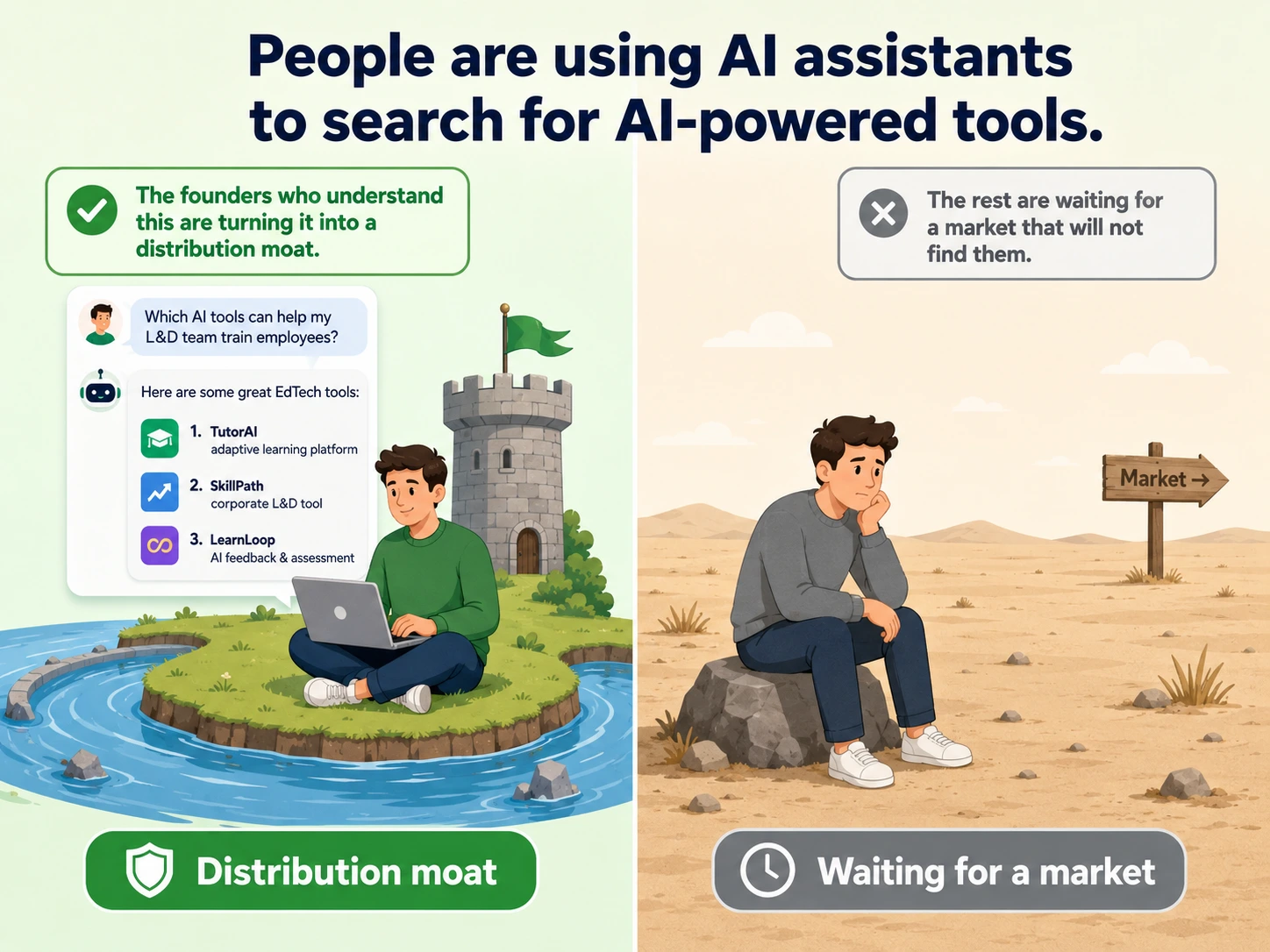
“People are using AI assistants to search for AI-powered tools. The founders who understand this are turning it into a distribution moat. The rest are waiting for a market that will not find them.”
➤ Why being an AI product does not help you get found by AI
There is a common assumption among EdTech founders that building an AI product gives them some natural affinity with AI search systems. It does not. AI search tools like ChatGPT, Claude, and Perplexity construct their answers from indexed web content, third-party citations, and structured information about what a product does and who it is for. They do not favour AI products over non-AI products. They favour products with clear, specific, well-indexed content that directly answers user questions.
In a noisy EdTech market, the founders building their content foundation now are compounding an advantage that will be very difficult to close once the market matures. AI search rewards early, consistent, specific content. The window to establish that foundation before competitors do is open right now. It will not stay open.
➤ The specific content gap most EdTech products have
Most EdTech startups describe their product in the language of their technology stack and feature set. That is useful for investors and integration partners. It is not useful for an AI trying to answer the question a learning and development manager or a school district administrator is asking.
| ✕ What AI skips over | ✓ What AI can recommend |
| “An AI-native learning platform leveraging adaptive algorithms and real-time inference to deliver personalised content pathways at scale.” | “An AI learning tool for corporate L and D teams with 100 to 5,000 employees. Cuts course completion time by 40%. Integrates with Workday and Salesforce. Used by teams at Deloitte, Adobe, and Shopify.” |
The first description tells AI what the product is built on. The second tells AI what the product does, who it is for, and why someone should choose it. AI search is not impressed by architecture. It is looking for the clearest, most specific answer to a user’s question. Founders who write for that question get recommended. Founders who write for their pitch deck do not.
➤ Is your product showing up where your users are searching?
Most EdTech founders have tested their product extensively. Very few have tested how their product appears when a potential user asks an AI assistant for a recommendation. Run through this diagnostic honestly.
Our product pages answer the exact questions buyers type into AI: Including use case, user role, company size, and integration context.
Outcomes are stated in specific, comparable terms: Such as time savings, completion rates, cost per learner, or measurable skill improvement. Not feature lists.
Third parties reference our product by name: In reviews, roundups, and industry content that AI can read and cite as evidence of credibility.
We publish content that addresses comparison queries: Such as how our product differs from established alternatives buyers are already aware of.
When we ask AI the exact question our users would ask: Our product is named in the answer without us prompting it with our name first.
If you checked fewer than 3, your product is likely invisible to the AI queries your users run before choosing a tool. Competitors with weaker products but stronger content are filling that gap right now.
The EdTech startups building their content foundation now will dominate AI search when the market matures. The ones waiting for product quality to speak for itself will find that AI never learned to listen for it.

FAQ's
1. Why don't AI-powered EdTech products automatically rank well in AI search?
Being an AI product gives no advantage in AI search. Tools like ChatGPT, Claude, and Perplexity build answers from indexed content, third-party citations, and clear product descriptions, not from a product’s underlying technology.
2. What content do EdTech founders need to get recommended by AI assistants?
Content that states what the product does, who it serves, company-size fit, integrations, and measurable outcomes like completion rates or time savings, instead of describing the technology stack or feature set.
3. How can I check if my EdTech product appears in AI search results?
Ask an AI assistant the exact question your buyers would ask, without naming your product. If your product is recommended unprompted, you have visibility. If not, you have a content gap.
4. Why does writing for buyers beat writing for investors in AI search?
Pitch-deck language describes architecture and features. AI search rewards specific answers to buyer questions, such as use case, user role, and outcomes, which is the language that gets a product recommended.
5. Is there a time advantage to building AI-search content now?
Yes. AI search favors early, consistent, specific content, so founders who build their content foundation now compound an advantage that becomes very hard for competitors to close as the market matures.