
AI Search Is the New Stage: Why Speakers Who Show Up in AI Answers Are the De Facto Experts
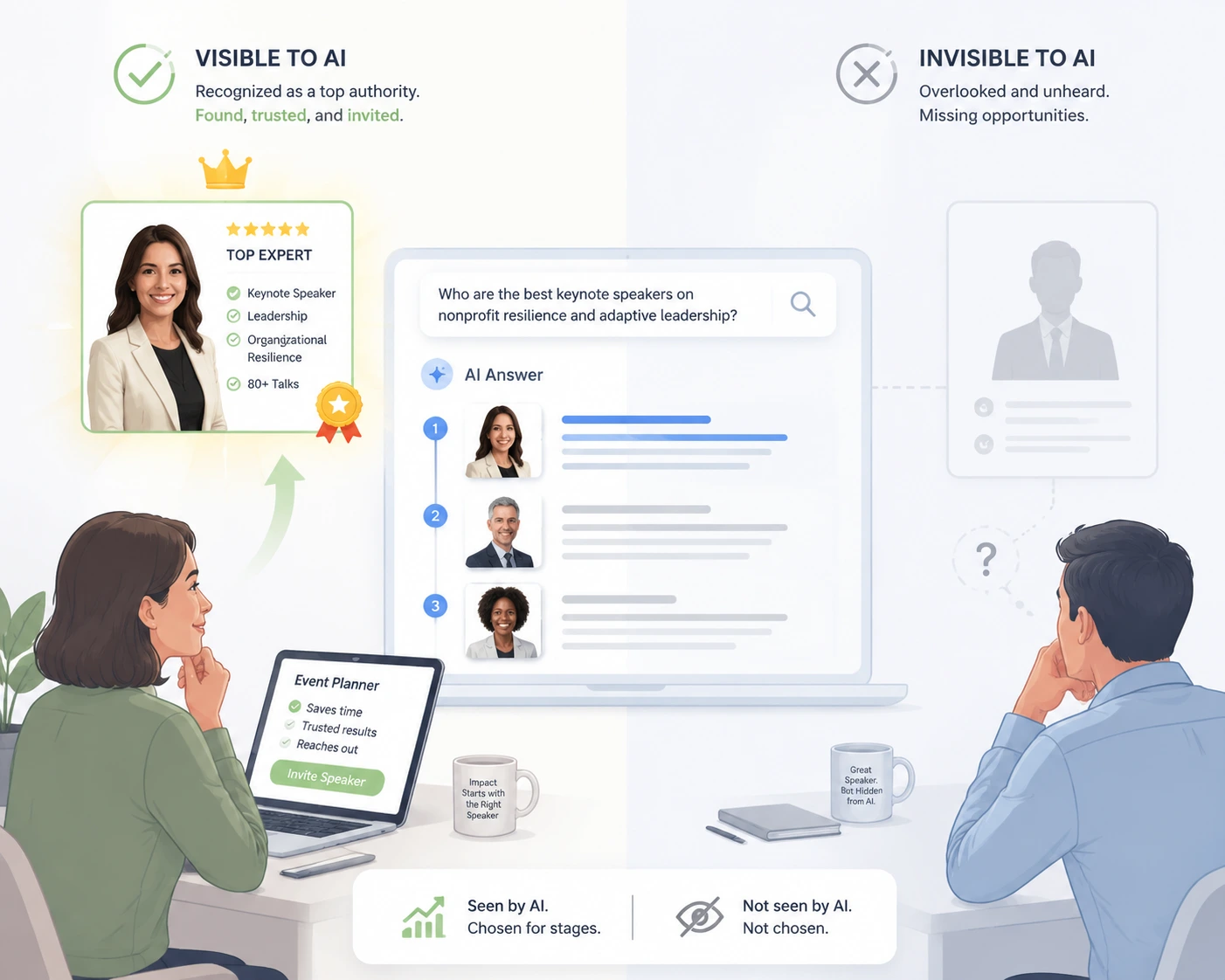
The speakers showing up in AI-generated answers are being perceived as the leading authorities in their field. Those who do not show up are invisible to the event planners, journalists, and organisations that are now using AI to find them.
Not sure how you show up when event planners search AI for speakers?
Get a free audit and find out exactly where you stand.
An event planner at a nonprofit conference needs a keynote speaker on organisational resilience. She does not have a speaker bureau on retainer. She opens an AI assistant and types: “Who are the best keynote speakers on nonprofit resilience and adaptive leadership?” The AI names three people. She looks them up. She reaches out to the first one that day.
The speakers named in that answer did not necessarily write the best book on the subject, deliver the best talk, or earn the most credibility over the longest career. They are the speakers whose content was structured in a way that AI could read, synthesise, and present with confidence. In the AI era, being named in the answer is the new form of being on the biggest stage. And it compounds every time AI gives that answer to someone new.
“The speakers who show up in AI-generated answers are perceived as the de facto experts. That perception shapes speaking fees, media requests, and book deals. It is not a small thing.”
➤ How AI is replacing the speaker bureau for many event planners
Speaker bureaus, conference committees, and editorial teams have always been the gatekeepers of who gets the stage. That gatekeeper role is being partially displaced by AI. Event planners at smaller organisations, journalists needing expert comment, and organisations looking for workshop facilitators are increasingly going to AI first because it is faster, more specific, and available at any hour.
The speakers who built their reputations through those traditional gatekeepers are not automatically visible to AI. An impressive speaking reel means nothing if the transcript is not indexed. A glowing introduction from a conference chair is invisible if it was never written down. Years of credibility built in rooms does not transfer to AI unless it has been translated into structured, indexed, publicly accessible content.
➤ The gap between speaker credibility and AI visibility
Most speakers present themselves the way they would in a speaker bio read from the stage. That language is warm, narrative, and credibility-signalling for a room that already knows who you are. It is opaque to an AI trying to match a specific event planner query to a specific expert.
| ✕ What AI cannot use | ✓ What AI can surface |
| “A passionate advocate for human-centred leadership, drawing on two decades of experience working with organisations navigating transformation at the intersection of people and purpose.” | “A keynote speaker on nonprofit resilience and adaptive leadership. 80 keynotes delivered across the US and Canada. Clients include United Way, YMCA, and Independent Sector. Available for conferences, leadership retreats, and workshops.” |
The first is a bio. The second is a brief. AI needs the brief. The event planner behind the AI query needs the brief. Rewriting your speaker positioning for AI is not a reduction of your authority. It is the act of making that authority discoverable to the people with the authority to put you on their stage.
➤ Are you showing up when event planners search for you?
Most speakers have never asked AI the question an event planner would ask about them. Run through this diagnostic before someone else in your space does.
Our speaker page answers the exact queries event planners ask AI: Including topic, audience type, format, and geographic availability.
Credibility is stated in specific, searchable terms: Including number of talks, named clients, conference brands, and media appearances with links.
Third parties reference us by name in indexed written content: Including event recaps, journalist quotes, podcast show notes, and organisation blogs.
We publish written thought leadership on our core topics: That AI can read, cite, and use as evidence that we are a genuine authority in our space.
When we ask AI the question an event planner would ask: Our name appears in the answer without prompting it first.
If you checked fewer than 3, you are invisible to the event planners using AI to find speakers right now. The stage AI is offering is available to whoever shows up first in the content infrastructure that supports it.
Every time AI names a speaker in an answer, it is making a booking decision on behalf of the event planner behind the query. The speakers who have made themselves readable to AI are collecting those decisions continuously, at scale, without ever making a pitch.

FAQ's
1. What is AI search visibility for speakers?
AI search visibility refers to how often a speaker appears in AI-generated answers when users ask for experts, keynote speakers, or thought leaders on specific topics.
2. Why are event planners using AI to find speakers?
Many event planners use AI because it provides quick, tailored recommendations based on expertise, industry focus, audience type, and speaking experience.
3. How can speakers improve their visibility in AI search results?
Speakers can improve visibility by publishing authoritative content, optimizing speaker pages, earning third-party mentions, and clearly defining their expertise in searchable formats.
4. Does having a strong reputation guarantee AI visibility?
No. AI can only recommend information it can access and understand. Even highly respected speakers may not appear in AI answers if their expertise is not represented in structured online content.
5. How do AI-generated recommendations impact speaking opportunities?
Hire your SEO expert Today!