
Your Podcast Got You Here. AI Search Is How the Next 10,000 Students Will Find You.
Course creators who built audiences through podcasts and Google search are sitting on a discoverability advantage. The ones adapting for AI search now are locking in an audience that compounds over time.
Not sure how your course shows up in AI search?
Get a free audit and find out exactly where you stand.
A nonprofit program manager sitting at her desk on a Sunday afternoon wants to learn grant writing. She is not searching Google. She is not scrolling podcast directories. She opens an AI assistant and types: “What is the best course for learning grant writing from scratch?” The AI answers in seconds with three recommendations. She clicks through to the first one and enrolls by Monday morning.
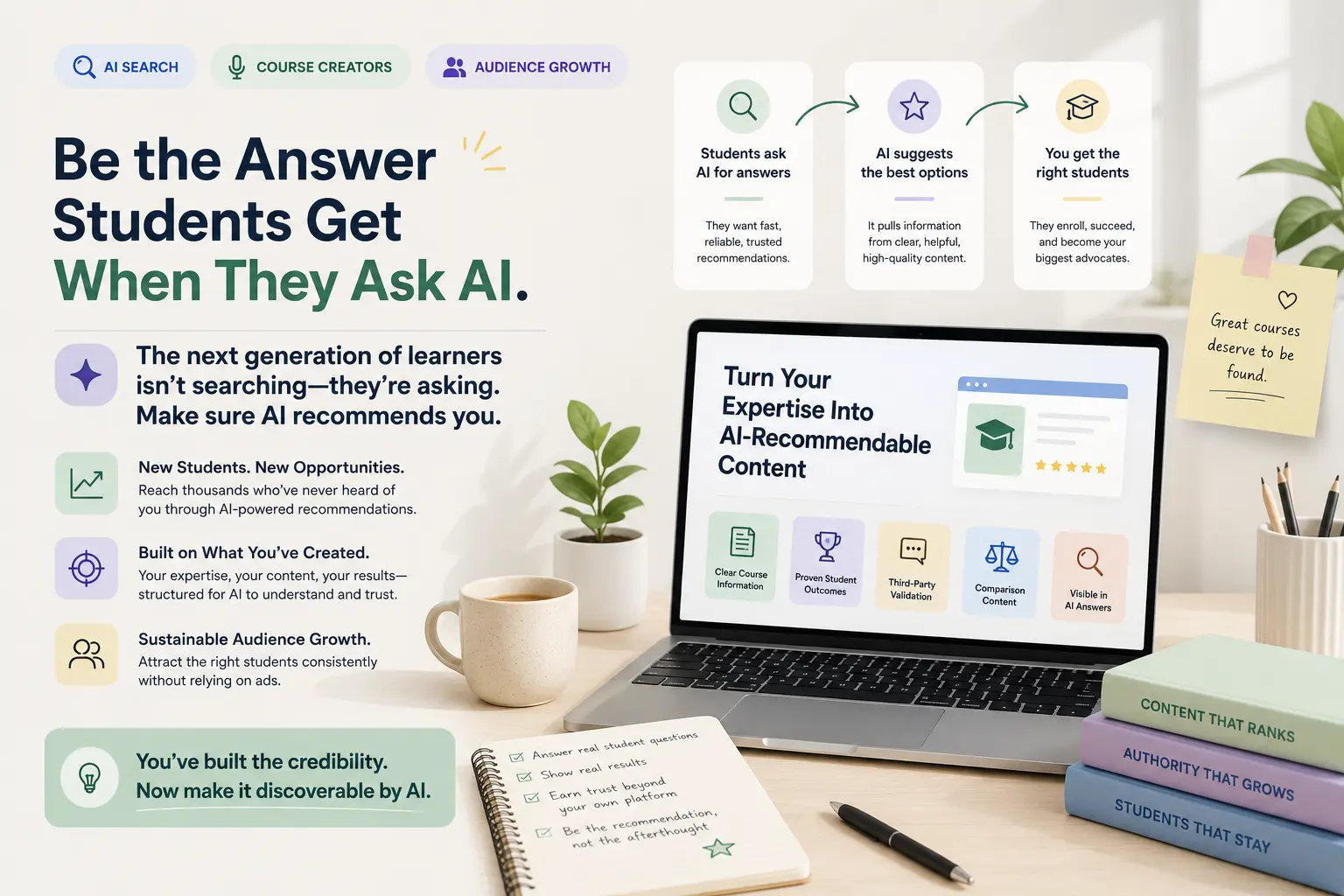
This is the new enrollment funnel for course creators. The podcast built the brand. The Google SEO built the back catalog. But the next wave of students, the ones who have never heard an episode and will never find you through a search result, are arriving through AI. And the course creators who have not yet structured their content for AI discovery are watching that wave pass them by.
“The audience you built through podcasting is loyal. But the audience AI search can send you has never heard of you. That is not a problem. That is the opportunity.”
Why podcast-built audiences and AI audiences are completely different
Building an audience through a podcast is a slow, trust-compounding process. Listeners find you, return week after week, and eventually convert because they feel they know you. The content that drives that relationship is audio. It is conversational, personality-driven, and deeply human. It is also, from an AI search perspective, almost entirely invisible.
AI assistants cannot listen to your podcast. They cannot index your warmth, your credibility, or the thousands of hours of value you have put into your episodes. What they can read is your website, your course descriptions, your written testimonials, and whatever third parties have written about you. Course creators who have spent years building authority through audio have often neglected the written content infrastructure that AI needs to recommend them to a brand new student.
The specific gap between what you have and what AI needs
Most course creators write about their courses the way they would describe them on a podcast. That is natural and authentic. It is also the wrong format for an AI trying to answer a direct question from a student who has never heard of you.
|
✕ What AI cannot use |
✓ What AI can recommend |
|
“I created this course because I spent years struggling to find grant funding and finally cracked the code. Now I want to share everything I know with the changemakers who need it most.” |
“A grant writing course for nonprofit professionals and freelancers with no prior experience. Self-paced, 6 modules, includes templates and live Q and A. Over 8,000 students enrolled. 4.9-star rating.” |
The first version is perfect for a listener who already trusts you. The second is what an AI needs to confidently recommend you to someone who has never encountered your work. Both matter. But most course creators have invested heavily in the first and almost nothing in the second. That gap is where enrolment opportunities are being lost every day.
Is your course showing up when students are searching?
Most course creators assume their existing audience is a proxy for their discoverability. It is not. Run through this diagnostic to see where you stand with the students who have never heard of you.
Our course pages answer the exact questions new students ask AI: Including topic, skill level, format, duration, and what they will be able to do after completing it.
Student outcomes are stated in specific, searchable terms: Such as grants secured, job placements, income earned, or skills demonstrated. Not just satisfaction ratings.
Third parties mention our course by name in written content AI can read: Including reviews on external platforms, mentions in sector blogs, and alumni testimonials structured on our site.
We have written content that addresses comparison questions: Such as how our course differs from alternatives a new student would find when researching their options.
When we ask AI the question a new student would ask: Our course appears in the answer without us prompting it with our name first.
If you checked fewer than 3, your course is likely invisible to the students searching for it right now. The audience AI could send you is going to a competitor instead.
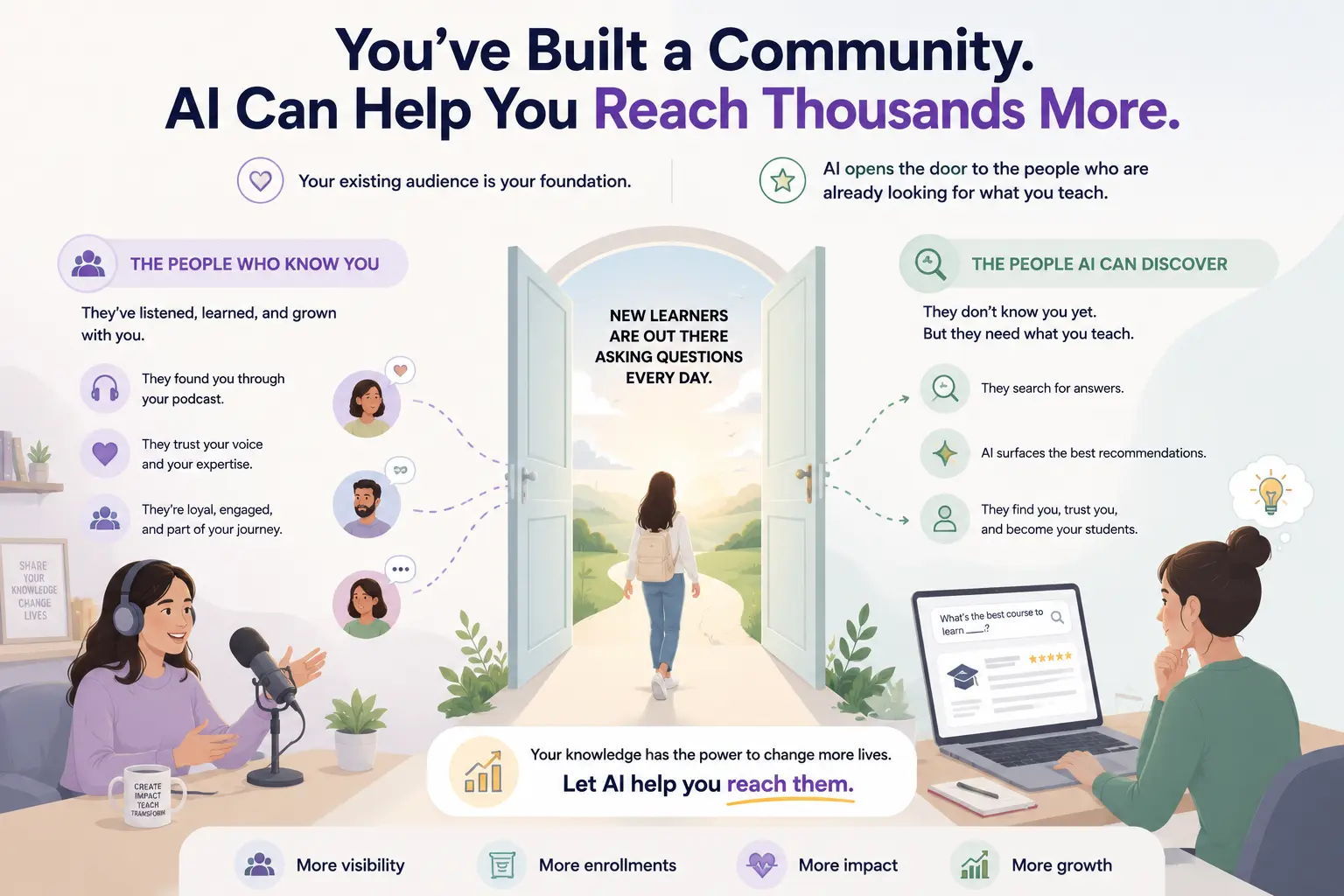
The audience you built through podcasting will always be your most loyal. But the students AI search can send you have never heard an episode, never seen a testimonial, and never been in your world. They just asked a question. The course creators who have made themselves findable are the ones who get to answer it.
FAQ's
1. How is AI search changing the way students find online courses?
Students are increasingly using AI assistants to discover, compare, and evaluate courses. Instead of browsing search results, they often receive direct recommendations from AI tools.
2. Why aren't podcasts enough to attract new students anymore?
Podcasts build trust with existing audiences, but AI assistants cannot easily interpret audio content. Without strong written content, course creators may miss students who discover courses through AI search.
3. How can course creators improve their visibility in AI search?
Course creators can improve visibility by creating detailed course pages, highlighting student outcomes, publishing comparison content, and earning mentions from trusted third-party sources.
4. What information does AI look for when recommending a course?
AI typically looks for clear descriptions of course topics, skill levels, formats, duration, outcomes, student reviews, and evidence of credibility.
5. How can I tell if my course is visible in AI search results?
Test the same questions potential students would ask AI tools. If your course doesn’t appear in relevant recommendations, your content may need optimization for AI discovery.