
How AI Search Is Changing Student Recruitment in 2026
Traffic doesn’t collapse overnight. It vanishes one search, one click, and one missed enrolment at a time. Education companies that fail to adapt now may find themselves invisible when prospective students are ready to choose.
Not sure how your institution shows up in AI search?
Get a free audit and find out exactly where you stand before enrolments decline.
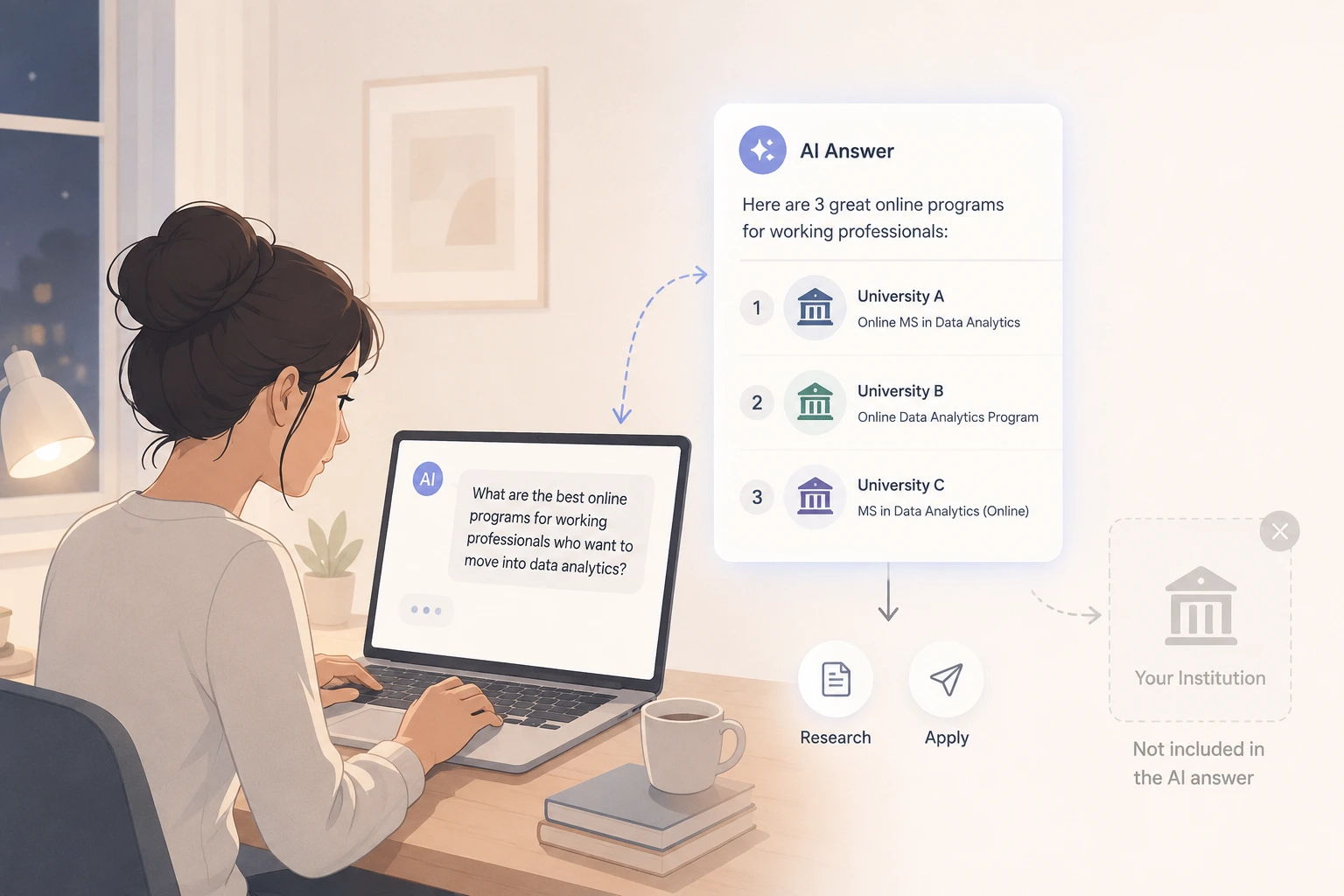
A prospective student opens her laptop on a Tuesday evening. She is 24, working full-time, and thinking about going back to school. She does not visit five university websites. She does not scroll through a comparison platform. She opens an AI assistant and types: “What are the best online programs for working professionals who want to move into data analytics?” The AI gives her three programs. She researches those three. She applies to two of them.
Your institution is not among them. Not because your program is weaker. Not because your outcomes are worse. Because the AI had not structured, specific, indexed content about your program to draw from when it constructed that answer. In 2026, that gap is no longer theoretical. It is showing up in traffic reports and enrolment pipelines across the education sector.
“The education companies seeing enrolment declines in 2026 are not losing to better institutions. They are losing to institutions that AI has learned to recommend.”
➤What changed in student search behaviour in 2026
For the past decade, student recruitment was built on a predictable foundation: Google ads drove awareness, SEO drove organic traffic, landing pages converted visitors, and enrolment teams closed applications. That model is not dead. But a new layer has inserted itself at the very top of the funnel, before the Google search, before the ad impression, before the website visit.
Students are now beginning their education research with an AI conversation. They describe their situation, their goals, their constraints, and ask for recommendations. The AI synthesises everything it knows about programs in that category and returns a confident shortlist. The institutions on that shortlist get the clicks, the inquiries, and the applications. The institutions not on it are invisible at the moment the decision frame is being formed. That is the most expensive moment to be invisible.
➤Why education companies are particularly exposed
Most education companies built their digital presence for a search-and-click world. Program pages were optimised for keywords. Paid campaigns drove volume. The underlying assumption was that students would arrive at your website and evaluate you there. AI search removes that step entirely for a growing proportion of students.
The content that performs in AI search is not keyword-optimised landing page copy. It is specific, structured, outcome-focused content that directly answers the questions students ask AI assistants. Most education company websites are built for Google bots and human visitors. Very few are built for the AI intermediary that is now sitting between the student and the website. That mismatch is where enrolment leakage begins.
➤What the gap looks like in practice
The difference between programs that get recommended and programs that do not is rarely about quality. It is almost always about how the program is described in publicly indexed content.
|
✕ What AI skips over |
✓ What AI recommends |
|
“Our innovative, industry-aligned curriculum is designed to equip learners with the skills and mindset needed to thrive in a rapidly evolving professional landscape.” |
“A 12-month online data analytics program for working professionals. No prior coding experience required. Taught by industry practitioners. 84% of graduates report a salary increase within 12 months of completion.” |
The first is written for an admissions brochure. The second is written for the student who has just described her situation to an AI assistant and needs a confident, specific answer. AI search rewards specificity, outcomes, and buyer context. Generic value statements, however polished, are effectively invisible to it.
➤Is your institution visible to the students researching right now?
Most education companies have not tested how their programs appear when a prospective student asks AI for a recommendation. Run through this diagnostic before your next enrolment cycle begins.

FAQ's
1. How is AI search changing the way students discover educational programs?
AI search allows students to ask detailed, personalized questions and receive curated recommendations without visiting multiple websites. Institutions that are visible in AI-generated answers gain a significant advantage in attracting prospective students.
2. Why isn't my institution appearing in AI-generated recommendations?
AI platforms prioritize content that is specific, structured, and focused on outcomes. If your program pages lack clear details about duration, career outcomes, eligibility, and target audience, AI may struggle to recommend them.
3. What type of content does AI search prefer when recommending educational programs?
AI tends to favor content that directly answers student questions, highlights measurable outcomes, explains who the program is designed for, and provides clear information about study formats, costs, and career opportunities.
4. How can educational institutions improve their visibility in AI search results?
Institutions can improve AI visibility by creating detailed program pages, publishing comparison content, showcasing graduate outcomes, earning third-party mentions, and ensuring their information is easily accessible and understandable by AI systems.
5. Will traditional SEO still matter if students are using AI assistants?
Yes. Traditional SEO remains important because AI systems often rely on publicly available, well-indexed content. However, institutions must now optimize for both search engines and AI-driven recommendation systems to remain competitive.