
◆ Digital Marketing for Real Estate
Property decisions rarely begin with a realtor’s name, especially in competitive US real estate markets. Buyers, sellers, investors, landlords, and tenants search neighborhoods, property types, prices, amenities, market information, and local services across search engines, property portals, maps, social platforms, websites, and increasingly AI-powered tools. Digital marketing for real estate connects these discovery points to help prospects find relevant properties, evaluate their options, and take the next step.
Real estate visibility isn’t just about being found. It’s about being considered when someone is ready to make a property decision.
What is digital marketing for real estate?
Digital marketing for real estate uses search, local visibility, property-focused content, social media, paid campaigns, websites, reputation signals, and emerging AI search to help buyers, sellers, investors, landlords, and tenants discover and evaluate real estate opportunities. The goal is to connect the right audience with relevant properties and make the path from online research to enquiry more direct.
Real estate visibility extends well beyond appearing for a single property search.
Property prospects can discover a brokerage, realtor, developer, or listing through search engines, maps, property content, social platforms, listing pages, and AI tools. A strong digital presence keeps a real estate brand visible across the moments when people are researching locations, properties, prices, and professionals.
01 — Search
People begin with property types, locations, prices, neighborhoods, and investment-related searches, from local homes to commercial property across US markets.
02 — Local
Maps and location results help prospects discover realtors, brokerages, developments, and property services in the cities and communities they are considering.
03 — Evaluation
Listings, market knowledge, reviews, property details, and agent credibility shape the shortlist.
04 — AI
Conversational search is creating another route for people to research markets, properties, and real estate professionals.
— FEATURED VIDEO
How Real Estate Buyers Are Finding Properties Online
Property discovery has moved beyond traditional advertising.
Today, prospective buyers, tenants, investors, and businesses often begin their search online looking for specific property types, locations, budgets, amenities, and commercial spaces. For real estate businesses, this makes search visibility an important part of how potential customers discover and evaluate available properties.
In this video, UnoSearch explains how real estate SEO helps builders, brokers, and developers improve their visibility for high-intent searches such as “2-bedroom home in [city]” or “office space for rent.” It also covers how technical optimization, content strategy, and website syndication work together to make property listings easier to discover across search.
Real Estate SEO · Property Search Visibility · High-Intent Keywords · Lead Generation
— THE MODERN REAL ESTATE JOURNEY
How Buyers, Sellers & Investors Discover Real Estate Opportunities Online in the US
A property decision can begin months before a prospect contacts an agent. In the US, buyers and sellers may compare neighborhoods, listings, agents, and market information across multiple digital channels before reaching out. Someone may start by researching a neighborhood, browsing property types, checking prices, comparing listings, reading market information, and evaluating realtors before making an enquiry. Effective digital marketing for real estate is built around these different research stages.
01 · DISCOVER
Location & property searches.
Prospects begin with neighborhoods, cities, ZIP codes, property types, budgets, amenities, investment questions, or general market searches.
Listings & market information.
They browse properties, compare prices, explore neighborhoods, and look for information that helps narrow their options.
03 · SHORTLIST
Properties & professionals.
Once preferences become clearer, prospects compare listings and may begin evaluating realtors, brokerages, developers, or property managers.
04 · EVALUATE
Details & credibility.
Property information, images, location, reviews, agent experience, market expertise, and website quality can influence the final shortlist.
05 · ENQUIRE
Viewing & next action.
The prospect may request property details, schedule a viewing, call an agent, submit an enquiry, or begin a transaction.
— THE REAL ESTATE DIGITAL LANDSCAPE
Why Real Estate Digital Marketing Is Highly Competitive
Real estate brands compete in a crowded digital environment where prospects can compare properties, agents, locations, and prices before making contact. Winning visibility requires more than publishing listings; it requires strong discovery channels, useful property information, credible expertise, and clear paths to enquiry.
US Property Searches Are Often Location-First
People frequently search for an area, neighborhood, property type, price range, or investment opportunity before they know which realtor or brokerage they want to contact. Digital visibility therefore needs to capture demand before a brand-specific search begins.
▲ CHALLENGE: GETTING DISCOVERED BEFORE THE AGENT IS CHOSEN
Trust Can Determine Which Listing Gets Attention
A property may look attractive online, but prospects also evaluate the people and businesses behind the transaction. Reviews, market knowledge, property information, responsiveness, and professional presentation can influence whether an enquiry happens.
▲ CHALLENGE: TURNING DIGITAL PRESENCE INTO CREDIBILITY
Local Competition Is Intense
Realtors, brokerages, developers, and property businesses often compete for the same location-based searches, particularly in competitive US metro markets. Strong local signals, neighborhood content, listings, and relevant landing pages can help a brand stand apart.
▲ CHALLENGE: STANDING OUT IN LOCATION-BASED SEARCH
Real Estate Discovery Is Expanding Beyond Listings
Prospects increasingly use social platforms, video, conversational AI, and other digital experiences alongside traditional search and property portals. Real estate brands need consistent, useful information across the places where prospects conduct research.
▲ CHALLENGE: REMAINING VISIBLE ACROSS SEARCH, SOCIAL & AI
— What you get
What Does Digital Marketing for Real Estate Include in the US?
Real estate digital marketing combines multiple channels designed to attract property demand, including strategies that can be adapted to US buyer, seller, investor, and rental audiences, strengthen brand visibility, showcase inventory, and turn online interest into qualified enquiries. The right mix depends on the market, property type, audience, and business model.
01
Real Estate SEO
Improve visibility for searches involving properties, locations, neighborhoods, property types, real estate services, and market-related topics.
02
Local SEO
Increase discoverability for realtors, brokerages, developers, property managers, and other location-based real estate businesses.
03
Property Content
Create useful content around neighborhoods, buying and selling questions, property types, market trends, investment considerations, and local demand.
04
Reputation Management
Strengthen the reviews, business information, expertise signals, and digital proof prospects use when evaluating real estate professionals.
05
Paid Search & Property Campaigns
Capture high-intent searches and promote relevant properties, services, locations, or landing pages to audiences closer to taking action.
06
AI Search Visibility
Prepare real estate information and brand signals to be accurately understood and surfaced across ChatGPT, Gemini, Google AI Overviews, and other AI-driven discovery experiences.
— How it works
How Digital Marketing and Real Estate Come Together Across the US Property Search Journey
A real estate digital marketing strategy works across multiple stages of the property search process. From understanding what people search for to improving property discovery and measuring what happens after a visitor arrives, each stage helps build a stronger connection between online demand and real estate businesses.
Understand How People Search for Property
Real estate searches can vary by location, property type, budget, purpose, and stage of decision-making. For US audiences, this may include city, neighborhood, ZIP code, property type, price range, and local market intent. Identifying these patterns helps determine which searches, topics, locations, and audiences a digital strategy should address.
Make Property Information Easier to Discover
Search-friendly property pages, location content, technical improvements, structured information, and useful landing pages can help search engines understand what a real estate business offers and connect relevant searches with the right information.
Build Visibility Across Property Discovery Channels
Prospects may discover properties through organic search, local results, property listings, social platforms, websites, and increasingly AI-powered search. A broader digital presence creates more opportunities to appear during property research.
Measure What Happens After Discovery
Digital performance can be evaluated through search visibility, qualified traffic, property-page engagement, enquiries, calls, viewing requests, and other actions. These signals help identify which channels and content are contributing to real estate demand.
— WHY IT MATTERS
Why Digital Marketing Matters for Real Estate Businesses
Property research is increasingly digital. Prospects can spend significant time exploring locations, listings, prices, agents, and market information before they ever make direct contact.

Capture Early Property Demand
Digital marketing helps real estate businesses appear while prospects are still exploring locations, property types, budgets, and market opportunities.

Own More Local Searches
Location-focused visibility can put a realtor, brokerage, or property business in front of prospects searching within the markets it serves, whether that means a local US city, metro area, or neighborhood.

Give Listings More Reach
Optimized property pages and supporting content can help relevant listings reach people searching for specific property features and locations.

Build Confidence Before the First Call
Reviews, expertise, market knowledge, useful content, and a professional website can help prospects feel more confident about initiating contact.

Generate More Qualified Enquiries
A connected digital strategy can move high-intent visitors from search and property research toward calls, viewings, requests, and enquiries.

Prepare for AI-Led Property Discovery
As people use conversational tools to research neighborhoods, properties, and real estate professionals, brands need information that can be clearly understood and accurately represented.
— THE CHANGING REAL ESTATE SEARCH LANDSCAPE
Traditional Property Search vs. Modern Real Estate Discovery
Prospects no longer rely on one listing or one search result when making property decisions. Their research can move between search engines, property websites, maps, listing platforms, social media, reviews, video, and conversational AI.
Traditional Property Search
Prospects search using locations, property types, budgets, neighborhoods, amenities, and real estate service queries.
Organic results help audiences discover financial websites, service pages, guides, and educational resources
Listings and maps help prospects identify available properties and local real estate professionals.
Reviews and business information influence how prospects compare agents and brokerages.
Property websites provide deeper details, images, amenities, locations, and enquiry options.
Search performance can be evaluated through rankings, qualified traffic, enquiries, calls, and conversion rates.
Modern Real Estate Discovery
Prospects can begin with conversational questions such as where to live, what areas fit a budget, or which property types may suit a goal.
AI tools can summarize market information, locations, property considerations, and real estate brands from available sources.
Research may move between AI answers, search results, listings, maps, social content, and websites.
Authority, local relevance, accurate property information, and brand credibility become increasingly important.
Real estate businesses need consistent information across websites, profiles, listings, social channels, and other digital touchpoints.
Visibility increasingly means being present wherever prospects investigate their next property decision.
— BUILDING AN EFFECTIVE STRATEGY
Digital Real Estate Marketing Strategies to Consider for US Markets
An effective digital real estate marketing strategy connects property demand, local intent, useful information, brand credibility, and measurable lead generation across the prospect journey.
01 · Start With Location & Property Search Intent
Identify the locations, property categories, price-related searches, and service queries that reveal what prospects are actually trying to find. For US campaigns, this can include city, neighborhood, ZIP code, and market-specific search intent.
STRATEGY: ALIGN PAGES AND CAMPAIGNS WITH REAL PROPERTY SEARCH DEMAND
02 · Build Content Around Property Research Questions
Create content that helps prospects understand neighborhoods, property types, buying or selling considerations, market questions, amenities, and local opportunities.
STRATEGY: TURN RESEARCH QUESTIONS INTO DISCOVERY AND ENQUIRY PATHS
03 · Strengthen Local Real Estate Visibility in US Markets
Location pages, business profiles, reviews, neighborhood content, and consistent business information can help real estate brands compete in local discovery.
STRATEGY: MAKE YOUR MARKET PRESENCE EASY TO FIND AND TRUST
04 · Make Property & Agent Expertise Easy to Evaluate
Clear listing information, market knowledge, agent profiles, reviews, experience, and useful resources give prospects more evidence before they reach out.
STRATEGY: SHOW WHY PROSPECTS SHOULD CHOOSE YOUR BRAND
05 · Connect Listings With the Next Action
A visitor viewing a property page needs a clear reason and simple path to request details, arrange a viewing, call, or submit an enquiry.
STRATEGY: REDUCE THE GAP BETWEEN PROPERTY INTEREST AND LEAD ACTION
06 · Keep Real Estate Information Consistent
Property details, business information, locations, services, and agent information should remain accurate across the digital channels prospects use to research.
STRATEGY: MAINTAIN ONE RELIABLE DIGITAL VERSION OF YOUR BRAND
— MEASURING WHAT MATTERS
How Do You Measure Digital Marketing Success in Real Estate?
Real estate digital marketing should be judged by more than rankings and traffic, particularly when the goal is to generate qualified demand in a defined US market. Measurement should show whether visibility is reaching the right market and whether digital interactions are progressing toward genuine property or service enquiries.
01
Visibility
Organic rankings, local presence, location visibility, property search visibility, and exposure for commercially relevant queries.
02
Engagement
Qualified organic traffic, property-page engagement, content interactions, listing views, and returning visitors.
03
Interest
Property detail requests, saved or engaged listings, calls, viewing interest, and interactions with agent or brokerage information.
04
Conversions
Enquiry forms, calls, viewing requests, consultation requests, property leads, and other defined conversion actions.
05
Acquisition
Cost per lead, lead source, conversion rate, campaign performance, and the quality of enquiries generated by each channel.
06
AI Visibility
Whether the real estate brand, locations, services, and expertise are accurately represented across AI-generated discovery experiences.
— FROM STRATEGY TO EXECUTION
How UnoSearch Supports Real Estate Businesses in the US & Beyond
Digital marketing and real estate require more than isolated campaigns. Our approach connects search demand, property content, local visibility, paid acquisition, brand credibility, and measurable lead generation into a unified strategy.
Understand the Property Search Journey — We identify how buyers, sellers, investors, tenants, and other prospects search, what information they need, and which digital interactions influence their decisions.
Build the Digital Property Foundation — We strengthen websites, property pages, location content, local profiles, and conversion paths so prospects can discover and explore the right information.
Connect Visibility With Credibility — We align property information, reviews, expertise, market content, and brand signals to help prospects evaluate the business behind the listing.
Expand Across Emerging Discovery Channels — Search remains important, while social platforms, video, property ecosystems, and conversational AI create additional discovery opportunities.
Measure Real Business Outcomes — We look beyond traffic to understand qualified enquiries, calls, viewing requests, lead quality, acquisition costs, and conversion performance.
// WHAT_UNOSEARCH_BRINGS
US Market-Focused
Strategies built around your locations, property categories, audience segments, and competitive landscape
Connected
SEO, local, content, paid media, reputation, social, and AI visibility working as one system
Measurable
Reporting focused on visibility, engagement, qualified leads, property actions, and business outcomes
— CASE STUDIES
What Digital Marketing Can Deliver Across Different Industries
Real estate has its own search behavior, but the fundamentals of digital growth extend across industries: becoming visible for relevant searches, strengthening local presence, building authority, and creating clearer paths from discovery to enquiry.
SEO • Real Estate • Navi Mumbai
How Sarayu Real Estate increased Google Business Profile interactions by 700%.
+700%
Increase in Google Business Profile interactions
The challenge: Sarayu Real Estate had a strong offline reputation but limited online visibility. The business was not ranking consistently for rental searches, its Google Business Profile needed optimization, and there was no strong mobile-first system for converting property searches into enquiries.
→ Optimized Google Business Profile with improved business information, images, categories, and local signals
→ Built conversion-focused local pages to support property-related searches
→ Combined local SEO with paid campaigns to reach high-intent audiences
→ Improved Google Maps visibility by over 40%
→ Generated 5.8K conversions from 171K clicks
→ Generated 43 leads through social advertising in three weeks
What this shows: For real estate businesses, local search visibility can play an important role in connecting property demand with enquiries.
SEO + GEO + Paid Media • Immigration Consultancy • USA
How Jinee Green Card combined SEO, AI visibility & paid media to generate 15,500+ leads.
15,500+
Leads generated through Meta campaigns
The challenge: Jinee Green Card needed to become visible when H1B professionals were researching EB-1A Green Card options. The brand had limited visibility across traditional search and was not appearing consistently in AI-generated answers, while its paid campaigns needed more precise audience targeting.
→ Rebuilt content architecture around high-intent search queries and the questions potential clients were researching
→ Optimized content for AI citations across Google AI Overview, ChatGPT, and other AI discovery experiences
→ Strengthened topical authority through structured service pages, FAQs, internal linking, and entity-focused content
→ Used precision Meta targeting to reach H1B professionals at specific technology companies
→ Generated 15,500+ leads across Meta campaigns
→ Achieved a best cost per lead of $2.96
→ Established visibility across paid social, organic search, and AI-powered discovery
What this shows: Real estate businesses can similarly benefit from connecting SEO, paid acquisition, content, and emerging AI search visibility rather than treating each digital channel as a separate activity.
SEO • Legal • London, UK
How Brackenfield & Co. grew organic leads by 74%.
+74%
Increase in organic consultation enquiries
→ Strengthened local SEO through Google Business Profile, citations, and location-specific pages
→ Improved technical and on-page SEO including site structure, page speed, metadata, and conversion paths
→ Built authority through targeted link building
→ Earned 40+ quality backlinks and citations
→ Increased Domain Rating from 8 to 24
→ Increased organic leads by 74%
→ Google Business Profile calls increased by 165%
What this shows: Local visibility, technical foundations, and authority-building can work together to turn previously underutilized search demand into measurable enquiries.
— KEEP LEARNING
Explore More About Digital Marketing for Real Estate
Go beyond property listings and explore how different digital channels, budgets, and marketing approaches can influence real estate visibility and lead generation.
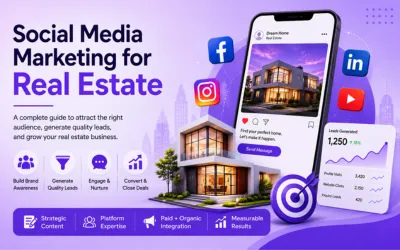
01 — Social Media Marketing for Real Estate
How does social media marketing work for real estate businesses?

02 — What Is Digital Marketing Cost in India?
What should businesses consider when planning a digital marketing budget?
Digital marketing costs depend on the services involved, campaign complexity, channels used, and the level of execution required. This guide provides a broader look at digital marketing pricing in India, helping businesses understand what goes into a digital marketing budget before comparing packages or providers.
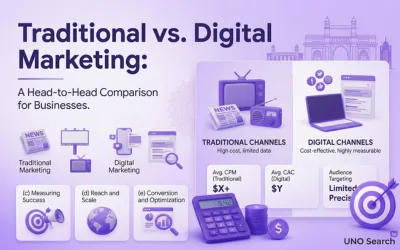
03 — Traditional Marketing vs Digital Marketing
How do traditional and digital marketing approaches differ?
Understand the key differences between traditional and digital marketing, including how audiences discover businesses, how campaigns can be measured, and how digital channels can support more targeted and trackable customer acquisition. This comparison can help real estate businesses evaluate where digital channels fit within their overall marketing mix.
— Before we talk
Digital Marketing for Real Estate — US Market FAQs
What is digital marketing for real estate?
Digital marketing for real estate is the use of search, local visibility, property-focused content, paid campaigns, social channels, websites, reputation signals, and AI search to help prospects discover and evaluate properties and real estate businesses. The objective is to turn relevant digital demand into meaningful enquiries and business opportunities.
Why is digital marketing important for real estate businesses?
Property prospects often research locations, listings, prices, neighborhoods, agents, and market information online before making contact. Digital marketing helps real estate businesses remain visible throughout this research process while giving prospects useful information that supports their decisions.
What does a real estate digital marketing strategy include?
The right mix depends on the market, property type, business model, and audience. It can include real estate SEO, local SEO, property content, reputation management, paid search, social media, conversion optimization, and AI search visibility working together.
How can real estate businesses generate more leads online?
A strong strategy starts by identifying high-intent property and service searches, creating useful pages around those needs, strengthening local and brand visibility, and making it easy for prospects to request information, schedule a viewing, call, or submit an enquiry.
How does SEO support digital real estate marketing?
SEO helps real estate businesses become more visible for searches involving locations, neighborhoods, property types, market questions, real estate services, and other relevant topics. It can support both early-stage property research and later-stage searches with stronger commercial intent.
How do you measure the success of real estate digital marketing?
Success should go beyond rankings and website visits. Real estate businesses can measure qualified visibility, engagement, property-page activity, calls, viewing requests, enquiries, lead quality, acquisition costs, conversions, and visibility across AI-powered discovery experiences.
— Let’s grow together
Turn property searches into meaningful opportunities.
Prospects rarely move directly from a search to an enquiry. They explore locations, browse properties, compare options, evaluate agents, and research market information before taking action. Let’s identify where your digital presence is losing demand and build a clearer path from property discovery to qualified enquiry.