
AEO vs SEO: What the Evidence Actually Says (and How to Split Your Effort)
Published Date: December 27 2025
Understand the shift from traditional search to answer-driven discovery and build a strategy that helps your brand get found, understood, and referenced across AI-powered search.

Growth Manager, UnoSearch
Read more..
Funnel-Focused
Acquisition & Conversion Strategy
Experiment-Driven
Testing & Growth Loops
SEO-Led
Organic Search & Content Growth
Conclusion
FAQs
What are AEO and SEO?
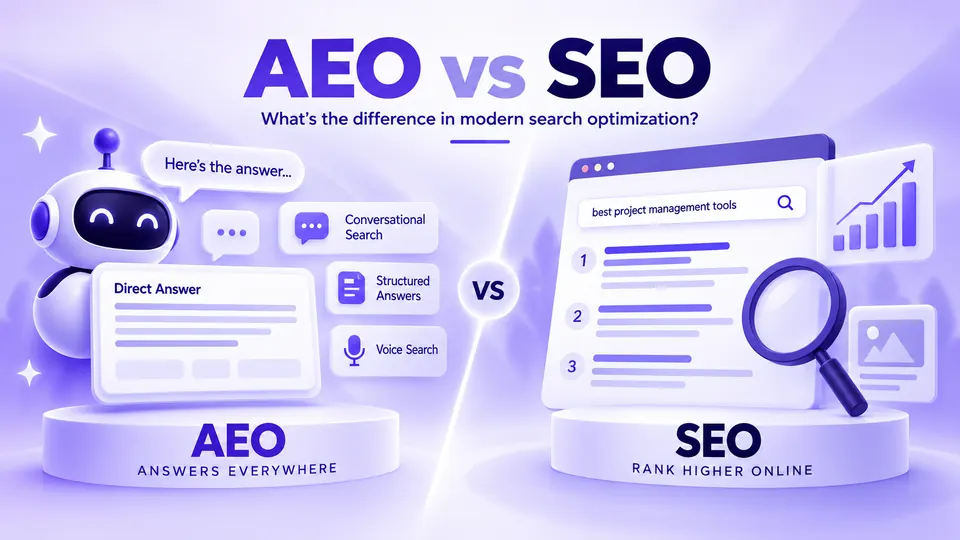
SEO (search engine optimization) earns your pages rankings and clicks in search results. AEO (answer engine optimization) earns your brand a mention or citation inside AI-generated answers from tools like ChatGPT, Perplexity and Google’s AI Overviews. Google treats the two as one discipline for its own AI features, so SEO is the foundation for both.
SEO in one line
Make pages crawlable, useful and authoritative so they rank, and win the click.
AEO in one line
Make your content and brand easy for AI tools to retrieve, trust and cite, and win the answer.
Key takeaways
- On Google’s AI features, AEO is SEO. Google says optimizing for AI search is optimizing for the search experience. See which tactics that rules out.
- Beyond Google, the real differences are sourcing, variability and measurement. See where citations come from.
- Plan around direction, not decimals. The most-quoted statistics measure different things. See them decoded.
- Sequence beats split. Fix the SEO foundation, baseline your AI visibility, then extend. Use the calculator.
You already know SEO earns rankings and AEO earns citations in AI answers. The harder question is how much effort each deserves. Also, advice on AEO vs. SEO often contradicts itself: one guide calls schema mandatory, while Google says it isn’t required, and one statistic says most searches end without a click. Yet another one says 86% of users click through AI summaries. This guide offers evidence-backed claims and suggests tools to help you decide.
Where do AEO and SEO actually differ?
SEO wins a ranked click; AEO wins a mention or citation inside an AI answer. They share a foundation (crawlable, indexed, useful content) and diverge on where you win, how stable results are, and how you measure.
| SEO | AEO | |
|---|---|---|
| Goal | Rank a page, win the click | Be cited or named in an AI answer |
| Unit of work | Keywords and pages | Questions, prompts, passages |
| Where you win | Mostly your own site | Often third-party sources too |
| Stability | Rankings shift gradually | Answers vary run to run |
| Measurement | Search Console, rank trackers | Prompt tracking, AI referrals, branded search |
Ranking well doesn’t guarantee a citation. Semrush’s research found AI tools often cite deeper subpages from authoritative domains rather than the top-ranking URL, and that overlap with Google’s top results varies by platform, with Perplexity closest and ChatGPT furthest.
Which AEO tactics hold up against Google's guidance?
Google’s May 15, 2026 guide says schema, llms.txt, content chunking and AI-style rewrites aren’t required for its AI features. Keep building authority and genuine coverage; test everything else.
| Tactic | What vendors say | What Google says | Our verdict |
|---|---|---|---|
| Schema (FAQ, HowTo) | Critical, or a template requirement | Not required; no special markup | Add it for rich results, not as an AI unlock |
| llms.txt / AI files | Widely promoted | Not needed | Skip for Google; unproven elsewhere |
| 40–80 word answer blocks | Sources give three different ranges, none with test data | No need to break content into tiny pieces | Lead sections with a direct answer; don’t count words |
| Backlinks | Disputed: “low” for AEO vs “matters for both” | AI features rest on core ranking systems | Keep building authority |
| Brand mentions | Widely recommended | Manufactured mentions aren’t as helpful as they seem | Earn real coverage only |
| Freshness | AI favors recent pages | No specific claim found | Update with genuinely new information |
Caveat
Google’s guide covers Google only. We found no equivalent official guidance from OpenAI or Perplexity, so claims about those engines are hypotheses to test. See the guide itself and Search Engine Journal’s summary.
Why do AEO and SEO statistics contradict each other?
They measure different things: all searches vs AI-triggering queries, surveys vs clickstream, and conversion defined differently. Use them for direction only, then measure your own traffic.
| Claim | Source as cited | Watch out for |
|---|---|---|
| ~60% of searches end without a click | Bain, via Yotpo | All searches, not B2B specifically |
| ~Two-thirds end without a click | SparkToro, via AEO Labs | Different dataset, same direction |
| 86% click through AI summaries to citations | WordPress VIP report | Seems to conflict with the rows above; survey vs clickstream may explain it (unverified) |
| AI Overviews cut organic CTR ~61% | Seer Interactive, via Siteimprove | Only queries that trigger an AI Overview |
| AI traffic converts 4.4x (HubSpot says 3x, Ahrefs 23x) | Semrush, via Siteimprove | “Conversion” and “AI traffic” defined differently |
| 51% of B2B buyers start with AI; 71% rely on chatbots | G2, via WordPress VIP and AEO Labs | Two questions, not one metric |
Where do AI citations actually come from?
Often not your own site. One vendor dataset puts a brand’s own site at just 2–6% of cited sources, which suggests roundups, review sites and communities matter as much as your blog.
AEO Labs measured this across live brands in three verticals over 90 days. It is vendor data with an undisclosed sample, so treat it as indicative. It fits other evidence: Semrush recommends being referenced across multiple trusted sources, and one reported Ahrefs finding says roughly 44% of pages ChatGPT cites are listicles. For SaaS, that means comparison pages, G2 and Capterra reviews, and “best X for Y” roundups deserve real effort.
How do Google, ChatGPT and Perplexity pick sources differently?
Only Google has published guidance, and it says its AI features run on its core ranking systems. For other engines, third-party studies show different overlap with Google’s results, so test each one rather than assuming one playbook.
| Engine | What the evidence shows | What’s unproven | What to do |
|---|---|---|---|
| Google AI Overviews / AI Mode | Uses retrieval and query fan-out on its core ranking systems; pages must be indexed and snippet-eligible | Any AI-only tactic | SEO fundamentals plus original content |
| ChatGPT | Weakest overlap with Google’s top results in Semrush’s study, though it still leans on authoritative domains | Exact source selection; one commentator argues it leans on Bing (unverified) | Earn third-party coverage; verify your site in Bing Webmaster Tools as a cheap hedge |
| Perplexity | Strongest alignment with Google’s rankings in Semrush’s study | How much of that holds across industries | Strong Google rankings likely carry over most here; track it |
| Bing / Copilot | Named among AI answer engines in vendor guides | We found no AEO-specific guidance | Submit a sitemap; include in your prompt tests |
What should you do first, by business type and query intent?
Route by intent: informational queries are a visibility play, comparison queries are where AI shortlists are earned, and transactional queries stay classic SEO. If you can only do one thing, fix the SEO foundation.
| Query intent | What AI tools tend to do | Where to focus |
|---|---|---|
| Informational (“what is X”) | Answer directly, often with no click | Original data and clear answers; judge success by branded search, not clicks |
| Commercial (“best X for Y”, “X vs Y”) | Name a shortlist of brands | Comparison and use-case pages, plus presence on review sites and roundups |
| Transactional (“X pricing”) | Send buyers to product and pricing pages | Accurate, crawlable product and pricing pages; classic SEO and brand |
| Business type | Lead with | Add next | Watch out for |
|---|---|---|---|
| B2B SaaS | Comparison and use-case pages, original research | Review-site presence, prompt tracking | Long cycles hide AI influence in branded and direct traffic |
| E-commerce | Accurate specs, detailed reviews, consistent product data | Q&A content for buyer sub-questions | Conflicting data between site and feeds |
| Local services | Local SEO basics, reviews, consistent business details | Clear service and pricing answers | Thin service pages |
| Ad-funded publisher | Original reporting a model can’t easily replicate | Selective answer-first formatting | Giving answers away can cost the click |
| Enterprise | One quality standard for SEO and AEO | Continuous monitoring | Template changes silently breaking structure |
Do SEO fundamentals first: crawlable, indexed, useful pages. Google and every guide we reviewed agree AI features build on them. This matrix is our recommendation from the evidence above, not a head-to-head test. Check your own stage with the calculator.
Calculator: should you start with SEO or AEO?
If your foundation is shaky, start with SEO. If it’s solid and you have no AI baseline, measure first. Answer six questions to see where you land.
How do you measure AEO without buying a tool?
Create an AI channel in GA4, log a fixed prompt set across engines, and compare branded search in Search Console over 90-day windows. Together they approximate what paid trackers automate.
- Create an AI channel in GA4. Under Admin, open channel groups (menu names shift) and add a custom channel such as “AI assistants” where session source matches
chatgpt|perplexity|gemini|copilot|claude. First check which sources actually appear in Reports > Acquisition > Traffic acquisition and adjust the pattern. - See where AI visitors land. Add landing page as a dimension for that channel. Those pages are your real “answer assets” and show what AI tools send people to.
- Expect undercounting. Many AI-driven visits arrive with no referrer and show up as direct, so treat the channel as a floor, not the total.
- Build a prompt log. Write 20 category, comparison and problem prompts. In a sheet, record prompt, engine, run date, mentioned (yes/no), cited (yes/no) and which competitors appeared.
- Run each prompt several times. Answers vary, so repeat across a couple of weeks. Mention rate is the answers that named you divided by total answers collected.
- Compare branded search. In Search Console, filter queries containing your brand name and compare two 90-day windows. Rising impressions suggest a downstream effect; they don’t prove one.
- Annotate your changes. Note when you update pages or earn coverage so you can connect movement to action.
Scorecard: how AI-visible is your brand?
AI visibility rests on four things: a strong search foundation, content that answers buyer questions, proof from the wider web, and whether AI tools actually know your brand. Answer 12 yes/no questions to get your score out of 12.
When shouldn't AEO be your priority?
When the click is the product, when pages have no conversion path, or when your SEO base is shaky. In those cases, visibility alone can cost you more than it earns.
| Situation | Why AEO isn’t first | What to do instead |
|---|---|---|
| Click-dependent model (ads, affiliate) | Answers that satisfy readers without a visit can cost revenue | Invest in original reporting, use answer-first formatting selectively, and track revenue per visit, not just visibility |
| Pages with no conversion path | Visibility with no next step earns nothing directly | Add a path (a tool, product link or signup) or treat it deliberately as a brand play |
| Shaky SEO foundation | AI features need crawlable, indexed pages | Fix crawling, indexing and content quality first |
| Thin pages made at scale | Google says pages made mainly to manipulate rankings or AI responses can violate its scaled content abuse policy | Publish fewer, better pages with original value |
| AI describes your brand wrongly | Repeated runs can surface inaccurate claims | Fix the source pages and third-party listings, then re-test |
| Very small team | Manual tracking can eat the time meant for content | Track 10 prompts monthly and skip the rest until it matters |
What should the first 90 days look like?
Fix the foundation and baseline in month one, upgrade your highest-value pages in month two, then measure and decide in month three.
Foundation and baseline
Audit crawlability and indexing, fix the basics, build your prompt set, and record mention rate, AI referrals and branded search. Need an audit?
Upgrade top pages
Ask whether a model could write an equally useful page. If so, add original data, first-hand experience, named authors and dated updates. Pursue genuine third-party coverage.
Measure and decide
Re-run prompts, compare against your baseline, retake the AI visibility scorecard, keep what moved, and decide whether to scale.
SEO services
Decision-stage pages, technical foundations and authority building.
We’ll review your foundation and AI visibility baseline and
tell you what to do first.
FAQs about AEO vs SEO
What is the difference between AEO and SEO?
Will AEO replace SEO?
Do I need schema markup for AEO?
Is AEO the same as GEO?
How long does AEO take to work?
Can I do AEO without SEO?
Sources and methodology
We reviewed eight ranking guides on October 7, 2026 and compared their claims with Google’s guidance. Figures are attributed as cited by those pages and were not independently verified; vendor data is labeled as such.
- Google: Optimizing for generative AI features
- Search Engine Journal summary
- Semrush: AEO vs SEO
- AEO Labs: AEO vs SEO
- Siteimprove enterprise guide
- WordPress VIP: AEO vs SEO
- Yotpo: AEO vs SEO strategy
Last updated October 7, 2026 by Aqsa Fatma.
How we got Jinee Green Card cited in Google AI Overview
Let us help you grow your business with a customized SEO strategy