
AI SEO Optimization: A Complete Strategic Guide
AI SEO is really two jobs: using AI to do SEO faster, and getting your brand into AI-written answers. This guide separates them, shows what Google says works, and gives you tools to decide where to start.
By Pankaj Shrivastava · Updated September 30, 2026 · 12 min read
The short version
The Two Jobs
Find Your Path
What Google Says
AI content optimization
AI content optimization tools
How to measure
AI visibility tracker
Case study
FAQs
References
12. Example audit
13. 90-day plan
14. Measuring results
15. LSAs, PPC and local SEO
16. AI search and Ask Maps
17. In-house, agency and cost
18. Expert insights
19. Self-check
20. FAQs
21. About the author
22. References
The short version
- Artificial intelligence search engine optimization covers using AI for SEO and optimizing to be found by AI search.
- Google says optimizing for its generative AI features is still SEO. Foundations matter more than tricks.
- AI can speed up your work, but original, experience-based content is what stands out.
- Use the tools below to pick your path and score your content, and check how often AI tools mention your brand.
Picture a marketing manager who asks an AI tool for the best analytics software for a 20-person team. She gets a short answer with three names and never opens a results page. If your brand isn’t in that answer, you were not considered. That is why artificial intelligence search engine optimization has become a real topic for teams that used to only think about rankings.
In plain terms, AI SEO is the practice of using AI to improve your search performance, and of shaping your content so AI search tools can find, understand and cite it. Those are different jobs with different risks, and most guides blur them together.
AI SEO is two different jobs
Job 1: Use AI to do SEO
Keyword clustering, content briefs, audits, drafting and updating pages. This is what people usually mean by AI SEO optimization.
Main risk: publishing generic, look-alike content faster than before.
Job 2: Be found in AI answers
Getting cited or recommended in Google AI Overviews, ChatGPT, Perplexity and similar tools.
Main risk: chasing "hacks" instead of fixing the basics.
They connect: strong, original content helps you in both, while AI tools help you produce and improve that content. But a team can be great at Job 1 and invisible in Job 2, and the reverse.
Which AI SEO path do you need?
Path finder
Two questions. No data is sent anywhere.
What Google actually says works
Google published official guidance on optimizing for generative AI features (last updated July 10, 2026). Its position is clear: these features rely on the same core ranking and quality systems, so SEO best practices still apply. It also says original, non-commodity content will likely matter more than any other tip in the guide.
Because “AI SEO” attracts a lot of advice, here is where Google’s guidance separates what to do from what to skip. Note this is about Google Search. Other AI tools may behave differently.
Myth: "I need an llms.txt file to appear in AI Overviews"
Fact: Google says you don’t need special AI files, because Google Search doesn’t use them. Creating one won’t help or harm your Google visibility, so it’s optional for other tools.
Myth: "I should chop my content into tiny chunks for AI"
Fact: Google says there is no requirement to chunk content, and no ideal page length. Write for your readers.
Myth: "I need a page for every fan-out or long-tail variation"
Fact: Google warns that creating pages mainly to manipulate rankings or AI responses can violate its scaled content abuse spam policy.
Myth: "Schema markup is required for AI search"
Fact: No special markup is required. Structured data is still useful for rich results, so keep using it as part of normal SEO.
Fact: what does matter?
Unique, experience-based content; a crawlable, indexable site with a good page experience; accurate business details; helpful images and video; and measuring with Search Console.
AI content optimization: improving drafts without making them generic
AI content optimization means improving a page so it matches what searchers want, covers the topic fully, is easy to follow and adds something new. AI can help with each step, but Google’s guidance is a warning to anyone who lets it write and publish alone: content a model could produce from common knowledge adds little.
A workable routine: use AI to analyse the top results and draft a brief, write or draft the page, then add what only you have (your data, client results, screenshots, opinions), verify every fact and edit for clarity. Score your own page below.
Content quality scorecard
Tick what your page already does.
AI content optimization tools: how to choose
Most lists of AI content optimization tools are written by vendors, and some are paid placements, so treat rankings with care. Choose by the job you need done:
| Need | Examples | Watch out for |
|---|---|---|
| Briefs and on-page scoring | Surfer, Clearscope, Frase | A high score doesn't guarantee rankings |
| Research and workflow in one suite | Semrush, Ahrefs | Paying for features you won't use |
| Measuring AI search performance in Google | Search Console (free) | Only covers Google's features |
How to measure AI SEO results
| Layer | Question it answers | What to track | Where to look |
|---|---|---|---|
| Visibility | Are we named when buyers ask? | Mention rate, share of answers against competitors, platforms covered | Prompt test and the tracker below |
| Perception | How are we described? | Accuracy, category and audience fit, sources cited | The same prompt log: read the full answers |
| Traffic | Do AI answers send visits? | AI referral sessions, landing pages, engagement | Analytics referral reports; Search Console for Google |
| Business | Do those visits turn into customers? | Leads, calls, pipeline, revenue | CRM and a "how did you hear about us" field |
Four metrics worth knowing
Mention rate
The share of your tracked prompts where your brand is named at all. A baseline, not a goal.
Share of answers
How often you are named compared with competitors across the same prompts. It works like market share.
Citation share
How often your pages are used as sources, compared with rival sites. It helps explain why others get named more.
AI referral sessions
Visits that arrive from AI platforms. Small numbers are normal today, so watch the trend.
A simple four-step routine
- Build a prompt set. Write 20 to 50 real customer questions with buying intent: best options in your category, comparisons, “who should I hire for…” and local queries. You don’t need every possible prompt, only a representative set you can reuse.
- Test it on each platform. Use a logged-out session on Google AI Overviews, ChatGPT, Perplexity and Gemini. Repeat each prompt about three times, because answers change with model, wording, location and time. Log whether you were named, who else was, which sources were cited and what was wrong.
- Connect it to traffic and leads. Check your analytics for visits from AI platforms and the pages they land on. For Google, use the Generative AI performance report in Search Console. Add an AI option such as ChatGPT or Perplexity to the “how did you hear about us” question on your forms, because analytics rarely shows which prompt led to a visit.
- Fix the biggest gaps, then retest. Start with prompts where competitors are named and you aren’t. Look at the sources behind those answers, then improve your content or authority on that topic. Rerun the same set every month and compare.
Be honest about the limits. No tool can yet tie a single prompt to a single sale. Analytics shows fragments and AI answers vary, so treat every number as a trend and compare like with like. Tracking leads matters more than tracking mentions.
You can run steps 1 and 2 in a few minutes with the tracker below.
AI visibility tracker: how often are you mentioned?
Buyers now ask AI tools for recommendations before they ever open a website. This tool shows the questions they are likely to ask about your services, then helps you check whether your company is named in the answers. We only use what you enter to run this check.
Are AI tools recommending your company?
Three quick steps. Takes about five minutes.
Click a platform to run the prompt in a new tab, and read the answer. Tick each platform where your company was named. Gemini has no link, so open it yourself and paste the prompt.
Case study: from invisible to cited in Google AI Overview
Jinee Green Card, an immigration profile consultancy in Pennsylvania, wanted to be found by professionals researching EB-1A green cards. UnoSearch rebuilt its content with SEO and GEO. Here is what that looks like in Google today.
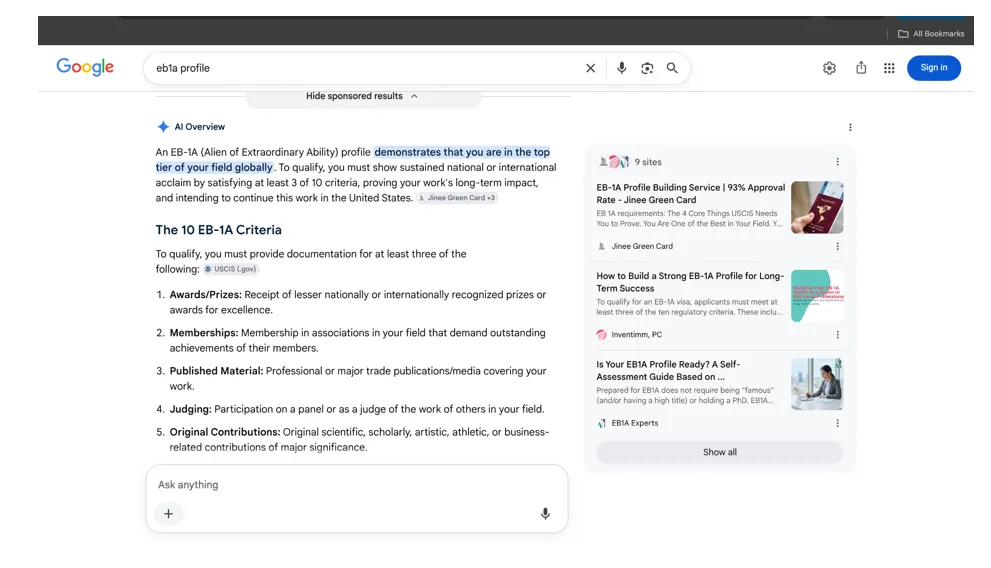
Jinee Green Card is visible in AI Overview for “eb1a profile”
- Cited in the answer. Google’s AI Overview credits Jinee Green Card for its opening explanation of what an EB-1A profile is.
- Listed first in the sources. Among the sites in the sources panel, Jinee Green Card’s page appears at the top.
- On a high-intent keyword. People searching “eb1a profile” are researching this exact service, so the citation puts Jinee in front of the right audience.
What made the content citable
- Direct answers. Content was rebuilt to answer each question directly, instead of circling the topic.
- One clear section per criterion. The page is structured around each of the ten EB-1A criteria, so an AI tool can lift a clean answer for any of them.
- FAQ markup. Added to the question-and-answer sections. Google says no special markup is required for AI features, but it supports normal SEO.
Takeaway: the citation came from clear, specific, well-structured answers, the same standard Google describes in its own guidance. Read the full case study. Results vary by business.
Watch: how AI is reshaping search
Pankaj Shrivastava, Founder & CEO of UnoSearch, was featured by MediaNews4U on how generative engine optimization is changing visibility in an AI-first world. You’ll hear about the changing search landscape, why GEO matters, where AI search is heading, how businesses can improve AI visibility, and why authority and trust matter more than ever.
How UnoSearch can help
The two jobs in this guide need different skills, and both sit on top of solid SEO. UnoSearch covers all three, so you don’t have to stitch together separate vendors.
AI SEO services
Use AI to speed up research, briefs, audits and content updates, with human review and original evidence added so your pages don't turn into look-alike content.
Explore AI SEO servicesGEO services
Get your brand cited and recommended in Google AI Overviews, ChatGPT and Perplexity. This is the kind of work behind the Jinee Green Card citation above.
Explore GEO servicesSEO services
Technical health, helpful content and authority. Google says its AI features use the same core ranking systems, so strong SEO is what everything else builds on.
Explore SEO servicesNot sure where to start? Get a free AI visibility review and we’ll show you which of the three will move the needle first.
Frequently asked questions
What is artificial intelligence search engine optimization?
It is using AI to improve SEO work, and optimizing your content so AI search tools such as Google AI Overviews and ChatGPT can find, understand and cite it.
Is AI SEO different from traditional SEO?
Mostly no. Google says optimizing for generative AI search is still SEO. The foundations of helpful content and a crawlable site are the same.
Does Google penalize AI-generated content?
AI-assisted content must meet the same quality standards and spam policies as any other content. Publishing it at scale to manipulate rankings violates Google’s scaled content abuse policy.
What is AI content optimization?
Improving a draft so it matches search intent, covers the topic fully, is easy to follow and includes original evidence, using AI tools plus human review.
Do I need an llms.txt file?
Not for Google Search, which ignores it. It neither helps nor harms your Google visibility.
References
-
-
- Google Search Central, Optimizing your website for generative AI features on Google Search (last updated July 10, 2026).
- Google Search Central, Google Search’s guidance on using generative AI content on your website.
- Google Search Central, Spam policies for Google web search (scaled content abuse).
- Google, Search Console, including the Generative AI performance report.
- Limy, How to Correctly Track AI Search Performance (July 7, 2026), which inspired the four-layer approach to measurement.
- UnoSearch, Jinee Green Card SEO case study.
- MediaNews4U, The Future of AI Search and GEO: Pankaj Shrivastava interview.
- UnoSearch, What is a GEO audit?
-
Google’s guidance is updated often, so check the linked pages for the latest wording. Sources checked September 30, 2026.

Pankaj Shrivastava
CEO & Co-Founder, UnoSearch
Pankaj Shrivastava is the CEO and Co-Founder of UnoSearch, leading the company’s strategic direction, business growth, and digital marketing initiatives.