
Content Marketing Strategy 2026 - Blueprint for marketers That Ranks, Converts & Gets Cited by AI
Pankaj Srivastava
Published Date: March 11th 2026
What Is Content Marketing — and Why Does It Matter?
Let’s get one thing straight: content marketing is not about publishing blog posts and hoping to attract traffic. It’s a deliberate, long-term strategy where you attract, educate, and retain an audience by creating genuinely useful content. The simplest definition? Content marketing means earning attention rather than buying it. This is done by creating and distributing valuable, relevant content pieces across different digital platforms.
But here’s where most marketers miss: content. It’s the raw material of every marketing channel you use — your website, your emails, your social posts, your videos, your sales decks. Getting your content strategy right means every downstream channel works better.
According to Statista, the global content marketing industry is projected to reach over $107 billion by 2026. However, many marketers still struggle to measure content ROI effectively
Source: Statista Report 2025
That gap between what’s spent and what’s measured? That’s precisely where most strategies fall apart — and where this guide helps you close it.
How to Choose Your Content Formats and Channels
One of the most common mistakes marketers make is choosing a content format before they understand why they’re creating content in the first place. The format should follow the audience, not the other way around.
Here’s a practical framework to cut through the noise:
Start with Your Content Perspective
- What do you think needs to change in the industry?
- How does that change benefit your target audience?
- How does your brand contribute to that change?
This becomes your ‘Content Perspective’. It’s what makes your brand’s content recognizable and worth reading, rather than just more noise in an already crowded space.
Match your Content Formats to your Goals
Once you know your perspective, match your format to your objective:
|
Awareness: Short-form video, social posts, podcast appearances, PR coverage Consideration: Long-form blog posts, comparison guides, webinars, case studies Decision: Product demos, detailed tutorials, testimonials, ROI calculators Retention: Email newsletters, exclusive resources, gated content |
This format isn’t the strategy — content format is the vehicle. Use it to reach your audience where they are. It would also depend on what stage of the buyer journey you’re targeting.
Content Formats & Which Platforms Work Best for Each
Here’s where the data gets interesting — and where a lot of marketers are surprised by what’s actually working right now.
1. Short-Form Video: The Undisputed Attention Champion
Short-form video is the most-consumed, highest-ROI content format in 2025-2026. Short-form video is the most widely used content format among marketers and also delivers the highest ROI, outperforming all other formats, as per HubSpot’s 2026 Marketing Report
Where it works best:
- Reels on Instagram: 3 billion monthly active users. Reels made up more than half of all ads on Instagram in 2025. Interestingly, static image posts still generate a 6.2% engagement rate — higher than Reels at 3.5%. Don’t abandon the humble carousel.
- YouTube Shorts: Better used as a repurposing channel than a primary creative investment.
2. Long-Form Content: For SEO and Building Authority
Despite the dominance of short-form video content, long-form content remains the backbone of organic search and LLM visibility.
Quick Facts –
• Blog posts ranked #3 in the most-used content formats by marketers in 2025, behind short-form video (60%) and long-form video (38%).
• Blog posts were among the top 5 highest-ROI content formats, cited by 22.26% of marketers. Small businesses are 23% more likely than average to see ROI from blog posts.
• The average top-ranking blog post on Google is around 1,400-3,000 words. Posts with visuals generate 650% higher engagement than text-only content.
Source: Ranktracker
3. LinkedIn: The B2B Powerhouse
- 3 billion members across 200 countries. LinkedIn is consistently ranked the most effective B2B social platform.
- A significant portion of users engage with business content weekly (~40%) as per Businessdasher
- Four out of five LinkedIn members drive business decisions.
- LinkedIn generates around 80% of B2B social media leads.
- Only 1% of LinkedIn users post regularly — meaning there’s far less competition for attention than on other platforms.
What works best on LinkedIn? Carousels (document posts), text posts, and native video.
LinkedIn has the highest median engagement rate of any major platform at 6.1% in 2025. Carousel/document posts achieve a staggering median engagement rate of 21.77%.
4.YouTube: The Second Largest Search Engine
YouTube is the most widely used video marketing platform, and it’s increasingly serving as a search engine for video content—especially for educational and how-to content.
- 4% of internet users used YouTube in the past month, making it the second most-used platform globally after Facebook as per DataReportal
- YouTube creators with under 500K subscribers see the highest engagement rates.
5. Facebook: Is it Still Worth Your Attention?
Facebook’s organic engagement rate has dropped to 0.15% — but that doesn’t mean you should ignore it. With over 3.07 billion monthly active users, it remains the world’s largest social platform and is especially valuable for paid content distribution
- Facebook and Instagram together capture over 55% of global social media ad revenue.
- For B2C brands, paid social media content on Facebook and Instagram ranks as the 2nd highest ROI channel, after email marketing.
Developing an Effective Content Strategy
Here’s the truth: most content fails not because the writing is bad, but because there’s no strategy behind it. Content published without a documented plan is just noise with good grammar.
According to Content Marketing Institute (2025), top-performing B2B marketers are significantly more likely to have a documented content strategy, making it a key driver of success. However, only around 40–50% of marketers have one in place.
Source: Content Marketing Institute 2025
The 5-Step Content Strategy Framework that Drives Results
Step 1: Define Your North Star Metric
Before creating a single piece of content, decide what success looks like. Is it organic traffic? Qualified leads? Brand mentions? LLM citations? Revenue? Pick one primary metric and let it guide every decision.
Step 2: Know Your Audience at a Granular Level
‘Marketers aged 25-45’ can be your target audience in paid ads, but for organic, ‘B2B marketing managers at a SaaS company who are overwhelmed by the volume of AI tools and want to make smarter budget decisions. The more specific your target audience is, the more specific you must get with your content piece so that it resonates with it. Focus on content that captures the pain point of customers or businesses, providing them with a solution.
Step 3: Build Topic Clusters, Not Just Keywords
AI SEO and LLM visibility, rewards depth, and authority over length. Instead of targeting isolated keywords, build topic clusters: a central ‘pillar page’ on a broad topic, supported by multiple ‘cluster pages’ that go deep on subtopics.
For SaaS brands, these topic clusters can be built around product features, use cases, comparisons, and customer problems. A dedicated SEO strategy for SaaS companies can connect these topics to commercial pages and broader organic growth goals.
For example, if you’re a CRM software company, your pillar page might be ‘The Complete Guide to CRM.’ Cluster pages would cover topics like ‘CRM for small businesses,’ ‘CRM vs spreadsheets,’ and so on. These pages interlink, signal authority to search engines, and make you more likely to be cited by AI tools.
Step 4: Map Content to the Buyer Journey
Every piece of content should have a clear job to do in moving someone from awareness to decision. If you’re only creating top-of-funnel content (how-to guides, educational blog posts), you’re leaving conversions on the table. If you’re only creating bottom-of-funnel content (product comparisons, demo requests) you’re missing the audience who isn’t ready to buy yet.
Step 5: Build for Humans, Optimize for Machines
The best-performing content in 2026 is written for real people first – it answers genuine questions, shares original perspectives, and provides information that can’t be found anywhere else. Then it’s structured for machines: clear headers, concise answers early in the piece, schema markup, and internal linking.
This dual optimization is what earns you visibility in both traditional search and AI-generated responses.
Steps to Use Semrush to Build a Data-Backed Content Plan
Theory is great, but you need a tool in your hands to bring a content strategy to life, so let’s get practical!
Imagine you run a project management software company. You want to rank for relevant keywords and build a content plan that drives qualified traffic.
Step 1: Start With the Keyword Magic Tool
Open Semrush’s Keyword Magic Tool and enter a seed keyword — let’s enter something broad like ‘project management software.’
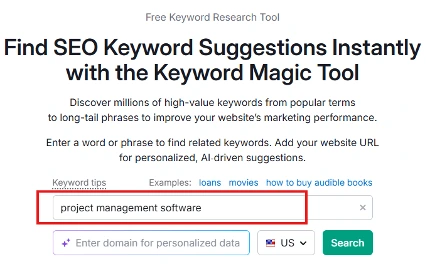
Pro Tip: Filter for keywords with KD under 40 and search volume over 500. These are your ‘quick win’ opportunities — real traffic potential without going head-to-head with HubSpot and Salesforce right away.
Step 2: Use the Keyword Gap Tool to Find Competitor Weaknesses
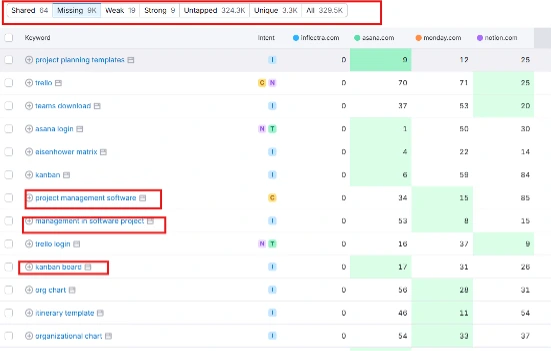
Go to Semrush’s Keyword Gap tool. Enter your domain and up to four competitor domains (e.g., Asana, Monday.com, Notion). Click ‘Compare.’
The tool shows you four categories:
- Missing: Keywords your competitors rank for, but you don’t — highest priority
- Weak: Keywords you rank for but at a lower position than competitors
- Untapped: Keywords where at least one competitor ranks but you don’t — great opportunities
- Strong: Keywords where you outperform competitors — double down here
For our project management example, you might discover that competitors rank strongly for ‘kanban board’ or ‘project management software’ — specific, intent-rich keywords you haven’t targeted yet.
Step 3: Cluster Keywords Into a Content Plan
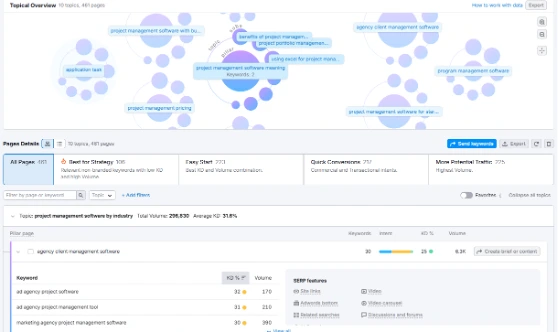
Use Semrush’s Keyword Strategy Builder to automatically group your keywords by topic cluster. It takes seed keywords and generates a structured roadmap of pillar pages and supporting cluster pages. Each cluster groups keywords with similar search intent — perfect for planning your content hierarchy.
Step 4: Validate Content Potential With the Content Gap Analysis
Before writing a single word, use Semrush’s On Page SEO Checker to analyze top-ranking pages for your target keyword. It tells you what content is missing from the top results, which semantically related terms you should include, and how long your content should be.
Step 5: Track Rankings and Iterate
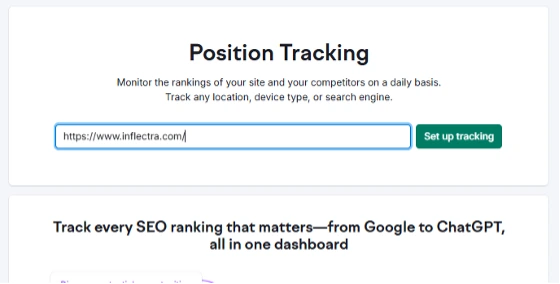
Set up Position Tracking in Semrush for your target keywords. Monitor movement weekly. Content that ranks positions 11-20 is often one update away from breaking onto page 1 — these are your highest-leverage optimization opportunities.
For those who prefer Ahrefs, the workflow is nearly identical: use Keywords Explorer to find opportunities, Site Explorer to analyze competitors, and Content Explorer to find content in your niche that’s performing well but isn’t being linked to enough.
Content Creation - Creating Content That Solves Real Problems
Here’s the most important thing anyone will tell you about content: the best-ranking content isn’t the best-written content. It’s the most useful content.
Google’s algorithm — and increasingly, LLMs deciding what to cite — rewards content that genuinely helps people accomplish something. That means moving from ‘what does our audience want to read?’ to ‘what problem does our audience need to solve, and can we solve it better than anyone else?’
The Problem-First Content Framework
Before writing any piece, answer four questions:
- What specific problem does this content solve?
- What unique insight, data, or perspective can we bring that others can’t?
- What’s the format that delivers this most effectively?
Turning a Generic Blog Post Into a Ranking Asset
Let’s say you’re writing about ’email marketing tips.’ A generic approach produces a listicle like ’10 Email Marketing Tips for 2025′ — the same article that already exists 20,000 times on the internet.
A problem-first approach asks: what’s the actual problem email marketers are facing right now? Through a bit of research (forums, Reddit, customer calls, Semrush’s Topic Research tool), you discover the real pain: ‘My open rates were good, but since Gmail’s new categories, they’ve tanked and I don’t know what’s changed.’
Now you write: ‘Why Your Email Open Rates Dropped in 2025 (And Exactly How to Fix It)’ — with a specific diagnosis, a clear cause, and step-by-step fixes backed by real data. That piece solves a real, urgent problem. It earns backlinks because it’s genuinely useful. It gets shared because it’s specific.
That’s the difference between content that gets traffic and content that builds a brand.
Building a Content Calendar That Actually Gets Used
A great content calendar isn’t just a publishing schedule — it’s a strategic document that connects every piece of content to a business objective, a target audience segment, a distribution channel, and a success metric.
Content Repurposing: The ROI Multiplier Most Teams Ignore
Creating one long-form blog post or video shouldn’t mean creating one asset. Repurpose it strategically:
One pillar blog post can become: a LinkedIn carousel, a Twitter/X thread, three social posts, a newsletter section, a short video script, a podcast talking point, and an infographic. One hour of video content can become 6-10 short clips, a transcript-turned-blog-post, and a YouTube chapter summary. This free downloadable content repurposing calendar maps out how a single piece of core content – a blog post – gets broken down, reformatted, restructured, and redistributed across multiple platforms
The calendar we’ve built covers three niche topics — Food Recipe Blog, Summer Vacation Travel, and CRM Software — across Blog, YouTube Shorts, Instagram, Meta Reels, and LinkedIn (for CRM), planned across 12 weeks (3 months) per theme. Each entry tells your content team exactly what to post, where, when, how long it should be, and what action to drive.
Think of it like a film production. The movie is shot once. Then it’s released in theatres, on streaming, as a trailer on YouTube, as a clip on Instagram, as a behind-the-scenes on TikTok. The core story never changed — only the packaging did.
Here’s what is in the content calendar:
It outlines a weekly plan with schedules –
Monday — A 1,500-word blog post goes live on your website. It’s detailed, SEO-optimised, and built to rank on Google.
Wednesday — A 60-second YouTube Short is created from the most interesting tip in that blog post. Fast cuts, text overlays, one punchy insight. You can use tools like Invideo AI, Steve AI, and NotebookLM
Friday — An Instagram carousel takes the step-by-step structure of the blog and turns it into a 6-slide carousel. Visual, snackable, saveable.
Saturday — A Meta Reel shows the same idea in a behind-the-scenes or lifestyle format — engaging and boosted for reach.
One idea. Four pieces of content. Four different audiences were reached. Fraction of the effort.
Measuring What Actually Matters
‘We got 10,000 page views last month. ‘Sounds good? But did any of them turn into customers?
The metrics that matter in content marketing are the ones that connect content activity to business outcomes. Here’s how to build a measurement framework that measures the effort.
Tier 1: Business Outcome Metrics (The Most Important)
- Revenue from content-influenced leads — track via UTM parameters and CRM attribution
- Qualified lead volume from organic content (not all leads are equal)
- Customer acquisition cost (CAC) vs. content investment — content should reduce your CAC over time
- Pipeline influenced — how many deals touched at least one piece of content?
Tier 2: SEO and Discoverability Metrics
- Organic search traffic (Google Search Console + Semrush Position Tracking)
- Keyword rankings — especially movement from positions 11-20 to top 10
- Backlinks earned — quality over quantity (domain authority of referring sites)
- AI citation tracking — are you being mentioned by ChatGPT, Perplexity, or in Google AI Overviews? Tools like Semrush’s AI Visibility Tracker and Profound now track this.
Tier 3: Engagement and Quality Signals
- Time on page / scroll depth — are people actually reading?
- Social shares and saves — do people find this worth keeping?
- Email CTR and open rates — are subscribers engaging with content you send?
- Comments and replies — are you starting real conversations?
Conclusion
Content marketing in 2026 is both more complex and more rewarding than it’s ever been. The bar for quality is higher. The distribution landscape is more fragmented. AI has changed the rules of discoverability. And yet — companies that invest in strategic, genuine, useful content are generating outsized returns compared to those chasing paid-ad shortcuts.
The brands that win aren’t necessarily the ones with the biggest budgets or the most content. They’re the ones with the clearest perspective, the most consistent execution, and the discipline to measure what actually matters. Start with a real problem your audience has. Build content that solves it better than anyone else. Distribute it where your audience actually spends time. Measure ruthlessly, iterate honestly, and keep showing up.