
Why Brands That Understand GEO Will Own the Next Decade of Search
Pankaj Srivastava
Published Date: March 11th 2026
Access specialized SEO expertise, flexible support, and scalable execution while keeping your search strategy focused on the US market.

Rajiv Ranjan
CTO, UnoSearch
Read more..
10+ Years
of Expertise
60+
Industries Served
AI-First
Technology & Innovation
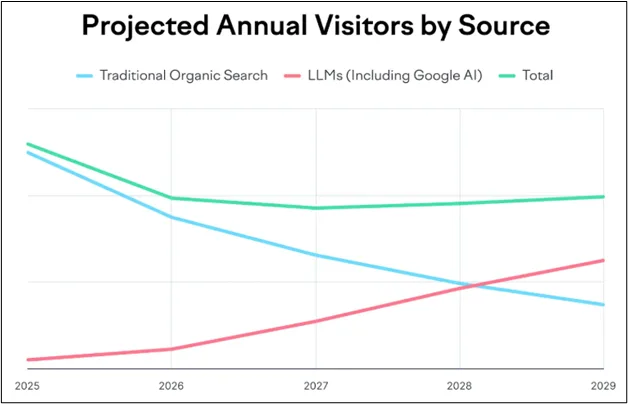
AI Search Visitors Shows Upward Trajectory
AI Query Trigger Rate (2025–2026)
AI Platform Query Volume Comparison (2025–2026 Estimates)
What is GEO? And Why It’s Not Just SEO With a New Name
Shift in Traditional SEO Metrics & KPIs – High Impressions + Low Clicks Is the New Normal
Practical GEO Content Strategy: A 5 Step Plan
Why Does This Model Work So Well in 2026?
Redefine Your Success Metrics for the GEO Era
SEO Isn’t Dead, But the Game Has Expanded
There’s a quiet crisis happening inside marketing dashboards right now.
Impressions are up. Sometimes dramatically. But clicks? Flat. Or worse — declining. And if you’ve been staring at that gap wondering what went wrong, here’s the truth: nothing went wrong. The rules just changed while most of us were still optimizing for the old game.
Welcome to the era of Generative Engine Optimization — or GEO. And if you haven’t started thinking about it yet, you’re already behind.
AI Search Visitors Shows Upward Trajectory
According to research by Semrush, by the end of 2027, LLM traffic will surpass Google search traffic, especially with Google’s AI mode feature.
AI Query Trigger Rate (2025–2026)
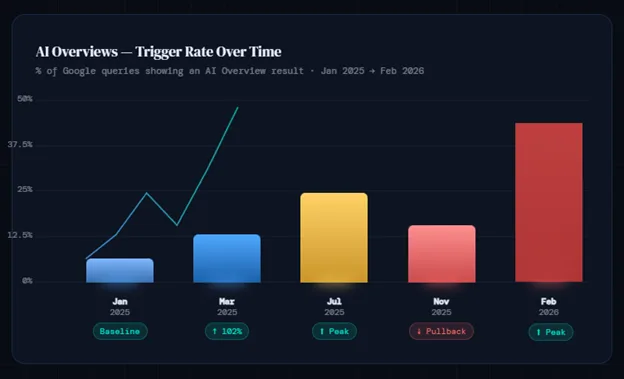
- Early 2025, In January 2025, AI Overviews appeared for 6.49% of queries, rising to 13.14% by March 2025 — a 102% increase in just two months.
- Mid-2025 peak: AI Overview visibility peaked in July 2025, appearing in just under 25% of queries as per Search Engine Land
- Late 2025 pullback: According to Semrush AI Overviews were triggered for 15.69% of queries in November 2025.
- Early 2026 (most recent): In February 2026, AI Overviews appeared on approximately 31% of tracked queries. By February 2026, that figure reached 48%
As per recent data AI Overview presence is at ~48–50% of U.S. queries as of early 2026, depending on the methodology — roughly a 4x increase from where things stood at the start of 2025.
AI Platform Query Volume Comparison (2025–2026 Estimates)
Monthly Queries (Billions)
| Platform | Daily Queries | Monthly Estimate |
|---|---|---|
| ChatGPT | ~2.5B | ~75B |
| Google Gemini ecosystem | ~0.5B | ~15B |
| Claude (Anthropic) | ~0.4B | ~12B |
| Grok (xAI) | ~0.1B | ~3B |
| Perplexity | ~25–30M | ~0.78B |
What is GEO? And Why It's Not Just SEO With a New Name
Generative Engine Optimization is the practice of structuring your content so that AI-powered platforms — ChatGPT, Google AI Overviews, Perplexity, Claude, Gemini, Copilot — can retrieve, understand, and cite your brand when generating answers to user queries.
The term was formally introduced in a landmark June 2024 paper by researchers at Princeton, Georgia Tech, and the Allen Institute for AI. Their findings were striking: “GEO strategies can boost visibility in generative engine responses by up to 40%. Which reference of IIT Delhi & Allen Institute of AI has this.”
The fundamental difference between SEO and GEO
SEO fights for clicks. GEO competes for citations. In traditional search, a user sees your link and decides whether to visit. In generative search, an AI reads your content and decides whether to quote you — often without the user ever visiting your page at all. The user gets the answer. You get the attribution. Sometimes a click follows. Often it doesn’t. But when it does, they’re far more qualified than a standard organic visitor.
And here’s the stat that should make every CMO pause: 63% of websites now report traffic originating from AI-based search engines according to Ahrefs. This is no longer a niche channel.
Shift in Traditional SEO Metrics & KPIs - High Impressions + Low Clicks Is the New Normal
Before GEO, the impressions-to-clicks relationship was relatively predictable. More impressions generally meant more clicks, modulated by your CTR. Now that logic is breaking down — and understanding why is critical to not panicking when you open your Search Console data.
When Google surfaces an AI Overview for a query, it synthesizes an answer from multiple sources directly on the results page. The user gets what they need without scrolling through blue links. According to research 58% of users saw at least one Google search with an AI summary in March 2025 and were measurably less likely to click when those summaries appeared. Bain & Company found that 80% of consumers rely on zero-click results for at least 40% of their searches.
- Proven US case studies– Not just Indian market results. Ask for traffic, lead, and revenue data from American clients specifically.
- White-hat practices only– Verify they follow Google’s guidelines. Run from anyone promising “#1 ranking in 30 days.”
- Transparent reporting– You should have direct access to Google Search Console, Analytics, and real-time dashboards. No black-box reporting.
- Senior-led teams– Ask who’s actually working on your account. If it’s all junior staff with a senior name on the proposal, that’s a red flag.
- Communication infrastructure– Slack/WhatsApp groups with dedicated account managers and overlapping work hours are non-negotiable.
- GEO and AI readiness– In 2026, any agency not optimizing for answer engines alongside traditional search is already behind.
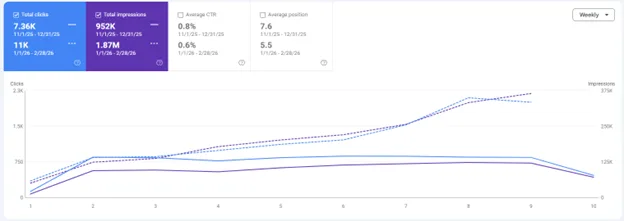
The above screenshot of a Client from Search Console is a proof of concept for the “great decoupling”. We started tailoring content for AIO and GEO targeting long-tail conversational queries in the month of December 2025. Our blogs and brand mentions began to surface on AI and LLMs post December.
Clicks grew from 7.36K to 11K (+49%) and Impressions grew from 952K to 1.87M (+96%)
Impressions nearly doubled while clicks grew at roughly half that rate — the gap between the two is the decoupling.
The GSC makes it even more intuitive:
- The dashed lines (impressions) trend steeply upward throughout the period
- The solid lines (clicks) stay relatively flat and plateau, especially from weeks 3–9
- By the end, the gap between the impression curve and the click curve is visually dramatic
- CTR fell from 8% to 0.6% — a 25% drop
This is the consequence of decoupling, where more people see your content (via AI Overviews, featured in GEO citations), but fewer feel the need to click through because the AI already answered them
Practical GEO Content Strategy: A 5 Step Plan
Here’s where we move from insight to execution. These aren’t abstract principles — they’re the specific steps that get content cited in AI responses
Step 1: Audit Your Current AI Visibility Before You Write a Single Word
Using Semrush’s AI Toolkit: Log in and set up your brand in the AI Toolkit. You’ll see an AI Share of Voice score benchmarking you against competitors across ChatGPT, Gemini, and Perplexity. Pay attention to the “how AI describes you” section — this reveals whether the narrative AI systems associate with your brand matches your positioning.
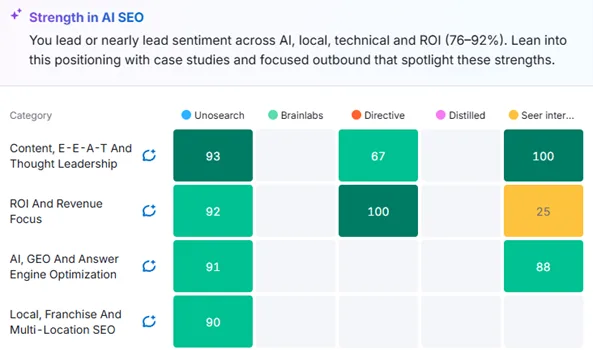
Using Ahrefs Brand Radar: Ahrefs’ Brand Radar tool lets you add competitor names and immediately see your “AI mention gap” — pages that mention competitors but not you. The Cited Pages report shows which third-party sites are most influential in shaping AI responses in your category.
Using Semrush AI Toolkit: Semrush toolkit also shows which competitor pages are being cited in responses that should mention you, surfacing immediate content gaps.
Manually: Open ChatGPT, Perplexity or others. Ask questions your target customer would ask — questions like “What’s the best [your service] in [Location]?” or “I need [your service] who do you recommend in [your location].
Additional Prompts:
“I am optimizing content for Generative Engines (GEO). Act as a reasoning engine. For the query ‘reducing small fleet fuel costs,’ identify:
- The top 5 sub-questions an AI must answer to provide a comprehensive response.
- The specific data points or ‘evidence types’ an AI would look for to verify authority (e.g., case studies, specific percentages, expert names).
Note who’s being cited. If your competitors appear and you don’t, that’s your content roadmap.
Step 2: Restructure Content for AI Extraction — The 40-Word Answer Rule
As per research, AI systems don’t read your page the way a human does. They scan for clear, extractable answers positioned near the top of the page. LLMs are 28-40% more likely to cite content with clear formatting — hierarchical headings, bullet points, numbered lists, and tables — than dense prose.
The practical rule: answer the primary question in 40 words or fewer at the start of each piece. Don’t bury your thesis in the fourth paragraph after context-setting. State it immediately, clearly, and factually.
Rewrite your H2s and H3s as natural questions. Instead of “Benefits of Email Marketing,” write “Why does email marketing outperform other channels for ROI?” This mirrors how users query AI systems and dramatically increases the chance your content gets pulled into a response.
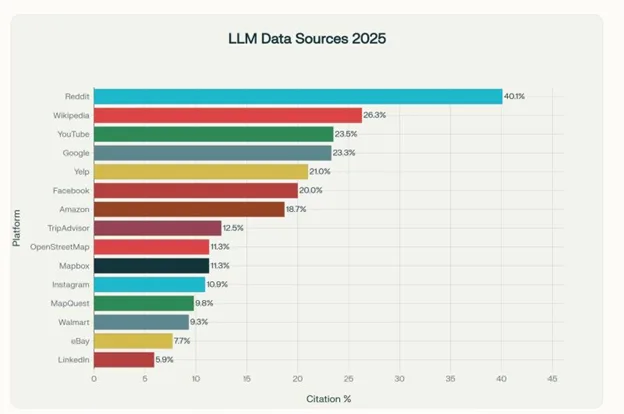
Add a FAQ section to every substantive piece of content. FAQs are the format most frequently cited by generative AI engines because they match the question-answer structure of AI queries exactly. Video content is the single most cited format across verticals — YouTube alone accounts for nearly a quarter of all AI citations — so consider whether your written content has a video companion as mentioned by Hubspot’s research
Step 3: Build Authoritative Third-Party Mentions
This is where the analogy from Ahrefs’ GEO guide resonates perfectly: traditional SEO was like competing to have the best storefront on a busy street. GEO is like making sure the local tour guide knows your business and recommends it to every visitor. The tour guide isn’t you.
Get listed in “best of” roundups and industry comparison pages. These are the pages AI systems cite most heavily for product category queries. Pitch for coverage in publications with high domain authority. Pursue podcast appearances. Monitor Reddit and Quora threads in your niche — UGC platforms have high exposure in generative engines, and brand presence in these communities directly influences AI responses.
Step 4: Add Structured Data and Schema Markup — The Technical Foundation
Schema markup is how you give AI systems a machine-readable map of your content. Think of it as a type system for prose — it tells search engines and LLMs not just what your content says, but what it means.
Prioritize these schema types for GEO: Article schema with author credentials and dateModified (recency matters enormously to LLMs), FAQ schema on every page that contains Q&A pairs, HowTo schema for instructional content, and Organization schema to establish your brand as a recognized entity in Google’s Knowledge Graph.
Step 5: Use Google AI Studio to Test and Refine Your GEO Readiness
This is a step most content teams skip entirely, and it’s one of the highest-leverage activities available to you right now.
Google AI Studio aistudio.google.com is a free tool that gives you direct access to Google’s Gemini models. For GEO purposes, you can use it as a laboratory to test how AI systems interpret and extract information from your content before it ever appears in a search result.
Practical workflow in Google AI Studio:
- Content comprehension test: Paste the full text of any piece of content and ask Gemini: “If a user asked [your target query], what would you cite from this content, and how would you phrase the answer?” Compare the AI’s extraction to what you intended to communicate. If the model pulls the wrong sentence or misrepresents your core claim, that tells you the structure needs work.
- Citation-readiness audit: Ask: “What is the single most authoritative claim in this content, and does it have sufficient evidence?” If Gemini can’t identify a clear, well-supported claim, neither can ChatGPT or Perplexity when they index your page.
- Competitive gap analysis: Paste competitor content alongside yours and ask which content is more likely to be cited as an authoritative source on a specific topic, and why. The model’s reasoning will surface specific structural, authority, or clarity gaps you can directly address.
- FAQ generation: Ask AI Studio to generate the 10 most likely questions a user might ask that this content should answer. Use this list to identify FAQ pairs you’re missing, then add them to the page with proper FAQ schema.
The key advantage of using Google AI Studio specifically is that Gemini’s citation logic is closely aligned with how Google AI Overviews selects sources. While no tool gives you a perfect preview of AI Overviews behavior, testing in AI Studio gives you the closest available proxy — and it’s free.
Redefine Your Success Metrics for the GEO Era
Now that you know how to build your GEO content strategy, It’s time to measure your tracking metrics and build a KPI dashboard.
New metrics your team needs to track for GEO alongside traditional one:
- AI Share of Voice: The percentage of brand impressions in AI-generated responses compared to total impressions for responses that mention any tracked brand in your category. Both Semrush’s AI Toolkit and Ahrefs’ Brand Radar calculate this.
- Citation frequency by platform: How often your content is cited in ChatGPT responses versus Perplexity versus Google AI Overviews. Each platform has different citation patterns and audiences — ChatGPT skews toward informational and professional queries (52.2% informational intent), while Google’s dominant intent remains navigational (49.6%).
- AI referral traffic quality: In GA4, use regex filters to segment traffic from AI platforms: chatgpt.com,perplexity,gemini and compare conversion rates against organic.
SEO Isn't Dead, But the Game Has Expanded
Let’s close by cutting through a common misconception. GEO doesn’t replace SEO. Semrush’s research shows that ChatGPT users don’t abandon Google Search — using generative AI actually expands overall search behavior. Traditional SEO fundamentals — crawlability, site speed, backlinks, E-E-A-T signals — are still the foundation that feeds AI systems in the first place. Generative engines rely on the same authority and relevance signals that search algorithms have always valued.
What’s changed is the output. AI systems synthesize your content into an answer rather than surfacing a link to it. The user relationship with your brand starts one step earlier than before, in a conversational interface, without a click. Your job as a marketer is to be present and authoritative in that moment — even when you don’t get the direct traffic.
If your brand isn’t appearing in AI answers, for many users today, it genuinely doesn’t exist. Not because your content is bad. Because it wasn’t built for the audience that’s now consuming it.
The metrics look strange right now. High impressions, fewer clicks, better conversions. That’s not a broken dashboard. That’s the map of a new territory. The brands that learn to read it — and optimize for it deliberately — will own the next decade of digital discovery.
Let us help you grow your business with a customized SEO strategy