
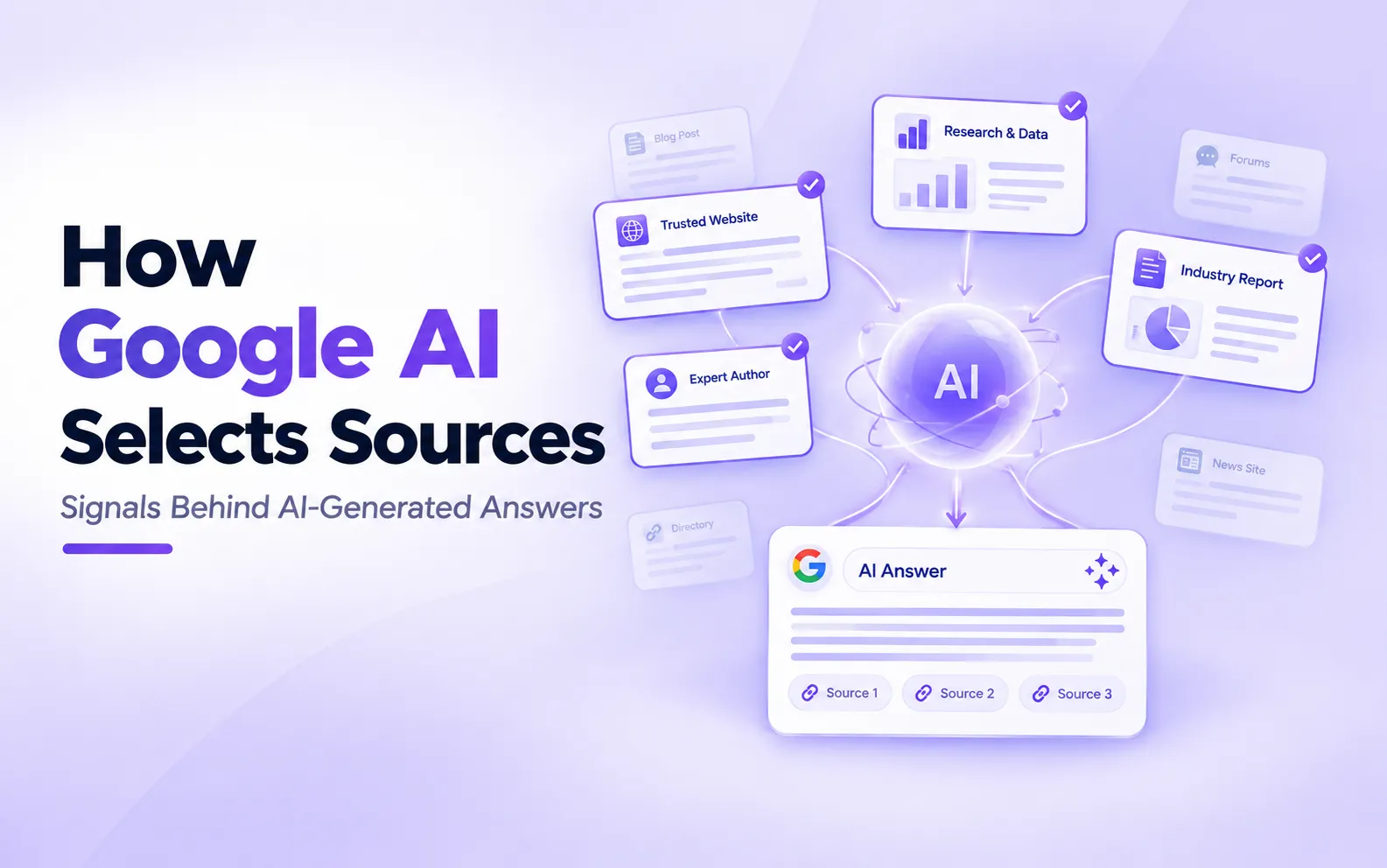
Google AI Overviews can use information from web sources to build responses to search queries. UnoSearch helps businesses strengthen their SEO and GEO strategy with clear, authoritative content designed to improve visibility across Google AI Overviews and other AI search platforms

Pankaj Shrivastava
CEO & Co-Founder, UnoSearch
Pankaj Shrivastava is the CEO and Co-Founder of UnoSearch, leading the company’s strategic direction, business growth, and digital marketing initiatives.
Read more..
With extensive experience in SEO and digital marketing, he focuses on helping businesses strengthen their online presence, drive sustainable growth, and adapt to the evolving digital landscape. His expertise spans business strategy, search engine optimization, AI-driven marketing, and performance-focused growth solutions.
10+ Years
of Expertise
60+
Industries Served
AI-First
Digital Growth Strategy
Google AI Overviews prioritize citations using seven key signals, including E-E-A-T, passage extractability, semantic alignment, freshness, entity density, query coverage, and domain authority overlap. Since the Google Gemini upgrade in January 2026, the focus has shifted from page-level authority to precise passage-level relevance. Research across 15,847 results shows that content with 15+ recognized entities is cited 4.8× more often, with optimal extractable passages typically ranging between 134–167 words.
“The old game was ranking number one on Google. The new game is writing one paragraph so clean, so factual, and so well-structured that Gemini has no reason to look elsewhere. That’s what we engineer at UnoSearch.” — Pankaj Srivastava, Founder, UnoSearch
The 7 Signals Google’s AI Actually Weighs Before Citing You
Google doesn’t rank your whole website for AI Overviews. It ranks your passages. And the evaluation happens in milliseconds, against a very specific set of filters.
Here’s how the selection really works in 2026:
- E-E-A-T verification — 96% of AI Overview citations come from sources with visible author credentials, first-hand experience markers, and trust signals.
- Passage extractability — your answer needs to sit cleanly inside a 100–300 word self-contained block.
- Vector embedding alignment — content with cosine similarity above 0.88 to the query gets selected 7.3× more often.
- Freshness stamps — a 2026-dated article almost always beats a 2024 one for trending queries.
- Query fan-out coverage — Google splits one search into 5–8 sub-queries, and pages showing across multiple get cited.
- Entity density — naming real tools and frameworks (like Perplexity, Ahrefs, Gemini) boosts selection.
- Top-10 organic overlap — there’s an 86% domain overlap between AI Overviews and traditional top-10 results.
Can You Optimize a Website Specifically for AI Overview Citations?
Yes — AI Overview optimization is now a distinct discipline called Generative Engine Optimization (GEO), and it requires passage engineering, schema layering, and entity architecture that traditional SEO ignores.
Traditional SEO chases rankings. GEO chases citations. The difference matters because AI Overviews now appear in over 50% of searches, and a cited brand captures visibility a ranked brand cannot. Techniques like structured Q&A blocks, 140-word answer pods, and schema markup with FAQPage plus Article plus Organization layers give Gemini the extraction signals it needs. We’ve seen client citation rates jump 3× within 90 days of applying this GEO framework across service pages and blog content.
Why Choose UnoSearch for Google AI Overview Optimization?
UnoSearch is a Google Premier Partner with 11+ years of search experience and $13.7M+ in client revenue delivered across 60+ industries. Our in-house AI engineers build custom GEO frameworks that engineer passage-level citations, not just rankings. We combine traditional SEO with answer extraction architecture, schema enrichment, and entity layering. Whether you’re a USA-based SaaS brand or an enterprise scaling globally, our GEO services are built for one outcome — becoming the AI’s preferred answer. Founders sit inside every client channel. No outsourcing, no middlemen, no empty promises.
📞 Call Now: +91 8976406245
We help brands grow traffic in AI search
FAQ's
1. Does my website need to rank on page one to appear in Google AI Overview?
Not always. Only 14% of AI Overview citations now come from page-one results — Gemini 3 pulls increasingly from deeper passages that match query intent better than the top-ranked page.
2. How long should a passage be to get cited by Google AI Overview?
Between 134 and 167 words is the current sweet spot. Shorter feels thin, longer loses focus. One clear claim, evidence, and context works best.
3. Does YouTube content get cited by Google AI Overview?
Yes. YouTube now accounts for 5.6% of all AI Overview citations and grew 34% in six months, especially for how-to, health, and product queries.
4. What's the single biggest factor for AI Overview citations in 2026?
E-E-A-T. 96% of cited sources show strong expertise and trust signals. Author bios, credentials, and verifiable first-hand experience matter more than backlinks.
Contact Us for a Free SEO Consultation Today!
Let us help you grow your business with a customized SEO strategy
References
- Search Engine Journal — Google AI Overview Citations From Top-Ranking Pages Drop Sharply — https://www.searchenginejournal.com/google-ai-overview-citations-from-top-ranking-pages-drop-sharply/568637/
- Semrush — AI Overviews Study: 86% Domain Overlap with Organic Results — https://www.semrush.com/blog/ai-overviews-study/
- Ahrefs — Brand Radar: AI Overview Citation Patterns in 2026 — https://ahrefs.com/blog/ai-overview-citations/
- Google Search Central — AI Features and Your Website — https://developers.google.com/search/docs/appearance/ai-features
Disclaimer: This blog is intended for informational purposes only. The data, statistics, and insights referenced are sourced from publicly available research and are accurate at the time of writing. Results from GEO and SEO strategies vary depending on industry, competition, content quality, and platform changes.