
How much does GEO cost in 2026
If your customers are asking ChatGPT, Perplexity, Gemini, or Google’s AI features which companies they should consider, you may be wondering what it takes to get your brand into those answers and, more importantly, how much generative engine optimization actually costs.
By Pankaj Srivastava | Published: May 27th, 2026 | Updated: August 20, 2026
GEO pricing can vary based on your business, competition, content needs, and the level of AI visibility work required. UnoSearch builds tailored GEO strategies focused on improving your brand’s visibility, citations, and presence across AI search platforms.

Pankaj Shrivastava
CEO & Co-Founder, UnoSearch
Pankaj Shrivastava is the CEO and Co-Founder of UnoSearch, leading the company’s strategic direction, business growth, and digital marketing initiatives.
Read more..
With extensive experience in SEO and digital marketing, he focuses on helping businesses strengthen their online presence, drive sustainable growth, and adapt to the evolving digital landscape. His expertise spans business strategy, search engine optimization, AI-driven marketing, and performance-focused growth solutions.
10+ Years
of Expertise
60+
Industries Served
AI-First
Digital Growth Strategy
1. Quick Answer
2. GEO Cost
3. What does GEO Pricing Includes
4. AI Changing Future of Search
5. GEO Pricing Models
6. Factors Affecting GEO Pricing
7. GEO Cost:- Per Month
8. GEO VS Traditional SEO
10. What Should GEO Include?
11. GEO Quote
12. How Unoserach Can Help With GEO?
12. FAQ’s
Quick Answer :
How Much Does Generative Engine Optimization Cost in 2026?
| GEO engagement | Typical 2026 cost | Best suited for |
|---|---|---|
| GEO audit | $2,500–$10,000 one-time | Businesses assessing their AI visibility |
| Starter GEO program | $1,500–$3,000/month | Smaller businesses beginning GEO |
| Growth GEO program | $3,000–$8,000/month | Growing brands competing for AI visibility |
| Advanced GEO program | $8,000–$15,000/month | Competitive categories and established brands |
| Enterprise GEO | $15,000–$20,000+/month | Large brands, multiple markets, complex programs |
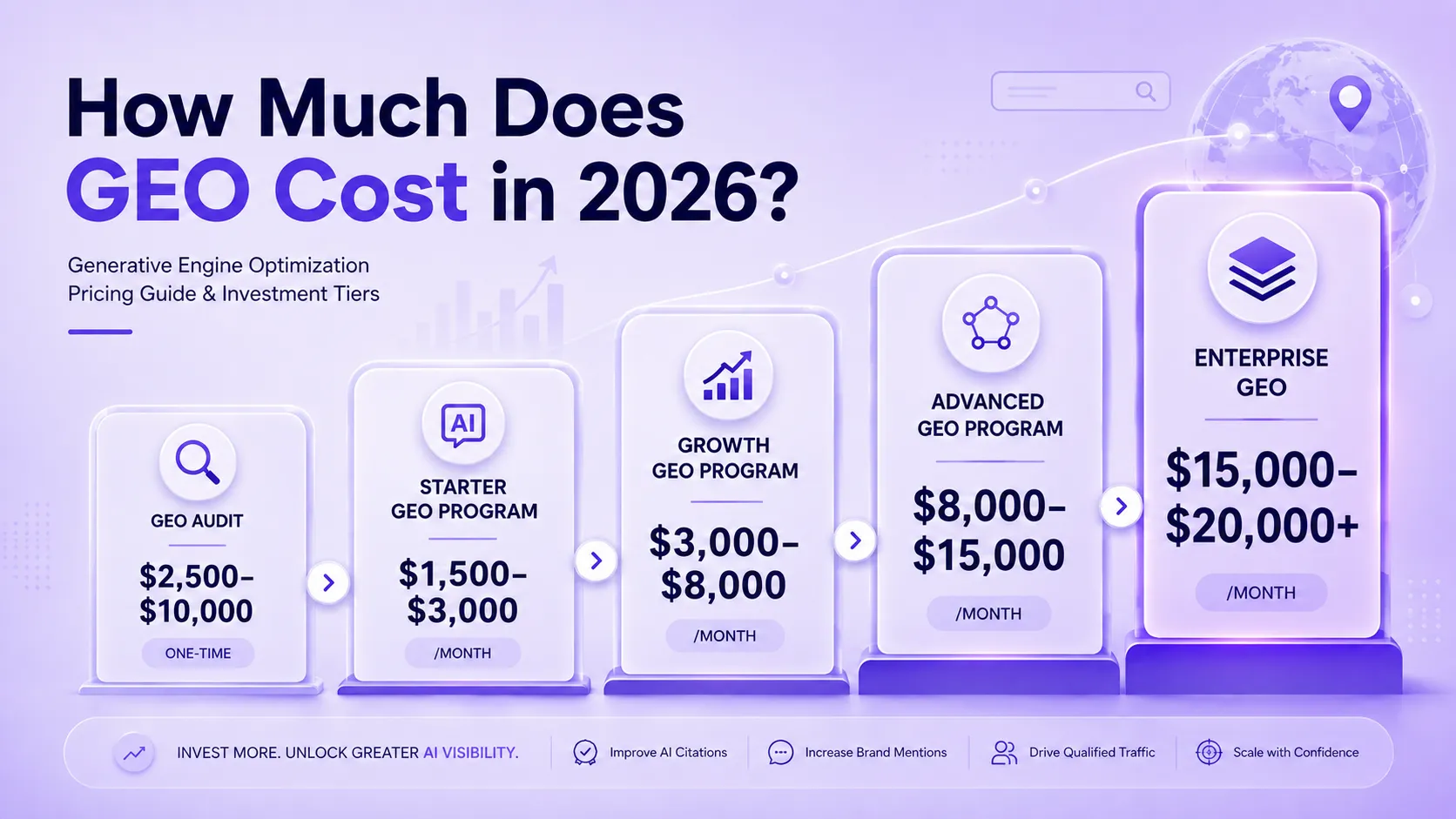
These are indicative market ranges rather than fixed industry rates. Published 2026 pricing guides show substantial variation depending on scope and provider, with some enterprise programs extending far beyond $20,000 per month.
The biggest mistake is comparing two GEO quotes based only on the monthly number. A $2,000 monthly package focused primarily on reporting and content recommendations is not equivalent to a $7,000 engagement that includes technical implementation, content production, entity optimization, authority building, and ongoing citation tracking.
Expert Insight : A Princeton-led study introduced Generative Engine Optimization (GEO) as a framework for improving content visibility in generative-engine responses. The research also found that optimization strategies can have a measurable impact on AI-generated visibility, although results vary by domain and optimization approach.
Source:Generative Engine Optimization — Princeton University, Georgia Tech
What Does GEO Pricing Usually Include?
GEO pricing varies because the actual work involved can vary significantly.
A comprehensive GEO program may include:
AI visibility and citation audits
Prompt and query research
Entity and brand optimization
Content restructuring for AI extractability
Answer-focused content creation
Existing content optimization
Digital PR and authority building
Third-party mentions and citation opportunities
AI visibility monitoring
This is why comparing GEO services pricing based on the number of articles alone can be misleading.
For Example : Two providers could both offer “10 optimized articles per month,” but one may simply rewrite existing content while another combines those articles with entity optimization, technical work, citation analysis, and authority building.
The deliverables may look similar on paper while the actual strategy is completely different.
Watch: How AI Is Changing the Future of Search
Search is evolving beyond traditional Google rankings as users increasingly turn to AI-powered platforms for answers and recommendations. In this video, explore how AI is reshaping search visibility and what businesses need to understand to stay discoverable in this new search landscape.
Watch the video to learn more about the shift toward AI-powered search.
How Do GEO Pricing Models Work?
Most GEO engagements fall into three pricing models.
1. One-Time GEO Audit
A GEO audit is usually the lowest-commitment way to assess your current position.
A comprehensive audit may examine:
Where your brand currently appears in AI answers
Which prompts trigger your competitors
Which sources AI platforms cite
Content gaps
Technical barriers
Competitor citation patterns
Opportunities for improving AI visibility
A one-time GEO audit can range from approximately $2,500 to $10,000, depending on how deep the analysis goes. An audit makes sense if you’re not ready for ongoing optimization but want to understand where your biggest visibility gaps are.
2. Monthly GEO Retainer
A monthly retainer is the most common model for businesses that want continuous AI visibility growth.
The reason is simple: getting cited once isn’t necessarily the goal. Your competitors are publishing, earning mentions, updating their websites, and changing their positioning. AI-generated answers can also change as the underlying search ecosystem evolves.
A monthly GEO program can therefore cover ongoing:
Content optimization
Technical improvements
Entity work
Citation monitoring
Competitive research
Authority building
New content
Reporting and optimization
Current 2026 market examples place ongoing agency-led GEO anywhere from roughly $1,500/month into five figures, depending heavily on scope and business complexity.
3. Project-Based GEO
Some businesses don’t need an ongoing retainer.
They may have a specific requirement such as:
Optimizing a website for AI search
Reworking a major knowledge hub
Fixing entity inconsistencies
Preparing a website for AI visibility
Conducting a competitor citation analysis
Optimizing a specific set of commercial pages
In those cases, a project-based engagement can make more sense than paying a monthly GEO retainer. The cost depends primarily on the number of pages, technical complexity, research depth, and implementation required.
What Factors Affect GEO Services Cost?
There is no single fixed GEO services cost because several variables determine how much work is required.
1. Your Industry's Competition
Competition is one of the biggest pricing factors. Getting a local service business mentioned for a handful of niche queries is very different from getting a national SaaS, healthcare, legal, financial, or ecommerce brand consistently cited for competitive commercial questions
If established competitors already dominate the sources AI systems rely on, more content and authority work may be required.
2. Your Existing SEO Foundation
GEO doesn’t exist separately from the rest of your search presence. If your website already has Strong technical SEO, Authoritative content, Clear entities, Quality backlinks and Consistent brand information, Strong topical coverage
If the above fundamentals are weak, part of the budget may need to go toward fixing them first.
3. Number of AI Search Platforms
Your target platforms can also affect scope. A business may want to monitor visibility across ChatGPT, Google AI Overviews, Gemini, Perplexity, Claude and Other AI-powered search experiences
The more platforms, prompts, markets, and competitors you monitor, the more research and reporting is required.
4. Content Production
Content is often one of the largest components of generative engine optimization pricing. But quantity isn’t everything. A strong GEO content strategy focuses on creating pages that answer the questions your target audience actually asks, while making the information clear, structured, attributable, and supported by credible sources.
That can involve:New articles, Comparison pages, Service pages, FAQs, Expert-led content, Statistics and research pages, Industry resources, Existing content restructuring
5. Authority and Digital PR
Being technically accessible to AI systems doesn’t automatically make a brand a trusted source. If your competitors are consistently mentioned by authoritative publications, industry websites, directories, and other trusted sources, you may need an authority-building strategy as part of your GEO program.
This is one reason a cheap GEO package can look attractive initially but fail to produce meaningful visibility gains.
6. Number of Markets and Brands
A single US website targeting one market is much simpler than a multinational organization with: Multiple countries, Multiple brands, Multiple languages, Multiple product lines, Multiple customer segments
How Much Does GEO Cost Per Month for Different Business Sizes?
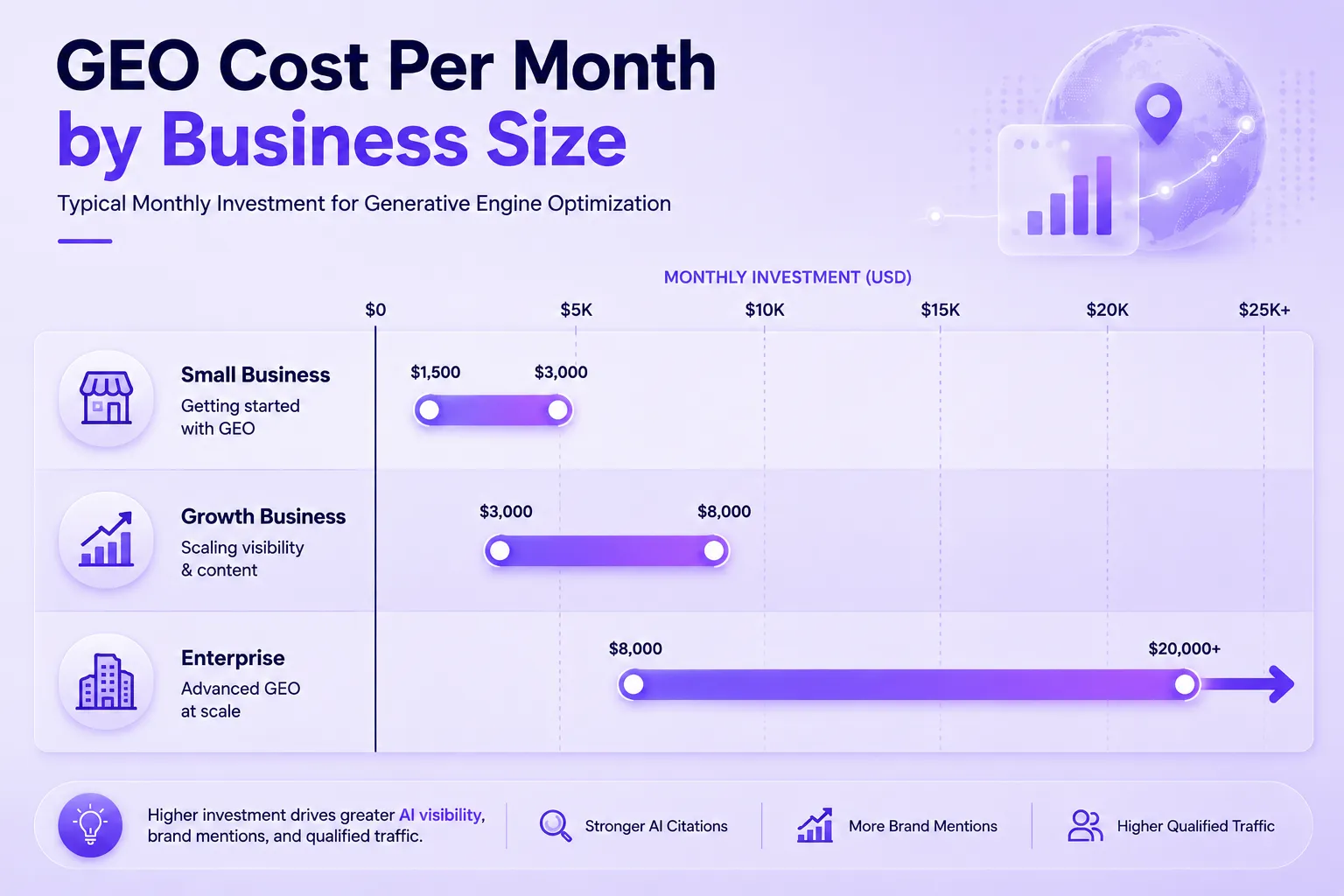
Your business size is a useful starting point when deciding how much to budget.
Small Business: $1,500–$3,000/month
This range can work for businesses that want to establish their initial AI visibility foundation.
The focus may include:
- GEO audit
- Priority-page optimization
- Basic entity work
- Content recommendations
- Initial AI visibility tracking
- Monthly reporting
The goal isn’t to dominate every AI query. It’s to establish a strong foundation and identify where the biggest opportunities exist.
Growth Business: $3,000–$8,000/month
This is where GEO becomes a more comprehensive growth program.
A typical engagement may include:
- Ongoing content optimization
- New content production
- Technical improvements
- Entity optimization
- Competitor monitoring
- Citation analysis
- Authority-building activities
- Multi-platform tracking
This range is particularly relevant for established businesses competing in categories where AI recommendations can influence high-value buying decisions.
Enterprise: $8,000–$20,000+/month
Enterprise programs require significantly more coordination.
The scope may involve:
- Multiple markets
- Multiple business units
- Large content libraries
- Complex technical infrastructure
- Enterprise-level reporting
- Large-scale content optimization
- Digital PR
- Multiple AI search environments
- Dedicated strategy and execution teams
With multiple markets, complex infrastructure, and large-scale AI search optimization involved, enterprise programs require a dedicated team and a highly coordinated strategy. As a result, they typically sit at the highest end of GEO pricing.
How Does GEO Agency Pricing Compare With Traditional SEO?
GEO and SEO overlap heavily, but a serious GEO engagement isn’t simply traditional SEO with “AI” added to the proposal.
Traditional SEO primarily focuses on improving visibility in conventional search results.
GEO focuses on increasing the likelihood that your brand, content, products, or expertise are surfaced, mentioned, recommended, or cited in AI-generated answers.
The work can overlap in areas such as:
Technical SEO:
Ensuring search engines and AI systems can efficiently crawl, understand, and access your website.
Content quality:
Creating accurate, helpful, and well-structured content that provides clear answers to relevant queries.
Topical authority:
Building comprehensive coverage around your core topics to demonstrate subject-matter expertise.
Structured data:
Using schema markup to help search engines better interpret your content, entities, products, and services.
Internal linking:
Connecting relevant pages to strengthen topical relationships and improve content discoverability.
Backlinks:
Earning authoritative links that can strengthen your website’s credibility and authority.
Entity signals:
Building consistent information about your brand, people, products, and expertise across relevant online sources.
What Should a GEO Package Include?
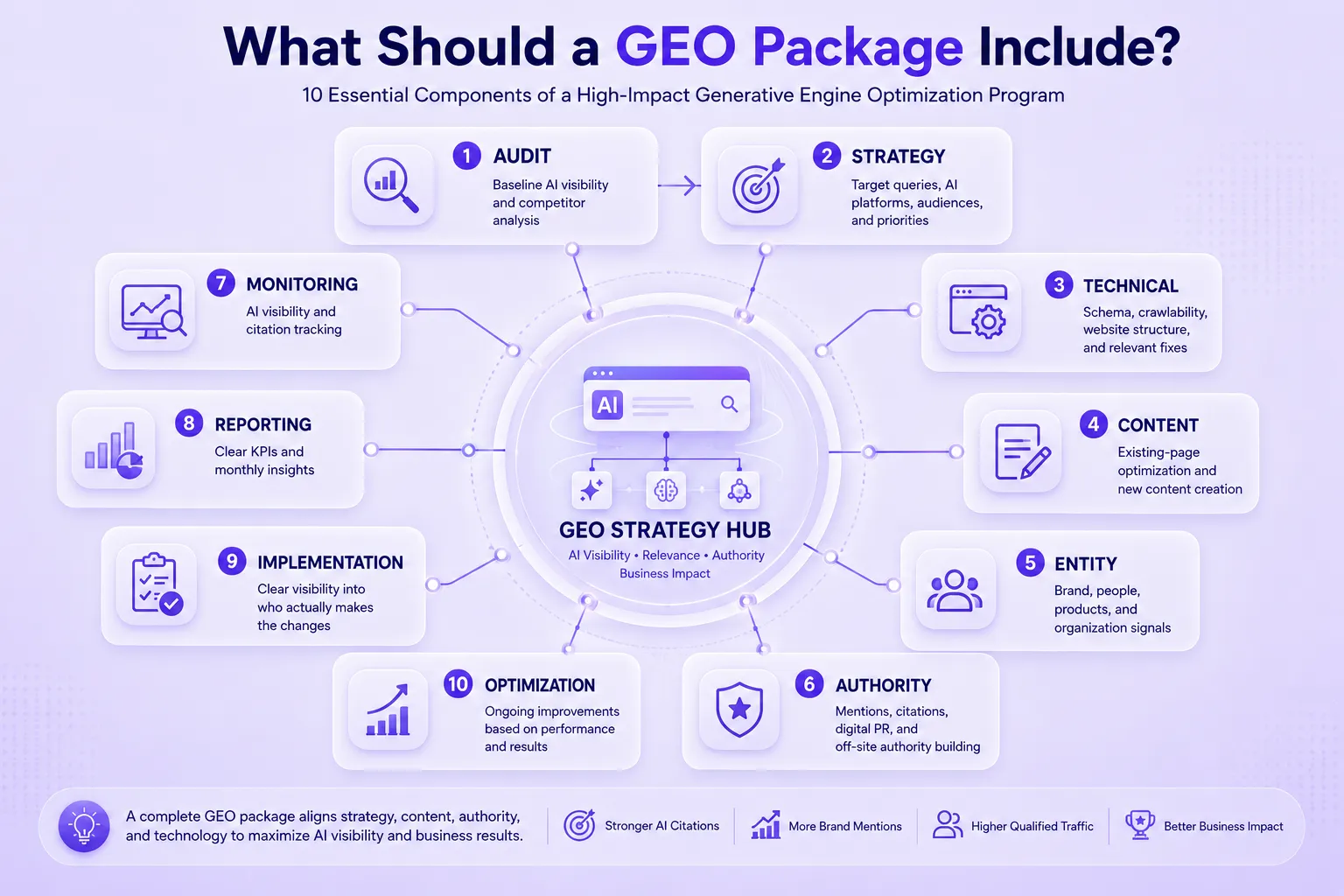
Before signing a contract, ask for a clear scope.
| Area | What to look for |
|---|---|
| Audit | Baseline AI visibility and competitor analysis |
| Strategy | Target queries, platforms, audiences, and priorities |
| Technical | Schema, crawlability, structure, and other relevant fixes |
| Content | Existing-page optimization and/or new content |
| Entity | Brand, people, products, and organization signals |
| Authority | Mentions, citations, PR, or other off-site activities |
| Monitoring | AI visibility and citation tracking |
| Reporting | Clear KPIs and monthly insights |
| Implementation | Who actually makes the changes |
| Optimization | What happens after the first results are measured |
If a proposal only says “AI-optimized content” without explaining the strategy behind it, ask for more detail.
How Do You Know If a GEO Quote Is Too Expensive?
A high GEO price isn’t automatically a bad deal. A $10,000 monthly program could be expensive for one business and completely reasonable for another.
Ask these questions before judging the quote:
1. What exactly is included?
A $3,000 package with substantial implementation may offer more value than a $1,500 package that mostly provides reporting.
2. Who is doing the work?
Find out whether you’re getting senior strategy, specialist execution, junior production, or a combination.
3. What will actually change on the website?
If the agency cannot explain what they plan to improve, it’s difficult to evaluate the investment.
4. How will success be measured?
Look beyond traffic alone. Relevant GEO metrics can include AI mentions, citation frequency, share of AI visibility, competitor comparisons, and qualified business outcomes.
Is the program built around your business or a template?
A generic GEO package may not account for your industry, competitors, customers, or existing authority.
How Long Does It Take to See Results From GEO?
GEO is not an overnight visibility switch. The timeline depends on your existing authority, technical foundation, competition, content quality, and scope of work.
A reasonable framework is:
- Month 1–2: Audit, baseline measurement, technical fixes, entity analysis, and strategy development.
- Month 3–4: Content and authority work begins compounding, with early changes in AI visibility potentially becoming measurable.
- Month 6+: A larger body of content, mentions, authority signals, and optimization data provides a stronger foundation for sustained AI visibility.
The exact timeline varies considerably. A business with strong existing authority may move faster than a new brand entering a highly competitive category.
Is GEO Worth the Cost in 2026?
For businesses whose customers increasingly use AI platforms during research, GEO can be worth considering as an extension of their existing search strategy. The question isn’t whether every company should spend $10,000 a month on GEO.
It is whether AI-generated answers are becoming relevant to your customer journey and whether your competitors are already gaining visibility there. If competitors are being cited when prospects ask questions about your category while your brand is absent, there is a measurable visibility gap.
The right investment depends on the size of that gap and how commercially valuable those queries are.
For some businesses, a one-time audit is the right starting point. For others, a $3,000–$8,000 monthly program may make sense. Large brands competing across multiple markets may require a significantly larger enterprise program.
The important thing is to match the investment to the opportunity rather than buying the biggest package available.
How Can UnoSearch Help With Generative Engine Optimization?
UnoSearch approaches GEO as more than content written for AI platforms.
The objective is to help businesses become credible, discoverable sources that AI search systems can understand, retrieve, and cite.
Depending on your current visibility, the strategy can include:
- AI visibility auditing
- Competitor citation analysis
- Entity optimization
- Content restructuring
- Technical SEO improvements
- AI-focused content strategy
- Citation and authority building
- Ongoing AI visibility tracking
- Performance reporting
The GEO pricing at UnoSearch ranges from $1200 to $2500 per month based on service requirements.
Not sure where your brand appears across AI search?
If you're not sure where your brand currently appears across ChatGPT, Perplexity, Gemini, or Google AI Overviews, starting with an AI visibility assessment can show where the biggest gaps are before you commit to an ongoing program.
Get Your Free AI Visibility AuditFrequently Asked Questions
How much does GEO cost?
GEO can range from approximately $1,500 to $20,000+ per month for ongoing agency-led programs, while one-time audits and DIY tools can cost considerably less. The final price depends on scope, competition, business size, and the number of markets and AI search environments being targeted.
How much does generative engine optimization cost per month?
For ongoing work, a common 2026 range is approximately $1,500–$20,000+ per month. Smaller businesses may start around $1,500–$3,000, while larger and more competitive programs can cost significantly more.
How much does GEO cost per month for a small business?
A small business can typically consider a starting budget of around $1,500–$3,000 per month for a focused GEO program. The exact cost depends on the business’s existing SEO foundation, competition, content requirements, and target queries.
How much does a GEO agency cost?
GEO agency pricing varies significantly. A smaller engagement may start around $1,500–$3,000 per month, while comprehensive programs can reach $8,000–$20,000+ per month. Enterprise programs may exceed that range.
How much does AI search optimization cost?
AI search optimization cost depends on whether you’re buying an audit, software, consulting, or ongoing implementation. Agency-led programs can range from several thousand dollars per month to significantly more for enterprise work.
Is GEO more expensive than SEO?
Not necessarily. GEO and SEO share many underlying activities, including technical optimization, content, authority, and entity work. However, a comprehensive GEO program may cost more when it adds AI visibility monitoring, citation analysis, additional content, authority building, and multi-platform optimization.
References
1. Princeton University – GEO: Generative Engine Optimization
https://collaborate.princeton.edu/en/publications/geo-generative-engine-optimization/
2. Google Search Central – Optimizing for Generative AI Features https://developers.google.com/search/docs/fundamentals/ai-optimization-guide
3. Google Search Central – AI Features and Your Website https://developers.google.com/search/docs/appearance/ai-features
Continue Learning About SEO & AI Search

Social Media Marketing for Law Firms: Full 2026 Guide
Social media marketing for law firms means using platforms like LinkedIn, Facebook, and Instagram to build trust with future clients before they ever call your office. A strong social presence helps a firm stay visible, answer common legal questions, and turn casual...

Link Building Cost in India: A Complete 2026 Pricing Guide
If you are budgeting for SEO, you need a clear answer on link building cost in India. This guide gives you real price ranges, the factors that move those prices, and a simple way to judge if a quote is fair. No guesswork, no filler. Just the numbers you need to plan...

PPC for Real Estate: How to Generate Better Leads (2026 Guide)
Real estate PPC can put your business in front of buyers and sellers at the exact moment they are searching for an agent, property, or real estate service. But simply paying for clicks does not guarantee quality leads. The difference comes down to targeting the right...