
Local SEO for Real Estate: What Works for Agents in 2026
A practical guide to profile setup, reviews, neighborhood pages and AI visibility, including the brokerage rules and measurement problems most guides skip.
By Mahendernath Pulidindi, Associate Vice President, UnoSearch · Updated October 10, 2026 · 10 min read
First 90 days
FAQs
References
The short answer
Local SEO for real estate means making sure that when someone in your market searches for an agent, a neighborhood, or a home, Google, Maps, and now AI tools find you, trust you, and show you. It comes down to four things: a correctly set-up profile, steady reviews, pages that say something specific, and measurable proof.
We read the top-ranking guides on local SEO for real estate before writing this one. The fundamentals they share are sound. What most of them skip is the part that actually trips agents up:
- Who owns your profile when a brokerage is involved,
- What makes a neighborhood page worth ranking, and
- Whether AI tools mention you or not.
Let us focus on these points here.
Key takeaways
- Profile ownership comes first. Agent, team and brokerage listings can collide. See how to set yours up.
- Reviews are a habit, not a campaign. See the wording and the rules.
- A neighborhood page has to beat the portals’ version. See the swap test.
- AI visibility can be tested today. See the prompts.
- Know your weakest area. Take the 12-question scorecard.
What is local SEO for real estate, and how is it different from regular SEO?
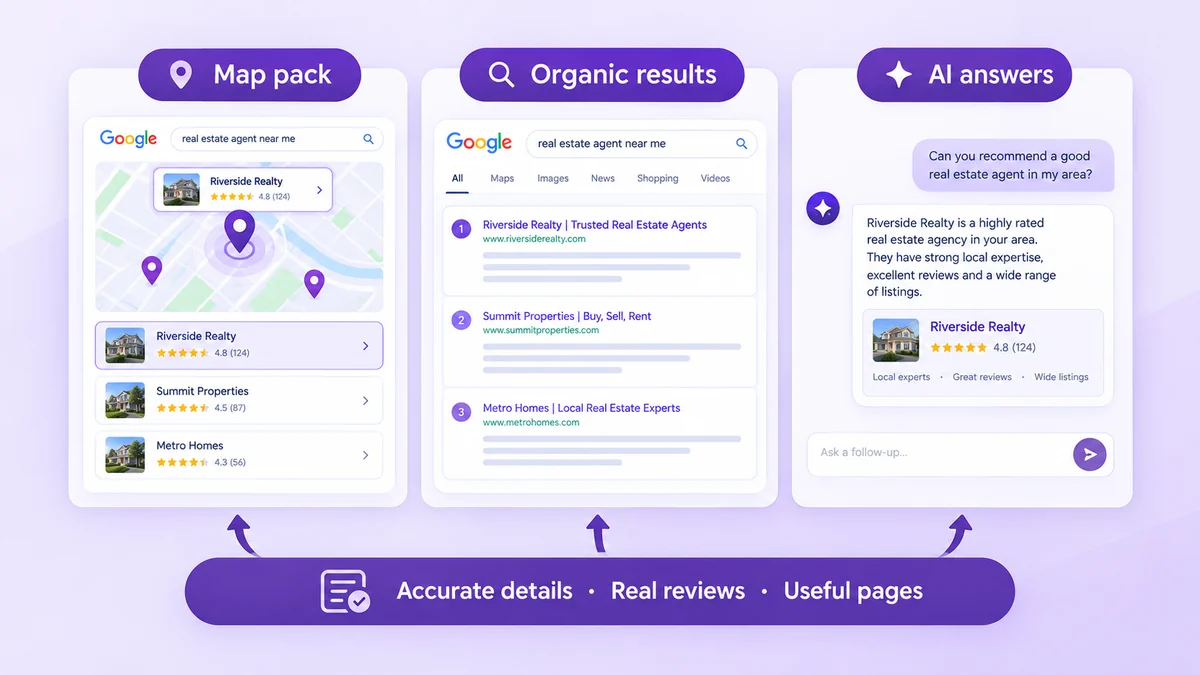
Did you know that you compete on three surfaces:
- The map pack (relevance, distance, and prominence),
- Organic results (useful, authoritative pages),
- AI answers (sources a model retrieves and trusts).
As Google says, its AI features run on its core ranking systems and need no special markup,[7] so one foundation should serve all three: accurate details, real reviews, and pages with substance.
Hence, local SEO for real estate means making sure that when someone in your market searches for an agent, a neighborhood, or a home, Google, Maps, and now AI tools find you, trust you, and show you. It comes down to four things: a correctly set-up profile, steady reviews, pages that say something specific, and measurable proof.
It differs from regular SEO because it adds a business profile, reviews, and consistent listings, and because your most valuable pages describe places rather than products.
That is also why SEO for a real estate agent differs from SEO for a typical business. Your product is you, your brokerage may share your name and address, and your most valuable pages describe places rather than services. The next sections follow that reality.
How should a real estate agent set up a Google Business Profile when a brokerage is involved?
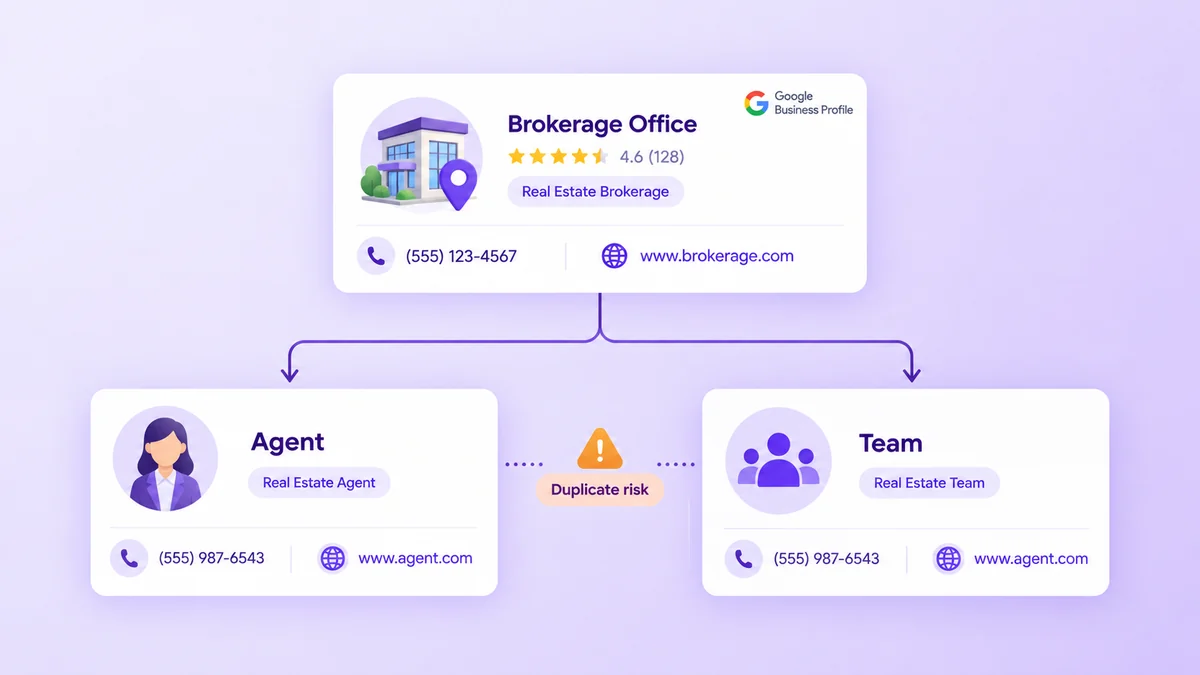
Hold a Google Business Profile you control, separate from the brokerage’s office listing, with an eligible address and the same name, phone and website everywhere you appear. Google allows individual practitioner listings in real estate,[1] but a profile that looks like a duplicate of the office listing can be filtered out, so decide which entity you want to rank before editing anything. The right setup depends on your situation:
| Your situation | A sensible setup | Where it goes wrong |
|---|---|---|
| Solo agent at a brokerage | Your own practitioner profile, separate from the office profile | Same address and phone as the office, so the two look like duplicates |
| Home-based agent | A service-area profile with your address hidden, if you serve clients at their location | PO boxes, virtual offices or borrowed addresses, which Google's guidelines don't allow[4] |
| Team | One team profile, plus member profiles only for real practitioners | Every member listing the same address and number |
| Moving brokerages | Update your name, site and every listing in the same week | The old brokerage name lingering on portals and directories for months |
Reviews attach to a profile, not to you personally, which is one more reason to hold a profile you control instead of leaning on an office listing. If you plan to switch brokerages, confirm how your current setup would carry over before you move.
- Consistency vs. compliance
Most guides tell you to use one exact business name everywhere.[2] That is good advice for search, but many states expect your brokerage name to appear in advertising. Check your state real estate commission’s rules first, then standardize on a format that satisfies both. This is general guidance, not legal advice.
Once the structure is settled, fill in the basics: accurate categories, services, areas served, hours, and photos, and the same name, phone, and all websites, including Zillow and Realtor.com, which have your profile.
How do real estate agents get more Google reviews without breaking the rules?
Ask every client, every time, within about a week of closing, with a direct link and no reward. A steady trickle matters more than a burst: several guides stress review velocity, though Google doesn’t publish how it weighs it.[2][11] For local SEO for realtors, reviews do two jobs: they help you appear in the map results, and they decide whether a stranger picks you once you do.
Ask within a week of closing, while the experience is fresh, and send a direct link so the client isn’t hunting for it. A message that works looks like this:
- Sample request
“Hi [Name], congratulations again on [the new home]. If you have two minutes, a Google review would help other buyers and sellers in [area] find an agent they can trust. Here’s the direct link: [link]. If you’d rather tell me what could have gone better, I’d value that too.”
Three rules keep you safe. Don’t offer a reward, because Google prohibits incentivized reviews.[5] Don’t filter who you ask, because review gating breaks platform rules.[6] And reply to every review, which shows future clients how you handle problems. To get more useful reviews, ask a specific question such as “what was the hardest part, and how did we handle it?” That draws out neighborhood and process detail without telling anyone what to write.
What makes a neighborhood page rank in local search for real estate agents?
A neighborhood page ranks when it contains what other agents’ pages don’t: your own sales data, first-hand local detail and original photos. Pages that any agent could publish unchanged risk being treated as thin, and Google’s spam policies single out pages made mainly to funnel visitors, often called doorway pages.[9] One major guide warns that real estate location pages can slip into that category.[1]
Use the swap test to decide what belongs on the page. Cover your name and ask whether another agent could publish it unchanged. If so, it carries nothing of yours. A page that passes should include:
- Your own sales: state the homes sold for against list price and how long they took from your closings, within what your brokerage and local rules allow.
- Live details: Which streets flood after heavy rain, how school boundaries really work, what HOA fees cover, and what the commute is at 8 a.m.
- Original photos of the actual streets and homes, not stock images.
- Honest drawbacks. Buyers trust a page that mentions them.
Choose neighborhoods deliberately. Start where you have closed deals, where people search, and where you can say something specific. A handful of strong pages beats thirty near-copies. Link each one to a city page and back, so the structure is clear to readers and to search engines. Writing FAQs on these pages helps visitors, but don’t expect special treatment in results, since Google reduced FAQ rich results in 2023.[8]
How do you get ChatGPT, Gemini or Google's AI answers to recommend your real estate business?
Make sure the same accurate details about you appear across your website, review profiles, portals and local coverage, then test with real prompts. Google says optimizing for its AI features is SEO,[7] but no other engine publishes a recipe, so test instead of guessing. Try prompts like these, a few times each since answers vary:
- “Best listing agent for condos in [neighborhood]”
- “Who should I hire to buy my first home in [city]?”
- “Real estate agents in [city] who work with relocating families”
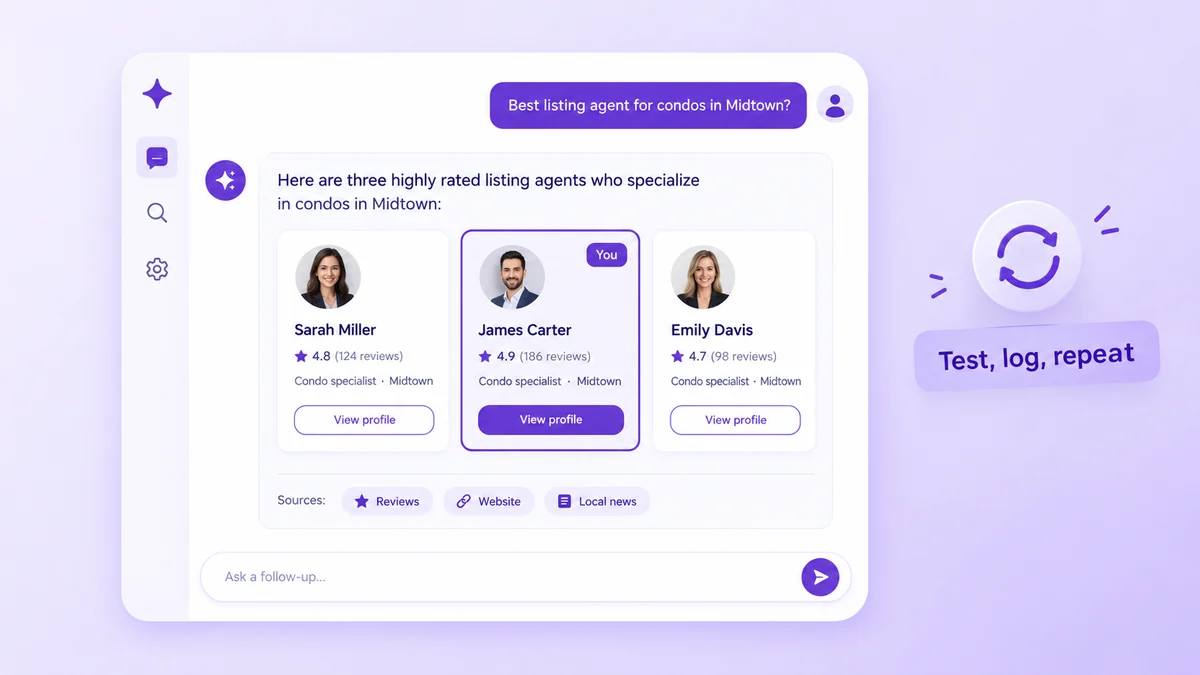
Log whether you were named, which competitors were, and which sources were cited. If you’re missing, the usual causes are thin bios, mismatched details between profiles, few reviews and no local coverage. Fixing those is ordinary local SEO, which is the point.
Which local SEO for realtors claims can you actually trust?
Trust advice that is consistent across sources, and treat exact figures about map-pack clicks or monthly calls with caution, because some of the most repeated numbers come without a source. One widely read guide gives such figures without citing where they came from,[2] and another still leans on 2020 and 2021 data.[3] What holds up everywhere: complete your profile, collect real reviews, keep details consistent, publish local pages with substance, and earn links from local organizations such as a chamber of commerce or community sponsorships.[1]
How do you measure whether real estate local SEO is working?
Track five things and compare them against your own baseline every 60 to 90 days: map visibility from several locations, profile calls and direction requests, Search Console impressions on your local pages, how new clients say they found you, and your AI prompt results. Rankings in the map results change from street to street, so check from several points in your market rather than only your office; geo-grid rank trackers exist for this.[10] No single number proves local SEO is working, but several moving together will.
Why isn't my real estate website or profile showing up in Google Maps?
Agents usually don’t appear in Google Maps because of an unverified or filtered profile, an ineligible address, weak or stale reviews, or distance from the searcher. Check these in order before changing anything else. Google doesn’t publish exact ranking weights, so treat this as a diagnostic guide, not a guarantee.
| What you see | Likely cause | What to do |
|---|---|---|
| Your profile doesn't appear at all | Not verified, suspended, or using an ineligible address[4] | Verify the profile and check the address against Google's guidelines |
| You appear only near your office | Distance is a ranking factor and your service area isn't set | Define service areas, and build local pages for areas farther away |
| The office listing shows, yours doesn't | Your practitioner profile may be filtered as a duplicate[1] | Give it its own phone, categories and a dedicated page on your site |
| Competitors with similar profiles outrank you | More recent reviews, stronger local links | Compare the top three on review count, review recency and local links, then close the gap |
| You rank in Maps but get little organic traffic | Thin neighborhood pages | Run the swap test above and add your own data |
How strong is your local SEO for real estate right now?
The short answer
Score yourself in two minutes. Tick a box only if it’s true for you today. Twelve yes/no questions across four areas give you a score, your weakest area, and the fix to start with. It’s a quick self-check, not an audit.
Local visibility scorecard for agents
New agent Solo agent, big metro Small-town agent Team lead
Score:
What should a real estate agent do in the first 90 days of local SEO?
Set up your profile and record a baseline in days 1 to 30, start the review habit and publish your first neighborhood pages in days 31 to 60, then re-measure and expand what worked in days 61 to 90. In the first month, settle your profile structure, fix listings, and record map visibility, profile calls and AI prompts. In the second, use data only you have for your first two or three pages. In the third, keep what moved and drop what didn’t. In a competitive market, treat local SEO for real estate agents as an ongoing practice, not a one-time project.
Frequently asked questions about local SEO for real estate
How many Google reviews does a real estate agent need to rank?
There is no official number. Compare yourself with the top three agents in your market and match both their review count and their recent pace, since Google doesn’t publish a threshold.
How long does local SEO take for real estate agents?
There’s no reliable universal timeline. Profile and review fixes can move map visibility within weeks; neighborhood pages usually take months. Compare against your own baseline every 60 to 90 days.
Do I need my own Google Business Profile if my brokerage has one?
Google allows individual practitioner listings for real estate agents, but they must follow its guidelines and can be filtered if they duplicate your office listing. Plan the setup first.
Is local SEO for realtors different from SEO for a real estate agent website?
Yes. Local SEO adds map visibility, reviews and business-listing consistency on top of normal website SEO.
Does schema markup help real estate local SEO?
It helps machines read your business details, but it isn’t a ranking switch. Treat it as hygiene, not strategy.

Mahendernath Pulidindi
Associate Vice President, UnoSearch
10+ Years
of Expertise
60+
Industries Served
360°
Business Growth Strategy
References
- BrightLocal. Local SEO for Real Estate (practitioner listings, local links, location pages).
- Jeff Lenney. Local SEO for Real Estate Agents: Complete Strategy Guide.
- Siteimprove. SEO for Real Estate.
- Google Business Profile Help. Guidelines for representing your business on Google.
- Google Maps Help. Prohibited and restricted content (reviews).
- BrightLocal. What is review gating?
- Google Search Central. Optimizing for generative AI features.
- Google Search Central Blog. Changes to HowTo and FAQ rich results (August 2023).
- Google Search Central. Spam policies (doorway pages).
- BrightLocal. Local Search Grid.
- Web Design Mechanic. Local SEO for Real Estate Agents.
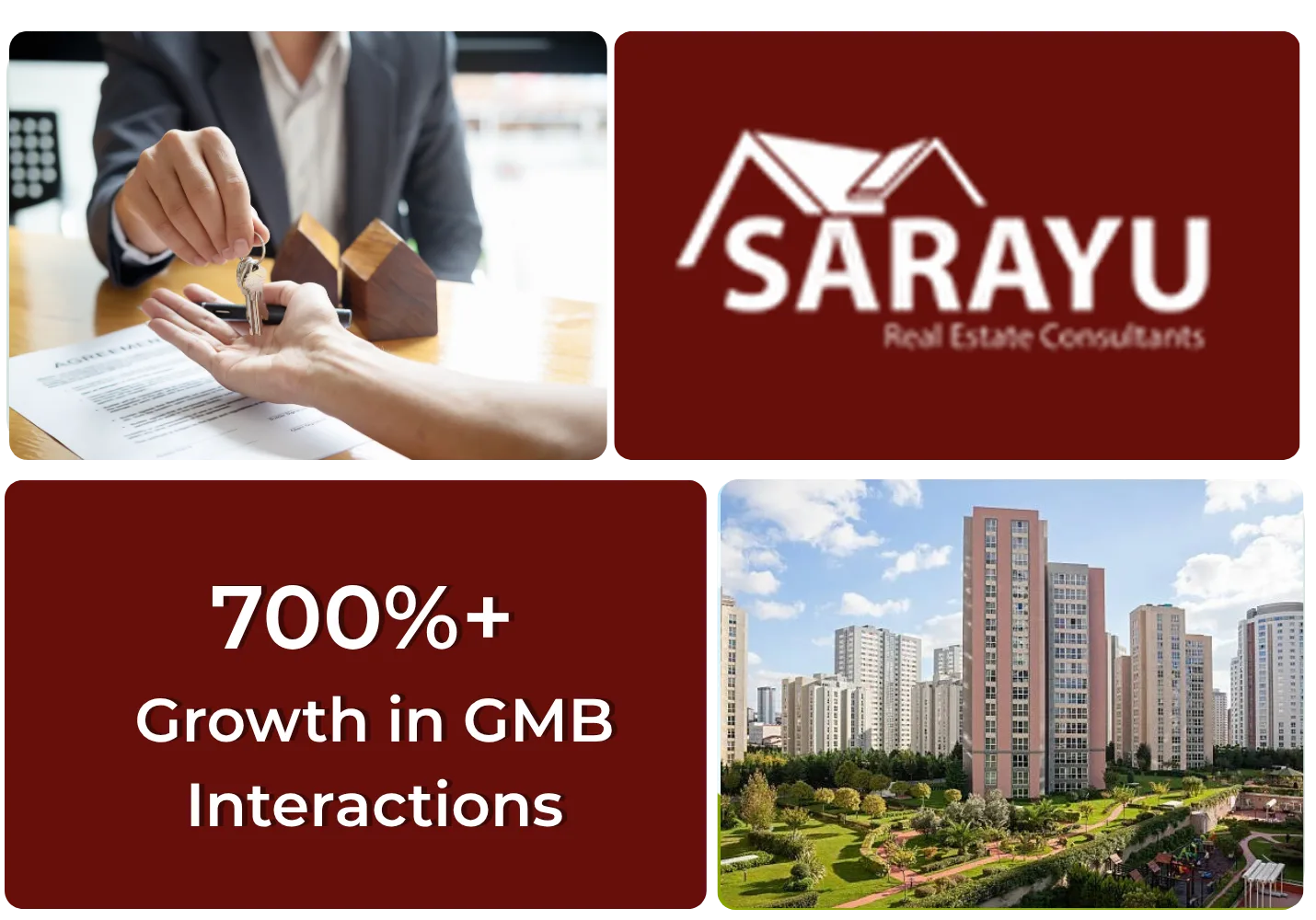
Real estate case study
How Sarayu Real Estate grew Google Business Profile interactions 700% in 40 days
700%
GBP interactions
2x
rental inquiries
5.8K
conversions