
What Is Topical Authority in AI Search in 2026?
Pankaj Srivastava
Published Date: March 11th 2026
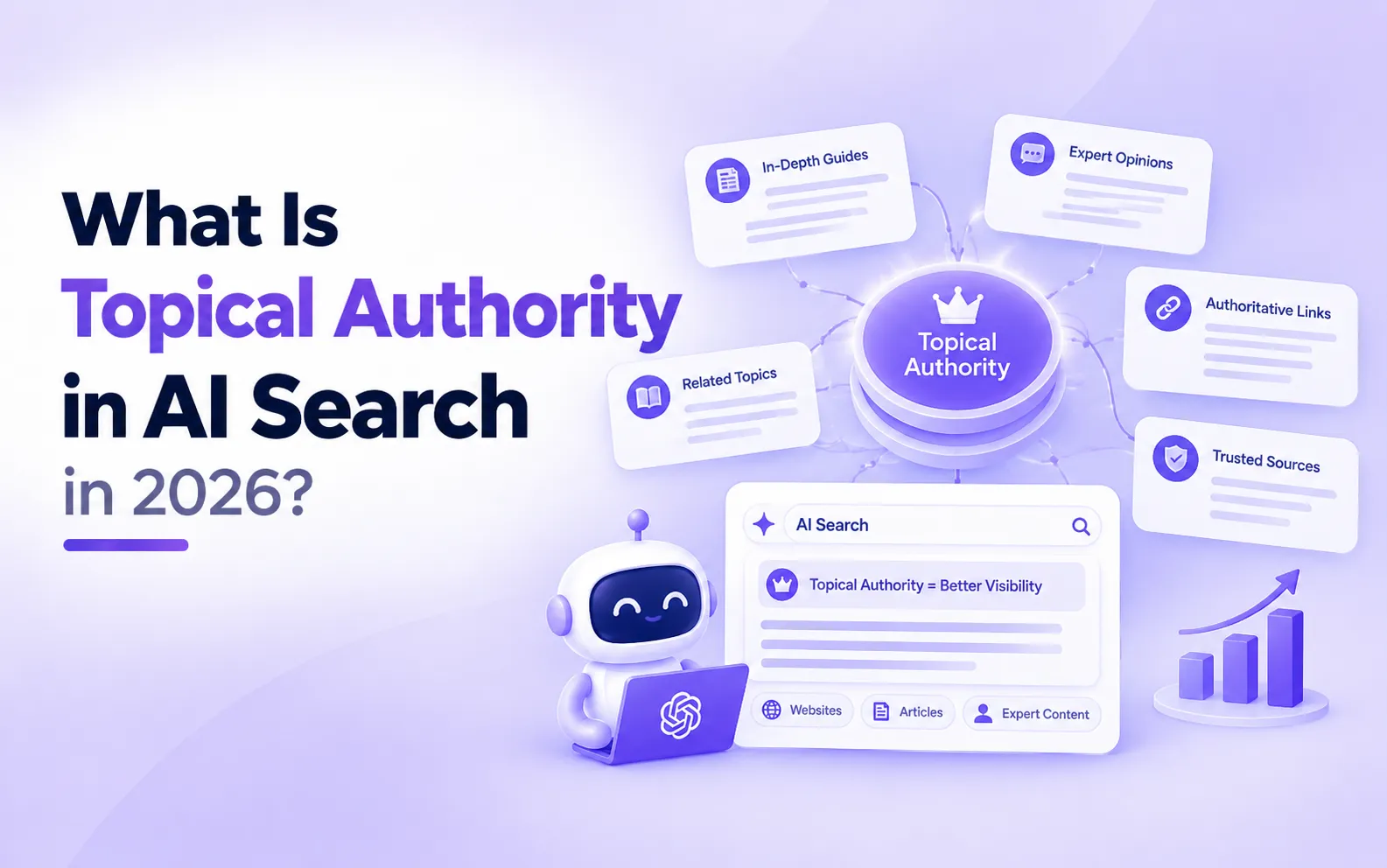
Create a stronger topical footprint with connected, authoritative content that helps AI platforms understand your expertise and confidently surface your brand.

Rajiv Ranjan
CTO, UnoSearch
Read more..
10+ Years
of Expertise
60+
Industries Served
AI-First
Technology & Innovation
Looking for an SEO agency? Talk to UnoSearch
Topical authority in AI search is the degree to which LLMs like ChatGPT, Claude, Gemini, and Perplexity recognize your domain as a comprehensive and consistent source across an entire subject area, not just one ranking page.
The definition has evolved sharply in 2026. Traditional topical authority was measured through backlinks and domain score. In AI search, it is measured through coverage depth, entity consistency, and citation frequency across a complete topic cluster. Growth Memo’s March 2026 analysis confirms that the top 10 domains in any topic capture 46% of all ChatGPT citations, while the top 30 capture 67% — a clear signal that compounding authority now shapes visibility in generative engines.
“Being number one on Google made you visible. Being the most-cited source on a topic makes you the default answer. The brands building topical depth now will be un-catchable by 2027.” — Pankaj Srivastava, Founder, UnoSearch
How AI Search Actually Measures Topical Authority in 2026
LLMs don’t score your homepage. They score your pattern of coverage across a subject. A single brilliant blog rarely beats a site with 40 connected pieces on the same theme.
Here’s what AI search evaluates when deciding if you own a topic:
- Coverage depth — does your domain answer foundational, mid-funnel, and niche sub-questions on the topic?
- Entity consistency — do you reference the same tools, frameworks, and terminology across every piece, reinforcing your semantic signature?
- Internal linking density — are related articles clustered and cross-linked so LLMs can map your topical graph?
- Third-party validation — are external sites, YouTube channels, and industry publications citing you for that topic?
- Freshness across the cluster — is every pillar and supporting article updated regularly, not just the hero page?
- Author and brand E-E-A-T — is a real expert, backed by credentials, publishing consistently in this space?
Brands with strong topical authority now receive 340% more AI-generated recommendations than domains without it.
How Long Does It Take to Build Topical Authority for LLMs?
Most brands see measurable LLM citation growth between 90 and 180 days with disciplined topical cluster execution — 12 to 20 interconnected pieces, consistent entity language, and steady third-party validation through digital PR.
At UnoSearch, we’ve seen the strongest momentum around the 120-day mark, when LLM crawlers re-index enough of the cluster to recognize topical pattern. The brands that fail usually publish scattered, disconnected content chasing random keywords. Our GEO services at UnoSearch map the full question space for your niche first, then build content pillars in a deliberate sequence: hub page, supporting articles, comparison pieces, and fresh monthly updates. That architecture is what LLMs reward.
Why Choose UnoSearch to Build Your AI Search Authority?
UnoSearch is a Google Premier Partner with 11+ years of search experience and $13.7M+ in client revenue across 60+ industries. We don’t sell one-page SEO wins. We build domain-level topical authority engineered for AI search visibility. Our in-house team maps your topic universe, deploys pillar-and-cluster architecture, engineers entity consistency, and drives third-party validation through strategic digital PR. Every AI SEO engagement is tracked through our proprietary DigiOps platform, so you see citation growth in real time. Founders sit inside every client channel — no outsourcing, no middlemen, no vanity metrics.
📞 Call Now: +91 8976406245
FAQ's
1. Is topical authority the same as domain authority in AI search?
No. Domain authority is a Moz/Ahrefs backlink-based score. Topical authority is coverage-based — it measures how comprehensively and consistently your domain covers a specific subject area that LLMs recognize.
2. Can a small website build topical authority faster than a big one?
Yes, often. A focused site covering one niche deeply can outrank a large generalist domain because LLMs reward specialized coverage patterns over sheer size, especially for mid-tail and long-tail queries.
3. Do backlinks still matter for topical authority in AI search?
Yes, but with a twist. Semantic proximity now outweighs raw domain score — links from topically relevant sites carry far more weight than generic high-DA placements that have no subject connection.
4. How many pieces of content do I need to establish topical authority?
Most successful clusters run between 12 and 25 interconnected pieces across one core topic. The mix should include one pillar page, 4–6 sub-hubs, and 10–15 supporting articles targeting specific questions.