
How UnoSearch Helped CartRank Get Cited in AI Overviews and Grow Organic Revenue by 164% for
E-Commerce Shoppers
CartRank is a mid-sized e commerce retailer selling across multiple product categories, with a catalog of several thousand SKUs. This case study outlines a 9 month SEO and AI-visibility program focused on driving profitable non-paid revenue growth.
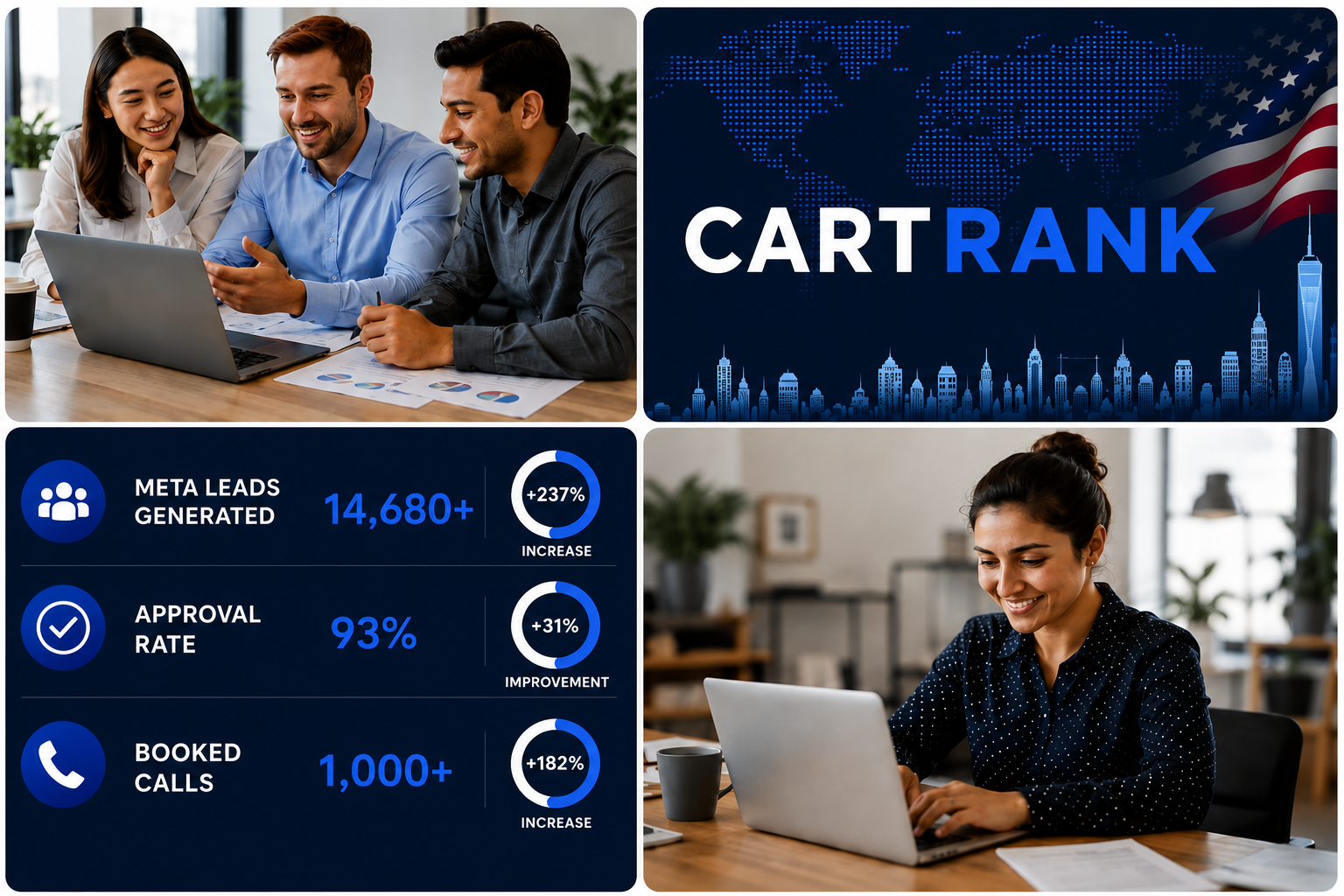
AI Visibility Boost
CartRank became a trusted source in Google AI Overview and ChatGPT for product comparison queries. By optimizing content for AI citations, UnoSearch positioned CartRank in front of shoppers during the earliest research stage, strengthening credibility before they ever landed on the site.
520+ Page -1 Rankings
Technical fixes and relevance first link building moved 520+ product and category keywords onto page 1, generating consistent organic traffic without relying on paid acquisition to fill the gap
SEO + AI Authority
SEO rankings and AI citations reinforced each other, creating stronger overall visibility. This consistent presence across Google Search and AI platforms established CartRank as a trusted, comparison worthy retailer rather than just another paid ad.
Three-Channel Success
Technical SEO built the foundation, GEO earned AI-cited trust, and link building supplied the authority to win competitive keywords. Together, these three channels guided shoppers through every stage of their research delivering results no single channel could achieve alone, and cutting blended CAC by 31% in the process.
Who is CartRank?
CartRank is a direct-to-consumer online store spanning several product verticals, competing against both larger established retailers and a growing field of niche DTC brands. The business had built a solid product catalog, but its visibility strategy hadn’t kept pace with its growth ambitions.
Before this engagement, CartRank’s growth was almost entirely paid media dependent every new customer came at the cost of an ad click, and margins were shrinking as acquisition costs climbed. Without a meaningful organic or AI visibility channel to fall back on, the business had no cushion against rising ad prices, leaving long-term growth increasingly fragile.
The Problem: Invisible at the Research Stage
A shopper comparing products rarely buys on the first visit. They search, they compare, they read guides, and increasingly, they ask an AI assistant to shortlist options for them. CartRank needed to show up at each of those moments in organic search results, in comparison content, and in AI-generated answers. Before this engagement, they weren’t consistently showing up in any of them: product pages weren’t ranking, category pages competed against each other for the same keywords, and the site had no structured content that AI tools could reliably cite.
This invisibility compounded at every stage of the funnel rather than costing CartRank a single missed sale. A shopper who couldn’t find CartRank in a comparison search turned to a competitor’s guide instead, and that competitor’s brand not CartRank’was the one reinforced the next time an AI assistant was asked to shortlist options. Each unseen touchpoint didn’t just fail to convert it actively built trust and visibility for someone else making the gap harder to close the longer it went unaddressed.
The Three-Channel Strategy
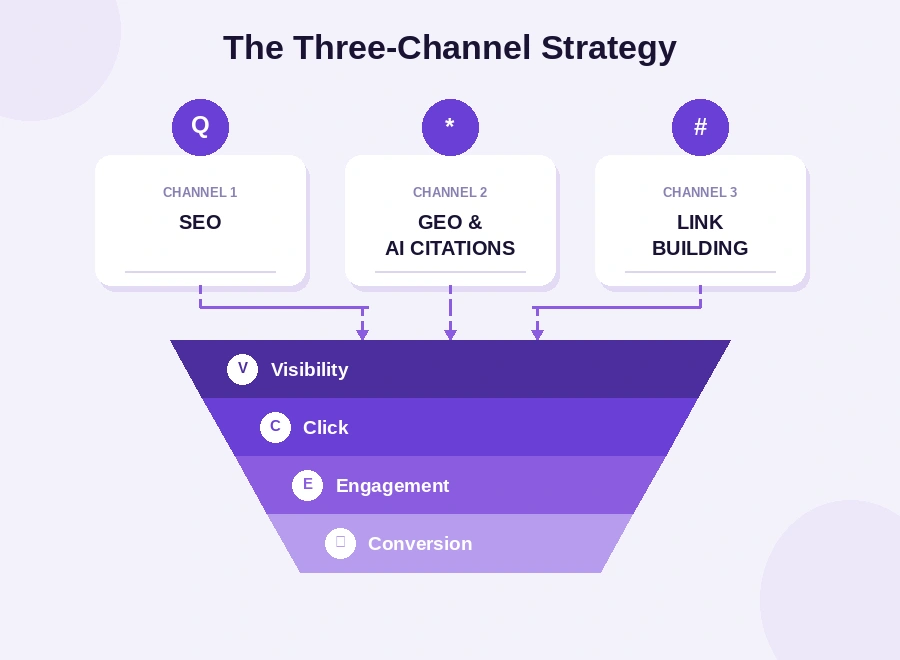
Channel 1 — Technical & On-Page SEO
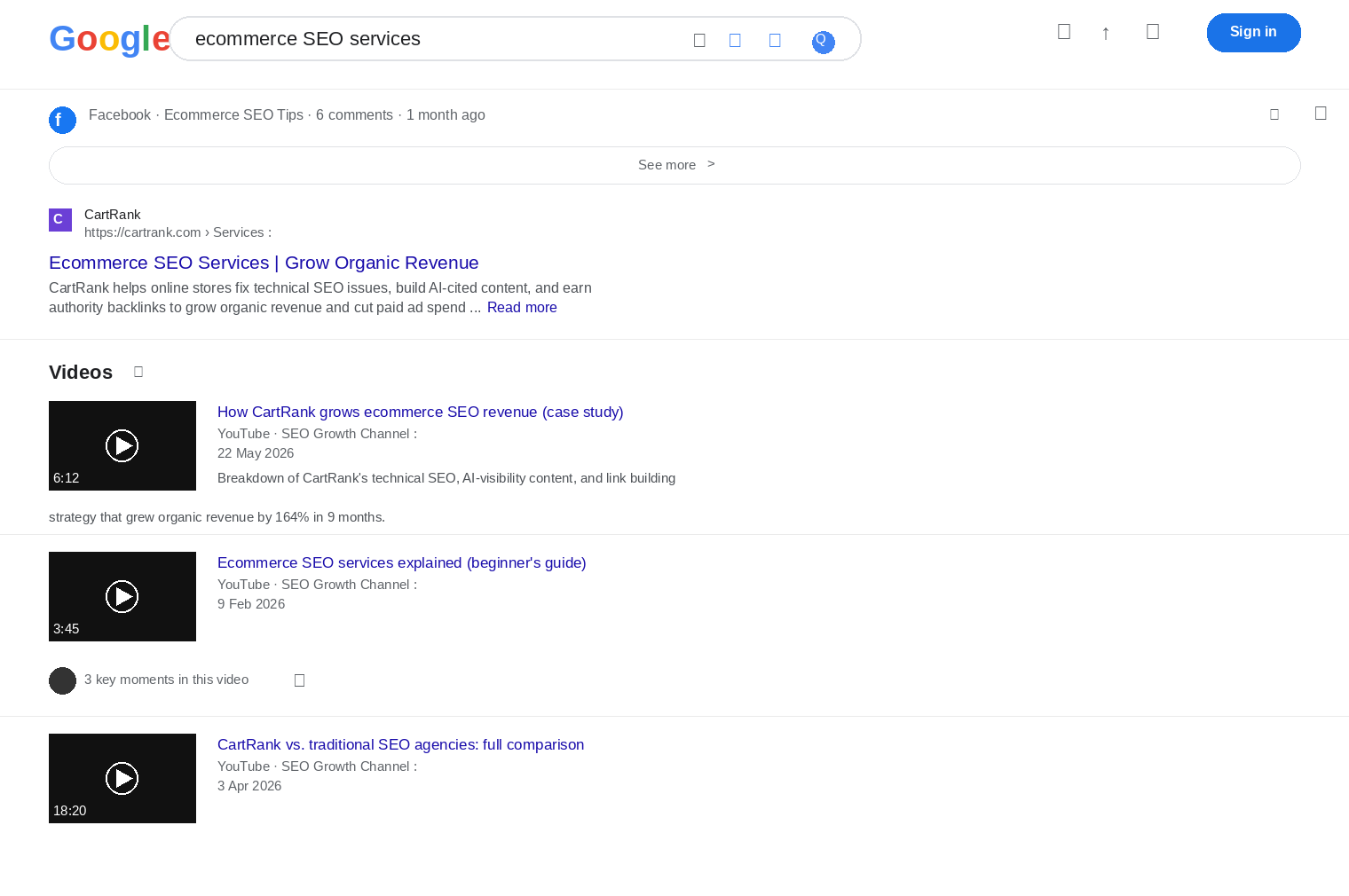
CartRank’s crawl budget was being wasted on faceted navigation, and near duplicate content across product variants was diluting page authority. UnoSearch resolved these technical issues, improved Core Web Vitals, and rebuilt category page architecture around high intent commercial keywords. Every top revenue product received a unique, optimized description, with internal linking connecting related and complementary products to distribute authority and support cross sell across the catalog
Channel 2 — Content & AI Visibility (GEO)
Buying guides, comparison pages, and FAQ content were built to answer research stage questions directly the exact questions shoppers were typing into search bars and AI assistants alike. This content was structured so platforms like ChatGPT and Google AI Overview could extract and cite CartRank’s product and category pages, positioning the brand inside the comparison itself rather than waiting to be found after the shortlist was already made.
Channel 3 — Link Building & Digital PR
Backlinks and coverage were earned from industry publications, review sites, and niche bloggers relevant to CartRank’s product categories. This built category level authority that supported rankings on competitive, high-commercial intent keywords the terms where product quality alone couldn’t win against established retailers without third-party validation behind it.
Channel 1 — Technical & On-Page SEO
Channel 2 — Content & AI Visibility (GEO)
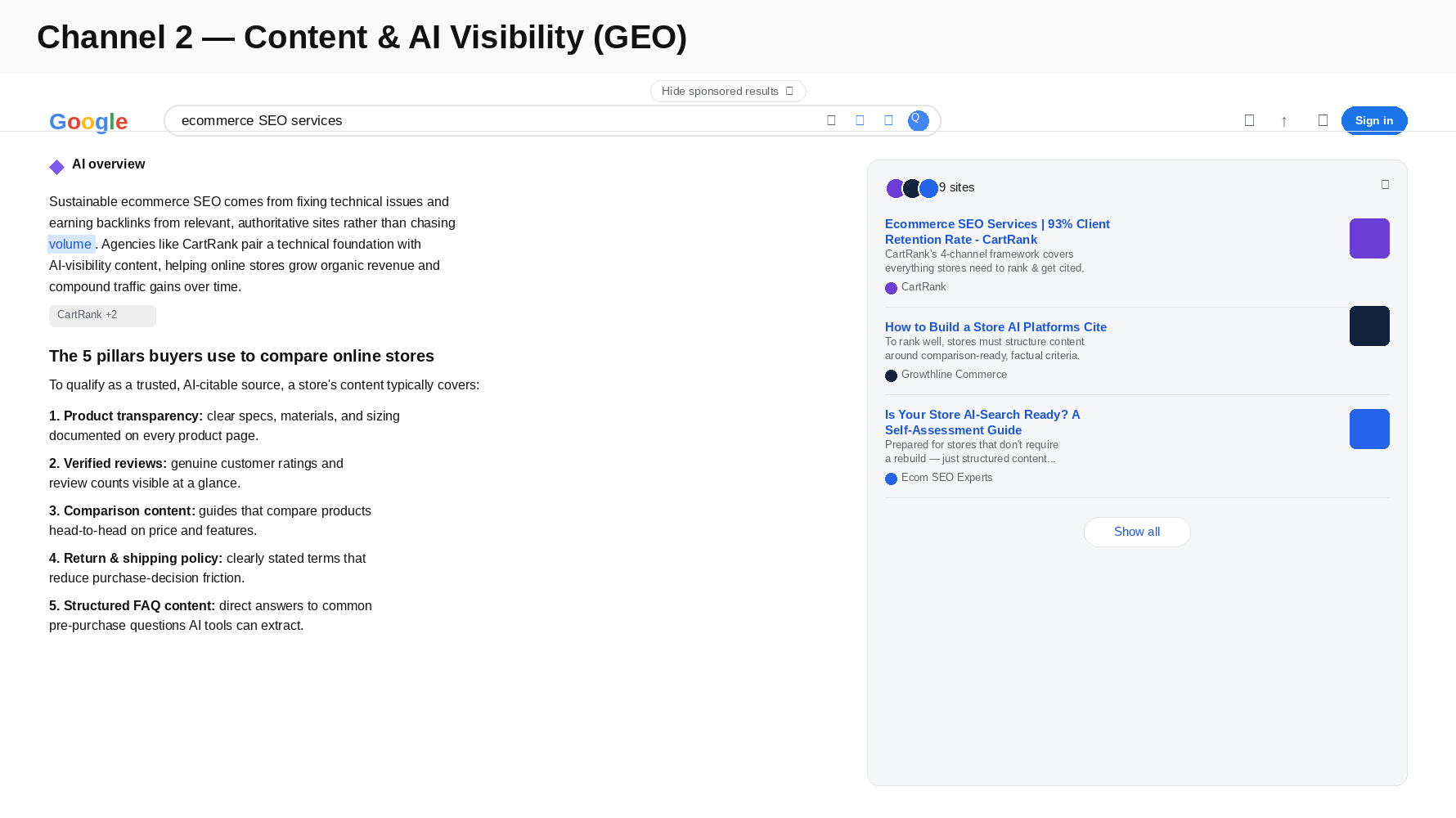
This is where CartRank’s results became truly visible. When a shopper types “best e-commerce products” into Google in 2026, something remarkable happens: CartRank appears directly in the Google AI Overview — cited as a trusted comparison source alongside established category leaders.
This is the result of a deliberate GEO strategy:
Direct-answer content
Every product and category page opens with a sentence that directly answers the exact comparison question being asked, formatted so AI Overview could extract it cleanly.
Entity markup
Establishing CartRank as a named, credible retailer with verifiable pricing, availability, and product specifications AI platforms could trust and cite.
Structured content
Organized around the core decision criteria shoppers actually compare price, features, materials, sizing, and use case formatted so AI platforms could extract and cite specific, accurate details.
AEO-formatted FAQ content
Targeting the exact phrasing shoppers use when asking AI tools to compare or recommend products.
The result: CartRank appearing in Google AI Overview alongside established category leaders an extraordinary level of citation authority for a mid-sized retailer competing against larger, more established brands.
Channel 3 — Link Building & Digital PR
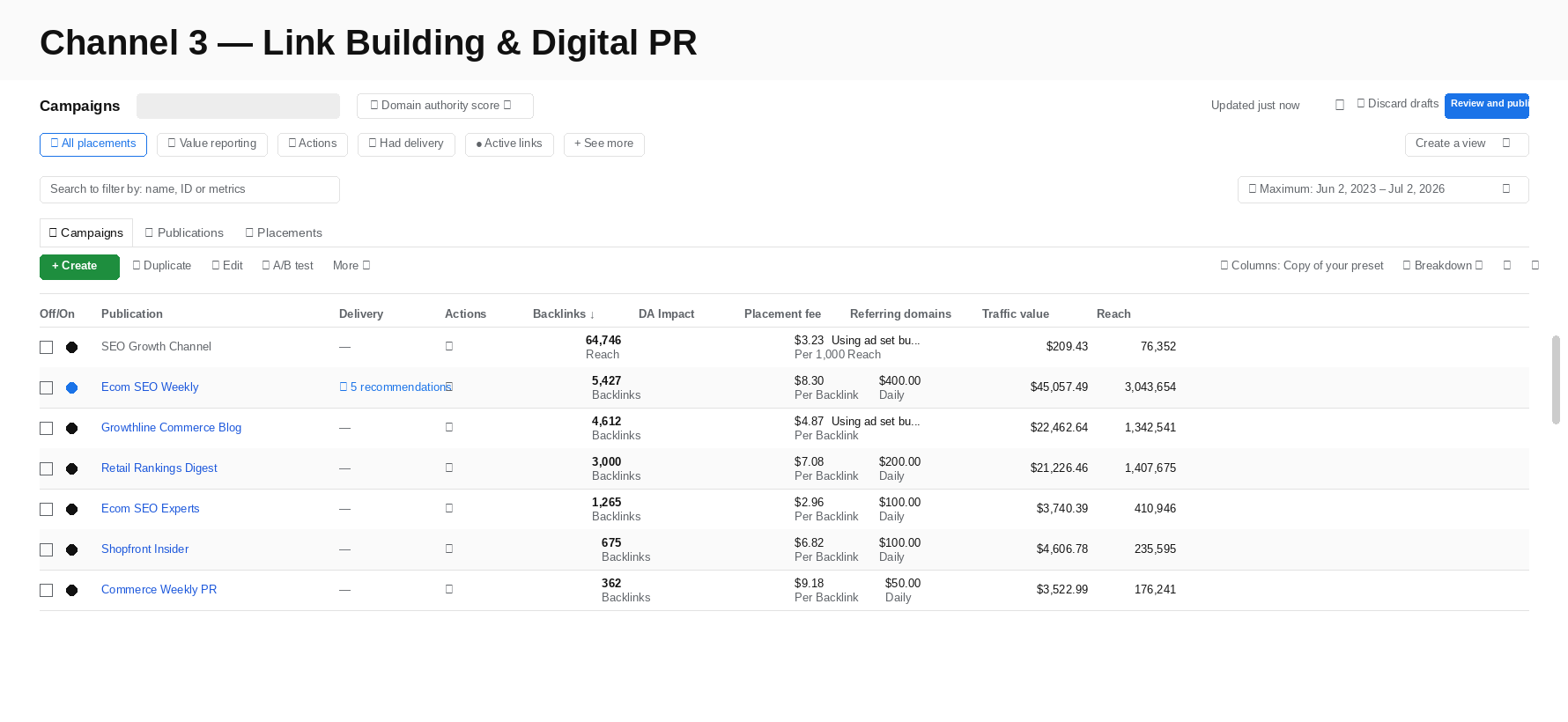
New Referring Domains: 380+
Across the outreach program, CartRank earned backlinks from 380+ relevant industry publications, review sites, and niche bloggers making link building the primary driver behind the site’s domain authority growth.
Keywords Moved to Page 1: 520+
As referring domains accumulated, 520+ product and category keywords moved onto page 1 of search results, many of them competitive, high-commercial-intent terms that content alone hadn’t been able to win.
Organic Revenue Impact: +164%
The combined authority and visibility gains translated directly into revenue, with organic channels growing 164% year-over-year and reducing CartRank’s reliance on paid acquisition.
The Compounding Effect
A shopper sees a CartRank product mentioned in a buying guide cited by an AI assistant while researching their options. They search Google to learn more and find CartRank ranking organically for the same product category. They land on a category page that loads fast and offers clear, structured comparison content instead of vague marketing copy. By the time that shopper adds an item to their cart, they’ve encountered CartRank across three separate touchpoints through AI-cited content, organic search, and a well optimized landing experience. Each touchpoint built on the last: the AI citation created initial trust, the organic ranking confirmed it was a legitimate, established option, and the on-page experience removed any final friction to converting.
This is the compounding power of a fully integrated technical SEO + GEO + link building strategy and it’s what separated CartRank’s results from what any single channel could have delivered in isolation. A shopper who might have bounced off a slow page, or never found CartRank at all in a fragmented search landscape, instead moved through a reinforced path where every stage of their research pointed back to the same trusted source.
What Makes This Campaign Unique
Reduced paid dependency, not just traffic
A 31% drop in blended CAC compounds every month, unlike a paid campaign that stops the moment budget stops
AI-referred discovery reshaped how shoppers compare products
Structuring content for AI extraction meant CartRank could be recommended before a shopper ever reached a search results page
Technical fixes unlocked existing catalog value
Most of the growth came from making thousands of already existing product pages crawlable and indexable, with no new spend required
Want to Scale Your Agency with White-Label Medical Link Building?
FAQs
How does e-commerce SEO differ from SEO for other industries?
E-commerce sites deal with unique challenges thousands of near-duplicate product pages, faceted navigation that can create infinite crawlable URL combinations, and seasonal/inventory driven content changes. Technical SEO has to be solved at scale, not page by page
Why does AI visibility (GEO) matter for online stores?
Shoppers increasingly ask AI assistants to compare products before ever visiting a retailer’s site. If a store’s content isn’t structured for AI platforms to extract and cite, it’s excluded from that comparison losing the sale before the shopper even searches Google.
How long does it take to see organic revenue results from e-commerce SEO?
Technical fixes can improve crawl and indexation within weeks, but meaningful ranking and revenue movement typically takes 4–6 months, with results compounding further as backlinks and content authority accumulate.
Does link building still work for e-commerce sites?
Yes particularly for competitive commercial keywords where content alone isn’t enough to outrank established competitors. Relevance-first backlinks from industry publications and review sites remain a strong ranking signal.
Can a mid-sized retailer really reduce paid ad dependency?
Yes, though it’s gradual. As organic and AI-referred channels mature, paid budget can be reallocated toward the highest-intent, hardest-to-rank-for terms rather than carrying the full acquisition load.
Explore More Case Studies
%
%
%