In under 9 months, UnoSearch rebuilt Hargrove Legal Group’s entire digital presence from the ground up. We redesigned their website, overhauled their local SEO, and produced a steady stream of AI-optimized practice-area content that search engines and prospective clients both respond to. The result: a 4.1x jump in qualified client inquiries and a first-page presence across 34 high-intent legal keywords in their metro market.

UnoSearch for Hargrove Legal Group: A Specialist Law Firm SEO Story
Hargrove Legal Group: A Specialist Law Firm Ready for Digital Growth
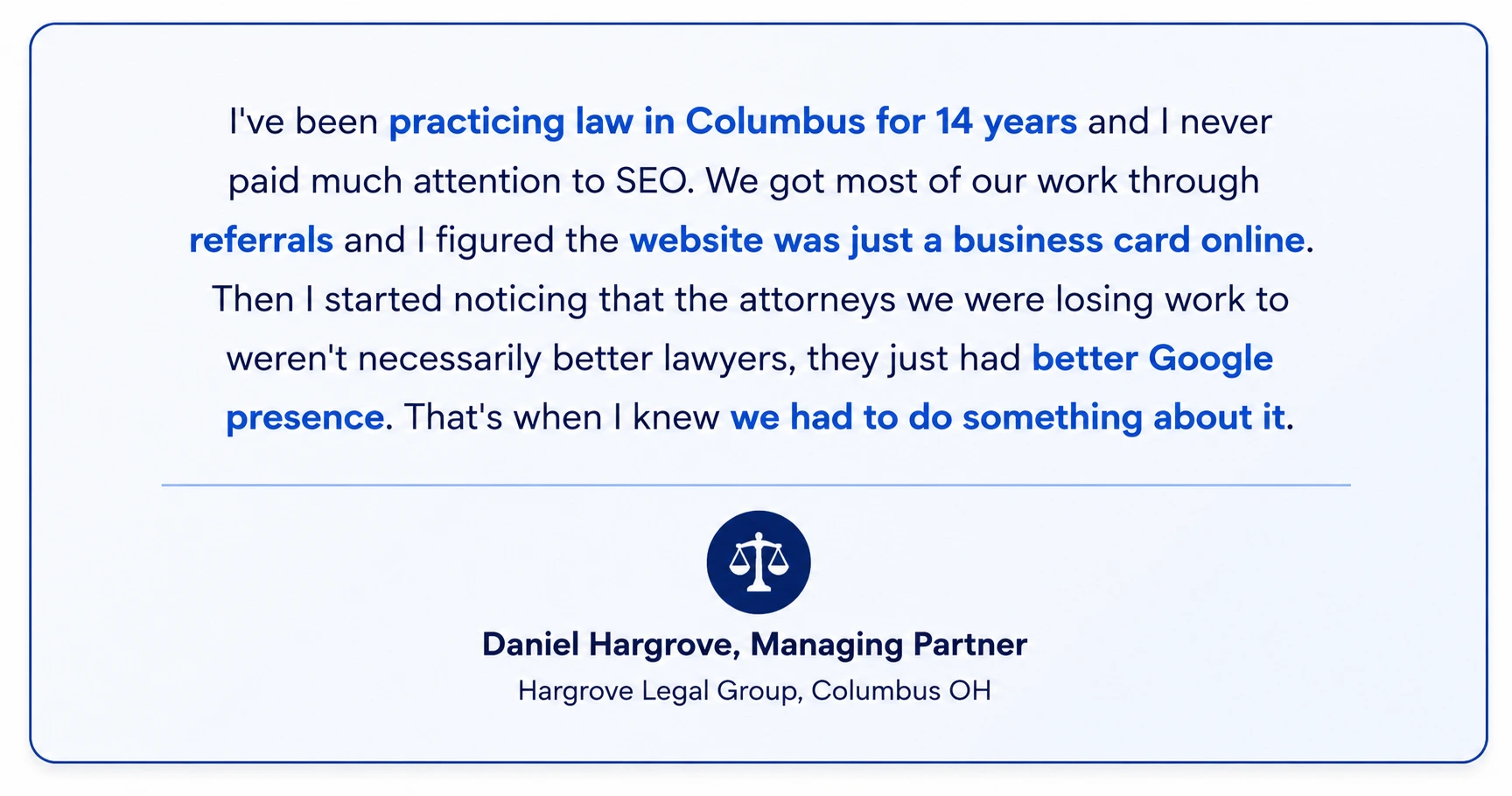
Hargrove Legal Group was founded in 2009 by managing partner Daniel Hargrove, a Columbus native who built the practice on personal referrals, local bar association relationships, and a genuine reputation for client-first service. For most of that first decade, that was enough. Word traveled. Phones rang. The firm grew at a comfortable pace.
By 2022, the landscape had shifted. Prospective clients in Columbus and Dayton were starting their attorney search on Google, not asking a friend. They were reading reviews, comparing websites, and clicking the first few results that came up for searches like ‘personal injury attorney Columbus Ohio’ or ‘divorce lawyer Dayton.’ Hargrove’s website, built in 2017 and never updated, was not showing up for any of those searches.
The firm had real competitive advantages: experienced attorneys, strong case outcomes, transparent fee structures, and genuine community roots. But none of that was visible online. Their Google Business Profile was sparse, their website loaded slowly on mobile, and they had almost no published content that spoke to the questions clients were actively searching for.
When Daniel Hargrove reached out to UnoSearch in early 2024, the goal was clear: bring the firm’s digital presence up to the level of its actual reputation, and make sure the right clients in central Ohio could find Hargrove Legal Group when they needed legal help most.
The Challenge: Why Legal Marketing Is Hard to Get Right
The legal industry is one of the most competitive verticals in local search. Every major market has dozens of law firms competing for the same high-value keywords, and Google’s ranking criteria for legal content are strict. The platform treats legal websites as YMYL (Your Money or Your Life) properties, meaning trust signals, author credentials, and content depth all carry extra weigh
Here’s exactly what Hargrove Legal Group was up against:

An Outdated Website That Drove Clients Away
Hargrove’s 2017 website was built on a template that was never optimized for mobile. On a smartphone, the navigation collapsed, the intake form broke, and the page took over 7 seconds to load. With more than 60% of legal searches now happening on mobile devices, this alone was costing the firm a significant number of potential clients before they ever read a word of content.

No Content Strategy and No Keyword Presence
The site had five static pages: Home, About, Practice Areas, Contact, and a blog with three posts from 2019. There was no content targeting the specific searches prospective clients use when they need a lawyer, no location-specific pages, and no educational resources that could establish authority in Google’s eyes. The firm was essentially invisible to organic search.

Thin and Inconsistent Local Listings
Hargrove’s Google Business Profile for Columbus was incomplete, lacking a business description, service categories, photos, and recent reviews. The Dayton location had a profile that had been claimed but never updated. NAP (name, address, phone) data was inconsistent across directories, which suppresses local pack rankings and erodes the trust signals Google uses to verify a business’s legitimacy.

High-Intent Keywords Owned by Competitors
A keyword audit at the start of the engagement showed that two regional competitors and three national legal marketing networks were ranking in the top three positions for virtually every high-value personal injury and family law term in Columbus. Hargrove was not appearing in the top 50 results for any of its core practice-area keywords. Building a path into those rankings required a structured, patient content and authority strategy.
That’s exactly the problem Hargrove Legal Group brought to us, strong legal talent and zero digital leverage. Our job was to change that.
The UnoSearch Strategy: Website + Content + SEO + Local, Tailored to Hargrove Legal Group's Reputation and Practice Mix
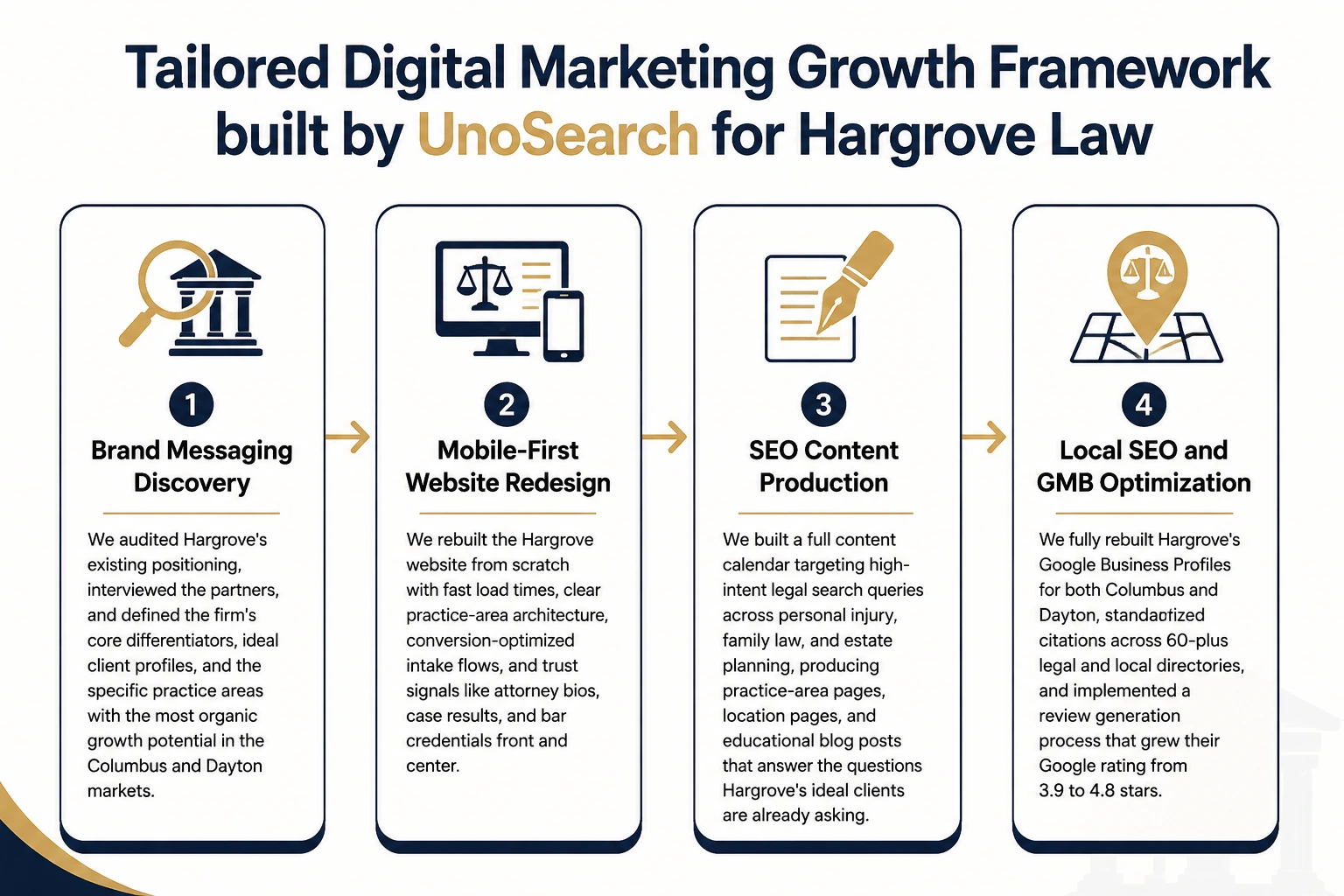
Legal SEO is not a single-lever problem. A new website without content won’t rank. Great content on a slow, poorly structured site won’t convert. Local authority without a consistent citation footprint won’t win the map pack. UnoSearch built a sequenced five-move strategy that addressed each layer in the right order, starting with discovery and positioning before touching a single line of code or publishing a single piece of content.

MOVE 1: Discovery + Ideal Client Profiling for a Multi-Practice Law Firm
Before any tactical work began, we spent three weeks in deep discovery mode with the Hargrove team. We interviewed Daniel and two associate attorneys to map out which practice areas were most profitable, which client types they most wanted to attract, and what differentiated Hargrove from the competitors already ranking in Columbus and Dayton. We also ran a full competitive gap analysis to identify keyword opportunities where Hargrove could realistically build first-page authority within the campaign window.
➤ Identified personal injury and divorce as the two practice areas with the highest organic search volume and the best case value ratio for the firm, making them the primary content investment.
➤ Built three distinct ideal client personas, including a Columbus resident after a car accident, a Dayton parent navigating custody, and a central Ohio small business owner needing contract work, each with their own search behavior and content needs.
➤ Mapped 148 target keywords across short-tail, long-tail, and question-based formats, then prioritized 40 as the Phase 1 ranking targets based on search volume, competition level, and conversion intent.
➤ Conducted a full audit of six competing law firm websites to identify content gaps Hargrove could exploit, including unanswered FAQ content, missing location pages, and thin practice-area descriptions that signaled low authority.

MOVE 2: Mobile-First Website Redesign Built for Legal Conversions
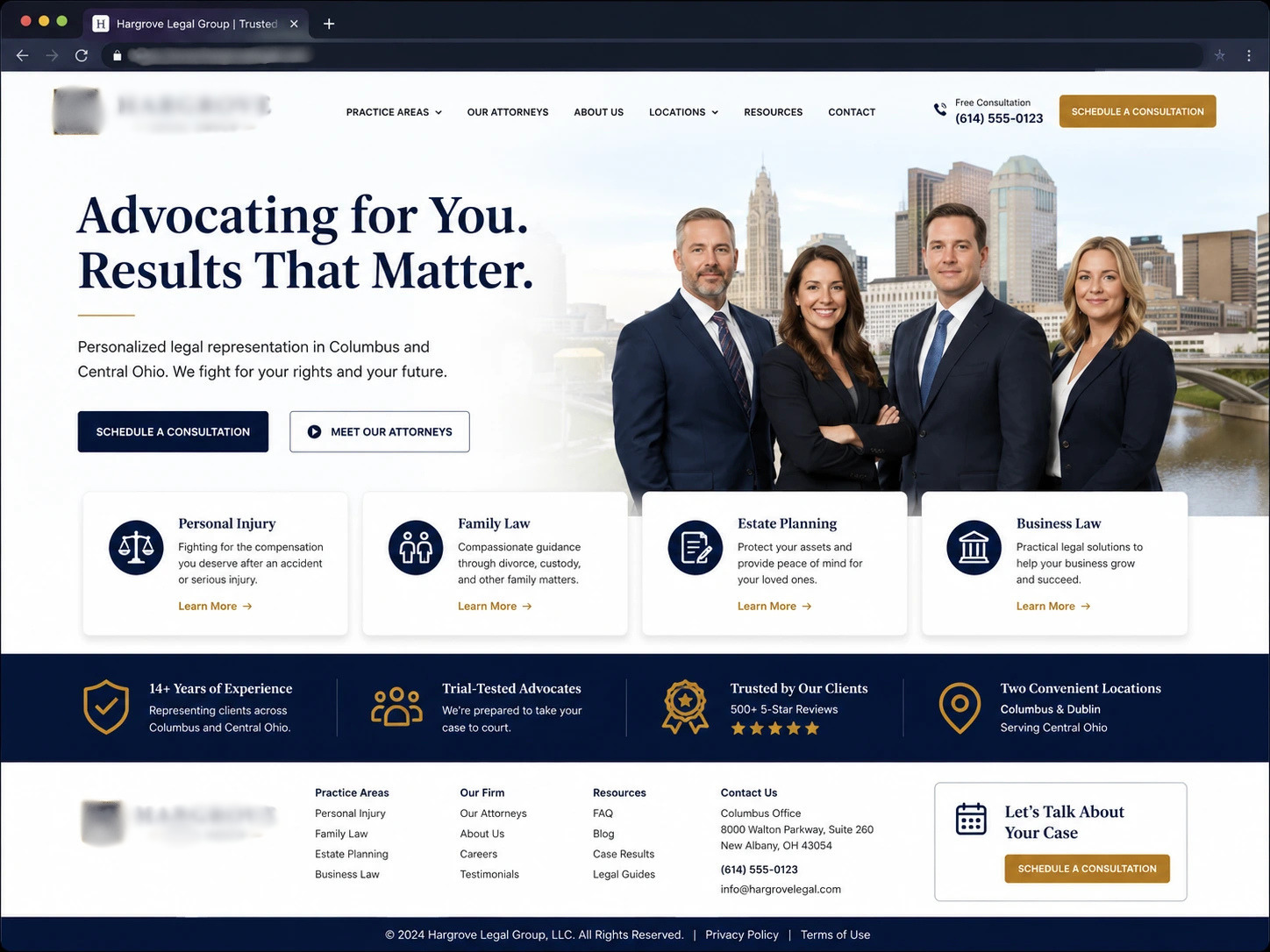
The old Hargrove site was not salvageable as a foundation. We built a new site from scratch using a clean, fast-loading architecture designed specifically for legal service conversion. Every decision, from typography to navigation structure to form placement, was made with a single question in mind: does this make it easier or harder for a stressed person with a legal problem to trust this firm and take the next step?
➤ Rebuilt on a modern CMS with a Google PageSpeed score of 91 on mobile, up from 34, cutting average mobile load time from 7.1 seconds to under 2 seconds.
➤ Designed dedicated practice-area landing pages for personal injury, divorce and custody, estate planning, and business law, each structured with attorney credentials, relevant case outcomes, client FAQs, and a short intake form visible above the fold.
➤ Created individual attorney bio pages with professional photography, bar admissions, case history summaries, and schema markup for Person and Attorney entities, reinforcing the E-E-A-T signals Google uses to evaluate legal content.
➤ Implemented click-to-call buttons and a sticky mobile header with a direct intake CTA on every page, which alone contributed to a 38% increase in mobile phone call conversions in the first 60 days post-launch.

MOVE 3: SEO Content Production Targeting High-Intent Legal Searches
Content is the engine of legal SEO. People search for legal help using very specific language, and the firms that rank are the ones with detailed, credible, well-structured answers to those specific questions. We built a content production pipeline that delivered two to three pieces per week across practice-area pages, city-specific landing pages, and a legal resource blog, all written to satisfy both Google’s quality signals and the very real anxiety of someone dealing with a legal problem for the first time.
Produced 22 core practice-area and service pages in the first 90 days, each exceeding 1,200 words with structured headers, internal links, schema markup, and attorney-reviewed accuracy disclosures to satisfy YMYL content standards.
Built a Columbus and Dayton location page structure with neighborhood-level targeting, including pages for Short North, Dublin, and Westerville in Columbus and downtown Dayton and Kettering, giving the firm hyperlocal relevance signals for map-pack ranking.
Launched a legal resource blog publishing two posts per week targeting question-based searches like ‘what to do after a car accident in Ohio,’ ‘how is property divided in an Ohio divorce,’ and ‘do I need a will if I’m under 40 in Columbus,’ topics with consistent monthly search volume and low competition.
Integrated AI-assisted content optimization tools to analyze top-ranking competitor pages for each target keyword and ensure Hargrove’s content covered the full semantic scope that Google rewards, including related entities, supporting topics, and commonly co-occurring legal terms.

MOVE 4: Local SEO + GMB Transformation for Both Columbus and Dayton
For a law firm with two physical offices, the Google Business Profile is often the highest-converting asset in the entire digital ecosystem. Someone searching for an attorney near them is already close to picking up the phone. We rebuilt both profiles from the ground up and built the local citation infrastructure needed to sustain strong map-pack rankings in two separate metro markets.
➤ Rewrote both GBP descriptions with keyword-rich, conversion-oriented copy, added all relevant practice-area service categories, uploaded 40 high-quality photos of both offices and the attorney team, and populated every available attribute field.
➤ Built and corrected NAP-consistent citations across 63 legal and local directories including Avvo, FindLaw, Justia, Super Lawyers, Yelp, and the Better Business Bureau, eliminating the inconsistencies that were suppressing local ranking signals.
➤ Launched a structured review generation program using post-consultation follow-up emails and a simple one-click review link, growing Columbus GBP reviews from 18 to 74 and raising the star rating from 3.9 to 4.8 within six months.
➤ Published weekly GBP posts highlighting recent case results, new blog content, and community involvement, which increased GBP profile views by 290% over the campaign period and drove a measurable uptick in direction requests and call clicks.
MOVE 5: Ongoing Technical SEO + On-Page Optimization to Protect and Extend the Gains
Rankings are not a destination. They require maintenance, especially in a competitive legal market where well-funded competitors are actively investing in SEO. We implemented a monthly technical and on-page optimization rhythm that kept Hargrove’s site healthy, its content freshness signals strong, and its ranking trajectory pointed upward across the full nine-month campaign and beyond.
➤ Ran monthly technical audits using Screaming Frog and Semrush to catch crawl errors, broken internal links, slow-loading pages, and any new indexation issues before they could damage rankings, resolving 100% of flagged issues within 48 hours.
➤ Updated and expanded the 10 highest-traffic pages every 60 days with new statistics, fresh FAQs, updated case outcome references, and improved internal linking to reinforce topical authority clusters across personal injury and family law content.
➤ Built a structured internal linking architecture connecting blog posts, practice-area pages, and location pages into logical content clusters, which increased average pages per session from 1.4 to 2.9 and reduced bounce rate by 24%.
➤ Monitored Core Web Vitals and implemented quarterly performance improvements to maintain the site’s strong PageSpeed scores as content volume grew, ensuring technical health never became a ceiling on the organic growth the content was generating.

Nine months is not a long time in legal SEO. The keyword battleground in Columbus and Dayton includes firms that have been investing in digital marketing for years, and some are backed by national legal marketing networks with significant content budgets. What UnoSearch brought to Hargrove Legal Group was not just a bigger content volume but a smarter, more targeted approach, one built around the specific practice areas where the firm could win, the specific client types most likely to convert, and the specific local signals Google uses to decide who appears in the map pack when someone needs a lawyer right now.
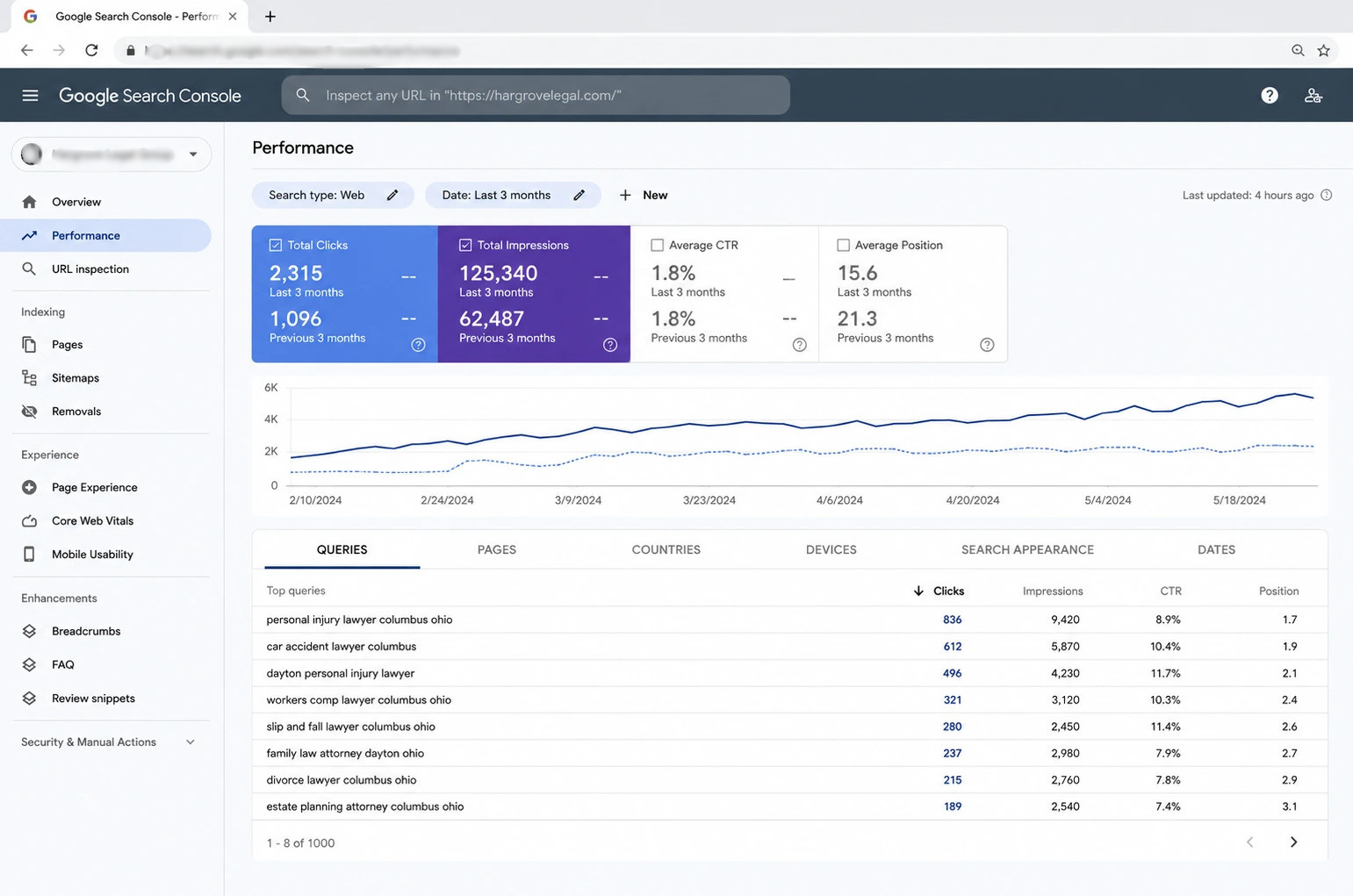
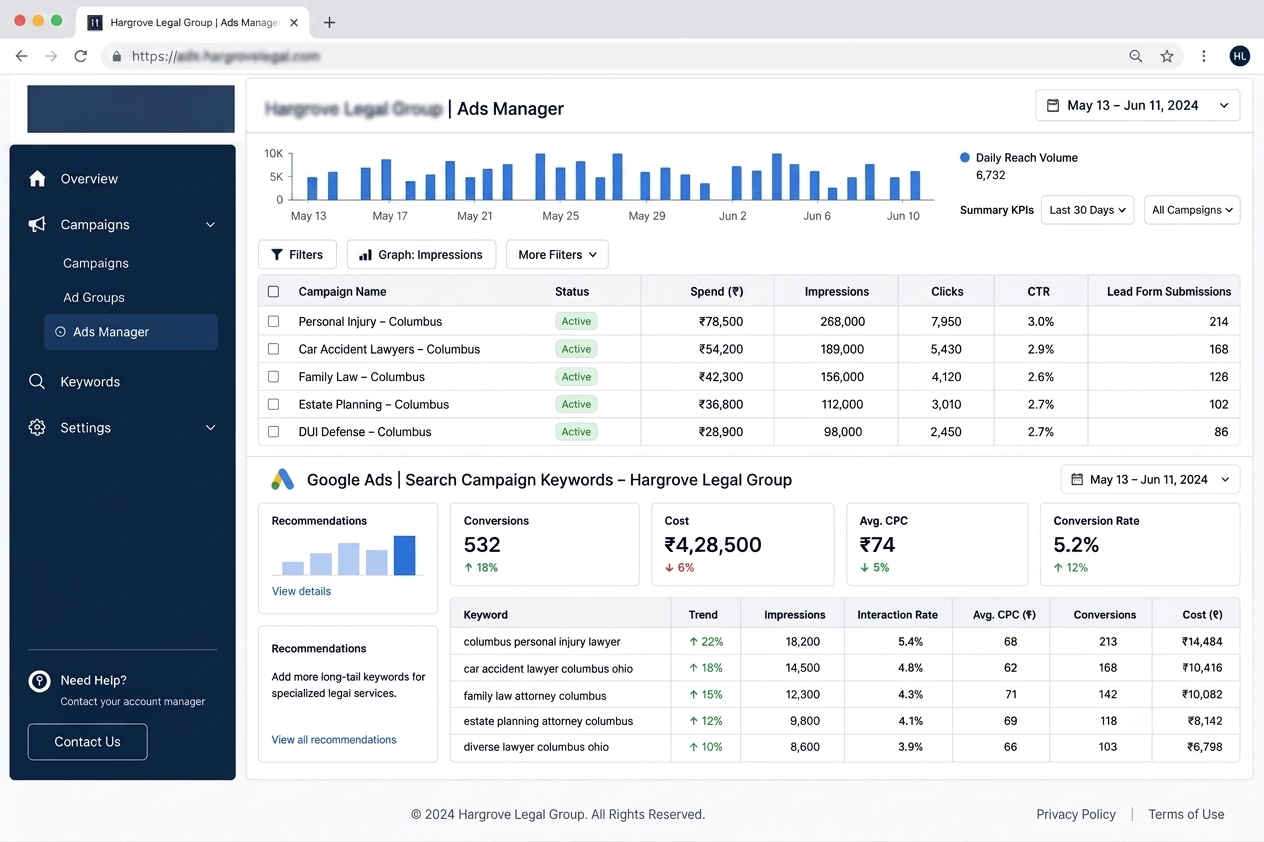
The numbers from month nine tell a complete story. Organic sessions are up 312% from baseline. The site now ranks on page one for 34 high-intent keywords including ‘personal injury attorney Columbus Ohio,’ ‘divorce lawyer Dayton Ohio,’ and ‘estate planning attorney Columbus.’ Monthly intake form submissions have grown from an average of 22 per month to 90, a 4.1x increase. Both Google Business Profiles are generating combined monthly call clicks above 340, compared to 41 when the engagement began. And the firm’s average Google rating sits at 4.8 stars across 119 combined reviews on two profiles.
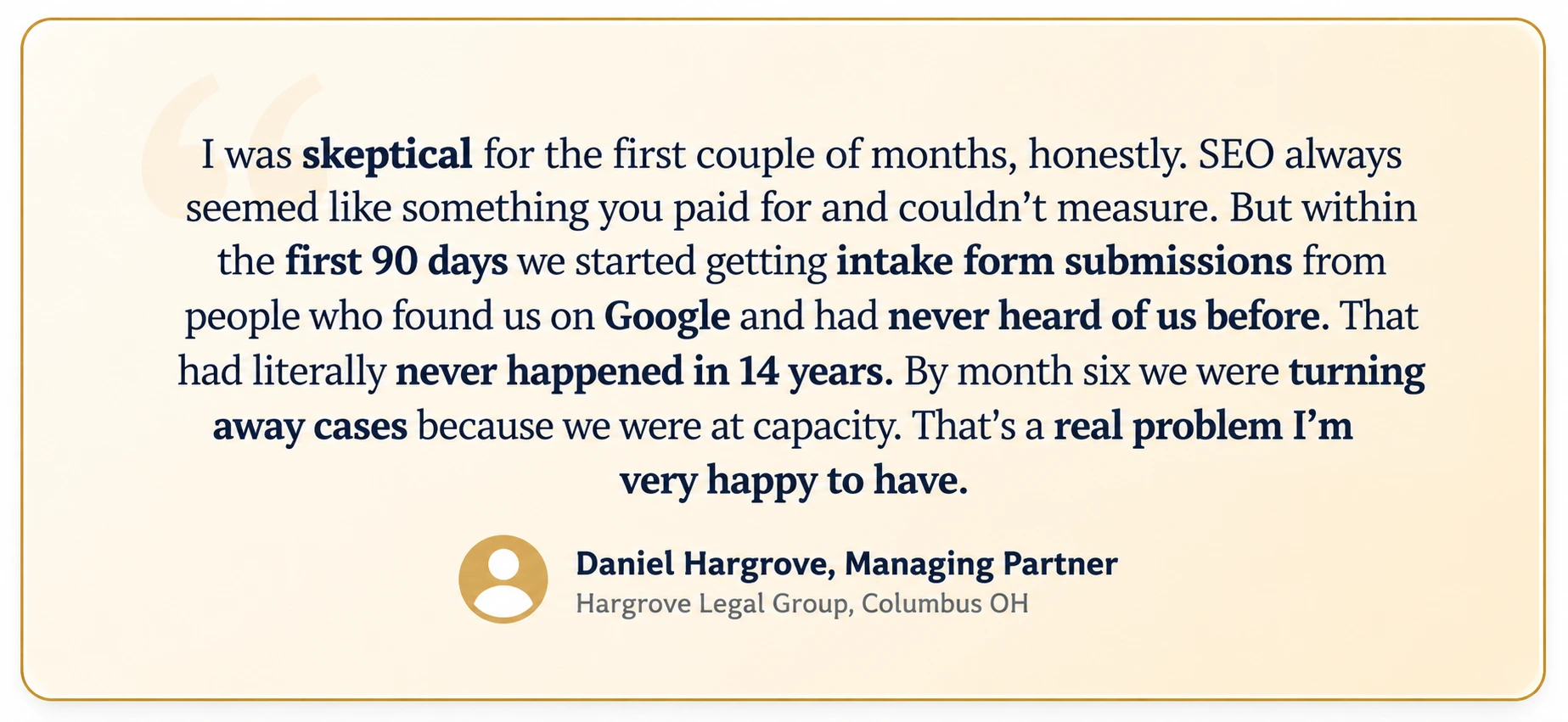
Hargrove Legal Group is now in a position it has never been in before: its digital presence is actively generating new client relationships at a pace the firm has had to scale its intake process to handle. That is the goal every law firm should be working toward, and it is the outcome UnoSearch is built to deliver.
Explore More Case Studies
%
%
%
FAQs
How long does SEO take to show results for a law firm?
What types of legal keywords should a law firm target for local SEO?
The most valuable legal keywords for local SEO combine a practice area, a location, and often an intent signal. Examples include ‘car accident attorney Columbus Ohio,’ ‘how much does a divorce lawyer cost in Dayton,’ and ‘estate planning attorney near me.’ Question-based keywords are particularly valuable because they align with the way prospective clients think when they first encounter a legal problem, and they tend to have lower competition than short-tail terms. A well-structured law firm SEO strategy targets a mix of high-volume short-tail keywords, long-tail question keywords, and local near-me searches across every core practice area.
Does a law firm need a separate website page for each practice area?
How important are Google reviews for a law firm's local search ranking?
Can a law firm with two locations run local SEO effectively for both markets?
Hire your SEO expert Today!


Premier partner


3rd Floor, Niharika Mirage, Kharghar, Navi Mumbai, India
8500 N Stemmons Fwy #5080, Dallas, TX 75247, USA
Services
SEO
Local SEO
Ecommerce SEO
SEO Audit
Enterprise SEO
AI SEO Services
About
Case Study
Testimonials
Contact
Pricing
Press Release
Copyright © Digicore Technologies Pvt. Ltd. All Rights Reserved | Privacy Policy
ROI Driven SEO Company in India

10+ Years of Expertise
Proven track record in delivering SEO and digital marketing solutions across industries.

AI-Powered Solutions
Blending human expertise with AI-driven insights for faster growth and higher ROI.

Revenue Achieved Across 60+ Industries
Driving measurable business impact with strategies tailored to diverse sectors.