
From Zero AI Citations to 22: How UnoSearch Made Solnfield Organic Supply Co. the Supplier ChatGPT Recommends
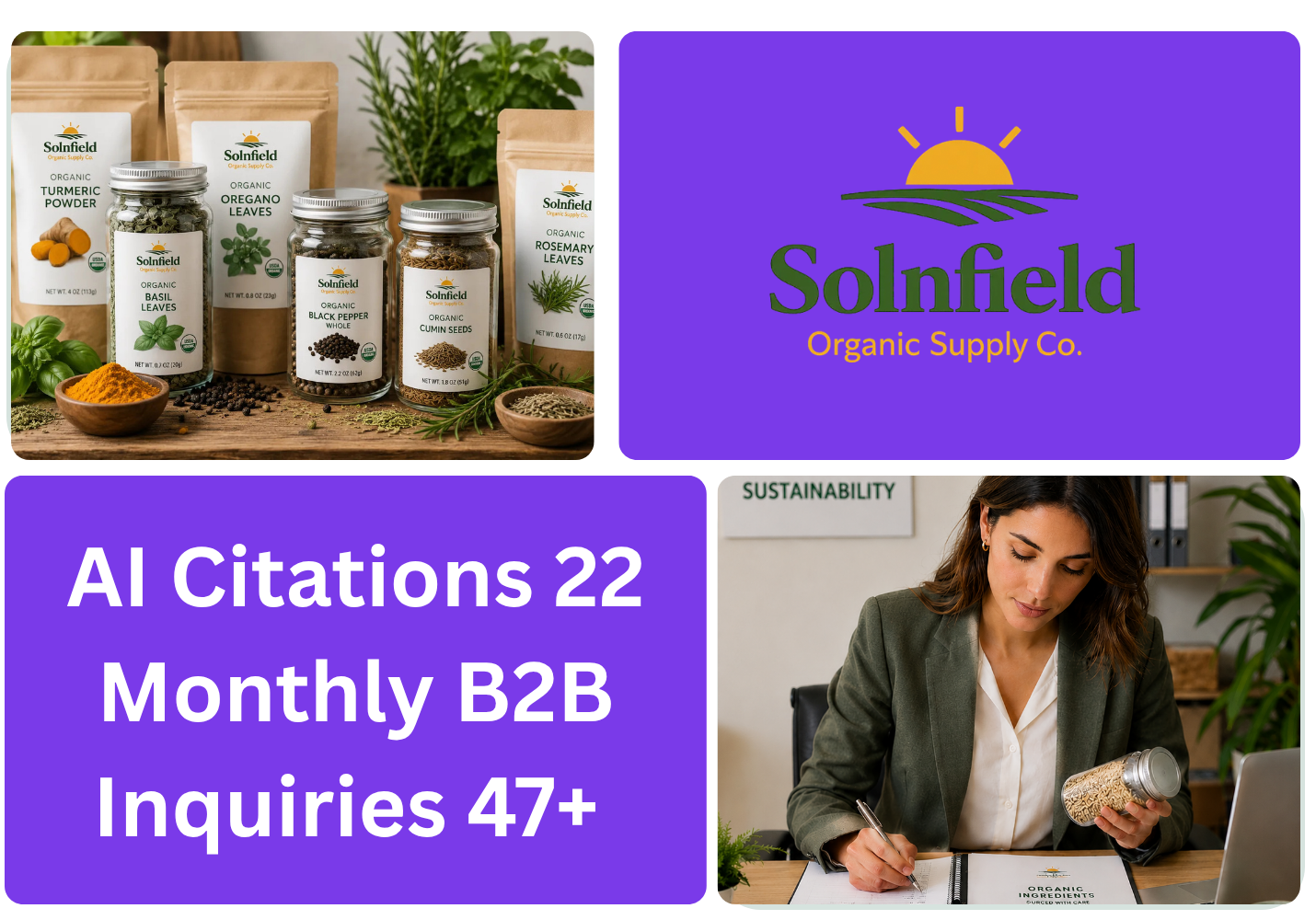
How a Portland, Oregon-based certified organic ingredients supplier went from completely invisible to AI platforms to 22 active citations across ChatGPT, Perplexity, Claude, and Google AI Overviews generating 47+ monthly B2B inquiries and expanding into 4 new export markets in 12 months.
Unosearch For Claridge HR Solutions
AI Discovery Challenge
Although Solnfield offered certified organic ingredients and trusted supply chain practices, it had almost no visibility on AI platforms. As more B2B buyers began using ChatGPT and other AI tools to discover suppliers, the company was missing valuable opportunities.
GEO Strategy Implementation
UnoSearch implemented a complete GEO strategy by optimizing entity information, creating AI-friendly content, adding structured schema markup, and building topical authority across key product categories to improve AI discoverability.
AI Visibility Growth
Within nine months, Solnfield earned 22 AI citations across ChatGPT, Perplexity, Claude, and Google AI Overviews, significantly improving its online credibility and making it a trusted supplier recommendation.
Business Growth
The increased AI visibility resulted in 47+ monthly B2B inquiries, Page 1 rankings for 18 target keywords, and expansion into 11 U.S. states and 4 international export markets, driving measurable business growth.
Meet Solnfield Organic Supply Co.
Solnfield Organic Supply Co. was founded in Portland, Oregon in 2020 by Claire Ashworth, a former supply chain manager who spent eight years sourcing ingredients for natural food brands before deciding to build a supplier that small and mid-size food manufacturers could actually trust.
The company sources and supplies certified organic spices, herbs, pulses, grains, and natural sweeteners every product carrying USDA Organic, Non-GMO, and Gluten-Free certification. Solnfield works directly with a network of organic farms across the Pacific Northwest and select international growing regions, offering the kind of traceable, certified supply chain that food manufacturers increasingly demand from their ingredient partners.
By early 2024, Solnfield had built a small but genuinely loyal client base of 14 regional food brands companies that had found Claire through trade shows, industry connections, and word-of-mouth. The product quality and certification standards were never in question. The problem was that beyond their existing network, almost nobody could find Solnfield at all.
Their website had no structured product data, no content built for search or AI discovery, and zero presence across any AI platform. A food brand searching for a new organic ingredient supplier whether through Google or through ChatGPT had no way of knowing Solnfield existed.
The AI Discovery Gap
Somewhere in the United States, a procurement manager at a food manufacturing company is searching for a certified organic spice supplier. Increasingly, that search doesn’t start with Google. It starts with a question typed into ChatGPT or Perplexity: “recommend certified organic spice suppliers in the USA.”

For Solnfield Organic Supply Co., that conversation was happening thousands of times a month across the food and beverage industry and Solnfield was never part of it. Not because their products weren’t excellent. Not because their USDA Organic certification wasn’t legitimate. But because nothing about Solnfield’s digital presence had ever been structured in a way that AI platforms could find, trust, and cite.
Every AI-generated recommendation that left Solnfield out was a buyer relationship that started somewhere else. In an industry where B2B purchasing decisions increasingly begin with an AI query rather than a Google search, that invisibility was costing Solnfield contracts they never even knew existed.
Why AI Citations Matter for Organic B2B Suppliers

Before building a strategy, UnoSearch researched how food and beverage procurement professionals actually source new ingredient suppliers in 2024 and the data pointed to a clear, urgent opportunity.
B2B ingredient buyers overwhelmingly begin their supplier research online before ever making direct contact and a growing majority now use AI tools specifically as part of that research process, asking for supplier recommendations, certification verification, and product category comparisons directly through conversational AI.
Critically, buyers who discover a supplier through an AI recommendation behave differently than buyers who find one through a generic directory listing. An AI citation functions as an implicit pre-vetting signal the AI has effectively done the first round of due diligence, summarizing the supplier’s certifications, specialties, and credibility in a way the buyer trusts more readily than a cold search result.
For Solnfield, this meant AI citations weren’t a nice-to-have SEO tactic. They were the single highest-leverage opportunity to reach buyers who had never heard of the company at the exact moment those buyers were actively evaluating new suppliers.
The GEO Strategy: How UnoSearch Made Solnfield Citable

UnoSearch built a complete GEO strategy around a single objective: make Solnfield Organic Supply Co. structurally impossible for AI platforms to ignore when buyers asked about certified organic ingredient suppliers.
Entity Optimization.
Every page on Solnfield’s website was restructured to clearly establish the company as a named, citable entity with consistent business information, certification details, product category coverage, and sourcing region data formatted in a way AI platforms could parse and trust.
Direct-Answer Content.
Product category pages were rebuilt so that the first two sentences directly answered the exact question a buyer would ask an AI tool “who supplies certified organic cumin in bulk” or “where can I source USDA certified organic lentils for food manufacturing.”
FAQ Schema and AEO Formatting.
UnoSearch structured FAQ content around the real phrasing patterns buyers use when querying ChatGPT and Perplexity questions about minimum order quantities, certification documentation, supply chain traceability, and lead times.
Certification and Trust Signal Markup.
Solnfield’s USDA Organic, Non-GMO, and Gluten-Free certifications were structured with proper schema markup, making them machine-readable trust signals that AI platforms could cite confidently rather than generic, unverifiable claims.
Topical Authority Clusters.
UnoSearch built five distinct content clusters organic spices, organic herbs, organic pulses, organic grains, and natural sweeteners each with its own hub page and supporting content, giving AI platforms a clear, comprehensive map of Solnfield’s full product expertise rather than a single generic “about us” page.
The Citations That Changed Everything

By month 4, Solnfield earned its first verified AI citation. By month 9, that number had grown to 22 active citations across ChatGPT, Perplexity, Claude, and Google AI Overviews appearing as a recommended supplier whenever buyers asked AI platforms about certified organic spices, herbs, pulses, grains, or sweeteners sourced from US suppliers.
The qualitative shift mattered just as much as the citation count. Claire Ashworth began hearing something she’d never heard before from new inbound contacts: buyers explicitly mentioning that they’d found Solnfield through ChatGPT or Perplexity, often already familiar with the company’s certifications and product range before the first conversation even began. The AI citation had done the work of building initial trust UnoSearch had simply made sure Solnfield was the company AI tools chose to trust.
The Compounding Results

Twelve months transformed Solnfield from a locally-known supplier into a nationally discoverable brand with genuine AI search authority.
AI citations grew from 0 to 22 across all major platforms. Organic search visibility expanded from near zero to Page 1 rankings across 18 target keywords. Monthly B2B inquiries grew from 3 to 47+ a more than 15x increase. And perhaps most significantly, Solnfield’s market reach expanded from local Pacific Northwest relationships to active business across 11 US states, with new export inquiries from 4 international markets that had never previously been on the company’s radar.
The AI citations and organic search authority compounded each other throughout the campaign every new piece of structured product content that earned a citation also strengthened the organic ranking signals search engines used to evaluate the same pages. By December 2024, Solnfield wasn’t just being found. It was being recommended by AI platforms, in the exact moment a buyer was deciding who to trust with their next ingredient sourcing contract.
Why This Campaign Worked
AI citations function as pre-vetting for B2B ingredient buyers.
Food manufacturers take supplier vetting seriously certifications, traceability, and reliability all matter enormously. An AI citation that accurately summarizes Solnfield’s USDA Organic certification and product range does meaningful credibility work before the buyer ever picks up the phone, significantly shortening Solnfield’s typical sales cycle.
Entity-first content structure made Solnfield legible to AI platforms.
Most B2B suppliers structure their websites for human browsing, not AI extraction. By rebuilding Solnfield’s content architecture around clear entity data, direct-answer formatting, and structured certification markup, UnoSearch gave AI platforms exactly the kind of clean, trustworthy information they need to confidently cite a source.
Category-specific authority beat generic positioning.
Rather than positioning Solnfield as a generic “organic ingredient supplier,” UnoSearch built distinct topical authority for each product category spices, herbs, pulses, grains, sweeteners. This meant Solnfield could be cited specifically and accurately, whatever a buyer was actually searching for, rather than competing as one generic option among many.
Want to Scale Your Agency with White-Label Medical Link Building?
What the Client Said

FAQs
Why do AI citations matter for a B2B ingredient supplier?
Food and beverage procurement professionals increasingly use AI tools like ChatGPT and Perplexity to research potential suppliers before making direct contact. A supplier cited by an AI platform receives an implicit credibility endorsement that shortens the trust-building process significantly. For Solnfield, AI citations directly generated new B2B inquiries from buyers who had never previously heard of the company.
How long does it take a B2B supplier to earn AI citations?
Most B2B suppliers implementing a proper GEO strategy begin seeing initial AI citations within 3 to 5 months. Solnfield earned its first verified citation in month 4 and reached 22 active citations across all major AI platforms by month 9.
What makes a supplier's content citable by AI platforms?
AI platforms prioritize content that is structured, specific, and verifiable clear entity data, direct-answer formatting, schema-marked certifications, and category-specific expertise rather than generic marketing language. Solnfield’s GEO strategy was built entirely around making this kind of structured, trustworthy content the foundation of every page.
Can a small organic supplier compete against larger, established ingredient companies in AI search?
Yes, and category specificity is often the advantage smaller suppliers have. Large generic ingredient companies often have broad, unfocused content that doesn’t clearly establish expertise in any single category. Solnfield’s GEO strategy built distinct authority in five specific product categories, which made the company easier — not harder — for AI platforms to cite accurately for those specific queries.
How much does a GEO and AI citation strategy cost for a B2B supplier?
Investment depends on the number of product categories, the competitiveness of the supplier’s market, and the scope of content restructuring required. Solnfield’s 12-month engagement covered full entity optimization, content architecture rebuilding, and five topical authority clusters. Contact UnoSearch for a custom assessment.
Explore More Case Studies
%
%
%