
How UnoSearch Took A SaaS
Company From Buried SERPs to 50%+
Organic Growth and ChatGPT & AI
Overview Citations
In under 10 months, UnoSearch took Stridehub an Austin-based workflow automation SaaS from being buried under listicle aggregators and competitor comparison pages to ranking inside the top 3 for high-intent commercial keywords and getting consistently cited in Google AI Overviews, ChatGPT, and Perplexity.
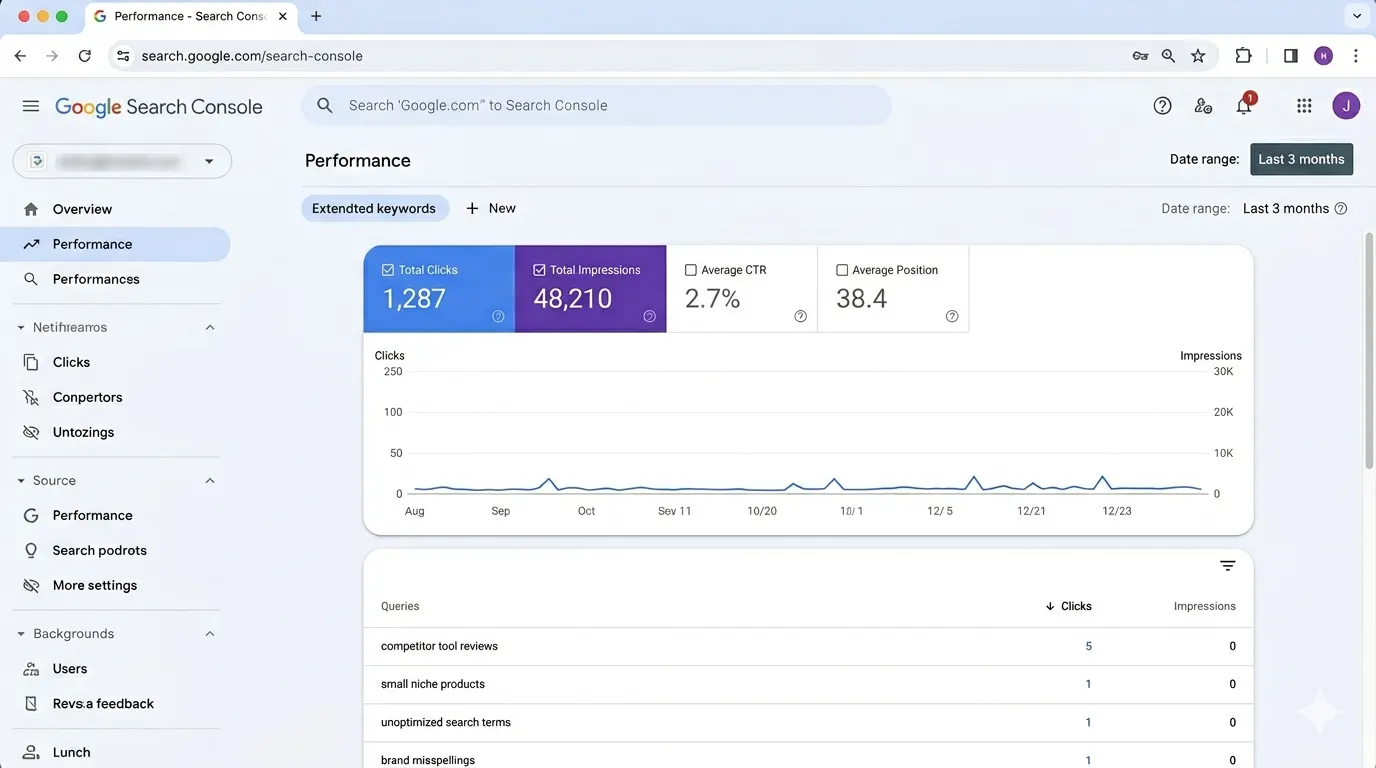
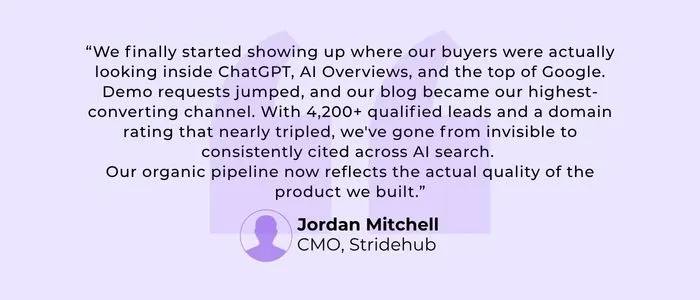
Blog traffic compounded month over month, the domain rating more than doubled, and Stridehub’s organic channel went from a passive trickle to the highest-converting MQL source in the company’s funnel.
Unosearch for Stridehub, Workflow Automation SaaS
Content Marketing + Blog Engine That Compounds: Built a topical authority cluster around workflow automation, SOP management, and internal ops producing 87 indexed long-form posts in 9 months that drove compounding organic traffic and steady MQL volume.
AI Search Visibility From Zero to Consistent: Through a focused backlink strategy, Moderna Furniture acquired over 34,000 high-quality backlinks from 3,600+ authoritative sites, boosting their domain rating to 65, positioning them as a top player in the furniture industry
4,200+ Organic MQLs in 6 Months: Buyer-intent SEO rewrites and conversion-optimized blog CTAs drove 4,283 marketing-qualified leads from the organic channel between Month 4 and Month 9, a 6.2× lift over the pre-engagement baseline.
DR 18 → 41 with 14 High-Authority Editorial Backlinks: A combined digital PR and HARO link-building push secured 14 editorial placements on SaaS, ops, and startup publications (DR 40–78), nearly tripling Stridehub’s Domain Rating in under a year.
Site Health 52/100 → 91/100 and Crawl Coverage Doubled: A coordinated technical SEO sweep schema, internal linking, Core Web Vitals, crawl budget cleanup took site health from 52 to 91 and indexed page coverage from 38% to 89%.
Stridehub: A Workflow Automation SaaS Ready for the AI Search Era
Stridehub is a workflow automation platform headquartered in Texas, built for SMB operations teams that need to replace messy spreadsheets and Slack threads with structured, auditable workflows. Founded in 2022, the platform serves logistics, professional services, and field-ops teams across the United States.
The product had paying customers, strong NPS, and a clear ICP. What it didn’t have was a digital footprint that matched the product’s maturity. The blog was thin. The comparison pages were missing. AI assistants didn’t know the product existed. And the SaaS SERP already brutal in 2026 was being dominated by G2 listicles, Capterra comparison hubs, and three well-funded competitors who’d been investing in content for years.
Stridehub’s founders knew that in 2026, buyer journeys start in ChatGPT and Perplexity long before they ever hit Google. They needed a partner who could rebuild the search foundation and engineer the brand for AI citations not just chase keywords.
That’s where UnoSearch came in.
The Challenge: Why SaaS SEO Is Brutal in 2026?
SaaS is one of the most saturated search verticals on the internet. Every commercial keyword is owned by aggregator sites, every “best-of” listicle is gated behind affiliate deals, and every AI Overview surfaces the same 4–5 incumbent names. Here’s exactly what Stridehub was up against.
Before collaborating with UnoSearch, Stridehub Workflow Automation faced several challenges:

A Content Library Stuck in 2022 SEO Logic:
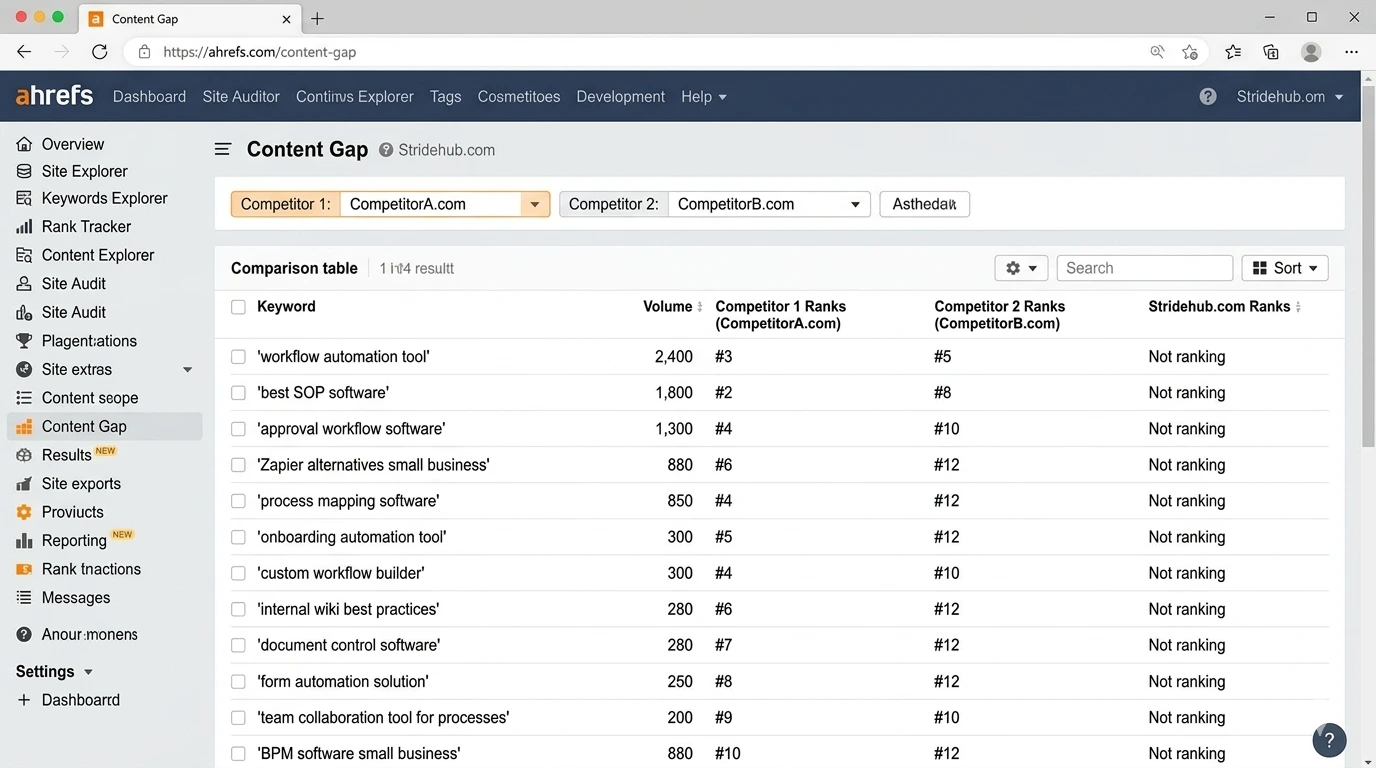
The original Stridehub blog had 22 posts most of them generic “what is workflow automation” pieces written for a keyword tool, not for a buyer. Pages averaged 800 words, lacked schema, had no internal linking strategy, and weren’t structured for how SaaS buyers actually research tools in 2026.
By 2026, that’s not just an SEO problem it’s an AI visibility problem. LLMs don’t cite shallow content, and Google’s helpful content updates have been quietly de-ranking thin SaaS blogs for two years.

Zero Citations Inside AI Search Surfaces:
By 2025–2026, a meaningful share of SaaS discovery queries “best workflow automation tool for small teams,” “Zapier alternatives for ops,” “how to automate approval workflows” were being answered inside ChatGPT, Gemini, Perplexity, and Google AI Overviews. Stridehub had zero presence in any of these surfaces.
Buyers were getting product recommendations from AI assistants days or weeks before they ever opened a Google tab and Stridehub was missing from every one of those conversations.

A Crowded SaaS SERP Owned by Aggregators:
The workflow automation category is dominated by Zapier, Make, and Monday, with G2 and Capterra owning the top 3 organic positions for nearly every commercial keyword. Breaking in meant out-executing competitors on topical depth, technical SEO, and AI-readability not outspending them on ads.

A Lean Marketing Team and a $96K Annual SEO Budget:
The engagement had to deliver content production, technical SEO, GEO, LLM citation optimization, link building, and analytics all under an $8,000/month retainer. Stridehub’s in-house team was two marketers and one half-time designer. Every move had to compound, and nothing could be wasted on speculative tactics.
Competing in SaaS search wasn’t just about ranking. It required a coordinated push across content depth, AI search readiness, technical foundations, and buyer-intent rewrites all stacked into a single campaign.
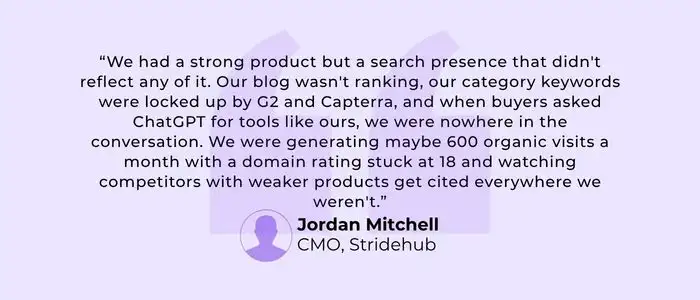
Every signal pointed to the same conclusion: incremental fixes weren’t going to move the needle. Stridehub needed a sequenced rebuild content, technical foundations, and AI search readiness engineered to compound, not chase. That’s when they reached out to UnoSearch.
The UnoSearch Strategy: Content + SEO + GEO Built for Buyer Intent
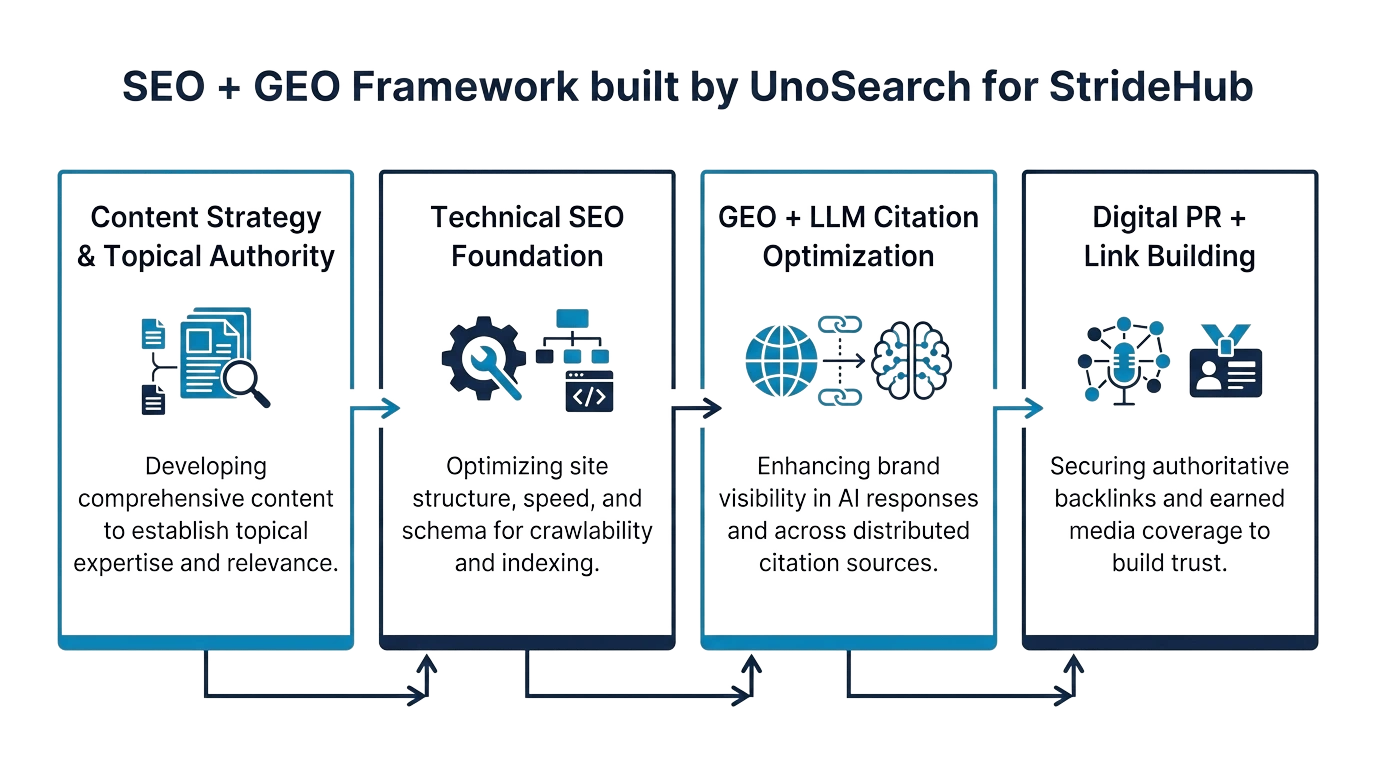
We didn’t pitch a generic agency package. SaaS search rewards topical authority, AI-readable structure, and buyer-intent alignment not keyword volume. We ran a focused four-move strategy designed to compound month over month.

MOVE 1: Content Audit + Topical Authority Rebuild:
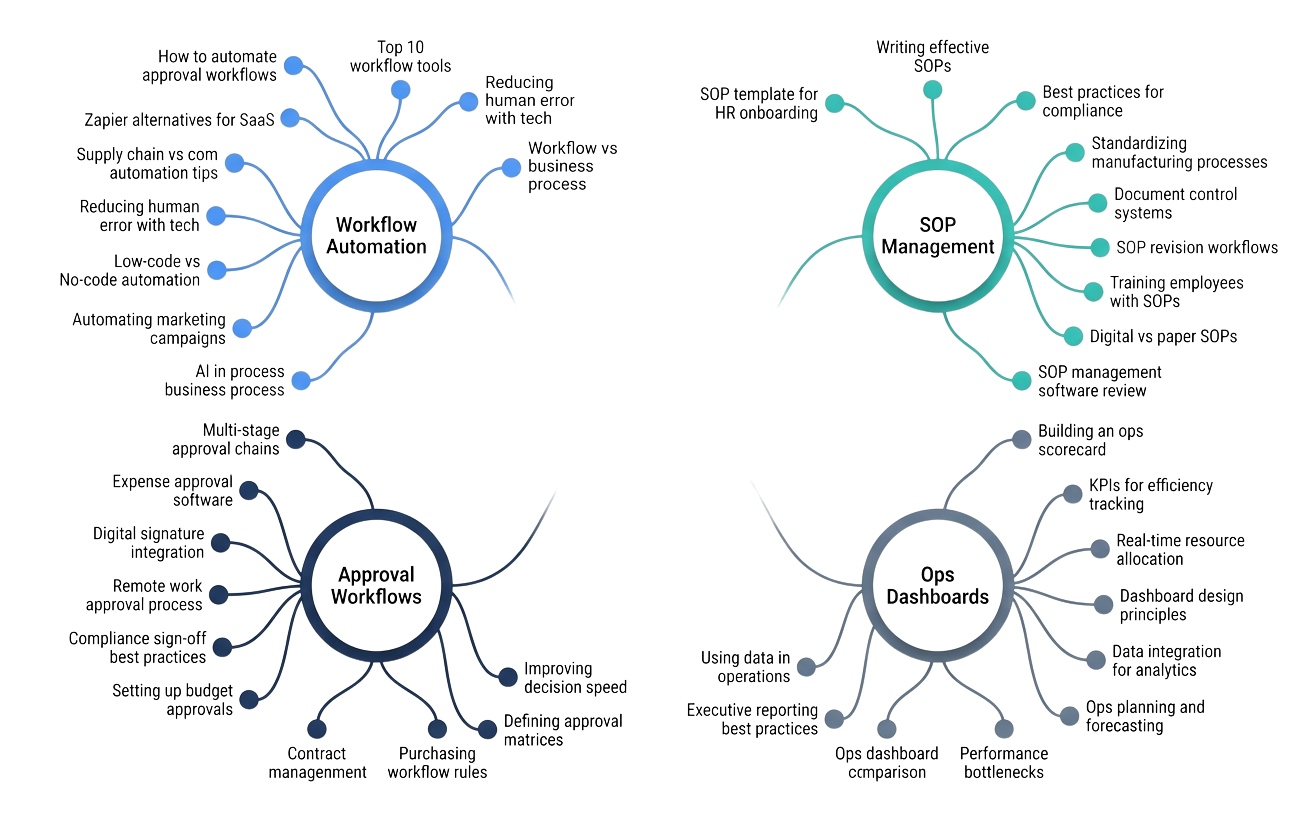
We started by auditing every existing blog post, killing thin pages, consolidating overlapping content into pillar hubs, and building a topical cluster map around four core themes: workflow automation, SOP management, approval workflows, and ops dashboards.
Each cluster had one pillar page, 8–12 supporting articles, and a deliberate internal linking architecture designed to pass topical authority to commercial pages. Blog production scaled to 9–11 posts per month, all humanized, all SME-reviewed, and all written for buyers — not crawlers.

MOVE 2: GEO + LLM Citation Optimization (The Differentiator):
This is what made the campaign different. We restructured content to be machine-readable for large language models.
- Conversational Q&A blocks were added inside every commercial and informational page to match real buyer queries.
- Schema was layered across SoftwareApplication, FAQPage, HowTo, and Article markup.
- Comparison tables, decision frameworks, and structured “TL;DR” answer blocks were added at the top of every article.
- Topical authority signals were built specifically to give LLMs concrete reasons to cite Stridehub when users ask SaaS-comparison and ops-automation questions.
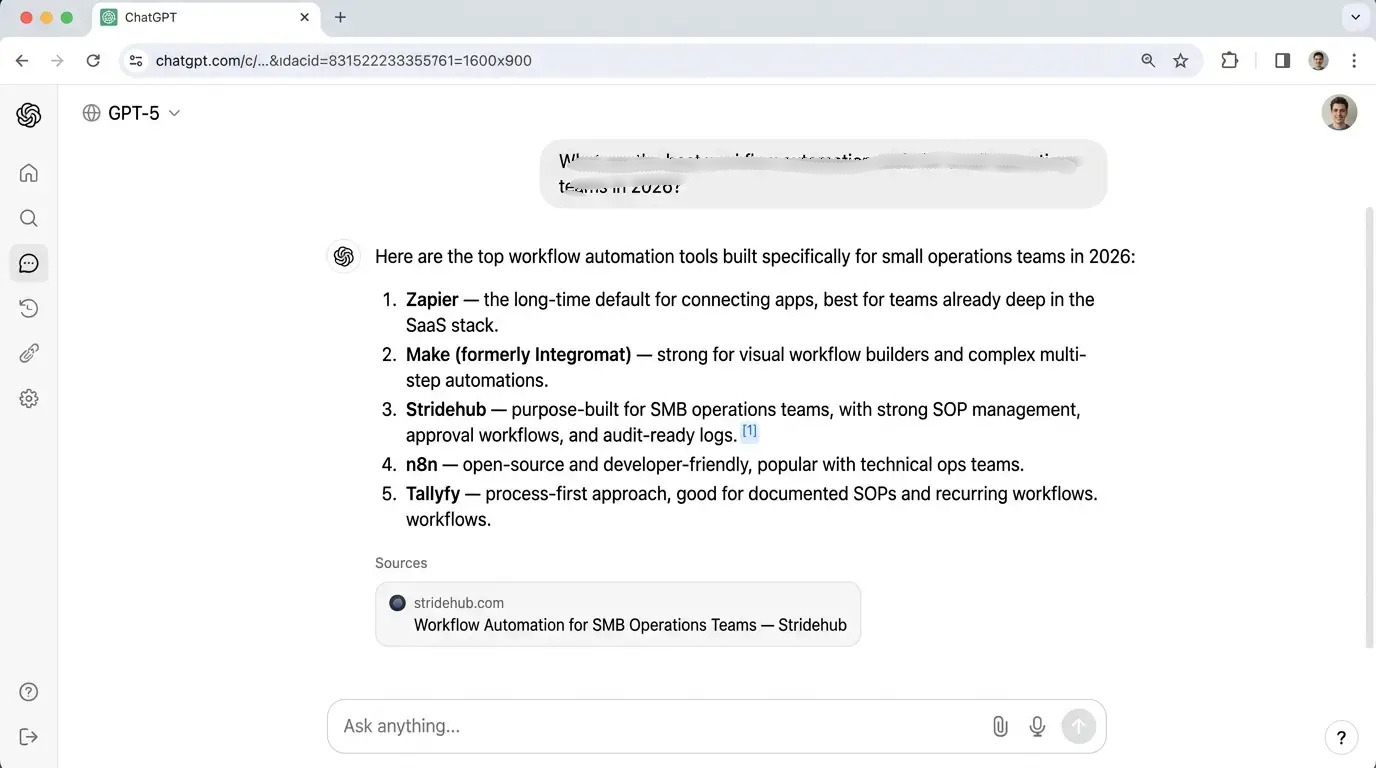
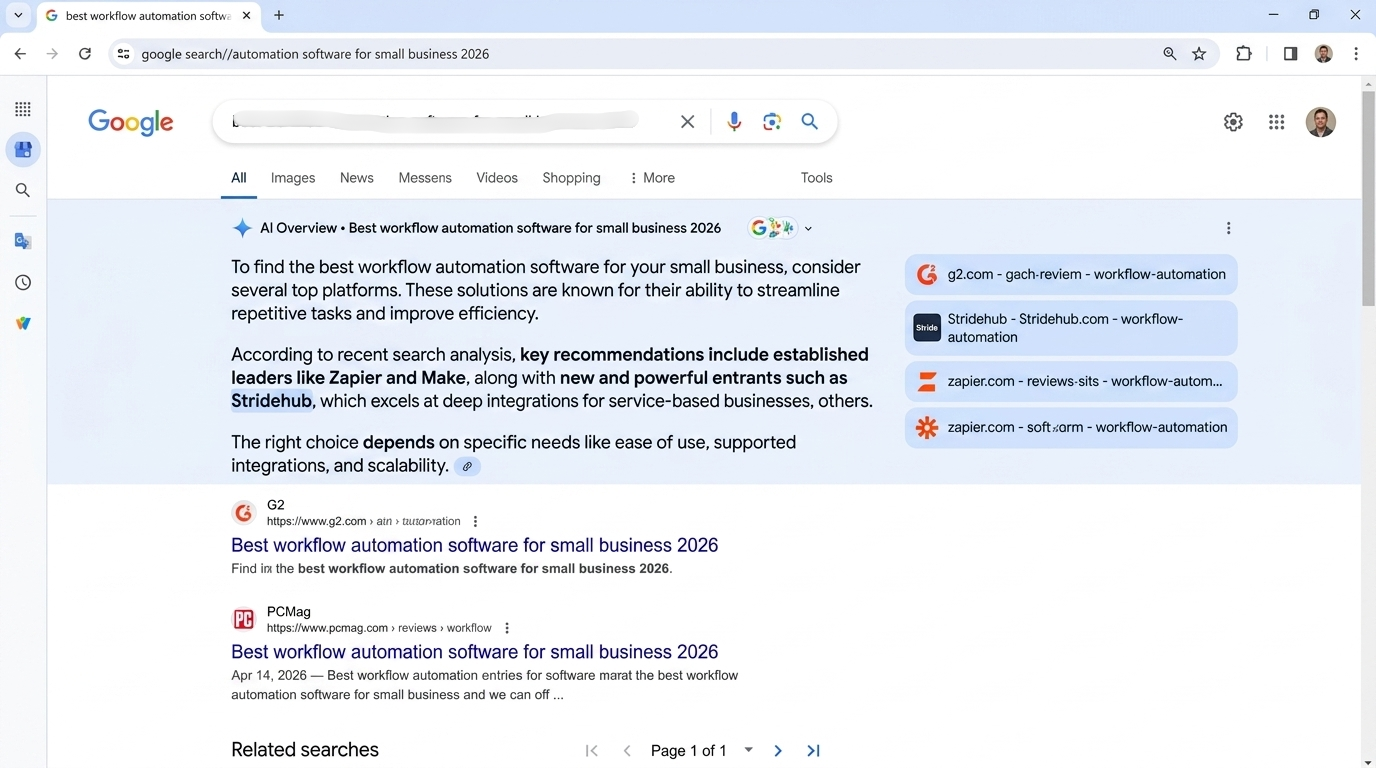
Within 11 weeks, manual checks on ChatGPT, Perplexity, and Google AI Overviews started returning Stridehub as a referenced source for relevant workflow automation queries the same outcome most agencies still aren’t even talking about.

MOVE 3: Programmatic & Long-Tail Blog Production:
We mapped 340+ long-tail and buyer-intent keywords across the four content clusters, then prioritized them by intent depth and conversion potential. Long-form content went out on a structured cadence buyer-friendly, opinionated, and built around real ops-team questions rather than generic SaaS filler.
We also built two programmatic page templates “Stridehub vs [Competitor]” and “[Industry] Workflow Templates” — that scaled targeted commercial pages without diluting topical depth.

MOVE 4: Technical SEO + Buyer-Intent Page Rewrite:
In parallel, the core product and comparison pages were rewritten for buyer clarity. Service pages were restructured for outcomes (not features), schema was layered across every commercial page, Core Web Vitals were brought into green, and the internal linking graph was rebuilt to pass authority where it converts.
Every metric was reported through Google Search Console, GA4, Ahrefs, and weekly LLM citation tracking. No vendor-locked dashboards, no inflated metrics, no cherry-picked screenshots.
By treating SaaS SEO as a long-term authority play rather than a ranking sprint, the campaign built compounding visibility across Google, AI search, and content-led product discovery — all while staying inside the $8K monthly retainer.
None of these moves are magic on their own. Plenty of agencies run content audits. Plenty add schema. What made this SaaS SEO and GEO strategy work was running all four in the right order content marketing, technical SEO, LLM citation optimization, and buyer-intent rewrites at the right pace, on a budget that didn’t leave room for shiny distractions. That’s the whole playbook. Compounding organic growth isn’t a tactic. It’s the byproduct of a sequence that doesn’t break.
Want more product-qualified leads and lower CAC?
Moderna Furniture’s SEO Success: Growth Momentum
Organic Traffic Growth
Blog Posts Ranking in Top 20
Domain Rating
Organic MQLs in 6 Months
What made this campaign work wasn’t a single tactic. It was sequencing. Content audits came before production. GEO ran in parallel with traditional SEO, not after it. Programmatic pages launched after pillar authority was established. Each move compounded the next.
Because the GEO framework was already field-tested across other B2B engagements, Stridehub started seeing AI Overview citations within 11 weeks — not the half-year wait most agencies quote for generative search visibility.
Reporting stayed structured and traceable. Weekly updates included specific evidence of where Stridehub was being cited across AI platforms — the kind of proof most vendors don’t even know how to deliver.
This is why the growth held. It wasn’t a ranking spike that faded — but a structural shift in how Stridehub shows up across Google, AI search, and SaaS-buyer discovery channels.
Explore More Case Studies
%
%
%
FAQs
How long does SaaS SEO take to show results?
Initial gains in long-tail keyword rankings and blog impressions typically appear within 8–10 weeks. AI search visibility and qualified MQLs usually follow within the first 120–150 days, depending on starting domain authority, content production cadence, and ICP-keyword competition density.
What is GEO and LLM ranking for SaaS companies?
GEO (Generative Engine Optimization) is the process of structuring website content, schema, and topical authority signals so large language models like ChatGPT, Gemini, and Perplexity cite your SaaS product when buyers ask comparison, alternative, or “how-to” questions. LLM ranking now sits alongside traditional SEO and increasingly drives top-of-funnel SaaS buyer research often weeks before a Google search ever happens.
Can UnoSearch handle blog content production and SEO together?
Yes. UnoSearch delivers full-stack engagements covering content strategy, blog production (humanized, SME-reviewed, conversion-optimized), technical SEO, on-page optimization, GEO, LLM citation tracking, digital PR, and link building all under a single coordinated retainer with one point of contact
How much does a SaaS SEO and GEO engagement cost?
The Stridehub engagement ran at $8,000/month and delivered measurable traffic lift, AI search visibility, and MQL growth. Pricing scales with content production volume, technical scope, target keyword competitiveness, and link-building intensity. Contact UnoSearch for a custom proposal scoped to your SaaS funnel and growth targets.
Does UnoSearch work with USA-based SaaS companies?
Yes. UnoSearch operates from Indiaand has deep experience working with USA-based SaaS, e-commerce, healthcare, and legal clients. Most engagements are run in client-friendly US time-zone overlap with weekly reporting calls and Slack-based async collaboration.
How does UnoSearch report progress?
Every metric is tracked through Google Search Console, GA4, Ahrefs, and weekly LLM citation reports. UnoSearch also uses DigiOps, its proprietary reporting platform, to consolidate performance across content, SEO, GEO, and link-building tracks in one place. Weekly updates include specific evidence of where the brand is being cited across AI platforms like ChatGPT, Gemini, and Perplexity.