
Search Engine Optimization vs Pay Per Click: Which One Should You Invest In First?
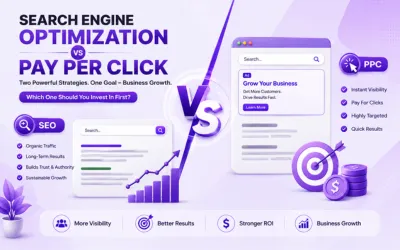
If you have ever sat down to plan a marketing budget, you have probably run into this exact debate. Should you put your money into SEO and wait for organic rankings to build, or should you launch a PPC campaign and start getting clicks the same afternoon? The honest answer is that search engine optimization vs pay per click is not really a competition with one winner. They solve different problems, on different timelines, and most businesses that grow well eventually use both. But if you are trying to figure out where to start, or how to explain the difference to someone on your team, this guide walks through it properly.
Looking for an SEO agency?
UnoSearch helps brands rank higher and drive real organic growth.
Get Free Proposal1. SEO vs PPC: Key Differences
2. SEO vs Paid Ads
3. How SEO Works
4. How PPC Works
5. SEO vs PPC: Cost & Results
6. When to Choose PPC
7. PPC & SEO Together
8. Client Story: SEO & PPC Growth
9. SEO vs PPC: The Data
10. Expert Take: SEO vs PPC
11. Our PPC & SEO Services
12. FAQs
What Is the Real Difference Between SEO and PPC?
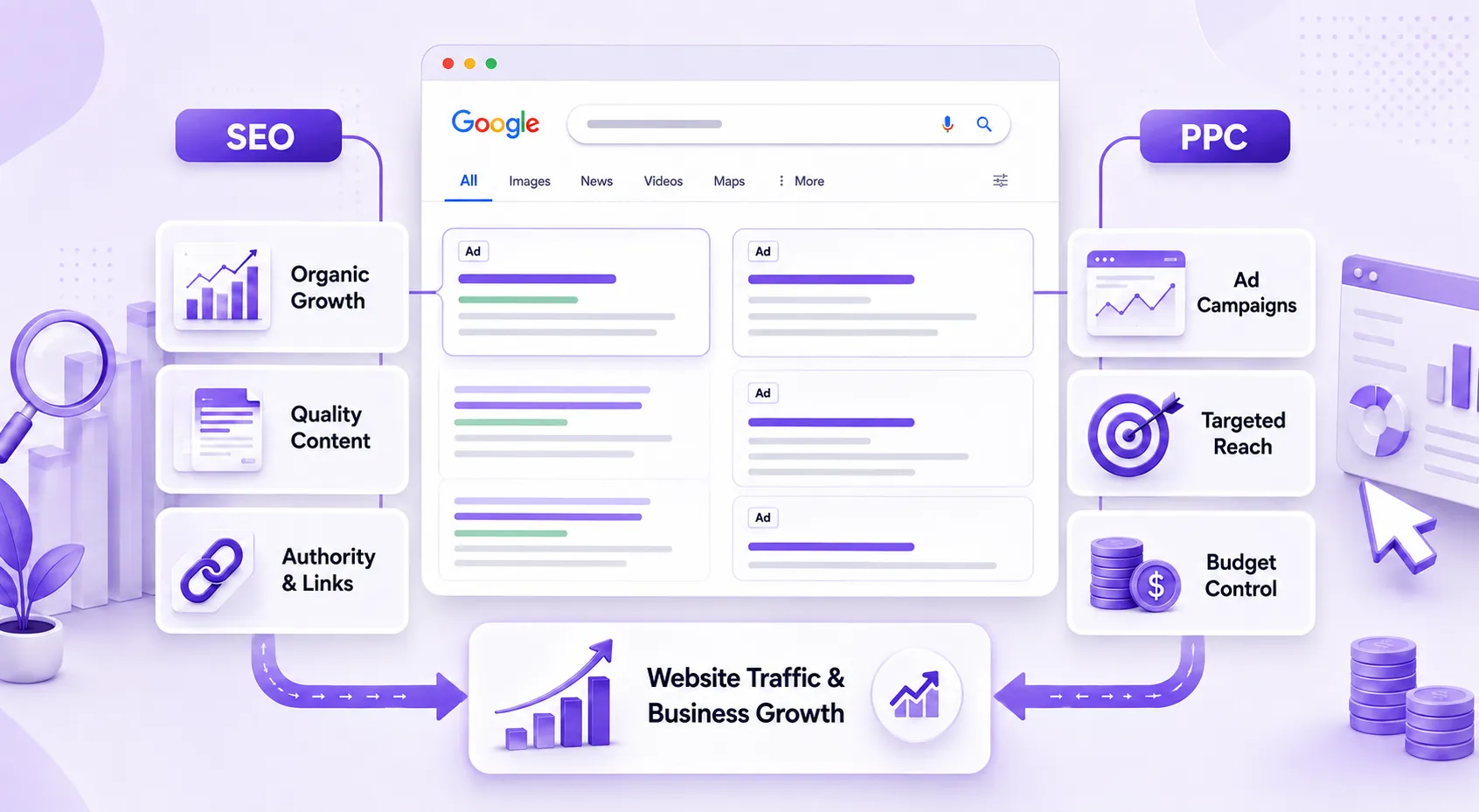
SEO, or search engine optimization, is the work you do to earn a spot in Google’s organic results, the listings that show up because your page is genuinely relevant and trustworthy, not because you paid for the placement. PPC, or pay per click, is the opposite approach. You bid on keywords, Google auctions off the ad space, and you pay every time someone clicks your ad, regardless of whether that click turns into a customer.
The difference between SEO and paid search comes down to how you earn visibility, how quickly you can see results, and what happens when you stop investing. With SEO, you are trying to earn visibility through relevance and authority, and it takes time to build. With PPC, you are effectively renting visibility, and the moment you stop paying, that visibility disappears. Neither approach is inherently better. They just behave differently, and understanding that behavior is what actually helps you decide where to put your budget.
SEO vs Paid Ads at a Glance
Sometimes a table says more than a paragraph ever could, so here is the quick version.
| Factor | SEO | PPC |
|---|---|---|
| Cost structure | Investment in content, technical work, and links | Pay per click, ongoing ad spend |
| Time to results | Often several months for meaningful movement, varying by competition and site history | Immediate, often within hours of launch |
| Longevity | Rankings can last for years with maintenance | Traffic stops the moment spend stops |
| Trust factor | Often seen as more credible by users | Clearly labeled as an ad, some users skip it |
| Best for | Long-term, compounding growth | Fast, time-sensitive campaigns and testing |
| Control | Limited control over exact position | Full control over budget, targeting, and timing |
This is the shortest way to explain seo vs paid advertising to someone who just wants the summary before diving deeper.
How Does SEO Actually Work?
SEO is less about a single trick and more about consistently doing three things well: making sure your site is technically easy for Google to crawl and understand, creating content that genuinely answers what people are searching for, and earning enough trust and authority, often through backlinks, that Google feels confident ranking you above competitors.
None of that happens instantly. A new page can take weeks just to get indexed, and it often takes several months of consistent effort before you see it climbing toward the first page for a competitive term. The upside is that once a page ranks well, it tends to keep bringing in traffic without you paying for every single visit, which is exactly why so many businesses treat SEO as a long-term asset rather than a monthly expense.
How Does PPC Actually Work?
PPC runs on an auction. You choose keywords you want to show up for, decide how much you are willing to pay per click, and Google decides your ad’s position based on your bid combined with the quality and relevance of your ad and landing page. The moment your campaign goes live, your ad can start appearing, which is the biggest reason businesses turn to PPC when they need visibility right away, not in three months.
The tradeoff is that you are paying for every click, good or bad. A visitor who clicks and leaves immediately costs you the same as one who converts into a customer, which is why well-managed PPC campaigns spend so much energy on targeting, negative keywords, and landing page relevance. Done carelessly, PPC can burn through a budget fast. Done well, it can be one of the most predictable ways to generate leads on demand.
SEO vs Paid Search: Cost, Speed, and Longevity
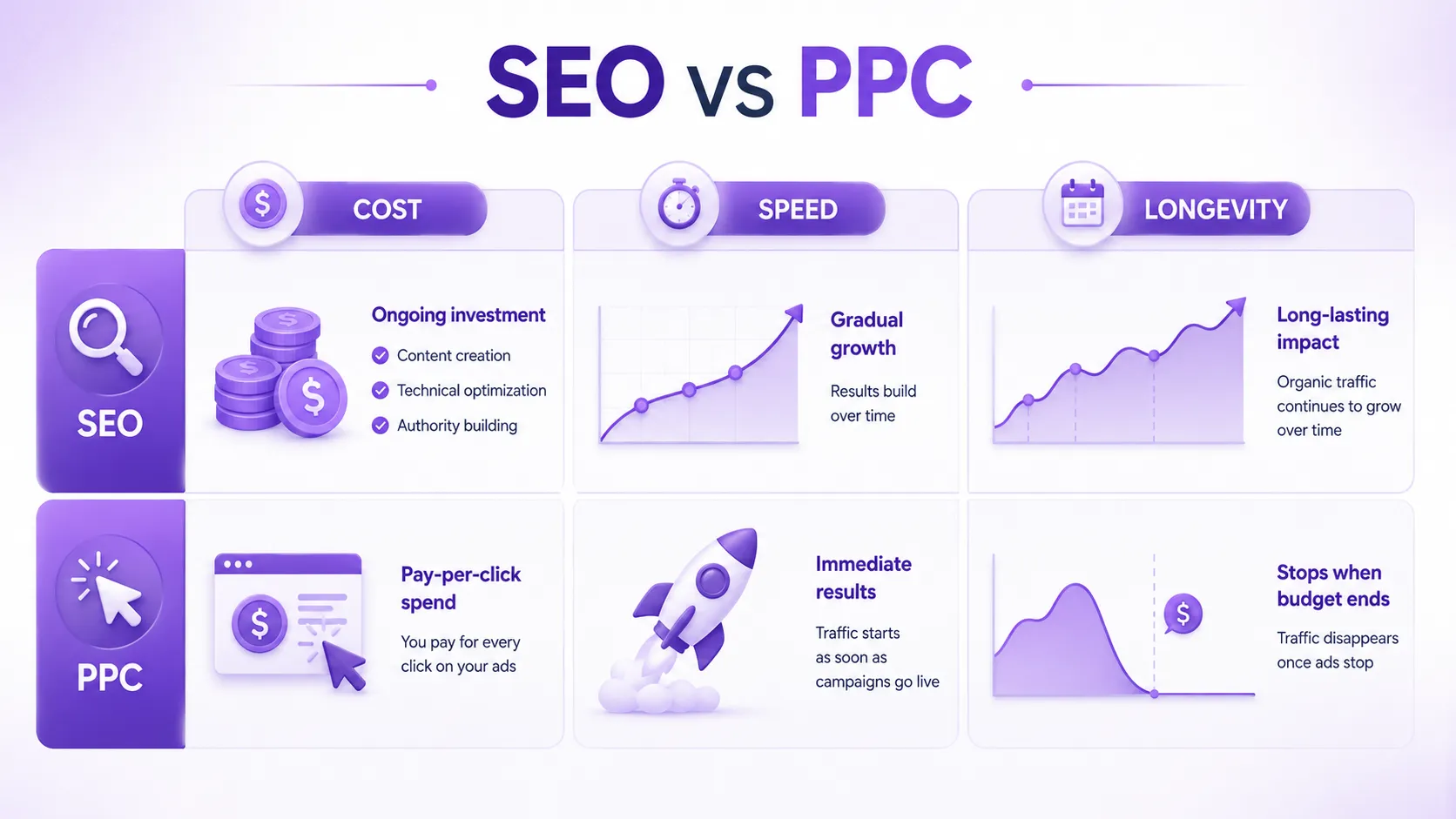
This is probably the section most people are actually looking for, so let’s be direct about it. When you break paid search vs SEO down into cost, speed, and longevity, the tradeoffs become a lot easier to see.
On cost, SEO tends to be a larger upfront time and effort investment, but the ongoing cost per visitor drops significantly once a page ranks well. PPC has a lower barrier to entry, you can start with almost any budget, but the cost per visitor stays fairly constant, since you are paying for every click for as long as the campaign runs.
On speed, there is no real contest. PPC wins if you need results this week. SEO wins if you are building something meant to last years, not days.
On longevity, this is where the seo vs paid search conversation gets interesting. A well-optimized page that continues to rank can keep generating traffic long after the work was done, sometimes for years with only occasional updates. A PPC campaign generates traffic only while it is actively funded. Turn off the budget, and the traffic disappears the same day.
None of this means one approach is smarter than the other. It means they solve different problems, and the right choice depends on what you actually need right now.
When Should You Choose PPC Over SEO?
There are a few situations where PPC genuinely makes more sense as your starting point:
You are launching something new and need visibility immediately, not in a few months
You want to test which keywords or messaging actually convert before investing in long-term content around them.
You are running a time-sensitive promotion or seasonal campaign.
Your website is brand new and has no organic authority yet to compete for competitive terms.
On the other hand, SEO tends to make more sense when you are playing a longer game, building a brand that people will search for by name over time, or trying to reduce your dependence on an ongoing ad budget. Most businesses that are being honest with themselves eventually realize they need a bit of both, just weighted differently depending on where they are in their growth.
Can You Run PPC and SEO Marketing Together?
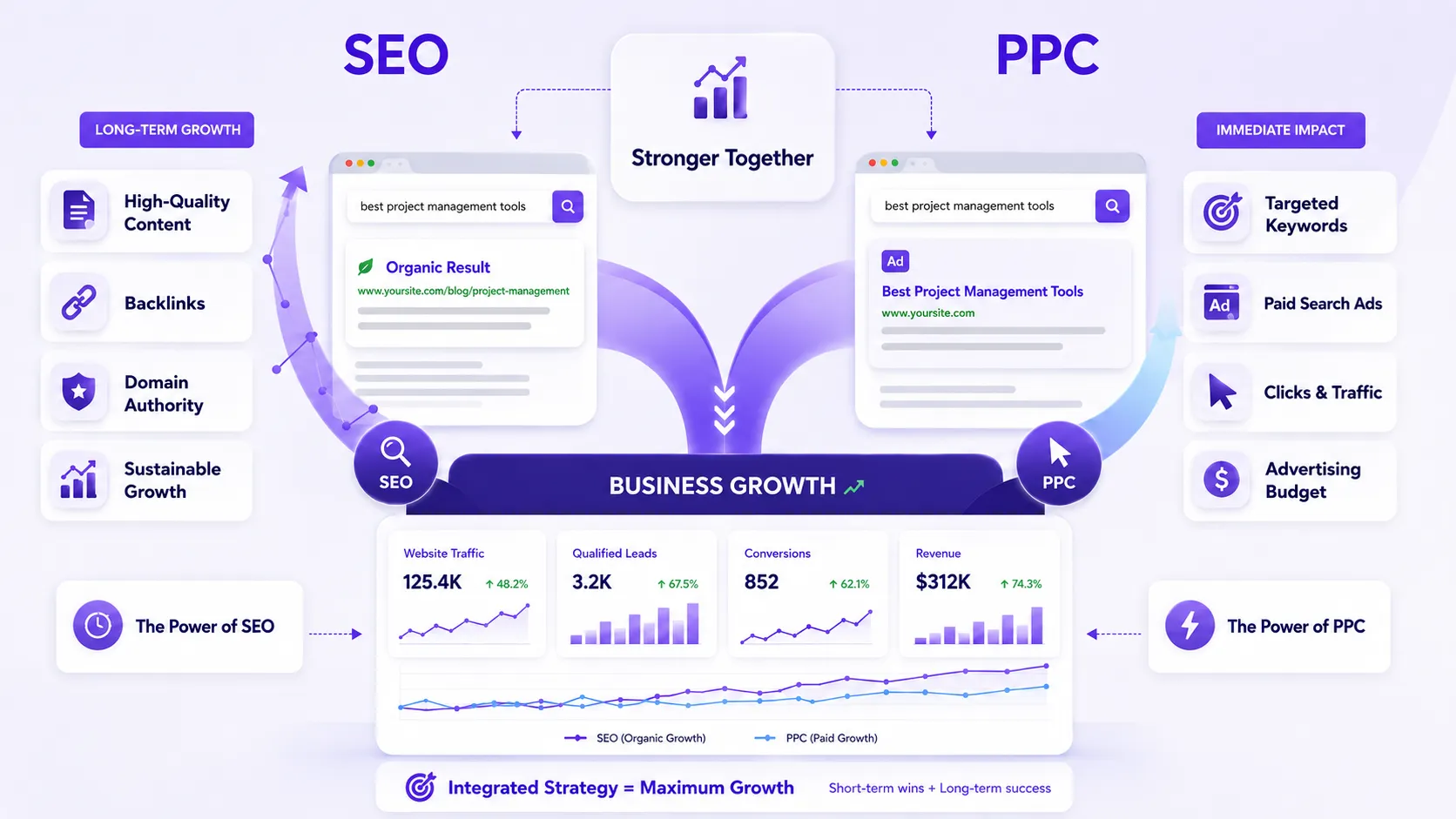
Yes, and in most cases, this is actually the smarter strategy rather than picking a side. PPC and SEO marketing work well together because they cover each other’s weaknesses. PPC can fill the gap while your organic rankings are still building, giving you visibility and data in the meantime. SEO, in turn, reduces your long-term reliance on paid traffic, so your cost per lead does not scale linearly with your growth.
There is also a data advantage that gets overlooked. Running PPC and SEO marketing side by side gives you keyword and conversion data from paid campaigns that can directly inform your organic content strategy, since you can see exactly which search terms and messages are actually driving conversions, not just traffic.
A common, practical approach looks like this: use PPC to generate leads and gather data early on, while your SEO strategy builds in the background. As your organic rankings mature and start pulling in consistent traffic, you can gradually shift more of your budget away from paid ads for those specific keywords, and reinvest that spend into new campaigns or other growth channels.
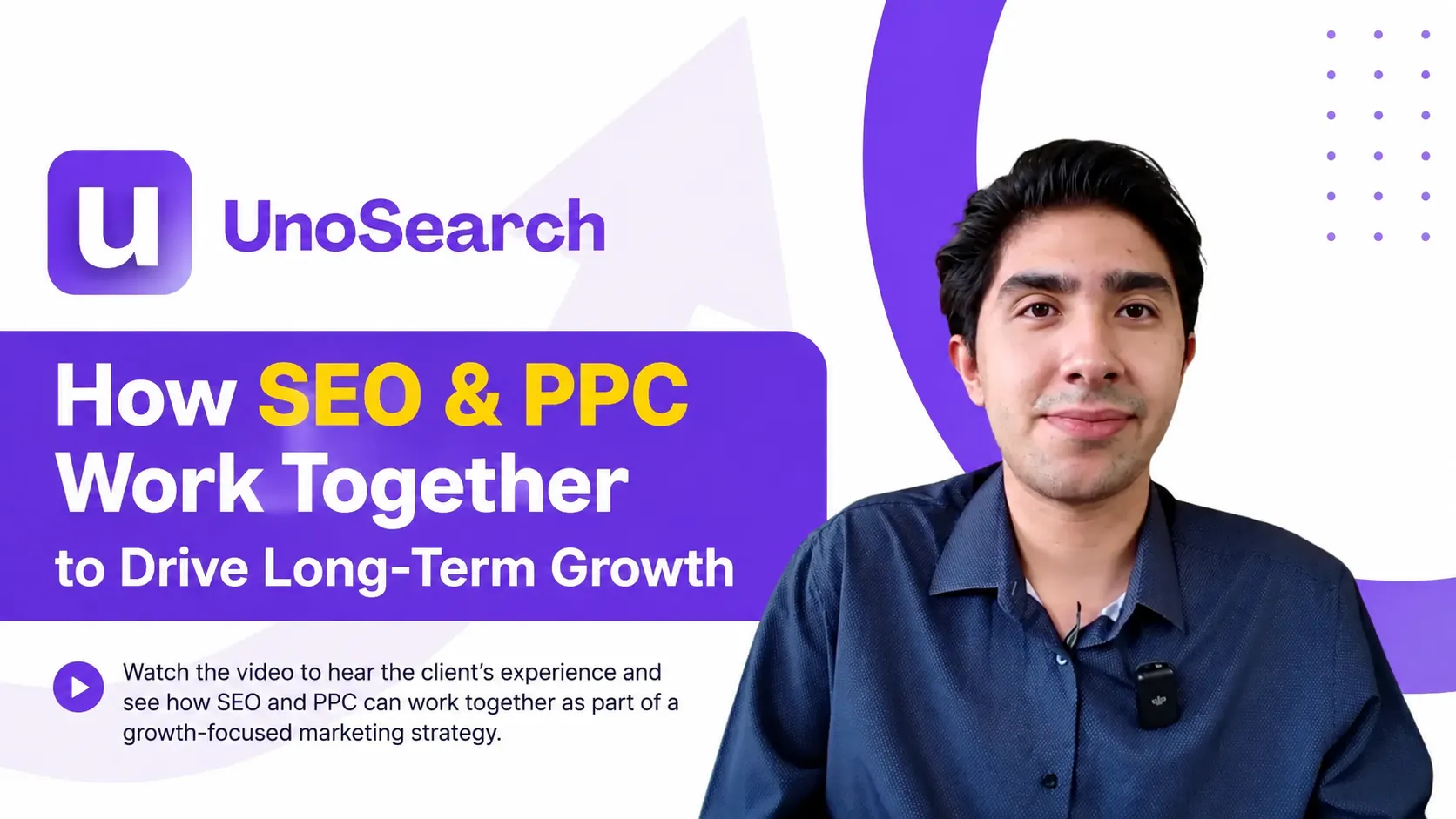
See How SEO and PPC Helped a Real Business Grow
Wondering what is the difference between SEO and PPC looks like in the real world? Hear directly from a UnoSearch client about how our SEO and PPC services helped support their business growth.
In this client story, they share their experience working with UnoSearch and explain how combining organic search visibility with paid campaigns helped their business reach more potential customers and drive growth.
Watch the video to hear the client’s experience and see how SEO and PPC can work together as part of a growth-focused marketing strategy.
What Do the Numbers Actually Say About SEO vs PPC?
Opinions about search engine optimization vs pay per click are easy to find. Reliable numbers are harder to pin down precisely, since click-through rates, conversion rates, and cost benchmarks shift from year to year and vary significantly by industry. Rather than presenting fixed percentages that could be outdated within months, here are the general, well-documented patterns worth understanding before you decide where your budget goes.
| Metric | Organic Search (SEO) | Paid Search (PPC) |
|---|---|---|
| Click-through behavior | Organic listings, particularly the top few positions, tend to capture a substantial share of clicks on most search results pages | Paid ads perform well in the top ad slots, but click share tends to drop off quickly below that |
| Perceived trust among searchers | Frequently reported as more credible in user behavior research, since placement is earned rather than paid for | Clearly labeled as an ad, which leads a portion of users to skip past it deliberately |
| Typical time to meaningful traffic | Builds gradually, often over several months | Can begin the same day a campaign goes live |
| Traffic after spend stops | Tends to continue, though it can decay over time without ongoing upkeep | Stops almost immediately once the budget is paused |
A second, more business-focused way to look at the comparison is through cost and lead quality.
| Metric | SEO | PPC |
|---|---|---|
| Cost per lead over time | Tends to decrease as rankings mature, since traffic is not paid per click once a page ranks well | Stays relatively consistent, since every lead still originates from a paid click |
| Lead quality, as reported in marketing surveys | Organic visitors are often further along in their research, which some marketers associate with stronger close rates | Lead volume can be higher and faster to generate, though quality varies more with targeting |
| Budget flexibility | Requires sustained investment regardless of short-term results | Can be paused, scaled up, or scaled down almost immediately |
An Expert's Take on Choosing Between SEO and PPC
Expert insight: Marketers who manage both channels regularly tend to agree on one thing: the “SEO versus PPC” framing itself is a bit misleading. The businesses that get the most value rarely treat it as a choice between the two. They treat PPC as the fast lane for immediate visibility and real-time keyword data, and SEO as the compounding asset that gradually reduces how much they need to rely on that fast lane. Judging either channel in isolation, without asking how it fits into the other, is one of the most common ways businesses misjudge which one is “working.”
For a deeper look at how paid search pricing actually behaves in practice, Search Engine Land covers ongoing PPC trends and auction dynamics that are worth following alongside your own campaign data.
Mistakes People Make When Comparing SEO and Paid Ads
A few patterns come up again and again when businesses try to decide between the two, or judge which one is “working better.”
Comparing them on the same timeline.
Judging a three-month-old SEO campaign against a three-month-old PPC campaign is not really a fair comparison, since SEO is often just beginning to show results at that point.
Turning off PPC the moment SEO starts working
This can create a visibility gap if your organic rankings are not yet strong enough to fully replace the traffic PPC was bringing in.
Ignoring the data PPC generates.
Paid campaigns often reveal exactly which keywords and messages convert, and that insight is frequently underused in shaping the content strategy behind SEO.
Assuming SEO is free.
It is not paid per click, but it still requires ongoing investment in content, technical maintenance, and link building to stay competitive.
Treating PPC as a permanent solution rather than a bridge.
PPC can be a strong long-term channel too, but many businesses use it as a stopgap without ever building the organic presence that would reduce their dependence on it.
How Unosearch Can Help With Your PPC and SEO Marketing
If you are still weighing search engine optimization against pay per click, or you are already running one and wondering whether the other deserves a slice of your budget too, that is exactly the kind of decision Unosearch helps businesses work through.
Trying to figure out whether SEO or PPC fits your timeline?
Unosearch’s PPC management services can get you visible while your organic strategy builds in the background.
Want a long-term organic strategy that reduces your reliance on ad spend?
Unosearch’s SEO services are built around measurable growth, not just rankings.
Not sure how to combine both into one coherent plan?
Unosearch’s digital marketing services bring PPC and SEO marketing together under one strategy instead of treating them as separate, disconnected efforts.
If you are also curious what PPC specifically costs before committing a budget, our guide on
how much Google PPC costs breaks that down with real 2026 benchmarks.
What Do Unosearch's SEO and PPC Packages Cost?
If you would rather see clear, upfront pricing instead of estimating your own budget from scratch, Unosearch publishes its packages and rates directly. You can view current SEO and PPC plans on the Unosearch pricing page, so you know exactly what you are paying for before you commit to either channel.
Frequently Asked Questions
What is the main difference between SEO and PPC?
SEO earns visibility through relevance and authority over time, without paying per visitor. PPC buys visibility immediately through an auction, and you pay for every click for as long as the campaign runs.
Is SEO better than paid ads?
Neither is universally better. SEO tends to win for long-term, compounding growth, while PPC wins when you need visibility and leads quickly. Most businesses benefit from using both, weighted differently depending on their stage of growth.
How long does SEO take compared to PPC?
PPC can generate traffic within hours of launching a campaign. SEO often takes several months to show meaningful movement, although the timeline varies significantly by website, competition, and industry.
Should a new business start with SEO or PPC?
A brand-new website often has little organic authority to compete on right away, so many businesses start with PPC to generate early visibility and leads, while building SEO in parallel for the long term.
Can PPC data actually help my SEO strategy?
Yes. PPC campaigns reveal which keywords and messages convert in real time, and that data can directly inform which topics and terms are worth investing in for organic content.
References
- Backlinko: Organic Click-Through Rate Research
https://backlinko.com/google-ctr-stats - HubSpot: State of Marketing Report
https://www.hubspot.com/marketing-statistics - Search Engine Land: SEM and Paid Search Coverage https://searchengineland.com/library/channel/sem
Social Media Marketing for E-Commerce: From Reach to Revenue
Posting product photos and hoping for sales is not a strategy. Social media marketing for e-commerce works when you build it the same way you build any other growth channel: with a clear budget, the right platforms, and numbers you can actually measure. This guide...
PPC for E-Commerce: A Profit-First Guide to Paid Ads That Pay Off
Every click on your ad costs money. So the goal is not more clicks. The goal is clicks that turn into profit. PPC for e-commerce puts your products in front of shoppers who are ready to buy. Done well, e-commerce pay per click brings fast, measurable sales. Done...
SEO for Lawyers: How to Get Found by Clients on Google
SEO for lawyers is the practice of improving your website so your firm can appear when people search Google for legal help. Most people looking for legal assistance begin their search online, and firms that appear prominently in those results are more likely to...
Hire your SEO expert Today!