
SEM vs SEO: What’s the Real Difference? (2026 Guide)
Ask five marketers to define SEM and you will probably get three different answers, and that is not really anyone’s fault. It is genuinely a term that has drifted in meaning over the past decade, which is part of why sem vs seo keeps coming up as its own search. Before this turns into a strategy conversation, it helps to sort out what the words even mean, because a good chunk of the confusion here has nothing to do with tactics and everything to do with vocabulary that shifted without anyone announcing it.
Looking for an SEO agency?
UnoSearch helps brands rank higher and drive real organic growth.
Get Free Proposal2. SEM and SEO Differences
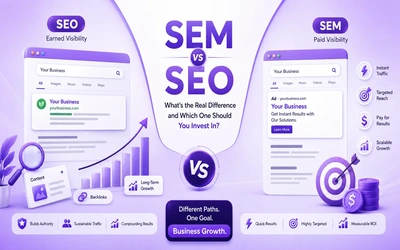
SEM vs SEO, and Why Does It Confuse Everyone?
Quick Answer :
Expert Insight : The terminology around SEM has changed over time. Search Engine Land notes that “search engine marketing” was historically used as a broader term covering both SEO and paid search, while many marketers today use SEM specifically to mean paid search advertising. The American Marketing Association, meanwhile, still uses the broader definition of SEM to include both SEO and paid search.
Here’s how that happened:
The original definition:
Search engine marketing was commonly treated as the broader discipline of marketing through search engines, including both organic search optimization and paid search.
The shift in everyday use:
Over time, many marketers began using SEM as shorthand for paid search, particularly Google Ads and other keyword-based advertising.
Why the confusion remains:
Both definitions still appear in reputable marketing resources. Some sources treat SEO as a part of SEM, while others use SEM and SEO as two separate channels.
What matters in practice:
When someone asks about sem vs seo today, they usually want to understand the practical difference between organic search visibility and paid search advertising.
What Is the Difference Between Search Engine Marketing and Search Engine Optimization?
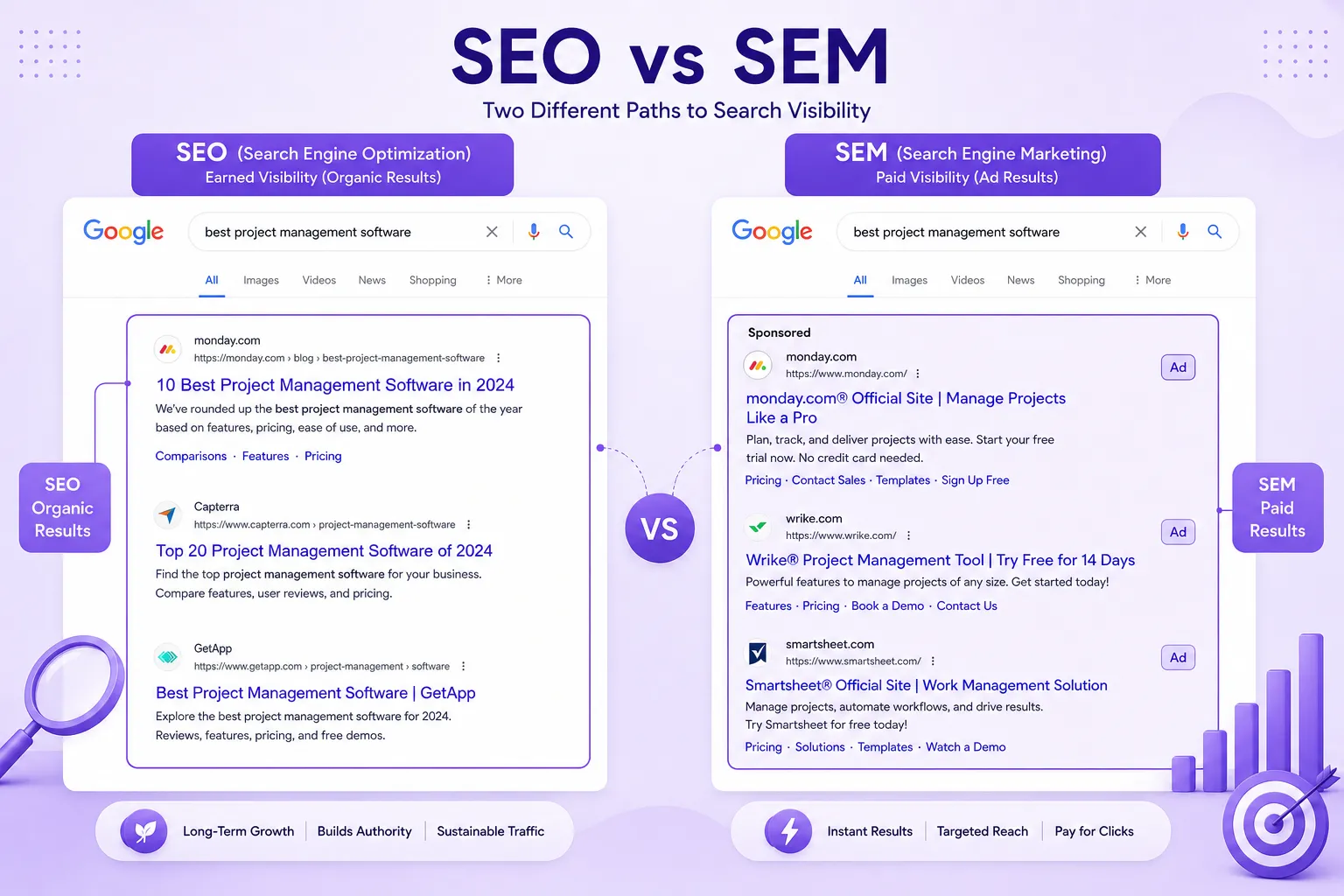
SEO
SEM
Here’s the side-by-side breakdown:
| Factor | SEO | SEM (Paid Search) |
|---|---|---|
| You pay for | Content, technical work, link building | Every click your ad receives |
| Your position depends on | Relevance, authority, technical quality | Your bid combined with ad quality |
| First meaningful traffic | Usually months out | Same day the campaign launches |
| What happens if you stop | Traffic tends to fade slowly | Traffic stops almost immediately |
| How it appears on the page | Unmarked, earned placement | Clearly labeled as sponsored |
Should SEO and SEM Marketing Be Managed as Separate Budgets?
The reverse is also true:
If a page is already ranking organically for a keyword and converting well, that is a strong hint you may be overpaying to bid on that same keyword in SEM, since you are essentially paying for clicks you were already getting for free.
The practical takeaway:
Should I Choose SEO or SEM First for My Business?
If your site is brand new
There is no history yet for Google to trust, so SEO alone will leave you invisible for a while. SEM fills that gap immediately, buying visibility while your organic presence has time to establish itself.
If you already get decent traffic but ad costs keep rising
That usually signals SEO has been underinvested in. Shifting some budget toward content and technical fixes could lower your cost per visitor over time.
If you are testing a new offer or messaging angle
You may not yet know what resonates, and SEM gives you an answer in days. Building SEO content around an unproven message is a slower, riskier way to find out the same thing.
If your business depends on repeat, branded searches
People typing your company name directly into Google, that outcome is almost entirely built through SEO and reputation. No amount of SEM spend creates that kind of recognition on its own.
Can SEO and SEM Marketing Actually Work Together?
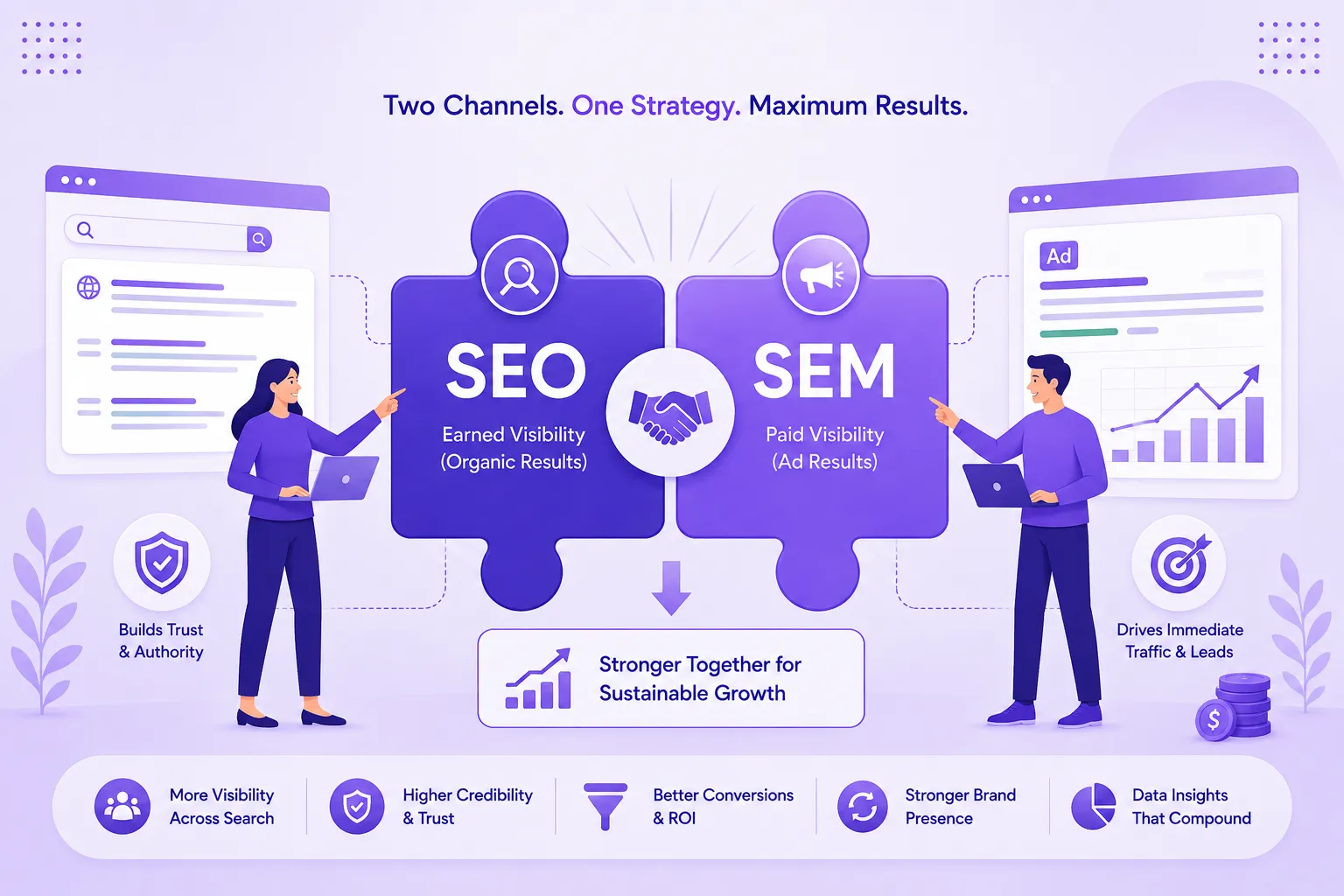
SEM carries the visibility load
SEO gradually reduces how dependent the business is on paid spend
Together, they smooth over the awkward middle stretc
What Do the Numbers Say About SEM vs SEO?
You will find plenty of articles quoting exact percentages for organic versus paid click-through rates, or precise cost comparisons between the two channels. Treat those numbers carefully. Search behavior studies get republished constantly, methodologies differ between them, and a figure that was accurate two years ago is not guaranteed to hold today.
| Pattern | SEO | SEM (Paid Search) |
|---|---|---|
| Click-through behavior | Organic listings, especially the top few positions, tend to capture a meaningful share of clicks on most results pages | Paid ads perform strongly in the top ad slots, though click share tends to drop off quickly further down |
| User trust | Frequently reported as more credible in search behavior research, since placement is earned rather than paid for | Clearly labeled as sponsored, which leads a portion of users to skip past it deliberately |
| Cost behavior over time | Tends to decrease per visitor as rankings mature | Stays relatively consistent, since every click carries a cost regardless of campaign age |
What Mistakes Do Businesses Make When Comparing SEM and SEO?
A few recurring missteps are worth naming plainly.
Judging both channels by the same timeline.
SEO and SEM produce results at different speeds, so a three-month comparison does not necessarily give either channel a fair evaluation.
Treating paid and organic traffic as interchangeable.
Both can bring visitors, but they play different roles in building visibility, acquiring customers, and sustaining traffic.
Optimizing for clicks instead of business outcomes.
More traffic does not automatically mean more revenue. The real comparison should include conversions, customer value, and acquisition costs.
Using SEM data without feeding it back into SEO.
Search terms, ads, and conversion data can reveal what messaging resonates, giving SEO teams useful insights for content and keyword strategy.
Expecting SEO to become completely free once rankings improve.
Organic traffic does not have a per-click cost, but maintaining visibility still requires ongoing content, technical improvements, and authority building.
Switching off one channel too quickly.
SEO and SEM often work best when their roles change over time rather than when one is suddenly replaced by the other.
See How SEO and SEM Helped a Real Business Grow
Wondering what is the difference between SEO and PPC looks like in the real world? Hear directly from a UnoSearch client about how our SEO and SEM services helped support their business growth.
In this client story, they share their experience working with UnoSearch and explain how combining organic search visibility with paid campaigns helped their business reach more potential customers and drive growth.
Watch the video to hear the client’s experience and see how SEO and SEM can work together as part of a growth-focused marketing strategy.
How Can UnoSearch Help With My SEO and SEM Strategy?
If you are trying to work out how to split attention and budget between organic and paid search, this is a question UnoSearch fields regularly from businesses in exactly that spot.
1. Need visibility while your SEO groundwork is still being laid?
UnoSearch’s PPC management services keep your brand visible while organic rankings develop.
2. Ready to reduce your dependence on ad spend?
3. Want SEO and SEM working together?
Frequently Asked Questions
What is SEM vs SEO in simple terms?
Is SEM the same thing as PPC?
What is the difference between search engine marketing and search engine optimization for a new business?
Can SEO and SEM marketing actually help each other?
Why does the definition of SEM keep causing confusion?
References
1. Backlinko — Organic Click-Through Rate Research
https://backlinko.com/google-ctr-stats
2. Google Ads Help — How Auction-Based Bidding Works https://support.google.com/google-ads/answer/1704431
3. Search Engine Land — SEM and Paid Search Coverage https://searchengineland.com/library/channel/sem
Continue Learning About SEO & AI Search
Social Media Marketing for E-Commerce: From Reach to Revenue
Posting product photos and hoping for sales is not a strategy. Social media marketing for e-commerce works when you build it the same way you build any other growth channel: with a clear budget, the right platforms, and numbers you can actually measure. This guide...
PPC for E-Commerce: A Profit-First Guide to Paid Ads That Pay Off
Every click on your ad costs money. So the goal is not more clicks. The goal is clicks that turn into profit. PPC for e-commerce puts your products in front of shoppers who are ready to buy. Done well, e-commerce pay per click brings fast, measurable sales. Done...
SEO for Lawyers: How to Get Found by Clients on Google
SEO for lawyers is the practice of improving your website so your firm can appear when people search Google for legal help. Most people looking for legal assistance begin their search online, and firms that appear prominently in those results are more likely to...