
Local SEO for Lawyers: How Law Firms Win the Map Pack in 2026
Google shows three firms in the Map Pack and hides the rest. This guide explains what decides which three, using Google’s own guidelines, the 2026 Local Search Ranking Factors survey and the bar rules that limit what attorneys can do.
By Pankaj Shrivastava, CEO & Co-Founder, UnoSearch | Published October 1, 2026 | Updated October 3, 2026 | 20 min read
Checked against: Google Business Profile guidelines, Whitespark 2026 ranking factors, BrightLocal 2026 review survey, ABA Model Rules. How we researched this
1. What local SEO for lawyers is?
2. The legal search page in 2026
3. What moves rankings
4. Google Business Profile
5. Attorney and office profiles
6. Practice-area pages
7. Bar-compliant reviews
8. Citations and directories
9. Local links and PR
10. Fighting Map Pack spam
11. Where firms get stuck
12. Example audit
13. 90-day plan
14. Measuring results
15. LSAs, PPC and local SEO
16. AI search and Ask Maps
17. In-house, agency and cost
18. Expert insights
19. Self-check
20. FAQs
21. About the author
22. References
It’s 11:20 on a Tuesday night, and someone has just left the emergency room after a car accident. Worried about the bills, they type “car accident lawyer near me” into their phone. Three firms appear on the map, and they call the first one that looks credible. They never see the fourth.
That moment is why local SEO for lawyers matters. Legal searches are urgent, each new case is worth a lot to the firm, and the decision rests on trust. People rarely compare ten options. They pick from the handful Google puts in front of them.
You probably know that already. The harder questions are what actually moves rankings for attorneys, which tactics break Google’s rules or your state bar’s, and whether to run the work in-house or hire help. This guide answers each one with sources you can check.
Key takeways:
- Google ranks local results on relevance, distance and prominence. You can’t move your office for every searcher, so relevance and prominence are where the work happens.[3]
- In the 2026 expert survey, the top Map Pack factors are your primary Google category, proximity and the real name of your firm, followed by an address in the city searched, being open at the time of search and a high Google rating.[5]
- The #1 factor for local organic results is a dedicated page for each service. One “Practice Areas” page is not enough.[5]
- Reviews must be earned, not bought. ABA Model Rule 7.2(b), the FTC’s 2024 review rule and Google’s policies all point the same way.[7][9]
- Google retired Business Profile Q&A and the old “Google Screened” LSA badge. Advice built on either is out of date.[11][12]
- Want a second opinion on your firm? Request a local SEO audit.
What is local SEO for lawyers?
Local SEO for lawyers is the work of making a law firm visible when people nearby search for legal help, mainly in Google’s Map Pack, local organic results and AI answers. It covers your Google Business Profile, practice-area and location pages, client reviews, consistent listings across directories, and local links and mentions. The goal is not rankings for their own sake. It is calls and consultations from the kinds of cases your firm wants.
What a legal search page looks like in 2026
Search “divorce lawyer near me” in a US city and you will usually see several different result types stacked on one page. Each one is won differently, so it helps to know which one you are competing for.
| Result type | How you get there | How you pay |
|---|---|---|
| Local Services Ads (top) | Pass Google’s verification, then bid. Since October 2025 these show a single “Google Verified” badge.[12] | Per lead |
| Google Ads (search ads) | Bid on keywords | Per click |
| Map Pack (3 listings) | Business Profile, proximity, reviews, website signals | Free (organic) |
| Organic results | Practice-area pages, links, authority. Directories such as Avvo, Justia and FindLaw often hold these spots. | Free (organic) |
| AI Overviews, AI Mode, Ask Maps | Consistent facts across the web, reviews, mentions on trusted sites | Free (organic) |
This guide focuses on the organic local spots: the Map Pack, local organic results and AI answers. We cover how ads fit alongside them further down.
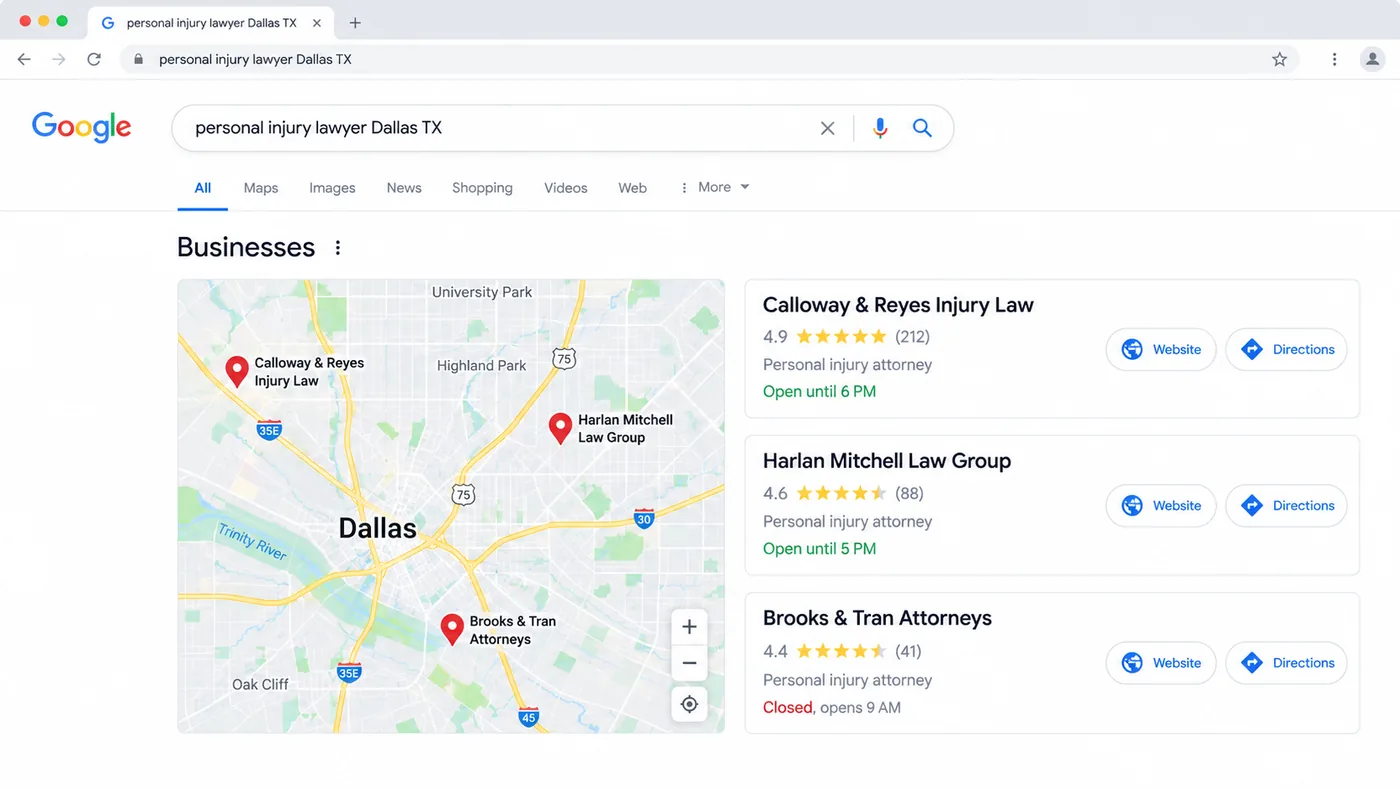
What the Map Pack looks like for a legal search: three firms, one decision. Illustrative example. Firm names are fictional.
What moves local rankings for law firms (2026 data)
Google confirms only the broad framework: relevance (how well your profile matches the search), distance (how far you are from the searcher or the location they typed) and prominence (how well known and well reviewed you are across the web). Google also states that you cannot pay for a better local ranking.[3]
For the detail, the most cited source is Whitespark’s Local Search Ranking Factors survey of local SEO practitioners, published in November 2025 as the 2026 edition.[5] It is expert opinion, not Google documentation, but it is the closest thing the industry has to a consensus. Here is what tops each list, and what it means for a law firm.
Top Map Pack factors, translated for attorneys
| # | Factor (Whitespark 2026) | What it means for your firm |
|---|---|---|
| 1 | Primary GBP category | Pick the category for the cases you most want, such as “Personal injury attorney”, rather than a generic “Law firm.” |
| 2 | Proximity to the searcher | You cannot change this for each search. You can add genuine, staffed offices where your clients are. |
| 3 | Keywords in the business name | Only your real-world business name counts. Adding “Car Accident Lawyer” when it is not part of your actual name can risk suspension. |
| 4 | Physical address in the city searched | Firms generally rank most easily in the city where their office is actually located. |
| 5 | Open at the time of search | Keep your hours accurate. Many legal searches happen at night, so list real hours and staff intake accordingly. |
| 6 | High Google rating (4–5 stars) | Rating quality matters as much as the number of reviews. |
| 9, 11, 14 | Review count, recency, and steady flow | A steady flow of reviews is better than a one-time burst of reviews. |
Source: Whitespark, 2026 Local Search Ranking Factors, Local Pack/Maps list.[5]
Three other findings from the same survey are worth acting on:
- Local organic results reward focus. The top local organic factor is a dedicated page for each service, followed by city and neighborhood relevance in your content and the quality of links to your site.
- AI visibility rewards reputation off your site. The top AI search factor is being named on expert-curated “best of” lists, followed by service pages and prominence on industry sites. For lawyers, that means legal directories, bar recognitions and local press.
- Some old tactics now hurt. Negative factors include a virtual office address, other profiles in the same category at the same address, review gating, too many reviews too fast and keyword stuffing in the business name.
Google Business Profile for lawyers: the setup that matters
Your Business Profile is the foundation of Map Pack visibility. Every rule below comes from Google’s published guidelines, because a suspended profile ranks nowhere.[4]
- Name. Use the name on your sign, letterhead and website. Practitioner profiles may include a title such as Esq. or JD. Taglines, practice areas and city names that aren’t part of your real name are not allowed.
- Address. Use a real office. Google says a virtual office isn’t eligible, and a co-working office only qualifies if it has permanent signage and is staffed during your listed hours. If you meet clients only at their homes or by video, set up as a service-area business and hide the address.
- Primary category. Choose the single most specific category for your main practice, such as Personal injury attorney, Family law attorney, Criminal justice attorney or Estate planning attorney. Add secondary categories only for practices you genuinely handle at that office. Google asks for the fewest categories that describe your core business.
- Hours. List the hours when someone answers. If your intake line is staffed after hours, make sure the profile reflects that honestly.
- Phone. Use a local number you control. Use call tracking on your website if you like, but keep your main local number on the profile so your name, address and phone match everywhere.
- Services and description. List each practice area as a service. Write a plain description of who you help and where. Google doesn’t allow links or promotional pricing in the description.
- Photos. Upload real photos of your office exterior, signage, reception and attorneys. Stock and AI-generated images are flagged as negative factors in the 2026 survey.[5]
- Booking and posts. Add a consultation booking link. Use posts for genuine updates such as office news, new attorneys or community events, not keyword-stuffed filler.
Out-of-date advice to ignore:
Many guides still tell lawyers to “seed your Q&A section.” Google shut down the Business Profile Q&A API in November 2025 and began removing the public section in December 2025, replacing it with an AI “Ask” feature in Google Maps that answers questions from your profile, reviews and website.[11] Put your common client questions on your website and in your profile details instead.
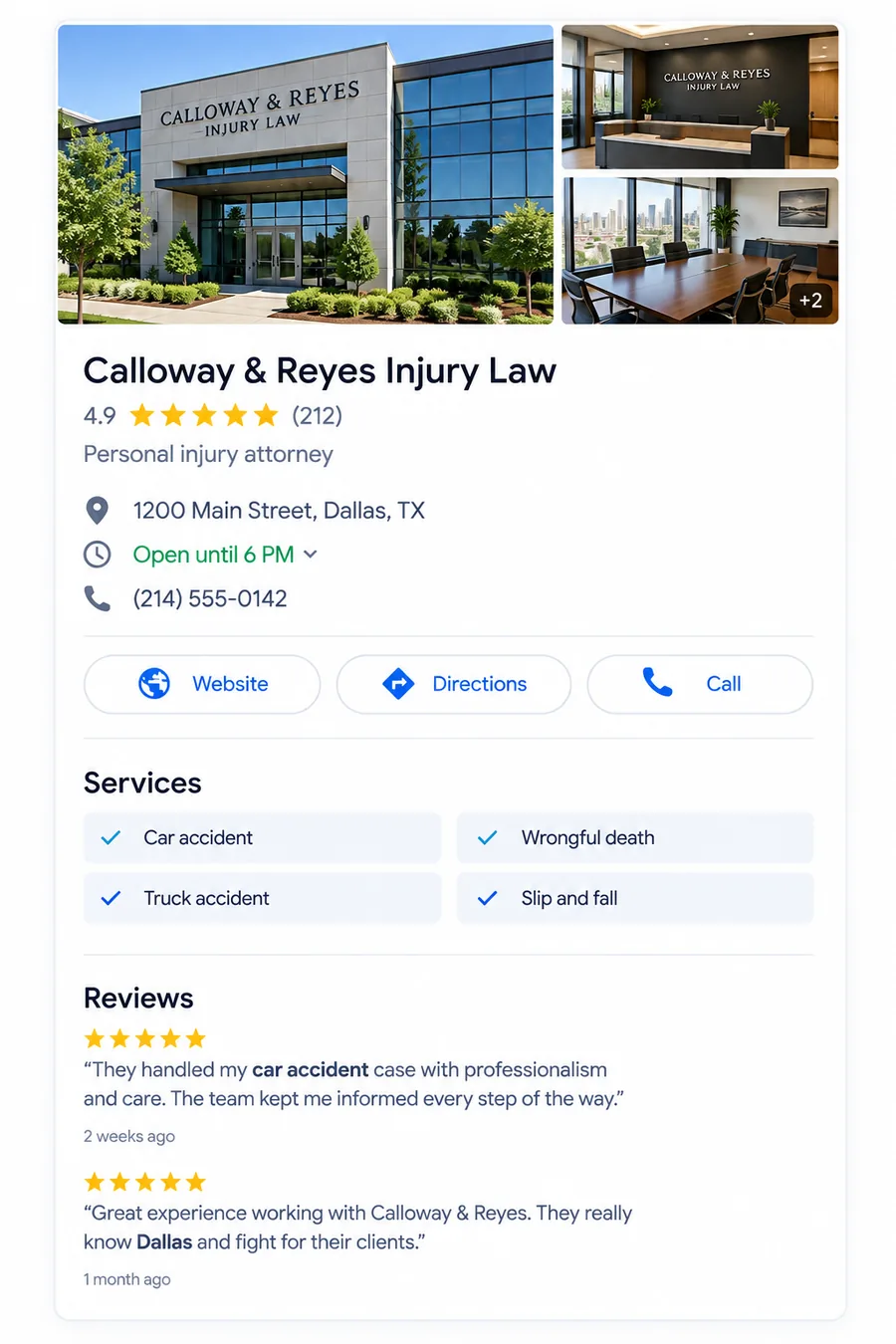
A complete Google Business Profile for a law firm. Illustrative example. Firm details are fictional.
Attorney profiles, multiple offices and "the filter"
Law firms are one of the few business types Google allows to have extra profiles, because lawyers count as individual practitioners. The rules are specific:[4]
- A public-facing attorney who can be reached at the office during stated hours may have their own profile. Support staff may not.
- Where several attorneys work at one location, the firm gets its own profile and each attorney profile carries only the attorney’s name, not the firm’s.
- A solo attorney at a branded firm should share one profile named “Firm: Attorney Name”.
- Each genuine, staffed office gets one profile. No duplicates for the same location.
Extra attorney profiles are not free visibility. When several profiles at one address share the same category, Google tends to show only one and filter the rest, and the 2026 survey lists this as a top negative factor.[5] A sensible pattern is to give the firm profile your main practice category and give attorney profiles categories that match each attorney’s own focus, so they don’t compete with each other.
Practice-area and location pages that rank
A single “Practice Areas” page cannot rank for every case type in every city. Give each core practice its own page, and give each office its own location page.
| Page | Example URL | What makes it worth ranking |
|---|---|---|
| Practice area | /personal-injury/ |
Explain how these cases work, what clients should do first, fees, and the attorneys who handle them. |
| Practice + city | /personal-injury/austin/ |
Cover local courts and venues, state deadlines, and local case results with required disclaimers. |
| Office location | /locations/austin/ |
Match the address on your profile, include an embedded map, parking details, directions, and attorneys at that office. |
What separates a strong page from a thin one is local substance: the county courthouse where cases are filed, the relevant state statute of limitations, the attorneys’ bar admissions, and real results presented the way your state bar requires. Pages that only swap the city name look like spam to Google and to readers. Link each location page from the matching Business Profile, and make sure the name, address and phone on the page match the profile exactly, since that match is a top-15 Map Pack factor.[5]
Add structured data to these pages. Use LegalService or Attorney markup with your name, address, phone, hours and areas served, and Person markup on attorney bios. Don’t mark up third-party reviews on your own site, which the 2026 survey also lists as a negative signal.
Getting reviews without breaking bar rules
Reviews influence both ranking and the choice a client makes. In BrightLocal’s 2026 survey of US consumers, 97% read reviews for local businesses, and 31% will only use a business rated 4.5 stars or higher, up from 17% a year earlier.[6]
For lawyers, three sets of rules shape how you can ask:
- ABA Model Rule 7.2(b) bars giving anything of value to someone for recommending your services. Treat any gift, discount or entry into a draw in exchange for a review as off-limits. Most states have adopted a version of this rule, so check yours.[7]
- The FTC’s rule on consumer reviews, in effect since October 2024, prohibits fake reviews, buying reviews and suppressing negative ones.[9]
- Google’s policies forbid review gating, which means asking only happy clients or screening clients before sending the review link.
A compliant review process
At the close of every matter, send every client the same short request with a direct link to your Google review form.
Ask clients to describe their experience in their own words. Don’t script what they say or ask them to name a case type or city.
Never offer anything in return, and never write or post reviews for clients.
Spread requests over time as matters close. A steady flow is both safer and stronger than a burst.
Responding to reviews
Respond to every review, but remember confidentiality. ABA Formal Opinion 496 says lawyers may not reveal client information when responding to online criticism, even to defend themselves.[8] A safe reply to a negative review looks like this:
“We take every concern seriously. Our professional obligations prevent us from discussing any client matter in a public forum. If you would like to talk, please call our office at [number].”
Citations and legal directories
A citation is any listing of your firm’s name, address and phone. Inconsistent details confuse search engines and clients. The 2026 survey gives more weight to consistency on Google, Bing and Apple Maps than to long tails of minor directories.[5]
| Priority | Where to be listed | Why |
|---|---|---|
| First | Google Business Profile, Apple Business Connect, Bing Places | These are the maps and local search platforms people actually use. |
| First | Your state bar’s lawyer directory | It is authoritative and expected for attorneys. |
| High | Avvo, Justia, FindLaw, Martindale-Hubbell, Lawyers.com | These sites can rank in organic search results and are frequently cited by AI tools. |
| Earned | Recognitions such as Best Lawyers or Super Lawyers | “Best of” lists were identified as a top AI visibility factor in the 2026 survey. |
| Support | Yelp, BBB, local chamber of commerce, data aggregators | They help maintain business information consistency and local relevance. |
Start with a cleanup of what already exists. Old suite numbers, former partners’ names and retired phone numbers are common in law firm listings and are often the quickest fix.
Local links, mentions and PR
Local news coverage, bar association pages, law school and community sites all signal prominence, and they also feed the “unstructured citations” that AI tools rely on.[5] Ethical ways for firms to earn them include:
- Commenting on local legal news through expert-sourcing platforms such as Qwoted or Featured.com
- Speaking at CLE programs, bar section meetings or community legal clinics
- Publishing plain-language guides on local issues, such as how to get a crash report in your county
- Sponsoring local events or nonprofits your firm genuinely supports
Avoid buying links. Paying for placement is against Google’s spam policies, and paying a person to recommend you can raise the same Rule 7.2 issue that applies to reviews.
Fighting Map Pack spam
Legal searches attract fake listings: lead-generation shells, keyword-stuffed names and “offices” that are mailboxes. They push real firms down. The 2026 survey counts spam removal as a ranking factor.[5] If you find a competitor’s listing that breaks Google’s rules, suggest an edit in Google Maps, and for repeated or serious cases use Google’s Business Redressal Complaint Form with clear evidence such as photos of the address or the firm’s real name on its website.
Where law firms get stuck
The basics are rarely the real problem. Firms usually lose ground in these areas:
- Strong for your name, weak for the case type. Many firms rank when someone searches their name but never appear for “divorce lawyer in [city],” which is where most new clients start.
- Profiles that compete with each other. Attorney and firm profiles in the same category at one address can filter each other out.
- Several offices, one set of content. Each office needs its own profile, page and reviews. Copied content weakens every location.
- Virtual or shared offices. Listings that bend Google’s address rules risk suspension, which can remove your visibility overnight.
- Advertising rules. Words like “best”, “expert” or “guaranteed” and unqualified case results can create bar compliance problems in profiles, pages and posts. Check your state’s rules before you publish.
What good looks like: an illustrative audit
This example uses a made-up firm to show how an assessment works. Calloway & Reyes Injury Law is a hypothetical five-attorney personal injury firm that ranks well for its own name but rarely appears in the Map Pack for case searches.
| What We Check | Finding | Fix |
|---|---|---|
| Primary Profile Category | Set to “Law firm” | Change to “Personal injury attorney” |
| Attorney Profiles | Three attorney profiles share the firm’s primary category | Align each attorney’s category with their individual focus |
| Practice Pages | One page covers five case types | Build a dedicated page for each case type, then create city-specific pages |
| Reviews | 4.6 rating, but no new reviews in five months | Add a review request to the case-closing checklist |
| Listings | Old suite number appears on three directories | Correct the listings and update the relevant data aggregators |
| Local Mentions | No local mentions in the past two years | Pitch local commentary opportunities and pursue one community sponsorship |
Calloway & Reyes is not a real firm. The findings are for illustration only.
None of these gaps is unusual. Each looks minor on its own, but together they keep a capable firm out of the top three.
A realistic 90-day plan
| Phase | Focus | What You Should See |
|---|---|---|
| Days 1–30 | Audit; fix categories, hours, and NAP; clean up listings; set up call tracking and baseline rank grids | Accurate profiles and a measured starting point |
| Days 31–60 | Launch the review process; publish or rebuild the top two practice-area pages; add structured data | Steady new reviews and early movement on nearby searches |
| Days 61–90 | Build location pages; strengthen directory profiles; secure first local PR and community links; report spam | Wider Map Pack coverage across the grid and more calls from the profile |
Profile fixes can move rankings within weeks. Competitive markets such as personal injury in a large metro usually take several months of steady reviews, content and links. Be wary of anyone who promises a fixed date.
How to measure local SEO results
Rankings are a means, not the result. Track these, in roughly this order of importance:
- Signed cases and cost per signed case from local search, tied to your intake or case management system
- Qualified calls and consultation requests, using call tracking on the website and Business Profile performance data for calls and website clicks
- Geo-grid rankings that show where you appear across your area rather than at a single point, using tools such as Local Falcon or Whitespark’s ranking grids
- Review volume, rating and recency compared with the three firms you most often lose to
Search Console impressions and clicks for practice-area and location pages
Speed of response matters too. A call that rings out at night is a case lost no matter how well you rank.
Local Services Ads, Google Ads and local SEO
Local Services Ads appear above the Map Pack and charge per lead. Lawyers go through Google’s verification, which for attorneys includes bar license and insurance checks, and since October 20, 2025 verified advertisers show a single “Google Verified” badge in place of the old Google Screened label.[12] Your review rating and responsiveness also affect LSA performance, so the review work above pays off twice. Some state bars have examined pay-per-lead arrangements, so confirm your state’s position before you start.
Ads can bring in calls while organic rankings build, but they stop when the budget stops. Most firms do best with local SEO as the base and ads covering gaps in high-value practice areas. See our guide to PPC for lawyers for the paid side.
Local SEO for lawyers and AI search
People now ask ChatGPT, Gemini and Google’s AI features to recommend lawyers. BrightLocal’s 2026 survey found 45% of consumers have used AI tools to find local businesses, up from 6% the year before.[6] Inside Google Maps, the new “Ask” feature answers questions about your firm from your profile, reviews and website.[11]
These tools favor the same things local SEO builds: consistent facts across the web, strong reviews, dedicated service pages and mentions on trusted legal and local sites. Our guide to a GEO audit shows how to check how AI tools describe your firm today.[10]
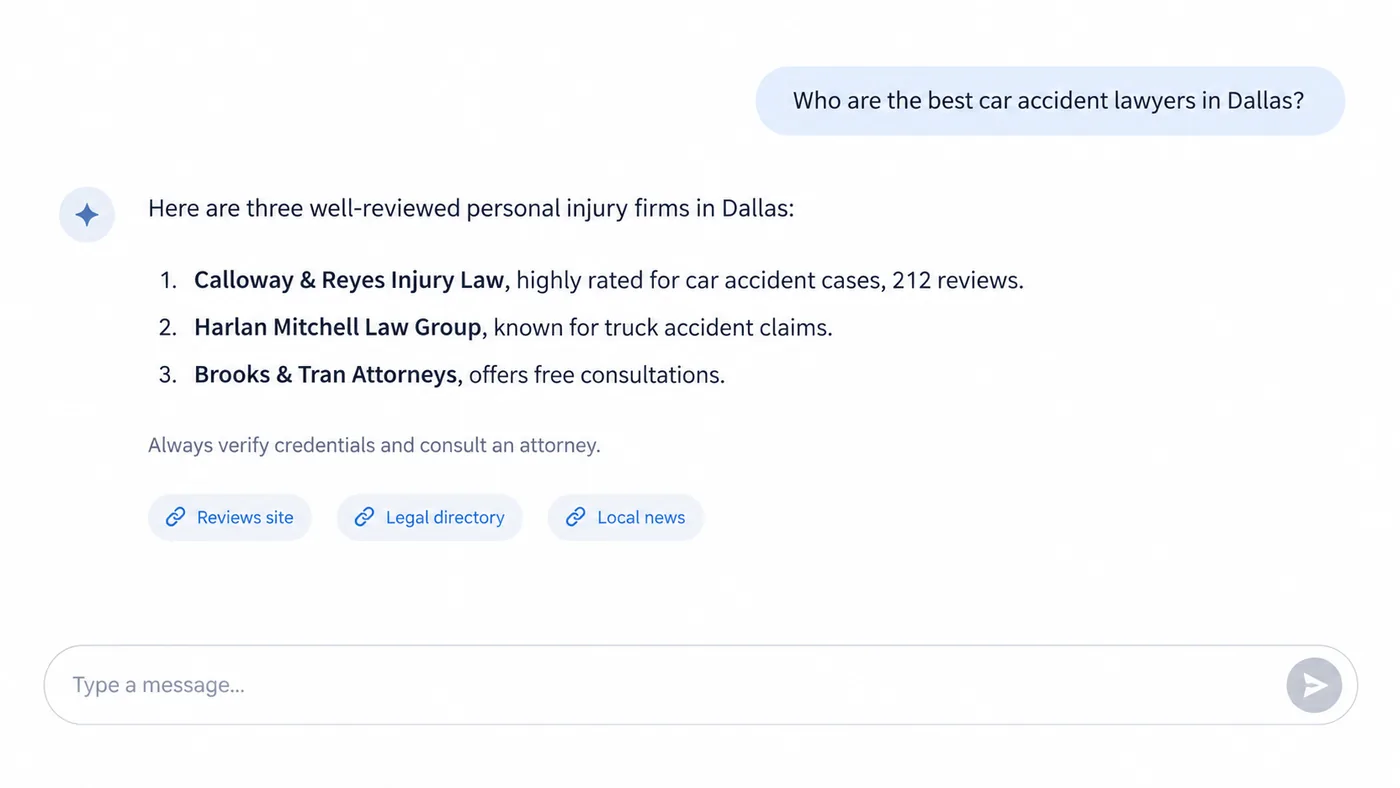
An AI assistant recommending local law firms. Illustrative example. Firm names are fictional.
In-house or agency, and what local SEO costs
In-house works when someone on your team has the time and skill to maintain profiles, reviews, pages and listings every month. Most firms underestimate how much ongoing attention that takes. Outside help makes sense when you have several attorneys or offices, when competitors are well ahead, or when nobody owns the work.
Pricing varies with the number of offices, practice areas and how competitive your market is. As one public reference point, a legal SEO agency lists retainers of $3,000 to $10,000 or more per month for packages that include local work.[13] Whatever the price, ask for a written list of deliverables.
A solid program should include:
- A baseline audit of profiles, website, listings, reviews and competitors
- Profile optimization and ongoing management for every office and attorney
- Practice-area and location pages written with real legal substance
- A review process built around your state bar’s rules
- Local link and mention building through reputable organizations
- Monthly reporting on calls, consultations and signed cases, not just rankings
Red flags when vetting a provider
- A guaranteed #1 ranking or a fixed timeline. Nobody controls Google’s algorithm.
- Adding keywords or a city to your business name, or setting up profiles at virtual offices.
- Review packages, review incentives or “review gating” funnels.
- Bulk citation or link packages with no list of the actual sites.
- No mention of your state bar’s advertising rules.
- Reports that show rankings but not calls or new cases.
Expert insights on local SEO for law firms
Gyi Tsakalakis, AttorneySync. Source: BrightLocal [1]
Of all local ranking factors, he would pick three: distance, reviews and local links.
Gyi Tsakalakis, AttorneySync. Source: BrightLocal [1]
A law firm’s Business Profile must follow ABA Model Rule 7.2. Use a real office address and never offer incentives for reviews.
Olha Bodnar, Ethos Leads. Source: Attorney at Law Magazine [2]
Local results rely mainly on relevance, distance and prominence. Nobody can pay for a better local ranking.
Google Business Profile Help. Source: Google Help Center [3]
An 8-question self-check
- Does your primary Google category describe the cases you most want?
- Is your profile name exactly the name on your office sign?
- Does each core practice area have its own page on your website?
- Does every staffed office have its own profile and its own location page?
- Do attorney profiles at the same office avoid sharing the firm’s primary category?
- Are your firm name, address and phone identical on Google, Apple, Bing, your state bar and the major legal directories?
- Did you earn new Google reviews in the last 30 days, and did someone respond without revealing client information?
- Can you say how many signed cases came from local search last month?
If you answered no to two or more, there is probably a quick win available.
Related reading: SEO for Lawyers and PPC for Lawyers
Local SEO for lawyers: FAQs
What is local SEO for lawyers?
Local SEO for lawyers is the work of making a law firm visible when people nearby search for legal help, mainly in Google’s Map Pack, local organic results and AI answers. It covers your Google Business Profile, practice-area and location pages, client reviews, consistent directory listings and local links.
How is local SEO for lawyers different from regular law firm SEO?
The two overlap. Local SEO focuses on location signals such as your Business Profile, proximity, reviews and listings, which decide the Map Pack. Regular SEO focuses on content and links across your website, which decide the organic results. Most firms need both.
How long does local SEO take for a law firm?
Profile corrections can move rankings within a few weeks. Competitive practice areas in large cities usually take several months of steady reviews, content and links. Treat any promise of a fixed date with caution
Can each attorney at my firm have their own Google Business Profile?
Yes, if they are public-facing and can be reached at the office during stated hours. When several attorneys share an office, the firm keeps its own profile and each attorney profile uses only the attorney’s name. Give attorney profiles categories that match their own practice so they don’t filter each other out.
Do I need a separate profile for each office?
Yes. Each genuine, staffed office should have one profile, one location page and its own reviews. Virtual offices aren’t eligible, and co-working offices qualify only with permanent signage and staff during listed hours.
Can my firm rank in the Map Pack in a city where we have no office?
Rarely. Proximity and a physical address in the city searched are two of the strongest Map Pack factors. You can still rank in organic results for nearby cities with useful city-specific pages.
Am I allowed to ask clients for reviews?
In most states, yes. Ask every client the same way, never offer anything of value in return, and don’t screen clients before asking. ABA Model Rule 7.2(b), the FTC’s consumer review rule and Google’s policies all prohibit paying for or filtering reviews. Check your own state’s rules.
How should a lawyer respond to a negative review?
Respond briefly and professionally without discussing the matter. ABA Formal Opinion 496 says lawyers may not reveal client information when responding to online criticism. Invite the reviewer to call the office instead.
Should I still add questions to the Q&A section of my Business Profile?
No. Google discontinued Business Profile Q&A in late 2025 and replaced it with an AI Ask feature in Google Maps that answers from your profile, reviews and website. Put common client questions on your website and in your profile details.
What do local SEO services for law firms cost?
It depends on the number of offices, practice areas and market competition. As one public reference point, a legal SEO agency lists retainers of $3,000 to $10,000 or more per month for packages that include local work. Ask for a written list of deliverables.
How we researched this guide
We reviewed Google’s Business Profile guidelines and ranking help page, the Whitespark 2026 Local Search Ranking Factors survey, BrightLocal’s 2026 Local Consumer Review Survey, the ABA Model Rules and Formal Opinion 496, and the FTC’s consumer review rule. We also compared the guides that currently rank for “local SEO for lawyers” to find what they miss or have out of date, such as Q&A seeding and the retired Google Screened badge. Statistics are linked to their original source in the references.

Pankaj Shrivastava
CEO & Co-Founder, UnoSearch
Pankaj Shrivastava is the CEO and Co-Founder of UnoSearch, leading the company’s strategic direction, business growth, and digital marketing initiatives.
10+ Years
of Expertise
60+
Industries Served
AI-First
Digital Growth Strategy
Hyperlocal SEO in action
The same local playbook works across industries. Brightwood Hotel was known for exceptional service but hidden in search results. UnoSearch revamped their Google Business Profile, built relevant backlinks and ran a hyperlocal SEO strategy that lifted their online presence.
Hear how Brightwood gained visibility, direct bookings and global guests.
Whether you need local visibility, a stronger search foundation, or a place in AI-generated answers, here’s where to start.
Local SEO services
Google Business Profile, attorney profiles, local pages, reviews and citations, built for firms competing for the Map Pack.
SEO services
Technical SEO, content and authority work that supports your practice-area pages and local rankings.
GEO services
Get your firm recommended in ChatGPT, Gemini and Google AI Overviews when people ask for a lawyer.
Find out how your firm shows up locally
Share your website, offices and practice areas. We’ll review your profiles, local pages and competitors, and send back a prioritized plan.
References
- Tsakalakis, G. “Local SEO for Lawyers: How to Improve Local Rankings for Attorneys.” BrightLocal, November 16, 2023. https://www.brightlocal.com/learn/local-seo-for-lawyers/
2. Bodnar, O. “At the Intersection of Ethics and Local SEO: Winning Local Clients Without Crossing the Line.” Attorney at Law Magazine, January 31, 2025. https://attorneyatlawmagazine.com/legal-marketing/seo/at-the-intersection-of-ethics-and-local-seo-winning-local-clients-without-crossing-the-line
3. Google Business Profile Help. “How to improve your local ranking on Google.” https://support.google.com/business/answer/7091
4. Google Business Profile Help. “Guidelines for representing your business on Google” (includes individual practitioner and address rules). https://support.google.com/business/answer/3038177
5. Shaw, D. “2026 Local Search Ranking Factors.” Whitespark, published November 6, 2025. https://whitespark.ca/local-search-ranking-factors/
6. BrightLocal. “Local Consumer Review Survey 2026.” February 11, 2026. https://www.brightlocal.com/research/local-consumer-review-survey/
7. American Bar Association. Model Rules of Professional Conduct, Rule 7.2: Communications Concerning a Lawyer’s Services: Specific Rules. https://www.americanbar.org/groups/professional_responsibility/publications/model_rules_of_professional_conduct/rule_7_2_communications_concerning_a_lawyers_services_specific_rules/
8. ABA Journal. “Lawyers must use caution when responding to negative online reviews, new ethics opinion says” (ABA Formal Opinion 496, January 13, 2021). https://abajournal.com/news/article/lawyers-must-use-caution-responding-to-negative-online-reviews
9. Morgan Lewis. “FTC Issues Final Rule on Consumer Reviews and Testimonials.” August 2024. https://www.morganlewis.com/pubs/2024/08/ftc-issues-final-rule-on-consumer-reviews-and-testimonials
10. Shrivastava, P. “GEO Audit: How to Check Your AI Search Visibility.” UnoSearch. https://unosearch.io/blogs/what-is-a-geo-audit/
11. PPC Land. “Google quietly kills Q&A for an AI button most won’t use.” December 2025. https://ppc.land/google-quietly-kills-q-a-for-an-ai-button-most-wont-use/
12. Schwartz, B. “Google To Replace Local Service Ads Badges With One Verified Badge.” Search Engine Roundtable, August 21, 2025. https://seroundtable.com/google-verified-local-service-ads-badge-39975.html
13. The SEO For Law Firms. “Local SEO for Lawyers” (published pricing section), April 2026. https://theseoforlawfirms.com/local-seo-for-lawyers/