
ChatGPT vs Perplexity vs Google AIO: Which to Focus?
Pankaj Srivastava
Published Date: May 15th 2026
Looking for an SEO agency? Talk to UnoSearch
Focus on Google AI Overviews for reach, ChatGPT for high-volume B2B referrals, and Perplexity for high-intent conversions. Google AIO appears in 47% of all US searches, ChatGPT sends 60% of measurable AI referral traffic, and Perplexity drives the highest conversion rate per visit at 4.4x the organic average. The right answer depends on whether your priority is awareness, qualified traffic, or revenue.
The three engines pull buyers in completely different ways, so picking one without context usually means optimising for the wrong outcome. Google AIO sits at the top of the funnel where users still search by habit, ChatGPT captures buyers who already trust conversational AI for research, and Perplexity attracts users who arrive ready to act. Most brands trying to “rank in AI” fail because they treat the three as one channel instead of three distinct surfaces with different mechanics.
“Clients always ask which AI engine matters most. The honest answer is that one of them matters most to your category, and the other two matter to your competitors. The brands winning right now run all three, but weight the budget based on where their buyer actually starts the conversation.” — Pankaj Srivastava, Founder, UnoSearch
ChatGPT vs Perplexity vs Google AIO at a Glance
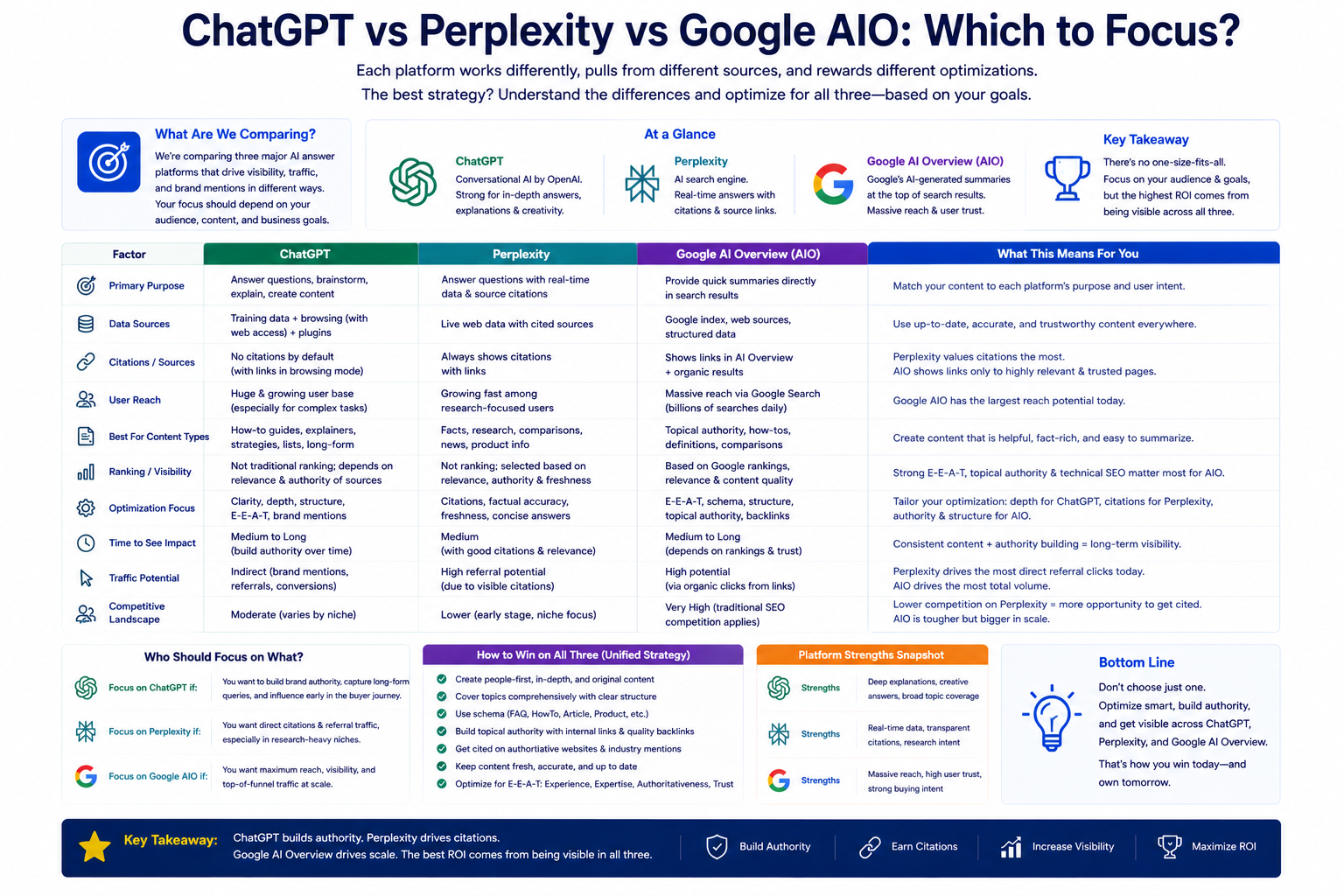
| Parameter | Google AIO | ChatGPT | Perplexity |
| Reach | 47% of US searches trigger AIO | 700M+ weekly active users | 22M monthly users |
| Citation Source | 99% from organic top 10 | 87% from Bing top results | Real-time web + curated sources |
| Conversion Rate | 1.6x organic baseline | 2.8x organic baseline | 4.4x organic baseline |
| Citation Speed | 2 to 8 weeks for new content | 6 to 12 weeks (slow refresh) | Within 2 hours of publication |
| Best For | Top-funnel awareness, broad queries | B2B research, long-tail informational | High-intent commercial queries |
| Optimisation Lever | Schema + organic ranking | Bing ranking + entity signals | Fresh content + Reddit/YouTube mentions |
How do ChatGPT, Perplexity, and Google AIO actually differ in 2026?
The mechanics behind each engine determine which one rewards your content first, and how quickly that translates into business outcomes.
- Google AIO is reach-driven and authority-heavy. Appearing in 47% of US searches, AIO pulls 99% of its citations from the organic top 10, which means strong traditional SEO is the gate. Citation speed sits at 2 to 8 weeks, slower than Perplexity but faster than ChatGPT.
- ChatGPT is the largest AI traffic source by volume. With 700M+ weekly active users, ChatGPT accounts for roughly 60% of measurable AI referral traffic, but its index refresh is slow at 6 to 12 weeks, and 87% of its citations correspond to Bing’s top-ranking pages, making Bing SEO surprisingly important.
- Perplexity is conversion-driven and fast. Despite a smaller user base of 22M monthly, Perplexity delivers AI-referred visitors converting at 4.4x the organic baseline (Semrush 2026), and it cites new content within 2 hours of publication because of its live web retrieval architecture.
- Citation overlap is lower than people assume. Studies show only 21% overlap in cited sources between ChatGPT and Perplexity, and just 14% between ChatGPT and Google AIO. Winning in one engine does not automatically win the others.
- Each engine rewards different content shapes. AIO favours structured Q&A and validated schema, ChatGPT favours topical depth and entity authority, while Perplexity favours fresh content, third-party mentions, and clear factual statements.
Princeton’s GEO research adds one finding that cuts across all three: adding statistics lifts AI citations by 41%, while keyword stuffing reduces visibility by 9 to 10% on every engine tested.
Which AI engine should brands prioritise first?
B2B and SaaS brands should start with ChatGPT and Perplexity in parallel, since 80% of US B2B buyers already use AI for research. Local service businesses, e-commerce, and category-defining brands should start with Google AIO because it touches the broadest top-funnel audience. Brands with strong existing organic rankings get AIO almost for free, since 99% of citations come from the top 10, so the marginal effort is small. Brands without that foundation see faster wins on Perplexity, where fresh, well-structured content can earn citations within hours rather than weeks. Our AI SEO services at UnoSearch map all three engines to one content investment, then weight production based on where each client’s buyers actually start their research.
Why choose UnoSearch for ChatGPT, Perplexity, and Google AIO optimisation?
UnoSearch is a Google Premier Partner with 11+ years of search experience and $13.7M+ in client revenue across 60+ industries. We track citation share weekly across ChatGPT, Gemini, Perplexity, Claude, and Google AI Overviews using prompt panels covering 30 to 50 high-intent queries per client. Our specialists handle technical SEO, schema layering, entity building, Bing ranking optimisation, and Reddit/YouTube digital PR under one roof, because each AI engine rewards a different signal. Every engagement runs through our proprietary DigiOps platform, giving you live visibility into citation share by engine, AI-referred traffic, and conversion impact. Founders sit inside every client channel.
We help brands grow traffic in AI search
FAQ's
1. Can I optimise for all three AI engines with one content strategy?
Yes, but production should be weighted, not duplicated. One content asset can be structured to earn citations across ChatGPT, Perplexity, and Google AIO, but the additional work (Bing ranking for ChatGPT, fresh PR for Perplexity, schema validation for AIO) varies enough that each engine benefits from targeted distribution beyond the core content.
2. Which AI engine sends the most actual traffic in 2026?
ChatGPT, by a wide margin. It accounts for roughly 60% of measurable AI referral traffic because of its 700M+ weekly active user base. Perplexity sends less volume but delivers higher conversion rate per visit, while Google AIO mostly drives zero-click visibility rather than traffic.
3. How do I measure performance across all three engines?
Use a prompt panel of 30 to 50 high-intent queries tested weekly across each engine, combined with AI-referred traffic in GA4 and conversion rate by source. Citation share, not click-through rate, is the leading indicator in 2026.
4. Does ranking in Google still help with ChatGPT and Perplexity?
Yes, indirectly. 87% of ChatGPT citations correspond to Bing’s top results, and Perplexity pulls heavily from indexed organic content, so a strong organic foundation feeds both engines. Pure AIO optimisation, however, depends on Google’s index specifically.
Contact Us for a Free SEO Consultation Today!
Let us help you grow your business with a customized SEO strategy
References
- Semrush, AI Search Conversion Benchmark Report 2026, https://www.semrush.com/blog/ai-search-conversion-2026/
- Princeton GEO Research, Generative Engine Optimization Methods and Visibility Impact, https://arxiv.org/abs/2311.09735
- Ahrefs, AI Referral Traffic Analysis 2026, https://ahrefs.com/blog/ai-referral-traffic-analysis/
- SE Ranking, AI Search Citation Overlap Study 2026, https://seranking.com/blog/ai-search-citation-overlap-2026
Continue Learning About SEO & AI Search
Local SEO for Real Estate: What Works for Agents in 2026
A practical guide to profile setup, reviews, neighborhood pages and AI visibility, including the brokerage rules and measurement problems most guides skip.By Mahendernath Pulidindi, Associate Vice President, UnoSearch · Updated October 10, 2026 ·...
Local SEO for Lawyers: How Law Firms Win the Map Pack in 2026
Google shows three firms in the Map Pack and hides the rest. This guide explains what decides which three, using Google's own guidelines, the 2026 Local Search Ranking Factors survey and the bar rules that limit what attorneys can do.By Pankaj...
Local SEO for Healthcare: A HIPAA-Safe Playbook for US Practices (2026)
Patients usually pick from the three practices Google shows first. This guide covers what decides those three, plus the HIPAA traps in reviews, tracking and listings that most local SEO for healthcare advice skips.By Rajiv Ranjan, CTO, UnoSearch...