
GEO agency vs SEO agency: What to choose?
Pankaj Srivastava
Published Date: May 16th 2026
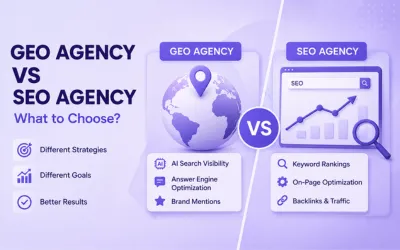
Understand how SEO and GEO differ, where each approach fits, and how to build a visibility strategy that covers both traditional search and AI-driven discovery.

Rajiv Ranjan
CTO, UnoSearch
Read more..
10+ Years
of Expertise
60+
Industries Served
AI-First
Technology & Innovation
Looking for an SEO agency? Talk to UnoSearch
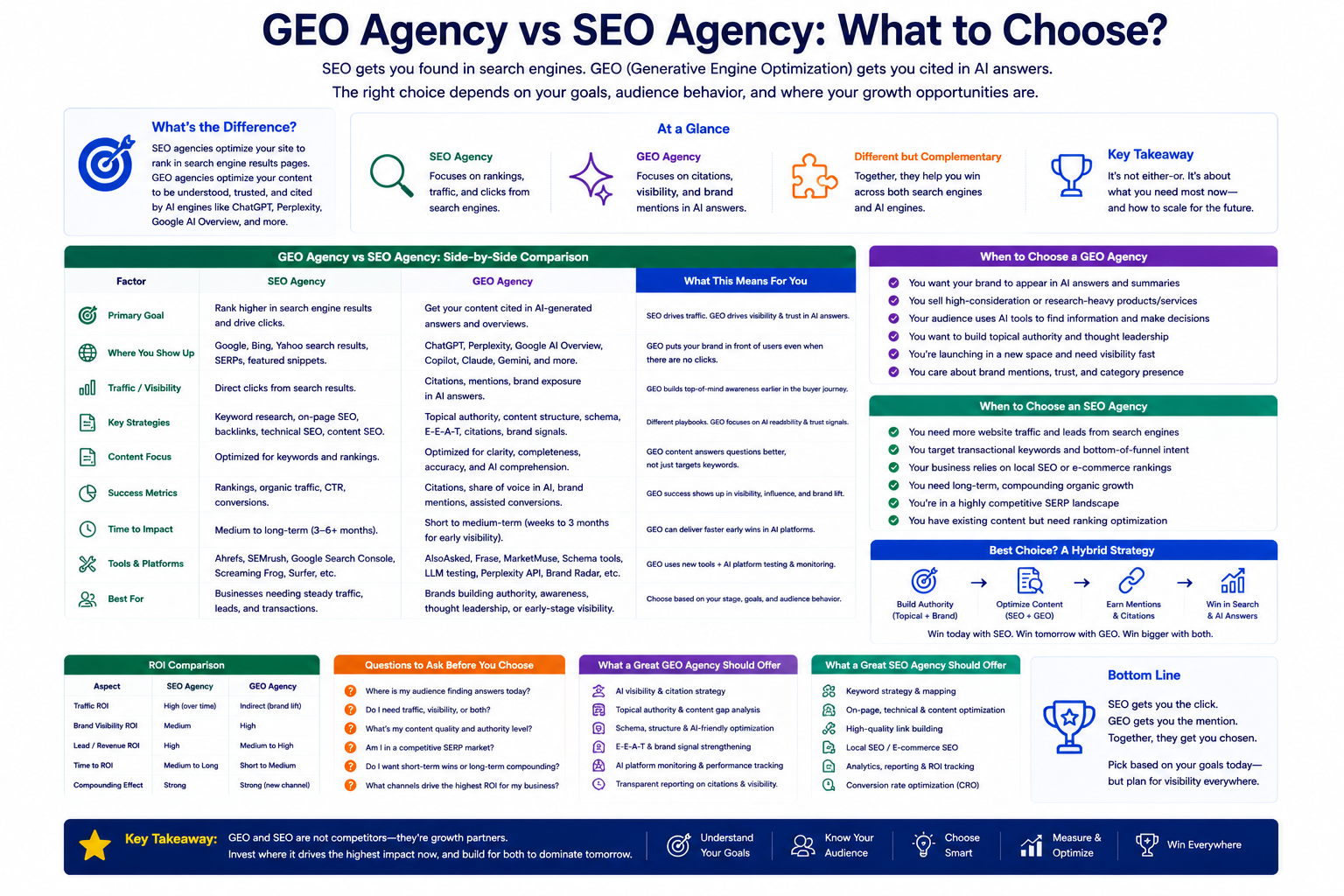
Choose an SEO agency if your buyers still discover you through Google’s organic results and your category has low AI search penetration. Choose a GEO agency if your buyers research on ChatGPT, Perplexity, and Google AI Overviews before deciding. Most brands in 2026 actually need a single agency that does both, because 58.5% of Google searches now end without a click and AI-referred traffic converts at 4.4x the rate of organic visits.
The split between SEO and GEO is real, but the way most agencies sell them as separate disciplines costs clients money. SEO focuses on organic rankings and click-through, while GEO focuses on citations inside AI answers where the click often never happens. Running them in separate budgets means producing duplicate content for two surfaces that share 87% of the same underlying data, which is why integrated agencies are pulling ahead in 2026.
“The agencies still pitching SEO and GEO as two retainers are leaving money on the table for their clients. One content brief, one technical foundation, two surfaces of compounding visibility. That’s the only way the math works at 2026 conversion rates.” — Pankaj Srivastava, Founder, UnoSearch
GEO Agency vs SEO Agency at a Glance
| Parameter | SEO Agency | GEO Agency | Integrated Agency |
| Primary Goal | Rank in Google’s top 10 | Get cited in AI answers | Both, from one content base |
| Core Deliverable | Rankings, organic traffic, CTR | Citation share, AI-referred conversions | Rankings + citation share + revenue |
| Time to First Result | 6 to 12 months | 8 to 12 weeks for citations | 8 weeks for AI, 6 months for organic |
| Conversion Rate | 1.0x baseline | 4.4x baseline (Semrush 2026) | Compounds both surfaces |
| Pricing Model | $2,500 to $15,000 per month | $3,000 to $20,000 per month | Comparable to single retainer |
| Best Fit | Brands in low-AI-adoption categories | B2B, SaaS, high-intent commercial | Most brands in 2026 |
How are GEO agencies actually different from SEO agencies?
The deliverables look similar on paper, but the underlying mechanics, measurement, and content priorities are far apart.
- Different ranking targets. SEO agencies optimise for Google’s blue links, while GEO agencies optimise for citations inside ChatGPT, Perplexity, Gemini, Claude, and Google AI Overviews. 99% of AIO citations come from the organic top 10, so the work overlaps, but GEO adds entity building, schema layering, and prompt-panel tracking that pure SEO agencies typically skip.
- Different content shapes. SEO content optimises for keyword density, internal linking, and backlinks, while GEO content optimises for extractability: short direct answers, statistics, comparisons, and clear hierarchy that LLMs lift cleanly. Princeton research found that adding statistics lifts AI citations by 41%, which most legacy SEO playbooks ignore.
- Different measurement. SEO agencies report rankings and organic sessions, while GEO agencies report citation share across AI engines, AI-referred traffic, and conversion rate by source. Both matter in 2026, but only one tells you what your buyer actually does after the click stops happening.
- Different timelines. Perplexity often cites new GEO content within 2 hours, Gemini follows within days, and ChatGPT lags 6 to 12 weeks because of its slower refresh cycle. Traditional organic ranking shifts still take 6 to 12 months, which is why GEO shows ROI faster while SEO compounds longer.
- Different commercial models. SEO retainers are typically $2,500 to $15,000 per month tied to keyword targets, while GEO retainers run $3,000 to $20,000 per month tied to citation share goals. Integrated agencies usually quote within the same range as a senior SEO retainer, because the underlying production overlaps.
SE Ranking’s 2026 analysis adds one finding worth flagging: brands running SEO and GEO under separate agencies show 31% slower citation growth than brands using a single integrated team, mostly because the two teams duplicate research and miss cross-surface signals.
Which agency model should brands choose in 2026?
For brands in B2B, SaaS, healthcare, finance, legal, and high-intent commercial categories, pick an integrated SEO and GEO agency. For very local service businesses, pure-play e-commerce in low-AI categories, or brands at very early SEO maturity, a strong SEO-only agency still works for now. Pure-play GEO agencies make sense only for brands that already have a mature SEO programme running well and want to layer in a specialist team to accelerate AI citations specifically. The right choice also depends on where each approach can create the strongest commercial return. For a deeper breakdown of the investment side, explore our guide on SEO vs GEO: Which Is Better for ROI? For every other situation, splitting the work between two vendors duplicates content production, slows down decision-making, and breaks the measurement loop between organic rankings and AI citations.
Why choose UnoSearch as your SEO and GEO agency?
UnoSearch is a Google Premier Partner with 11+ years of search experience and $13.7M+ in client revenue across 60+ industries. We don’t sell SEO and GEO as separate retainers, because the underlying production overlaps and clients pay twice when agencies split them. Our specialists handle technical SEO, topical cluster development, schema layering, entity building, and prompt-panel citation tracking across ChatGPT, Gemini, Perplexity, Claude, and Google AI Overviews under one roof. Every engagement runs through our proprietary DigiOps platform, giving you live visibility into rankings, citation share by engine, and conversion impact by source. Founders sit inside every client channel.
We help brands grow traffic in AI search
FAQ's
1. Is GEO replacing SEO in 2026?
No. 99% of Google AI Overview citations come from the organic top 10, and 87% of ChatGPT citations correspond to Bing’s top results, which means strong SEO is the foundation GEO sits on. GEO extends SEO across new surfaces, it doesn’t replace it.
2. Can one agency really handle both SEO and GEO well?
Yes, when the team is structured for it. The technical foundation, content production, and entity building overlap heavily between SEO and GEO, so a single team running both surfaces under one strategy typically outperforms two specialist agencies working in parallel.
3. How long does it take to see results from a GEO agency?
Citation movement on Perplexity often appears within 2 hours of publication, ChatGPT typically follows in 6 to 12 weeks, and Google AI Overviews show shifts in 2 to 8 weeks. Revenue impact from AI-referred traffic usually compounds inside 3 to 4 months.
4. How do GEO agencies measure success?
The leading indicator is citation share, measured weekly across a prompt panel of 30 to 50 high-intent queries inside ChatGPT, Gemini, Perplexity, Claude, and Google AIO. Secondary metrics include AI-referred traffic in GA4 and conversion rate by source.
Contact Us for a Free SEO Consultation Today!
Let us help you grow your business with a customized SEO strategy
References
- Semrush, AI Search Conversion Benchmark Report 2026, https://www.semrush.com/blog/ai-search-conversion-2026/
- Princeton GEO Research, Generative Engine Optimization Methods and Visibility Impact, https://arxiv.org/abs/2311.09735
- SE Ranking, Integrated SEO and GEO Performance Study 2026, https://seranking.com/blog/integrated-seo-geo-performance-2026
- Search Engine Land, AI Search Citation Speed Benchmarks 2026, https://searchengineland.com/ai-search-citation-speed-2026
Continue Learning About SEO & AI Search
Local SEO for Real Estate: What Works for Agents in 2026
A practical guide to profile setup, reviews, neighborhood pages and AI visibility, including the brokerage rules and measurement problems most guides skip.By Mahendernath Pulidindi, Associate Vice President, UnoSearch · Updated October 10, 2026 ·...
Local SEO for Lawyers: How Law Firms Win the Map Pack in 2026
Google shows three firms in the Map Pack and hides the rest. This guide explains what decides which three, using Google's own guidelines, the 2026 Local Search Ranking Factors survey and the bar rules that limit what attorneys can do.By Pankaj...
Local SEO for Healthcare: A HIPAA-Safe Playbook for US Practices (2026)
Patients usually pick from the three practices Google shows first. This guide covers what decides those three, plus the HIPAA traps in reviews, tracking and listings that most local SEO for healthcare advice skips.By Rajiv Ranjan, CTO, UnoSearch...