
How Long Does GEO Take to Show Results?
Pankaj Srivastava
Published Date: May 8th 2026
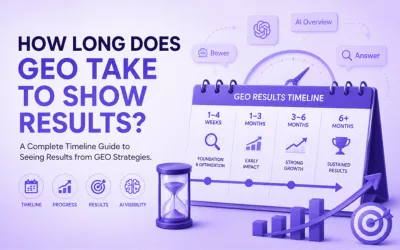
GEO results can vary based on your brand authority, content, competition, and AI search presence. UnoSearch helps businesses build a GEO strategy focused on stronger AI visibility, citations, and qualified discovery across platforms.

Pankaj Shrivastava
CEO & Co-Founder, UnoSearch
Pankaj Shrivastava is the CEO and Co-Founder of UnoSearch, leading the company’s strategic direction, business growth, and digital marketing initiatives.
Read more..
With extensive experience in SEO and digital marketing, he focuses on helping businesses strengthen their online presence, drive sustainable growth, and adapt to the evolving digital landscape. His expertise spans business strategy, search engine optimization, AI-driven marketing, and performance-focused growth solutions.
10+ Years
of Expertise
60+
Industries Served
AI-First
Digital Growth Strategy
Looking for an SEO agency? Talk to UnoSearch
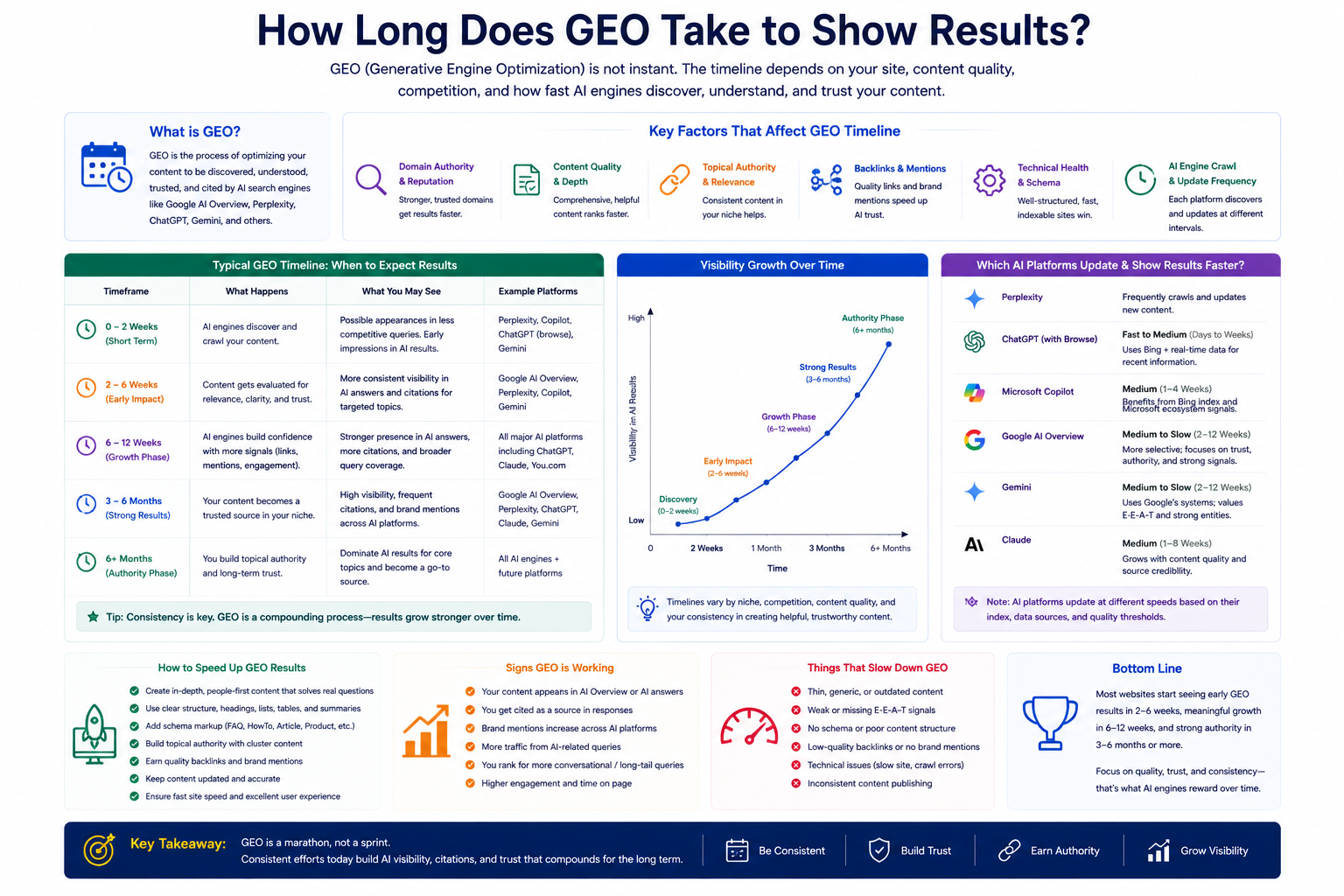
GEO results show on a layered timeline. Technical fixes like schema, robots.txt, and llms.txt produce visible effects in 2 to 4 weeks, AI citations across ChatGPT, Gemini, and Perplexity start appearing in 8 to 12 weeks, and lasting citation authority builds over 6 to 12 months as AI engines re-index updated content.
Most agencies pitch GEO as a quick win, while the data tells a more layered story. Princeton research shows top GEO methods can lift AI visibility by 30 to 40%, but the curve is not linear. Some brands see citation movement inside the first month, while others wait 90 days for the same shift, and a 280% citation lift recorded by one web design agency took four full months of disciplined schema and content rework. Speed depends heavily on starting position.
“Brands that wait six months to start GEO will spend the next six months trying to claw back mindshare from competitors who started early. Citation authority compounds, so every month of delay is a month a competitor pulls further ahead.” — Pankaj Srivastava, Founder, UnoSearch
What are the realistic stages of GEO timeline ?
GEO does not move at one speed. The work splits into three layers, each with its own pace, and understanding the split is what separates agencies that set realistic expectations from ones that overpromise inside the first call.
| Stage | Timeline | What Happens |
| Technical Foundation | 2 to 4 weeks | Schema, llms.txt, AI crawler access deployed and indexed |
| Content Restructuring | 4 to 8 weeks | Answer-first rewrites, FAQ blocks, entity layering re-indexed |
| Citation Surfacing | 8 to 12 weeks | First measurable AI citations across major engines |
| Authority Compounding | 3 to 6 months | Earned media and entity coverage strengthens citation share |
| Cumulative Authority | 6 to 12 months | Sustained citation share, AI-referred traffic rivals organic |
The three-stage GEO timeline:
- Weeks 2 to 4 — Technical foundation phase. Schema deployment, llms.txt setup, server-side rendering fixes, and AI crawler access produce measurable changes inside 14 to 28 days. Citation tools start picking up early signals.
- Weeks 4 to 8 — Content restructuring phase. Answer-first rewrites, FAQ blocks, atomic facts, and entity layering need 4 to 8 weeks to stick. AI engines re-index updated content on staggered schedules across platforms.
- Weeks 8 to 12 — Citation surfacing phase. ChatGPT, Gemini, Perplexity, and AI Overviews start citing optimized pages with measurable frequency, and prompt panels show clear share-of-voice movement against competitors.
- Months 3 to 6 — Authority compounding phase. Earned media, Reddit presence, and Wikidata entries strengthen entity confidence, while citation share accelerates as AI engines build trust in your domain across topics.
- Months 6 to 12 — Cumulative authority phase. GEO gains compound. Brands that maintain freshness cycles every 60 to 90 days hold their citation share, while the ones that stop updating watch competitors slowly take their slots.
A model update from OpenAI or Google can shift everything inside a single week, so the timeline is never fully predictable.
What factors actually speed up or slow down GEO results?
Five factors decide your real GEO timeline. Existing SEO authority, content structure quality, schema completeness, entity coverage across third-party platforms, and competitive density inside your category. Strong signals on the first three can pull your timeline forward by 30 to 50%, while weakness on any single factor slows the curve significantly.
A B2B SaaS brand with strong existing rankings and clean schema can see citations inside 4 to 6 weeks, while a smaller site without entity presence on Wikipedia, Crunchbase, or LinkedIn will need 4 to 6 months to reach the same point. Our GEO services at UnoSearch front-load the technical and entity work in the first 30 days, then layer content and authority signals through quarters one and two for the cleanest possible compounding curve.
Why choose UnoSearch for fast and durable GEO results?
UnoSearch is a Google Premier Partner with 11+ years of search experience and $13.7M+ in client revenue across 60+ industries. We compress GEO timelines by running technical, content, schema, entity, and digital PR work in parallel, not sequentially, so clients see citation lift faster than typical agencies deliver. Every AI SEO engagement flows through our proprietary DigiOps platform, giving you live visibility into citation share growth across ChatGPT, Gemini, Perplexity, Claude, and Google AI Overviews. Founders sit inside every client channel, no outsourcing, no middlemen, no vanity metrics.
We help brands grow traffic in AI search
FAQ's
1. Can GEO show results in less than 4 weeks?
Sometimes, on technical fixes only. Schema deployment and llms.txt setup can drive measurable changes inside 14 days, but full AI citation movement across platforms generally needs 8 to 12 weeks before clear patterns emerge in prompt panels.
2. Why does GEO take longer for some brands than others?
The biggest factor is starting position. Brands with strong existing SEO authority, clean technical foundations, and existing entity presence on Wikipedia or Crunchbase see results in half the time of brands starting from zero on those signals.
3. Do AI model updates speed up or slow down GEO results?
Both can happen. A favorable model update can lift your citation share inside a single week, while an unfavorable retraining cycle can drop it just as quickly. The fix is staying current with content freshness cycles every 60 to 90 days.
4. Is GEO faster than traditional SEO?
Often, yes. SEO ranking shifts typically take 3 to 6 months, while GEO citation movement can show in 8 to 12 weeks. The reason is real-time retrieval, since AI engines like Perplexity and ChatGPT pull live content rather than waiting for full re-indexing cycles.
Contact Us for a Free SEO Consultation Today!
Let us help you grow your business with a customized SEO strategy
References
- Singularity Digital — How Long Does Generative Engine Optimization Take? — https://singularity.digital/insights/how-long-does-geo-take/
- Mekaa — GEO 2026 Guide: Generative Engine Optimization Timelines and Mechanisms — https://www.mekaa.co/en/blog/geo-what-is-generative-engine-optimization-2026-complete-guide
- Stackmatix — Generative Engine Optimization: The Complete GEO Guide for 2026 — https://www.stackmatix.com/blog/generative-engine-optimization
- Princeton GEO Research (Aggarwal et al.) — Generative Engine Optimization Methods Increase Visibility 30-40% — https://arxiv.org/abs/2311.09735
Continue Learning About SEO & AI Search

Local SEO for Real Estate: What Works for Agents in 2026
A practical guide to profile setup, reviews, neighborhood pages and AI visibility, including the brokerage rules and measurement problems most guides skip.By Mahendernath Pulidindi, Associate Vice President, UnoSearch · Updated October 10, 2026 ·...

Local SEO for Lawyers: How Law Firms Win the Map Pack in 2026
Google shows three firms in the Map Pack and hides the rest. This guide explains what decides which three, using Google's own guidelines, the 2026 Local Search Ranking Factors survey and the bar rules that limit what attorneys can do.By Pankaj...

Local SEO for Healthcare: A HIPAA-Safe Playbook for US Practices (2026)
Patients usually pick from the three practices Google shows first. This guide covers what decides those three, plus the HIPAA traps in reviews, tracking and listings that most local SEO for healthcare advice skips.By Rajiv Ranjan, CTO, UnoSearch...