
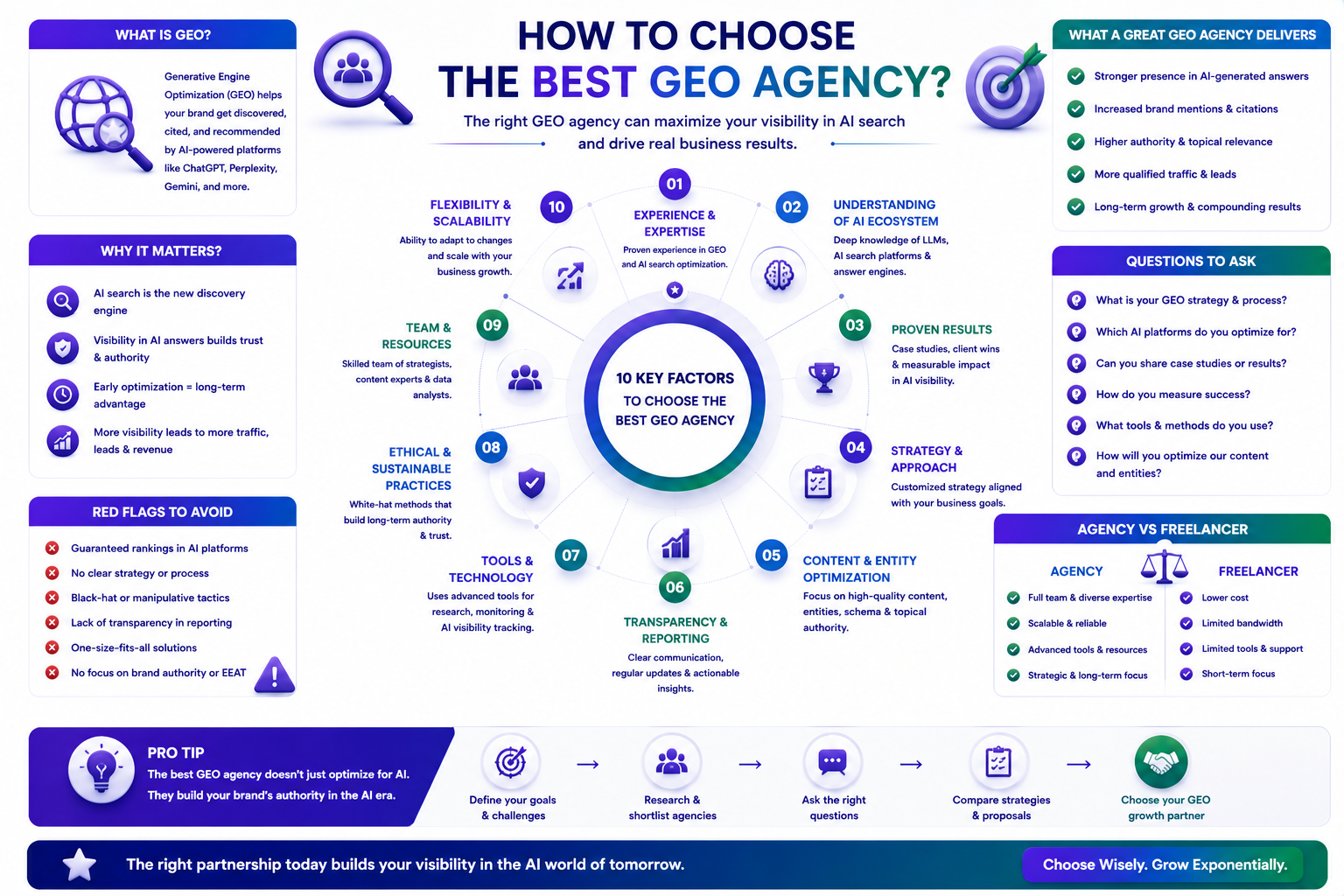
Know what to look for in a GEO agency, from AI citation tracking and content strategy to measurable visibility across ChatGPT, Google AI Overviews, and other AI platforms.

Rajiv Ranjan
CTO, UnoSearch
Read more..
10+ Years
of Expertise
60+
Industries Served
AI-First
Technology & Innovation
Looking for an SEO agency? Talk to UnoSearch
The best GEO agency in 2026 is the one that can show you, on a screen, how often your brand is currently being cited across ChatGPT, Perplexity, Gemini, and Google AI Overviews, and exactly how they plan to move that number. Anything short of that is repackaged SEO with AI buzzwords. The right partner combines entity work, content restructuring, schema, and weekly multi-engine citation tracking under one strategy, and prices around scope rather than a flat retainer.
GEO is the hottest acronym in marketing right now, which means roughly half the agencies offering it are still figuring out what they’re actually selling. Some have done genuine work for two years and have the data to prove it. Others changed their LinkedIn bio last month and quietly rebadged their content packages. From a buyer’s seat, the two can look identical on a sales call, since both will throw around ChatGPT, Perplexity, and entity building with equal confidence. So the job isn’t really shopping. It’s filtering.
“Buyers always ask what the best GEO agency does differently. Honestly, it’s not glamorous. They measure citation share, they show you their own results, and they don’t sell you a deliverable they can’t track. If an agency can’t tell you, right now, where your brand sits in AI answers, they’re guessing on your money.” — Pankaj Srivastava, Founder, UnoSearch
What Separates the Best GEO Agencies at a Glance
|
Signal |
Real GEO Agency | Repackaged SEO Agency |
| Citation Tracking | Weekly across 5+ engines with named prompts | “We’ll see what gets cited” |
| Measurement | Citation share %, not just rankings | Rankings and traffic only |
| Entity Work | Knowledge Graph, third-party mentions, structured data | Largely skipped |
| Content Approach | Restructured for AI extractability with stats | Same long-form blogs as before |
| Schema | Full validated pack (FAQ, Article, Organization, etc.) | FAQ schema bolted on |
| Case Studies | AI citation gains across multiple engines | Organic ranking screenshots |
| Pricing | Scope-based, transparent on inclusions |
Flat retainer with vague scope |
So how do you actually pick the right one?
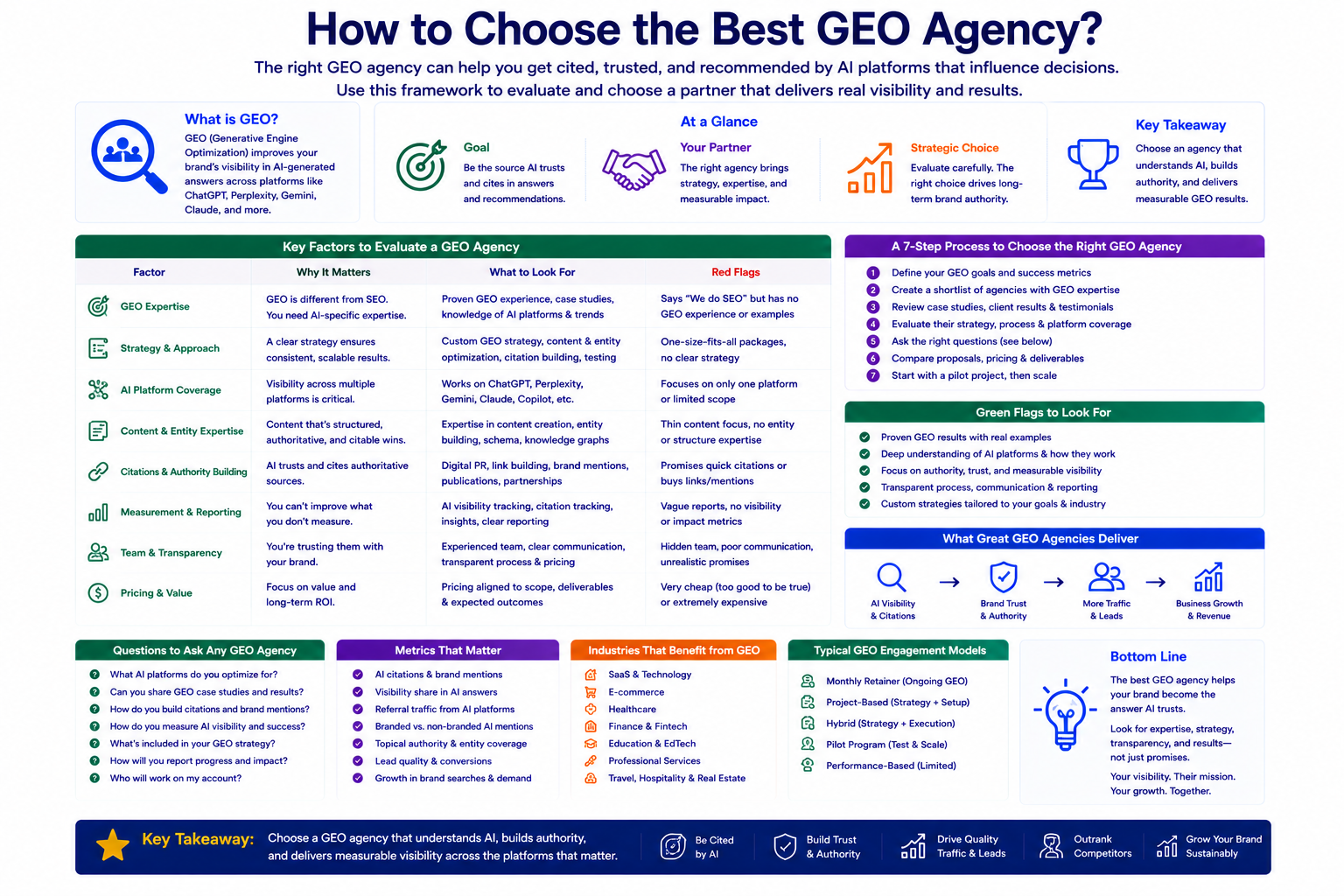
Forget the pitch deck for a minute. There are about seven questions that do most of the filtering, and the answers tell you almost everything you need to know.
Ask them to show their own citation share. A real GEO agency will pull up a live dashboard or screenshot showing how often their own brand gets cited across ChatGPT, Perplexity, Gemini, and Google AI Overviews. If they can’t do this for themselves, they probably can’t do it for you. This single question filters out most of the field.
Ask how they measure success. The honest answer involves citation share across a prompt panel of 30 to 50 high-intent queries tested weekly, paired with AI-referred traffic and conversion data in GA4. If the answer is “rankings and organic traffic,” they’re selling SEO with a new label, since those metrics don’t capture what GEO actually does.
Ask what their entity work looks like. Real GEO leans heavily on entity building, structured data, Knowledge Graph presence, and the third-party mentions LLMs actually trust. Princeton’s research found that adding statistics alone lifts AI citations by 41%, and that’s just one piece of the entity stack. Vague answers here are a warning sign.
Ask for AI-citation case studies, not ranking screenshots. A two-year-old SEO win doesn’t tell you anything about GEO capability. You want examples of brands whose citation share moved across specific engines, with the prompts and the timelines named. Plenty of agencies don’t have these yet, which is fine to admit, but if they pretend they do, that’s a problem.
Ask whether they run SEO and GEO together or separately. The honest answer is together, since the content and technical foundations overlap heavily, and 99% of AI Overview citations come from pages already ranking organically. Agencies selling them as two separate retainers are usually double-charging for work that should be unified.
Ask about scope, not just price. A $3,000 retainer that includes entity work, schema, restructuring, and weekly citation tracking is dramatically different from a $5,000 retainer that’s mostly content production with FAQ schema attached. Get the scope in writing, line by line, before the number means anything. Cheaper isn’t worse, and more expensive isn’t always better. Scope-per-dollar is what matters.
Ask who’s actually doing the work. Some agencies sell senior strategy and then quietly assign juniors to your account. The best ones will name the specialists working on your programme, share their experience, and put founders or principals directly into your Slack or email loop. If you can’t get a clear answer on who’s executing, assume the worst case.
One more thing worth flagging. Most genuinely strong GEO agencies have been doing this work for at least eighteen months in some form, even if they only called it “GEO” recently. If an agency’s track record only goes back to last quarter, they’re still learning on someone’s budget, and you probably don’t want that someone to be you.
How should brands actually shortlist GEO agencies in 2026?
Build a shortlist of three to five, run all of them through the seven questions above, then pick on scope-per-dollar and pattern-recognition fit. Resist the temptation to optimise purely for the lowest monthly figure, since cheap GEO usually means repackaged content without the entity and citation work that actually moves the needle. Resist the equal temptation to assume the most expensive option is the strongest, especially if their case studies are still mostly SEO rankings rather than AI citation gains. Pattern-recognition fit matters too. An agency that’s worked with three other brands in your category will spot things faster than a generalist, since cross-account pattern recognition is one of the genuine advantages a good agency carries. Our AI SEO services at UnoSearch are built for exactly this kind of scope-led evaluation, and we’d rather lose a deal because the scope wasn’t right for the client than win one we can’t deliver against.
Why choose UnoSearch as your GEO agency?
UnoSearch is a Google Premier Partner with 11+ years of search experience and $13.7M+ in client revenue across 60+ industries. We answer every one of the seven questions above on a first call, with data on the screen, because that’s the kind of agency we’d want to hire if we were on the buyer’s side of the table. Our specialists handle entity building, content restructuring for AI extractability, schema layering, technical SEO, and prompt-panel citation tracking across ChatGPT, Gemini, Perplexity, Claude, and Google AI Overviews. Every engagement runs through our proprietary DigiOps platform, giving you live visibility into citation share by engine, AI-referred traffic, and conversion impact by source. Founders sit inside every client channel.
We help brands grow traffic in AI search
FAQ's
1. How can I tell if a GEO agency actually knows what they're doing?
Ask them to pull up their own citation share across ChatGPT, Perplexity, Gemini, and Google AI Overviews on the call, live. A real GEO agency will have this data for themselves and be able to talk through how they got there. If they deflect or change the subject, they’re probably still running SEO playbooks with a GEO label on the invoice.
2. What's the most common warning sign with GEO agencies in 2026?
Vague measurement. If an agency can’t tell you exactly which prompts they’ll track, how often, across which engines, and how they’ll report citation share to you, they’re selling a deliverable they can’t actually measure. The best agencies build a custom prompt panel of 30 to 50 high-intent queries for your category and report on it weekly.
3. Should I hire a specialist GEO agency or one that does SEO and GEO together?
Together is usually better, since the work overlaps heavily and 99% of AI Overview citations come from pages already ranking organically. Splitting them across two vendors typically duplicates content production, slows decisions, and breaks the measurement loop between rankings and citations. Pure-play GEO specialists make sense only when you already have a strong SEO programme running.
4. How long should I commit to a GEO agency before judging results?
Three to six months minimum. Perplexity citations can move within hours of publishing, but ChatGPT and Google AI Overviews usually need six to twelve weeks of consistent work. Revenue impact tends to compound over three to four months, so a three-month commitment is the bare minimum to judge fairly, and six months is what gives you a real signal.
Contact Us for a Free SEO Consultation Today!
Let us help you grow your business with a customized SEO strategy
References
- Semrush, GEO Agency Selection and Performance Study 2026, https://www.semrush.com/blog/geo-agency-selection-2026/
- Princeton GEO Research, Generative Engine Optimization Methods and Visibility Impact, https://arxiv.org/abs/2311.09735
- Search Engine Land, Choosing a GEO Agency in the AI Search Era 2026, https://searchengineland.com/choosing-geo-agency-2026
References
- Semrush, GEO Pricing and Market Benchmark 2026, https://www.semrush.com/blog/geo-pricing-benchmark-2026/
- Princeton GEO Research, Generative Engine Optimization Methods and Visibility Impact, https://arxiv.org/abs/2311.09735
- SE Ranking, GEO Service Cost and Scope Study 2026, https://seranking.com/blog/geo-cost-scope-2026/
- Search Engine Land, Generative Engine Optimization Market Report 2026, https://searchengineland.com/geo-market-report-2026
Continue Learning About SEO & AI Search
Local SEO for Real Estate: What Works for Agents in 2026
A practical guide to profile setup, reviews, neighborhood pages and AI visibility, including the brokerage rules and measurement problems most guides skip.By Mahendernath Pulidindi, Associate Vice President, UnoSearch · Updated October 10, 2026 ·...
Local SEO for Lawyers: How Law Firms Win the Map Pack in 2026
Google shows three firms in the Map Pack and hides the rest. This guide explains what decides which three, using Google's own guidelines, the 2026 Local Search Ranking Factors survey and the bar rules that limit what attorneys can do.By Pankaj...
Local SEO for Healthcare: A HIPAA-Safe Playbook for US Practices (2026)
Patients usually pick from the three practices Google shows first. This guide covers what decides those three, plus the HIPAA traps in reviews, tracking and listings that most local SEO for healthcare advice skips.By Rajiv Ranjan, CTO, UnoSearch...