
In-house SEO vs agency: which works better?
Pankaj Srivastava
Published Date: May 19th 2026
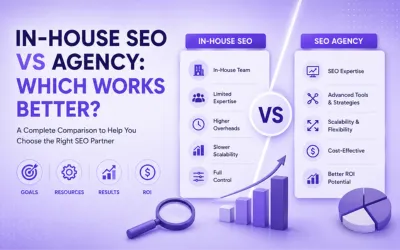
Compare the resources, expertise, costs, and flexibility of in-house and agency SEO to find an approach that aligns with your team and growth goals.

Rajiv Ranjan
CTO, UnoSearch
Read more..
10+ Years
of Expertise
60+
Industries Served
AI-First
Technology & Innovation
Looking for an SEO agency? Talk to UnoSearch
Pick an agency when you need senior SEO, GEO, technical, and content chops working from week one without dropping $180,000 a year on payroll. Build in-house only when SEO genuinely is your moat (Booking.com, HubSpot, G2 type businesses) and you can fund four to six real specialists with real tooling. For most brands between $5M and $100M ARR, the agency wins. And the reason isn’t glamorous. The workload calls for five different skill sets, and one full-time hire just delivers one of them.
Honest answers rarely live at the edges. A solo in-house manager will do 30% of the job brilliantly and the other 70% will inch along. A junior agency drowning under eight accounts gets you to the same place, only with more slides. What actually works? Matching the model to where the business sits today, not where the founder wishes it did.
“The real argument isn’t agency vs in-house. It’s whether your SEO problem needs five specialists or one. Five means agency. One means a hire. Most brands need five and spend eighteen months trying to solve it with one before they accept the maths.” — Pankaj Srivastava, Founder, UnoSearch
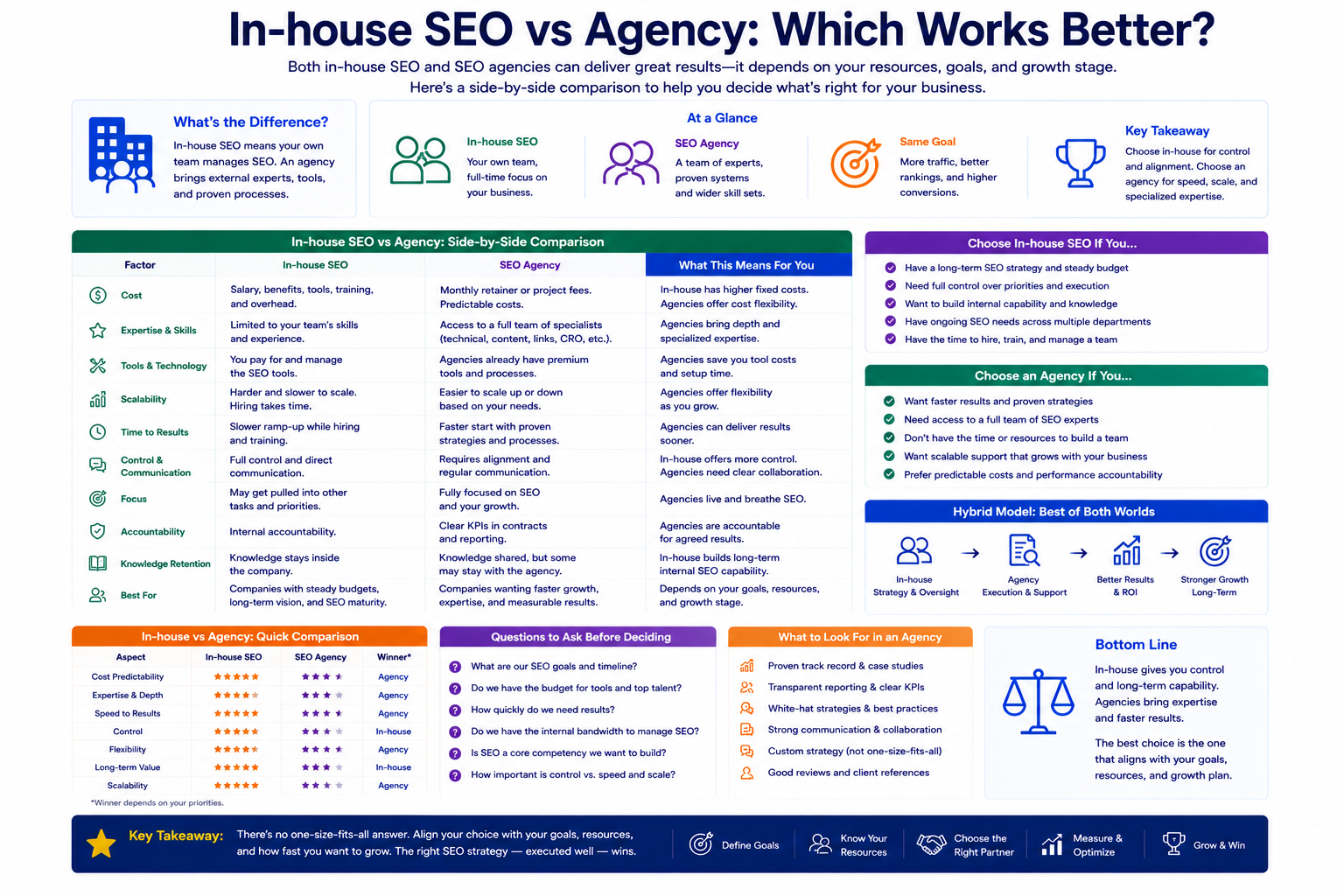
In-House SEO vs Agency at a Glance
| Parameter | In-House SEO | SEO Agency | Hybrid Model |
| Annual Cost | $180,000 to $700,000 (full team) |
$30,000 to $240,000 (retainer) |
$90,000 to $300,000 |
| Time to Full Productivity | 6 to 9 months | 4 to 8 weeks | 8 to 12 weeks |
| Skills Breadth | One specialist’s depth | 5 to 8 specialists’ depth | In-house lead + agency depth |
| Tool Stack Access | Pay separately ($30K+/yr) | Included in retainer | Mostly included |
| Cross-industry Pattern Recognition | Limited to past employers | Built from 50+ live accounts | Borrowed from agency |
| Strategic Continuity | High (if retention holds) | Medium to high | High |
| Best Fit | Mature brands with SEO as core moat | Growing brands needing speed and breadth |
Scale-ups bridging the gap |
How do in-house SEO teams and agencies actually compare in 2026?
The spreadsheet tells one story. Operating reality tells a very different one.
Start with cost, since that’s the bit everyone gets to first. A US-based SEO manager runs roughly ninety to a hundred and thirty thousand a year fully loaded. A senior strategist is closer to two hundred. Add a technical lead, a content writer, a link builder, and the tool stack on top (Ahrefs, Semrush, Screaming Frog, Surfer, and a prompt-tracking platform or two for AI citation work), and the floor sits at two hundred and fifty thousand before anyone has written a single brief. A solid mid-tier agency retainer at $8,000 a month covers that same surface for $96K a year. The maths is unkind to the in-house side, but only the people who have built both teams really feel it.
Ramp time is the other quiet killer. A new in-house hire needs somewhere between six and nine months to genuinely understand the product, the technical stack, the competitive landscape, and the historical context of what’s already been tried. Agencies are usually shipping technical fixes inside the first four to eight weeks. Playbooks already exist on day one, the team isn’t learning what canonicals do from scratch, and the tooling plugs in by the third day of onboarding.
Skill breadth is where most in-house bets fall apart. Modern SEO in 2026 isn’t one job anymore. It’s technical SEO, content strategy, link acquisition, schema engineering, AI citation tracking, and analytics that ties everything back to revenue. One in-house hire covers one of those well, maybe two. An agency runs the bench against the account, even when no single specialist sits on it full-time. That gap is where most in-house teams quietly start losing months to competitors.
Then there’s the pattern recognition advantage agencies have, which almost never makes it into a pitch deck. When BrightEdge polled 400 brands in 2026, agencies caught Helpful Content Update damage eleven days faster than in-house teams on average. The reason is dull but real. They were already watching the same pattern hit thirty other accounts before any single client’s dashboard surfaced the issue. That kind of cross-account view doesn’t develop inside a single company, no matter how strong the in-house team gets.
And finally, continuity. The average SEO manager tenure in 2026 sits at twenty-two months. If your in-house lead walks at month eighteen with the strategy living in their head, the next hire is back at month one. Agencies have churn too, but the institutional knowledge gets caught by processes, dashboards, and documented playbooks, which means handovers don’t restart the clock from zero.
One stat from BrightEdge’s 2026 analysis is worth pinning up somewhere. Brands using an agency for SEO grew organic revenue 34% faster year-over-year than brands relying purely on in-house teams during the same period. Almost all of that gap came from speed of execution, not strategic quality.
Which model should brands actually pick in 2026?
Stage matters more than preference here. Anything under $5M ARR almost always loses money on a full in-house team, because the headcount line eats the entire growth budget for a single channel. The $5M to $100M ARR band usually wins with an agency or a hybrid, since the work needs five specialists and one or two hires can’t realistically cover the surface. Above $100M ARR, where SEO is the primary acquisition channel (think large publishers, mature SaaS, marketplaces), the best setup is usually a full in-house team plus a specialist agency handling technical audits and GEO work. The hybrid model often does the strongest work in the middle: one in-house SEO lead owning strategy, internal stakeholders, and the roadmap, with an agency handling production, technical, content, and citation tracking. Our SEO services at UnoSearch are built for exactly this overlap, and a meaningful slice of our roster runs hybrid setups where we plug in alongside an internal lead rather than replacing one.
Why choose UnoSearch as your SEO agency?
UnoSearch is a Google Premier Partner with 11+ years of search experience and $13.7M+ in client revenue across 60+ industries. We work as an extension of in-house teams rather than a replacement, which is why hybrid setups click cleanly with us. Our specialists handle technical SEO, topical cluster development, schema layering, entity building, link acquisition, and prompt-panel citation tracking across ChatGPT, Gemini, Perplexity, Claude, and Google AI Overviews. Every engagement runs through our proprietary DigiOps platform, giving you live visibility into rankings, citation share by engine, traffic by source, and conversion impact. Founders sit inside every client channel.
We help brands grow traffic in AI search
FAQ's
1. How much does an in-house SEO team actually cost in 2026?
A bare-minimum team (one SEO manager, one content writer, one part-time technical resource) lands around $250,000 a year fully loaded, before tools and training. A proper team with a senior strategist, technical lead, content team, and link builder is closer to $500K-$700K. Most brands undershoot this estimate by roughly 40%, because they price headcount but forget the tool stack, which alone runs over $30,000 a year by itself.
2. How quickly can an SEO agency start delivering results?
Technical fixes typically ship inside the first four to eight weeks, with ranking movement starting in the second half of month two. Full revenue impact takes longer, usually four to six months. But the real value is the gap versus in-house ramp time, which is six to nine months just to be operational, so you’re effectively buying back two quarters of runway.
3. Is hybrid (in-house lead + agency) actually better than either model alone?
For most growing brands, yes. The in-house lead owns strategy, stakeholder buy-in, and product context. The agency brings specialist depth, tooling, and the kind of pattern recognition that only comes from running fifty accounts at once. Hybrid setups also tend to keep in-house talent longer, since the person isn’t drowning in tactical execution day after day.
4. What's the biggest mistake brands make when hiring in-house SEO?
Hiring one generalist and expecting them to handle technical, content, link building, AI optimisation, and analytics simultaneously. Modern SEO needs five distinct skill sets in 2026. One person delivering all of them at agency-level quality just doesn’t exist at any salary band, no matter what the LinkedIn profile says.
Contact Us for a Free SEO Consultation Today!
Let us help you grow your business with a customized SEO strategy
References
- BrightEdge, Agency vs In-House SEO Performance Report 2026, https://www.brightedge.com/resources/agency-vs-in-house-seo-2026/
- Conductor, SEO Salary and Team Cost Benchmark 2026, https://www.conductor.com/learning-center/seo-salary-benchmark-2026/
- Semrush, SEO Team Productivity and ROI Study 2026, https://www.semrush.com/blog/seo-team-productivity-2026/
- Search Engine Land, SEO Tenure and Retention Data 2026, https://searchengineland.com/seo-tenure-retention-2026
Continue Learning About SEO & AI Search
Local SEO for Real Estate: What Works for Agents in 2026
A practical guide to profile setup, reviews, neighborhood pages and AI visibility, including the brokerage rules and measurement problems most guides skip.By Mahendernath Pulidindi, Associate Vice President, UnoSearch · Updated October 10, 2026 ·...

Local SEO for Lawyers: How Law Firms Win the Map Pack in 2026
Google shows three firms in the Map Pack and hides the rest. This guide explains what decides which three, using Google's own guidelines, the 2026 Local Search Ranking Factors survey and the bar rules that limit what attorneys can do.By Pankaj...
Local SEO for Healthcare: A HIPAA-Safe Playbook for US Practices (2026)
Patients usually pick from the three practices Google shows first. This guide covers what decides those three, plus the HIPAA traps in reviews, tracking and listings that most local SEO for healthcare advice skips.By Rajiv Ranjan, CTO, UnoSearch...