
Perplexity vs Google: Which is better for AI visibility?
Pankaj Srivastava
Published Date: May 19th 2026
Looking for an SEO agency? Talk to UnoSearch
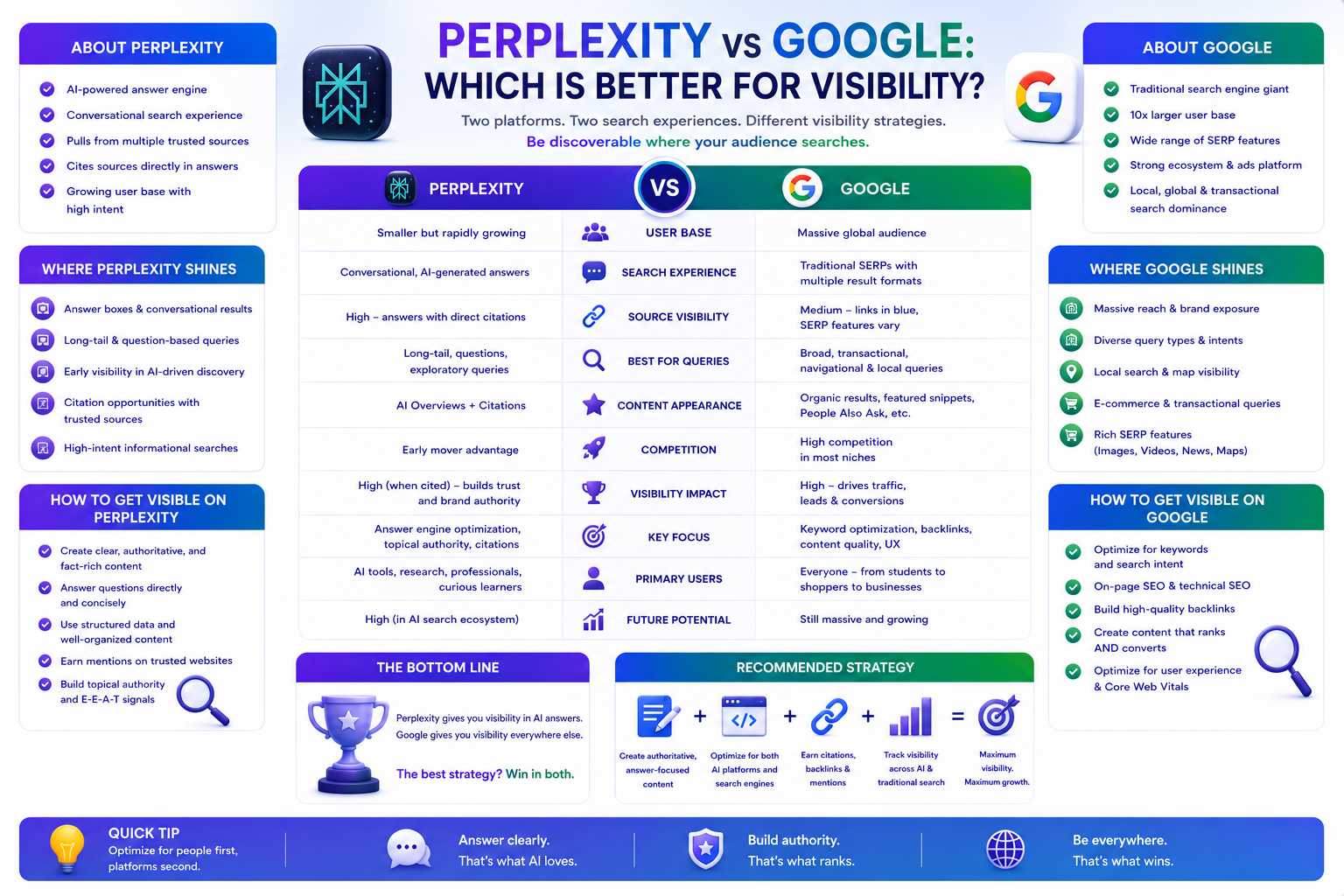
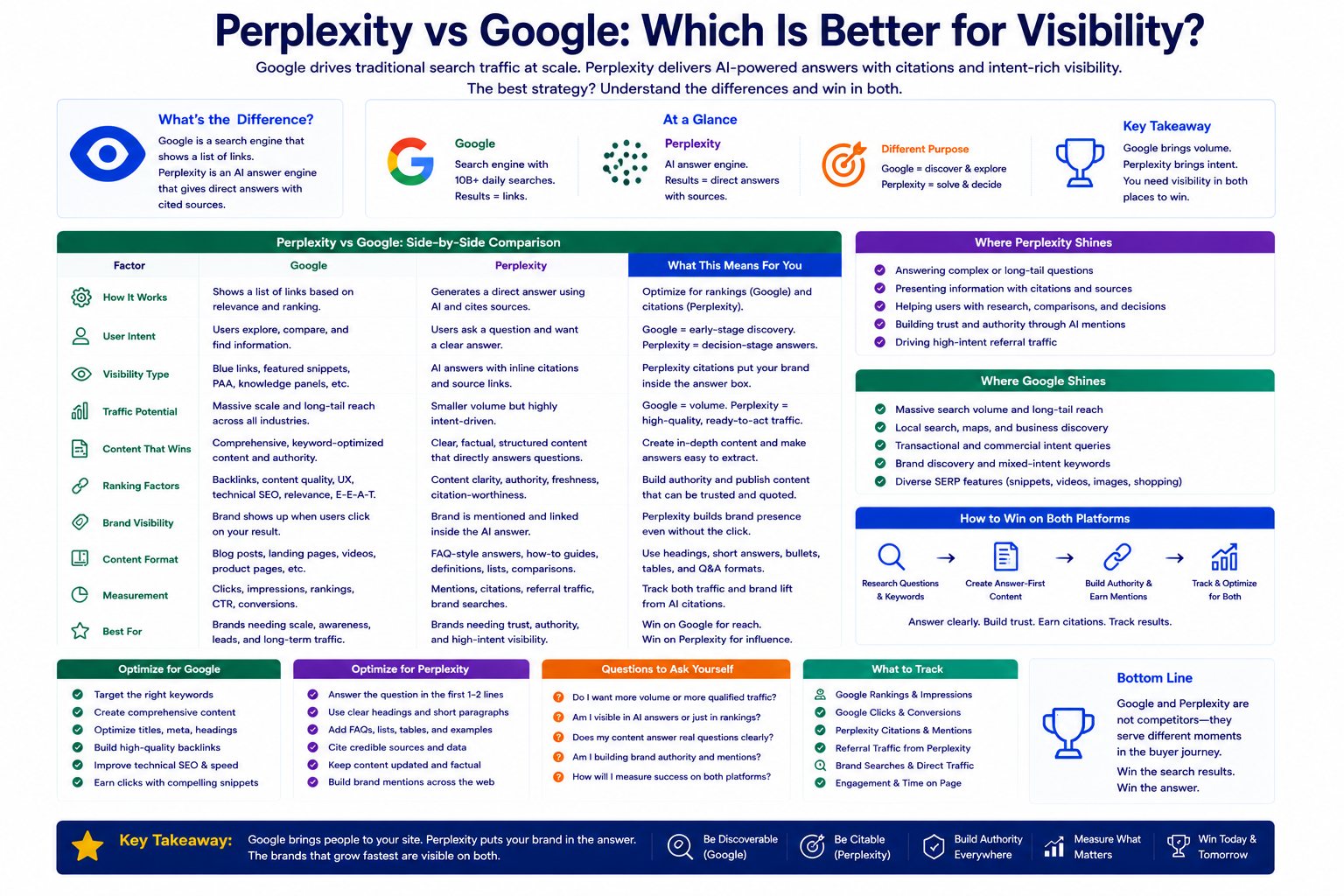
Google still wins on raw reach, with billions of daily searches dwarfing Perplexity’s roughly 22 million monthly users. But Perplexity wins on quality of visibility, since it cites sources directly inside its answers, sends users who convert at around 4.4x the organic rate, and can pick up brand-new content within two hours of publishing. The honest answer for 2026? You don’t choose. Google for scale, Perplexity for high-intent visibility that actually converts.
The two platforms make brands visible in completely different ways, and that’s the bit most people skip past. Google shows you a ranked list and lets you decide. Perplexity reads the web, writes an answer, and decides for you which sources to name. One rewards being findable. The other rewards being quotable. That single difference changes almost everything about how you’d optimise for each.
“Everyone asks whether Perplexity is going to kill Google. Wrong question. Perplexity isn’t taking Google’s volume, it’s taking Google’s most valuable clicks, the ones with buying intent. You optimize for both, but you measure them on completely different scoreboards.” — Pankaj Srivastava, Founder, UnoSearch
Perplexity vs Google at a Glance
|
Parameter |
|
Perplexity |
|
Reach |
Billions of searches daily |
~22 million monthly users |
|
Visibility Type |
Ranked list of links + AI Overviews |
Direct source citations inside answers |
|
Citation Speed |
2 to 8 weeks (AI Overviews) |
Often within 2 hours of publishing |
|
Conversion Rate |
Organic baseline (1.0x) |
~4.4x organic baseline |
|
Click Behaviour |
58.5% of searches end without a click |
Citations drive qualified click-throughs |
|
Key Signal |
Backlinks, authority, technical health |
Freshness, structure, factual clarity |
|
Best For |
Top-funnel reach, brand discovery |
High-intent research, conversion-ready buyers |
Which platform actually delivers better visibility in 2026?
Depends entirely on what you mean by visibility. And that’s not a dodge, it’s the whole answer.
If visibility means reach (how many humans could possibly encounter your brand) Google wins and it isn’t close. The search volume gap is enormous. Billions of daily queries against Perplexity’s 22 million monthly users. For a brand that needs awareness at the top of the funnel, broad discovery, or sheer impression volume, Google is still the centre of gravity and will be for a long while.
But here’s where it gets interesting. Google’s visibility is increasingly hollow at the click level. 58.5% of searches now end without anyone clicking through, and that climbs past 80% when an AI Overview shows up at the top. So you can rank beautifully and still watch the click never happen, because Google answered the question on its own results page using your content. Visibility without traffic. It’s the defining frustration of SEO right now.
Perplexity flips that. The user base is small, but every answer names its sources right there in the response, and those citations pull genuinely interested people through to the page. Semrush’s 2026 numbers put Perplexity-referred visitors converting at roughly 4.4x the organic baseline. The visibility is narrower but far richer, since the people arriving have already been pre-qualified by the research process itself.
Speed is the other gap nobody talks about enough. Google’s AI Overviews can take anywhere from two to eight weeks to start citing new content, gated by crawl and index cycles. Perplexity often cites fresh content within two hours, because it pulls live from the web rather than waiting on an index refresh. For brands publishing on fast-moving topics, that’s a massive difference in how quickly visibility actually materialises.
The signals each one rewards aren’t the same either. Google still leans hard on backlinks, domain authority, and technical health built up over time. Perplexity cares more about freshness, clean structure, and clear factual statements it can lift without ambiguity. Which is why a brand-new site with zero backlinks can sometimes earn a Perplexity citation the same week it launches, while still being months away from ranking on Google for the same query.
How should brands optimise for both in 2026?
Treat Google as the foundation and Perplexity as the accelerator. The good news is that the same underlying work feeds both, so this isn’t two separate jobs. Strong organic rankings on Google make you eligible for AI Overview citations and also make Perplexity more likely to trust and cite you, since it pulls heavily from already-indexed authoritative content. From there, the GEO-specific layer (fact-dense answers, clean structure, statistics, schema, and fresh publishing cadence) is what tips you into Perplexity citations and the conversion-ready traffic they bring. The one thing not to do is pick a side. Google without Perplexity leaves your highest-intent visibility on the table. Perplexity without Google means you never built the authority foundation that makes citations consistent. Our AI SEO services at UnoSearch optimise for both surfaces from one content strategy, then track visibility separately on each since they move on different timelines.
Why choose UnoSearch for Google and Perplexity visibility?
UnoSearch is a Google Premier Partner with 11+ years of search experience and $13.7M+ in client revenue across 60+ industries. We optimize for Google rankings and Perplexity citations off a single content engine, because the foundation work overlaps and running them separately wastes budget. Our specialists handle technical SEO, topical cluster development, schema layering, entity building, and prompt-panel citation tracking across ChatGPT, Gemini, Perplexity, Claude, and Google AI Overviews. Every engagement runs through our proprietary DigiOps platform, giving you live visibility into Google rankings, Perplexity citation share, AI-referred traffic, and conversion impact by source. Founders sit inside every client channel.
We help brands grow traffic in AI search
FAQ's
1. Is Perplexity going to replace Google?
Unlikely, at least not soon. Google’s reach is on a completely different scale, with billions of daily searches versus Perplexity’s roughly 22 million monthly users. What Perplexity is doing is capturing high-intent research queries, the valuable end of the funnel, rather than replacing Google’s overall volume. Most brands need visibility on both.
2. Which platform sends better quality traffic?
Perplexity, per visit. Its referred visitors convert at around 4.4x the organic baseline, because the research-led journey pre-qualifies them before they ever click. Google sends far more total traffic, but a growing share of its searches end without any click at all, especially when an AI Overview appears.
3. How fast can I become visible on each?
Perplexity is much faster. It often cites new content within two hours of publishing, since it pulls live from the web. Google’s AI Overviews typically take two to eight weeks to surface new content, and traditional organic rankings for competitive terms can take six to twelve months.
4. Do I need different content for Google and Perplexity?
Not different content, but a different emphasis. Both reward strong, authoritative, well-structured pages. Perplexity leans harder on freshness, clear factual statements, and extractable answer chunks, while Google still weighs backlinks and domain authority more heavily. One well-built page can serve both with the right structure.
Contact Us for a Free SEO Consultation Today!
Let us help you grow your business with a customized SEO strategy
References
- Semrush, AI Search Conversion Benchmark Report 2026, https://www.semrush.com/blog/ai-search-conversion-2026/
- Princeton GEO Research, Generative Engine Optimization Methods and Visibility Impact, https://arxiv.org/abs/2311.09735
Continue Learning About SEO & AI Search
Local SEO for Real Estate: What Works for Agents in 2026
A practical guide to profile setup, reviews, neighborhood pages and AI visibility, including the brokerage rules and measurement problems most guides skip.By Mahendernath Pulidindi, Associate Vice President, UnoSearch · Updated October 10, 2026 ·...
Local SEO for Lawyers: How Law Firms Win the Map Pack in 2026
Google shows three firms in the Map Pack and hides the rest. This guide explains what decides which three, using Google's own guidelines, the 2026 Local Search Ranking Factors survey and the bar rules that limit what attorneys can do.By Pankaj...
Local SEO for Healthcare: A HIPAA-Safe Playbook for US Practices (2026)
Patients usually pick from the three practices Google shows first. This guide covers what decides those three, plus the HIPAA traps in reviews, tracking and listings that most local SEO for healthcare advice skips.By Rajiv Ranjan, CTO, UnoSearch...