
SEO vs GEO: Key Differences & Which One Does Your Business Need?
Search Is Splitting Into Two Layers: SEO and GEO. Search used to mean one thing: type a query into Google, scan ten blue links, click one. That’s no longer the whole picture. A growing share of buyers now ask ChatGPT to recommend a product, ask Perplexity to summarize a market, or read Google’s AI Overview without clicking through to a single website. This shift has created two distinct but connected disciplines – SEO and GEO. Understanding how they differ, and where they overlap, is quickly becoming essential for any business that depends on being found online.
By Pankaj Srivastava | Published:May 13, 2026 | Updated: August 26, 2026
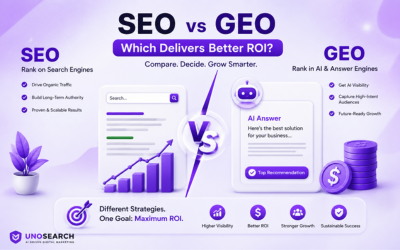
SEO and GEO can support different parts of your digital growth strategy. UnoSearch helps businesses identify the right mix of SEO and GEO based on their goals, audience, competition, and current search visibility.

Growth Manager, UnoSearch
Aqsa Fatma is a Growth Manager at UnoSearch, where she leads strategies that help brands attract, convert, and retain customers.
Read more..
With a strong focus on SEO, she works across search and content to identify growth opportunities, run structured experiments, and improve organic performance at every stage of the funnel. Her approach is built on data, clear priorities, and close collaboration with every team involved in a client’s growth.
Funnel-Focused
Acquisition & Conversion Strategy
Experiment-Driven
Testing & Growth Loops
SEO-Led
Organic Search & Content Growth
Looking for SEO and GEO expertise?
UnoSearch helps brands improve visibility across traditional search and AI-powered search experiences—so you can rank higher, get cited, and reach more potential customers.
Get Free Proposal1. Quick Answer
2. What is SEO?
3. What is GEO?
4. SEO VS GEO : Differences
5. Jinee Green Card : AI Citaion Case study
6. What is GEO for SEO
7. Is GEO Replacing GEO?
8. SEO VS GEO : ROI Comparison
9. Strategy to win SEO and GEO
10. How Unosearch Can Help
11. FAQs
Quick Answer
SEO ranks your website on search results pages like Google. GEO gets your brand cited inside AI-generated answers from tools like ChatGPT and AI Overviews. SEO and GEO aren’t competitors they’re two layers of visibility, and most businesses now need both.
What Is SEO?
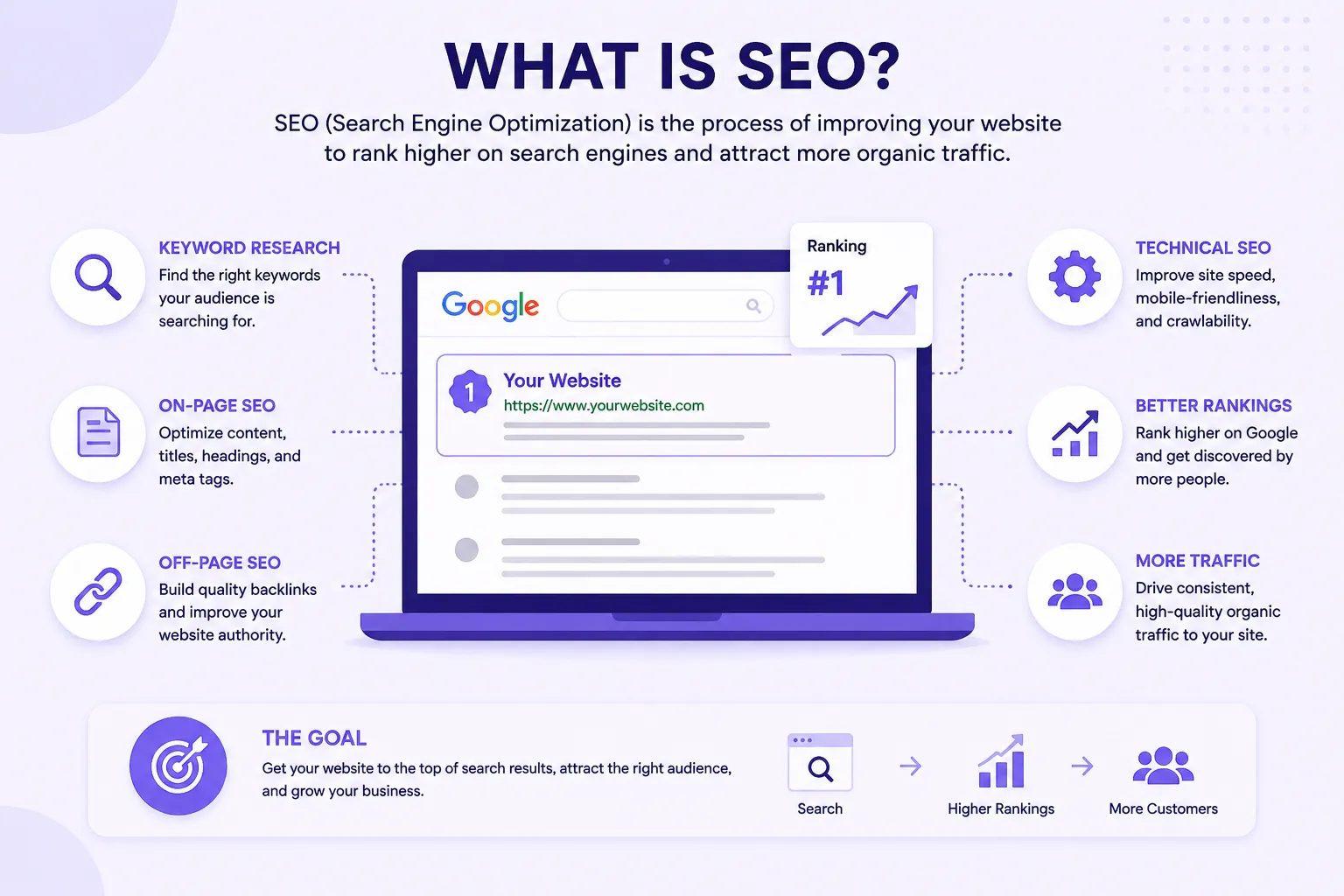
Search Engine Optimization is the well-established practice of improving a website so it ranks higher in traditional search engine results. It’s built around keyword research, on-page optimization, technical site health, content quality, and backlinks. Success in SEO has always been measured in fairly concrete terms: rankings, organic traffic, and click-through rate.
SEO works because search engines like Google crawl and index the web, then rank pages using hundreds of signals from page speed and mobile usability to the number and quality of sites linking back to you. It’s a discipline that rewards consistency: the sites that rank well today are usually the ones that’ve been investing in it for months or years.
What Is GEO?
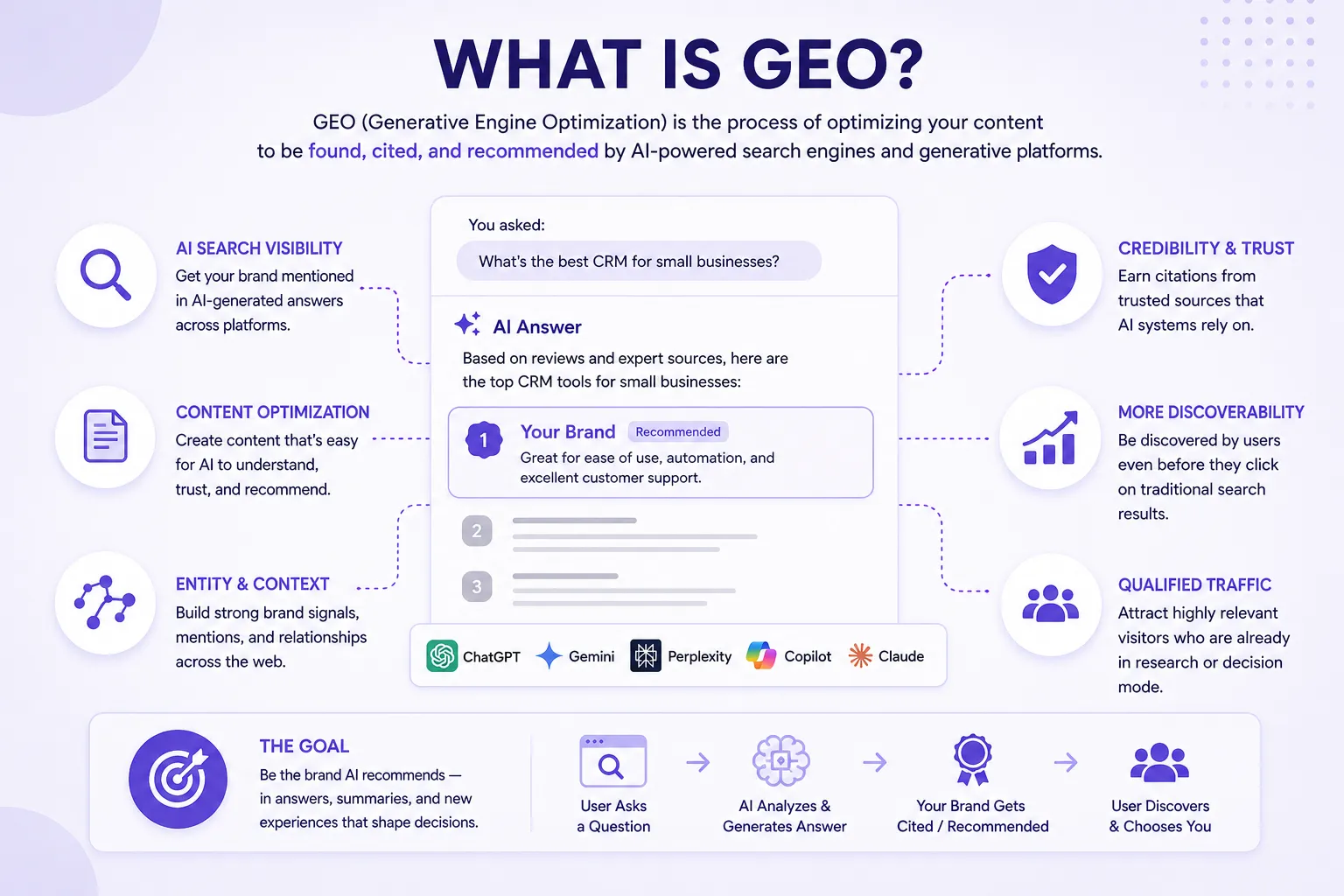
GEO stands for Generative Engine Optimization the practice of optimizing your content and brand presence so AI tools like ChatGPT, Google AI Overviews, Perplexity, and Copilot cite, quote, or recommend you when generating an answer.
Unlike SEO, there’s no ranking position to win with GEO. Instead of competing for a spot on a results page, you’re competing to be one of the sources an AI model trusts enough to reference by name. That means GEO looks beyond your own website AI engines also pull from Reddit threads, reviews, forums, and third-party publications, so your visibility depends on more than just what’s on your domain.
Expert Insight: SEO Is Evolving for AI Search
Mike King, Founder & CEO of iPullRank, explains that SEO needs to evolve as search moves toward AI-generated answers. His Relevance Engineering approach combines SEO, information retrieval, content strategy, AI, UX, and digital PR to help brands remain visible across traditional and AI search experiences.
Source: iPullRank – The AI Search Manual
Difference Between SEO and GEO
| Feature / Metric | SEO | GEO |
|---|---|---|
| Goal | Rank higher on search engine results pages | Get cited or recommended inside AI-generated answers |
| Success metric | Rankings, organic traffic, click-through rate | Citation frequency, share of AI answers, brand mentions |
| Where it happens | Your website and owned content | Your website plus third-party platforms (Reddit, reviews, news, forums) |
| Core inputs | Keywords, backlinks, technical site health | Structured content, fact density, entity relationships, third-party authority |
| User behavior | User clicks through to your site | User often gets the answer without ever clicking through |
| Maturity | Established, well-understood discipline | Emerging, still evolving rapidly |
What Is GEO for SEO?
Generative Engine Optimization is the practice of optimizing your content and brand presence so AI systems choose to cite, quote, or recommend you when generating an answer. Unlike SEO, GEO isn’t about earning a ranking position there’s no results page to rank on. Instead, it’s about being one of the sources an AI model draws from and trusts enough to reference by name.
GEO for SEO teams means expanding what “optimization” covers. Traditional SEO focused mostly on assets you control: your website, your blog, your landing pages. GEO extends far beyond that, because AI engines pull from across the entire web including places you don’t own. Reddit threads, Quora answers, review sites, industry publications, and forum discussions all shape how an AI describes your business, whether or not you ever touch that content directly.
This is why GEO strategy usually includes:
- Structuring content in clear question-and-answer formats that are easy for AI models to extract and cite
- Building a strong presence on third-party platforms where AI engines pull citations from
- Prioritizing fact density, clear sourcing, and unambiguous statements over keyword density
- Earning mentions in reviews, news coverage, and community discussions, not just backlinks
The clearest way to think about the difference between SEO and GEO: SEO is about earning a spot in the results, while GEO is about earning a spot inside the answer. SEO still relies on ranking web pages, while GEO is about influencing how large language models cite and ground their responses. Both aim to increase visibility and drive conversions they just operate through different mechanisms and are measured in different ways.
Is GEO Replacing SEO?
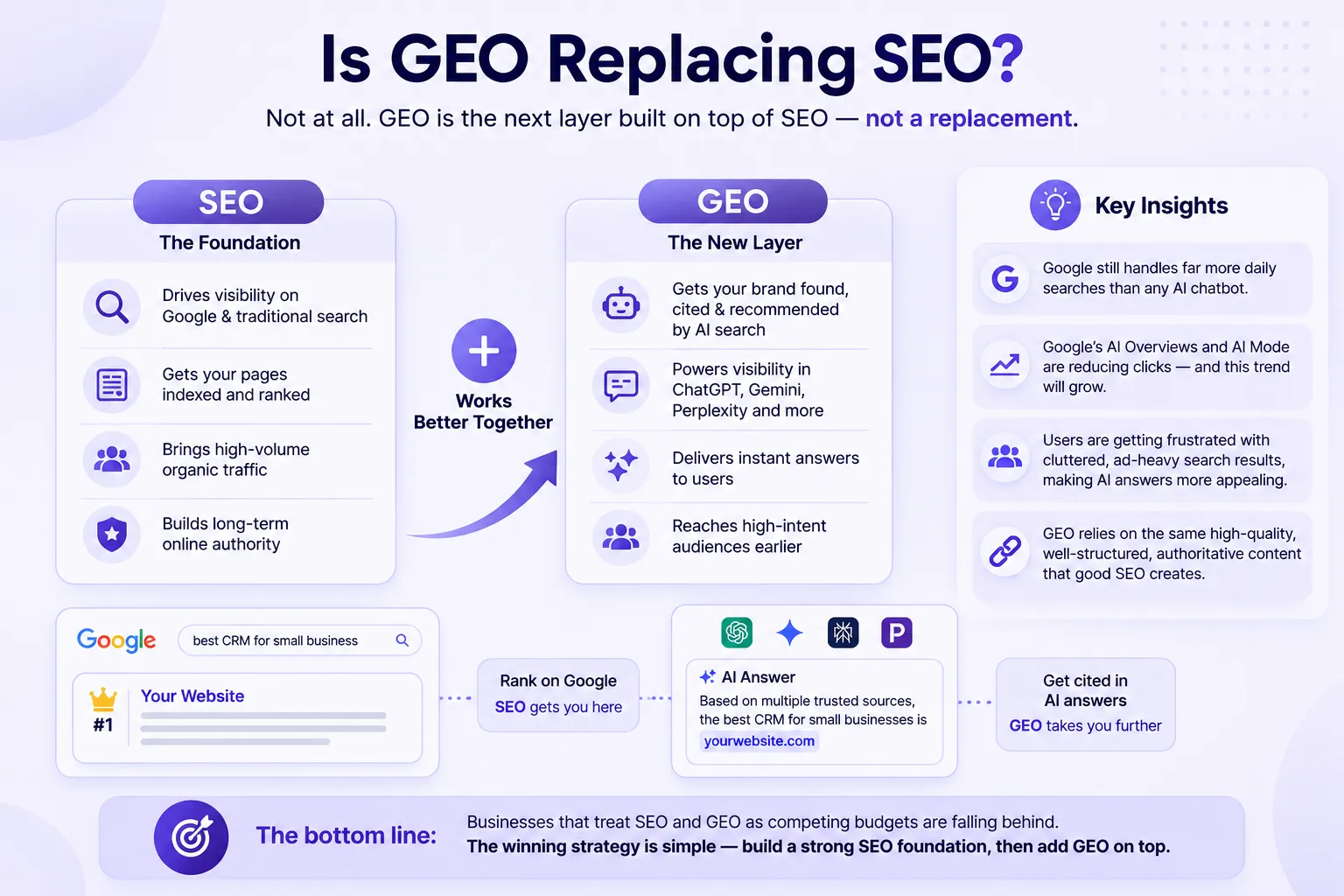
No, any business that ignores SEO to chase GEO is making a mistake. Google still handles a vastly higher volume of daily searches than any AI chatbot, and traditional search is nowhere near disappearing. GEO is additive, not a replacement.
That said, it’s fair to say the balance of attention is shifting. Google’s AI Overviews and AI Mode already summarize answers directly on the results page, reducing the need to click through — and that trend is only accelerating. Growing user frustration with cluttered, ad-heavy search results is also making generative alternatives more appealing to a segment of searchers. GEO doesn’t replace SEO; it sits on top of it, because GEO systems still rely heavily on the same crawlable, well-structured, authoritative content that good SEO produces in the first place.
The practical answer to is GEO replacing SEO is this: businesses that treat them as separate, competing budgets are already behind. The ones pulling ahead treat SEO as the foundation and GEO as the newer layer built on top of it.
GEO vs SEO ROI Comparison
SEO ROI
It is more predictable and easier to track. You can measure ranking position, organic sessions, and conversion rate from organic traffic with well-established tools and attribution models.
GEO ROI
It is harder to measure directly today, but early data is promising some studies show brands optimized for GEO earning meaningfully more citations in AI answers compared to sites that only invest in traditional SEO. The tradeoff is that GEO-driven traffic, when it does convert into a click, tends to convert at a higher rate, since the user has often already had their initial question answered by the AI and is visiting with stronger intent.
Combined ROI
This is where most of the long-term value sits. The content and authority-building work that improves SEO clear structure, credible sourcing, strong third-party mentions is largely the same work that improves GEO performance. Businesses rarely need to run two disconnected strategies; they need one strategy built to serve both layers of search.
In a genuine GEO vs SEO ROI comparison, SEO still wins on measurability today, but GEO is where the visibility gap is opening fastest and where being early carries a real advantage.
Common Mistakes When Approaching SEO and GEO
1. Treating GEO as Completely Separate from SEO
GEO builds on many of the same foundations as SEO, including strong technical performance, authoritative content, structured data, and clear entity signals. Treating them as entirely separate strategies can lead to duplicated efforts and missed opportunities.
2. Ignoring Third-Party Sources
AI engines often pull information and citations from reviews, forums, industry publications, and other trusted third-party platforms. Focusing only on your own website can limit your overall AI visibility.
3. Optimizing for Keywords Instead of Clarity
Keyword density alone is no longer enough. Both search engines and AI platforms increasingly favor content that is clear, factual, well-structured, and directly answers the questions users are asking.
4. Measuring GEO Like Traditional SEO
SEO success is often measured through rankings and organic traffic, while GEO requires different metrics, such as AI citations, brand mentions, visibility across AI responses, and referral traffic from AI platforms.
5. Waiting Too Long to Invest in GEO
Businesses that wait for GEO to become fully mature risk falling behind competitors that are already building authority and earning citations across AI-powered search experiences. Early investment can create a meaningful competitive advantage.
How to Build a Strategy That Covers Both
1. Start with strong technical and on-page SEO.
Clean site architecture, fast load times, and structured data are foundational for both disciplines AI crawlers need to access and understand your content just as search engine crawlers do.
2. Structure content for extraction.
Use clear headings, direct answers near the top of a section, and question-and-answer formats that are easy for both search engines and AI models to pull from.
3. Build authority beyond your own website.
Earn mentions in reviews, industry publications, and community platforms like Reddit and Quora, since these increasingly influence what AI engines cite.
4. Add structured data and clear sourcing.
FAQs, how-tos, and well-labeled facts make your content more discoverable and more trustworthy to both search engines and generative engines.
5. Track both sets of metrics.
Keep monitoring rankings and organic traffic, but start tracking brand mentions and citation frequency in AI answers as a parallel KPI.
Watch: How Search Is Changing And Why SEO Strategy Has to Adapt
Why businesses can’t rely on Google alone anymore
This video breaks down how customers are no longer only searching on Google they’re asking Siri, Alexa, ChatGPT, and AI-powered engines for recommendations too. It’s a direct look at the shift driving the SEO vs GEO conversation, and why a search strategy limited to traditional SEO is already leaving visibility on the table.
How Can UnoSearch Help With Your SEO and GEO Strategy?
If you’re a US business trying to figure out how to invest in SEO, GEO, or both without spreading your budget too thin, that’s exactly the kind of decision UnoSearch helps businesses work through.
1. Want your brand cited in ChatGPT, Gemini, Perplexity & AI Overviews?
UnoSearch’s GEO services build the entity structure, schema, and authority signals AI engines rely on to decide who to cite.
2. Want your content built specifically to perform in the GEO layer of search?
UnoSearch’s AI SEO services focus on structuring and positioning your content so it’s readable, trustworthy, and quotable by generative engines.
3. Not sure how SEO and GEO fit into your broader digital strategy?
UnoSearch’s SEO company for USA businesses brings technical SEO, content, and search strategy together under one coordinated plan.
How UnoSearch Helped Jinee Card Get Cited in AI Search Results
UnoSearch helped Jinee Card, a US-based business, strengthen its GEO and SEO visibility by optimizing content, technical SEO, and third-party authority signals—helping the brand gain visibility across AI-generated answers while continuing to improve traditional search rankings.

Final Thoughts:
SEO vs GEO isn’t really a competition, it’s a description of how search itself has split into two layers. Traditional SEO still drives the majority of discovery today, and it remains the foundation everything else is built on. But GEO is where the next wave of visibility is being won, often by businesses that got there before their competitors realized it mattered. The safest strategy isn’t choosing one over the other it’s building a content and authority foundation strong enough to perform in both.
Frequently Asked Questions
What is the main difference between SEO and GEO?
SEO focuses on ranking your website higher on traditional search engine results pages like Google. GEO focuses on getting your brand cited or recommended inside AI-generated answers from tools like ChatGPT, Gemini, and AI Overviews. One earns you a ranking position; the other earns you a mention inside the answer itself.
Is GEO replacing SEO?
No. GEO builds on top of SEO rather than replacing it generative engines still rely on crawlable, well-structured, authoritative content, which is the same foundation good SEO produces. Businesses that drop SEO to chase GEO usually end up losing visibility on both fronts.
What is GEO for SEO teams exactly?
For an SEO team, GEO means expanding beyond your own website to include third-party platforms reviews, forums, industry publications since AI engines pull citations from across the web, not just your domain. It also means restructuring content into clearer, fact-dense formats that are easier for AI models to extract and quote.
How do SEO and GEO ROI compare?
SEO ROI is easier to track today rankings, organic traffic, and conversion rate all have established measurement tools. GEO ROI is harder to measure directly right now, but early data shows AI-driven traffic often converts at a higher rate, since users arrive with their initial question already answered.
Do I need to choose between SEO and GEO, or invest in both?
Most businesses need both. SEO and GEO share overlapping inputs structured content, technical site health, and third-party authority so a combined strategy is usually more efficient than running them as separate, competing efforts.
How is GEO vs SEO measured differently?
SEO success is measured by rankings, organic sessions, and click-through rate. GEO success is measured by citation frequency and how often your brand is mentioned or recommended inside AI-generated answers metrics that don’t require a click to count.
References
1. Google Search Central
https://developers.google.com/search/updates
2. Princeton University — GEO: Generative Engine Optimization
3. OpenAI — Introducing ChatGPT Search
https://openai.com/index/introducing-chatgpt-search/
Continue Learning About SEO & AI Search

What Is Digital Marketing Cost in India? Pricing Guide (2026)
Trying to figure out what digital marketing should actually cost before you commit to an agency? You are asking the right question at the right stage. Understanding digital marketing cost in India helps you avoid overpaying for a bloated retainer, and it also helps...

How to Increase Website Conversion: A Practical Guide (2026)
Getting visitors to your site but not enough of them taking action? Figuring out how to increase website conversion isn't about one big redesign. It is about fixing the right friction points in the right order. Here's a practical, no-fluff breakdown of what actually...
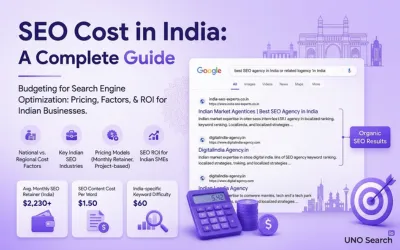
What Is SEO Cost in India? A Complete Pricing Guide (2026)
Trying to figure out what SEO should actually cost before you commit to an agency? You're asking the right question at the right stage. Understanding SEO cost in India helps you avoid both overpaying for a bloated retainer and underpaying for work that won't move the...