
Traditional Marketing vs Digital Marketing, What is the Difference?
Trying to decide where your next marketing budget should go traditional channels or digital ones? You’re not alone, and the honest answer isn’t “pick one forever.” Here’s a clear, evidence-based comparison to help you decide what fits your business right now, plus where each approach genuinely earns its place.
Looking for an SEO agency?
UnoSearch helps brands rank higher and drive real organic growth.
Get Free Proposal1. Quick Comparison
2. Key Differences
3. Traditional Marketing Channels
4. Digital Marketing Channels
5. Digital Marketing Advantages
6. Where Traditional Still Wins
7. Cost Comparison
8. How to Choose
9. Best Fit by Industry
10. Combining Both
11. Common Mistakes
12. How Unosearch Helps
13. FAQs
See how UnoSearch combined AI SEO, content strategy, and Meta Ads to help Jinee Green Card reach thousands of qualified EB-1A prospects
Quick Comparison: How Does Digital Marketing Differ From Traditional Marketing?
Before going deeper, here’s the side-by-side view most businesses actually want when comparing digital marketing versus traditional marketing.
| Factor | Traditional Marketing | Digital Marketing |
|---|---|---|
| Cost | Generally higher upfront (print, TV, billboards) | Flexible, scalable to any budget |
| Reach | Broad but untargeted (local/regional audience) | Highly targeted, local to global |
| Measurability | Difficult to track precisely | Real-time data on clicks, conversions, ROI |
| Targeting | Demographic, broad-based | Behavioral, interest-based, highly specific |
| Speed of Results | Slower to launch and adjust | Can launch, test, and adjust within days |
| Longevity of Impact | Can build strong local brand recall over time | Compounding visibility through SEO and content over time |
| Two-Way Engagement | Limited to none | Comments, reviews, direct messaging |
| Best For | Local businesses, brand prestige, older demographics | Measurable growth, lead generation, digital-first audiences |
Expert insight:
Neither channel is inherently superior; the right mix depends entirely on where your specific audience spends their attention and how quickly you need to prove return on investment.
This table alone answers the core of what most people are asking when they search “digital marketing vs traditional.” Still, the right choice really depends on your specific goals, audience, and budget, so let’s break down each side properly.
What Sets Digital Marketing Apart From Traditional Marketing?
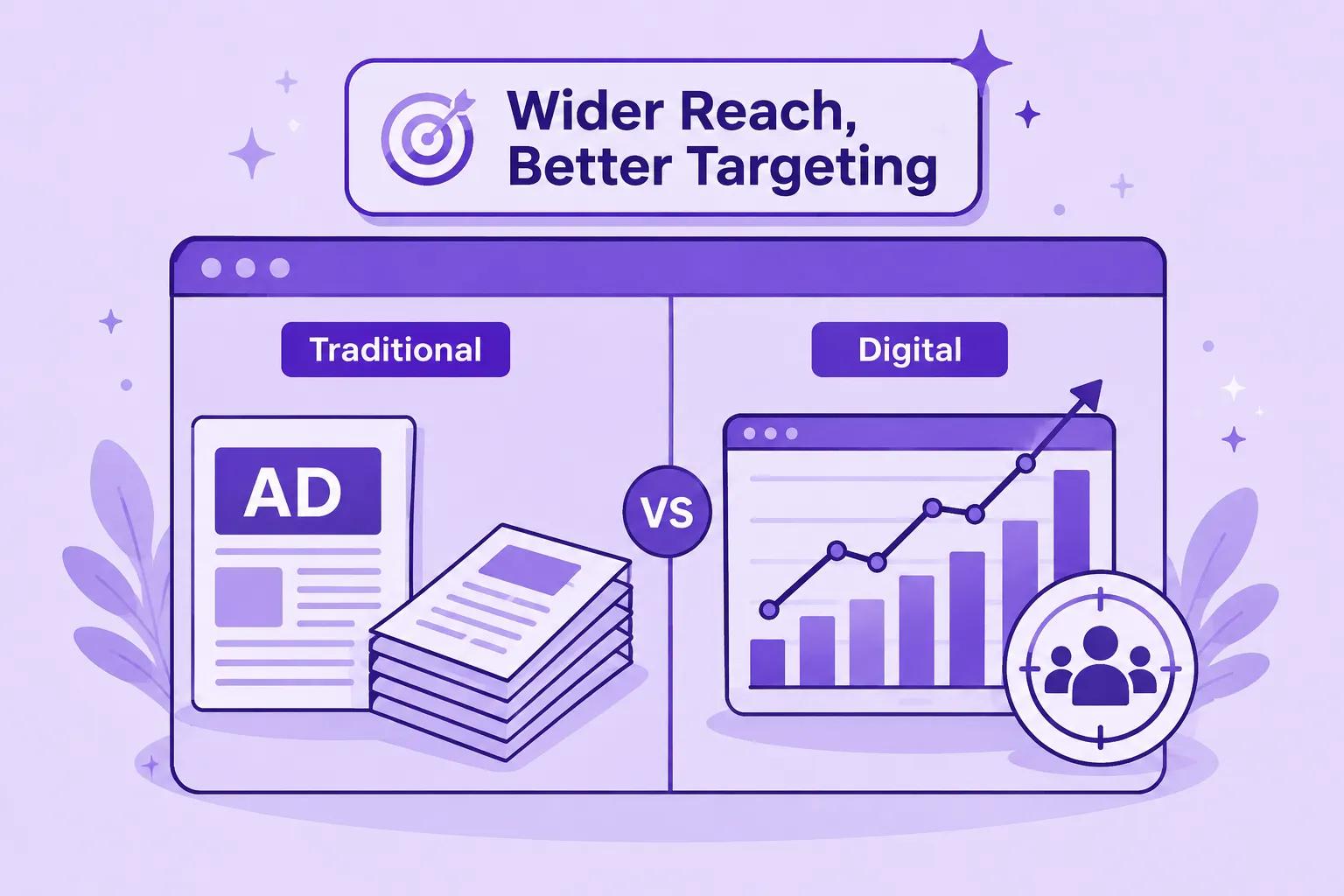
The core difference isn’t just where the ad appears it’s how much control and insight you have over what happens after it appears.
Traditional marketing works through broadcast: a billboard, a newspaper ad, or a TV spot reaches a wide, largely undefined audience, and you have limited ability to know who actually saw it or acted on it. You commit to the spend, run the campaign, and hope the exposure translates into brand recall or footfall. There’s no dashboard to check the next morning.
Digital marketing works through targeting and feedback: you choose who sees your ad based on behavior, location, interests, or search intent, and you can measure exactly how many people clicked, converted, or dropped off along the way. If something isn’t working, you find out within days, not months.
This is really how digital marketing differs from traditional marketing at a structural level one is a one-way broadcast, the other is a measurable, adjustable conversation with your audience. That difference is also why digital campaigns can be optimized mid-flight, while traditional campaigns typically run their full course before you learn whether they worked at all.
There’s also a difference in permanence. A print ad disappears once the next issue is published. A TV spot airs and is gone. But a well-optimized blog post, a ranking landing page, or a piece of evergreen content keeps generating visibility and traffic long after it’s published often for years, with only occasional updates.
A Closer Look at Traditional Marketing Channels
To compare fairly, it helps to look at what “traditional marketing” actually includes, since it’s often treated as one big category when it’s really several distinct formats:
Print advertising:
Newspapers, magazines, brochures, flyers
Broadcast advertising:
Television and radio commercials
Outdoor/out-of-home (OOH)
Billboards, transit ads, banners
Direct mail:
Postcards, catalogs, promotional mailers
Telemarketing
Outbound calls and SMS campaigns
Print/media sponsorships
Event sponsorships, local press coverage
Each of these has a different cost structure and reach pattern. A billboard, for instance, delivers passive, repeated local exposure over weeks or months, while a TV commercial delivers a short burst of broad exposure during a specific slot. Direct mail sits somewhere in between targeted by address, but still a one-way message with no built-in feedback loop.
A Closer Look at Digital Marketing Channels
Digital marketing is similarly made up of several distinct channels, each suited to different goals:
Search engine optimization (SEO)
Organic visibility on Google and increasingly inside AI-generated answers
Pay-per-click (PPC) advertising
Google Ads, social media ads, display advertising
Social media marketing
Organic and paid content across platforms like Instagram, LinkedIn, and Facebook
Email marketing
Direct, owned-audience communication with measurable open and click rates
Content marketing
Blogs, videos, guides that build authority and organic traffic over time
Influencer and affiliate marketing
Leveraging third-party audiences for targeted reach
Unlike traditional channels, most digital channels can be tested at a small budget first, measured, and scaled only once they’ve proven to work a sequencing that traditional formats rarely allow, since minimum spends are often required just to run a campaign at all.
Advantages of Digital Marketing Over Traditional Marketing
Precise targeting:
Reach people based on what they search for, where they are, or how they’ve interacted with your brand before not just a broad age or location bracket.
Real-time measurement:
See exactly what’s working (and what isn’t) within days, not after a campaign has already run its full course.
Lower barrier to entry:
A small business can run an effective digital campaign on a modest budget; traditional media often requires much larger upfront spend to be effective at all.
Compounding visibility:
Unlike a print ad that disappears once the issue is replaced, SEO-driven content and organic visibility keep working for you long after it’s published.
Two-way engagement:
Comments, reviews, and direct messages let you engage with your audience directly, something traditional formats simply don’t allow.
Adaptability:
Campaigns can be paused, adjusted, or reallocated based on real performance data, instead of committing fully before seeing results.
Attribution clarity:
You can trace a sale back to the specific ad, keyword, or piece of content that drove it something traditional marketing can rarely offer with confidence.
These advantages are exactly why so many businesses shifting their budgets are asking about the advantages of digital marketing over traditional marketing specifically it’s less about digital being “trendier” and more about it being measurable and adjustable in ways traditional channels structurally can’t match.
Where Traditional Marketing Still Holds Up
To be fair, traditional marketing hasn’t become irrelevant it still does a few things better than digital in certain contexts.
Local trust and prestige:
A well-placed billboard, local newspaper feature, or radio spot can build a sense of established credibility in a community that a digital ad sometimes can’t replicate.
Reaching non-digital audiences:
Certain demographics particularly older or less digitally active audiences still respond strongly to print, TV, or direct mail.
Tangible, memorable formats:
Physical formats like direct mail or print ads can feel more permanent and less easy to ignore than a scrollable digital ad.
No dependency on algorithms:
Traditional placements aren’t subject to platform algorithm changes, ad auction costs, or sudden policy shifts the way digital channels can be.
Passive, repeated exposure:
A billboard on a daily commute route delivers repeated impressions without requiring the audience to actively search or scroll.
If your business serves a strongly local, older, or brand-prestige-driven audience, traditional marketing may still deserve real budget not as a legacy habit, but because it’s genuinely the better fit for that audience.
Cost Comparison: What You're Actually Paying For
Cost is often the deciding factor, but comparing traditional and digital marketing spend isn’t always apples-to-apples, since you’re paying for different things.
| Cost Aspect | Traditional Marketing | Digital Marketing |
|---|---|---|
| Minimum entry cost | Often high (production, media buy minimums) | Can start with almost any budget |
| Cost per impression | Fixed regardless of engagement | Pay largely for actual clicks or actions (PPC) |
| Ability to test small | Limited — full campaigns often required | High — A/B test before scaling spend |
| Long-term cost efficiency | Cost resets with every new campaign | Organic SEO/content compounds, lowering cost per result over time |
| Waste from poor targeting | Higher, since reach isn't behavior-based | Lower, due to precise audience targeting |
The key difference isn’t just which is “cheaper” it’s that digital marketing lets you pay in proportion to actual engagement and results, while traditional marketing generally requires paying for exposure regardless of whether it converts.
How Do You Decide Between Traditional and Digital Marketing for Your Business?
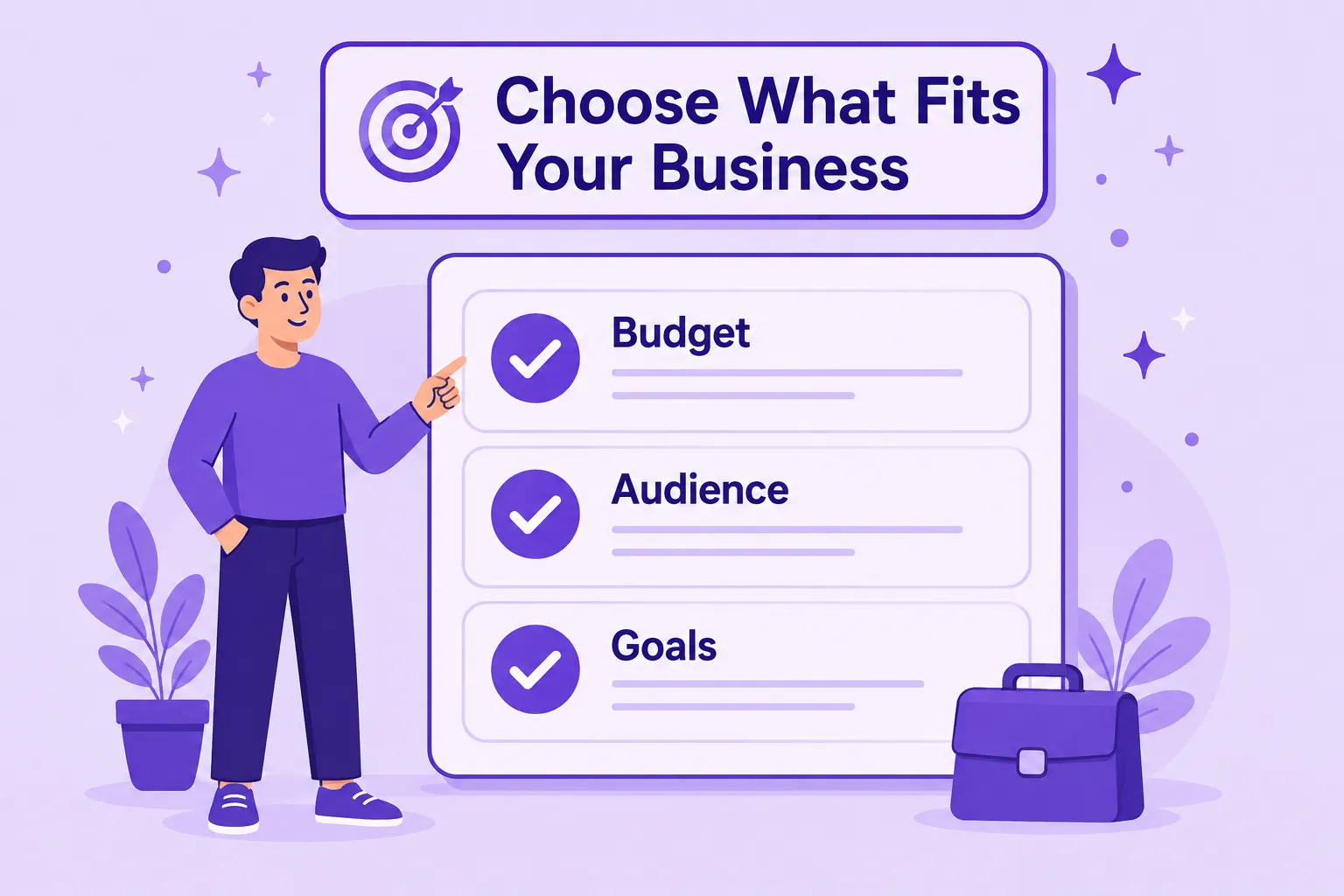
Rather than picking based on trend, it helps to evaluate three things specifically:
1. Budget:
If you need to start small and scale based on performance, digital marketing’s flexibility makes it the lower-risk starting point. If you have a larger, dedicated budget and a strong local presence, traditional formats can still deliver strong ROI.
2. Audience:
If your customers are digitally active — searching, scrolling, comparing options online digital marketing meets them where they already are. If your audience skews older or less digitally engaged, traditional channels may reach them more reliably.
3. Goals:
If you need measurable leads, conversions, or ROI tracking, digital marketing gives you the data to prove it. If your goal is broad brand recognition or local community presence, traditional marketing can still build that effectively.
Most businesses find that the answer isn’t strictly one or the other it’s about where to weight the budget based on these three factors, and revisiting that weighting as the business grows or the audience shifts.
Industry-by-Industry: Which Approach Tends to Win?
The right balance also shifts depending on your industry, since audience behavior varies significantly by sector.
| Industry | Typical Lean | Why |
|---|---|---|
| Ecommerce | Digital-heavy | Purchase journey happens almost entirely online |
| Local services (salons, clinics, restaurants) | Hybrid, digital-first | Local SEO and reviews drive discovery, but community presence still matters |
| Real estate | Hybrid | Digital listings dominate discovery, but local print and signage still build trust |
| B2B/SaaS | Digital-heavy | Buyers research extensively online before ever speaking to sales |
| Luxury goods | Hybrid, traditional-leaning | Brand prestige often still benefits from print and event sponsorship |
| Healthcare | Hybrid | Local SEO drives new patient discovery, but community trust-building still matters |
This isn’t a rigid rule it’s a starting point. The right mix ultimately depends on how your specific customers actually make buying decisions, not just broad industry norms.
Can You Combine Both?
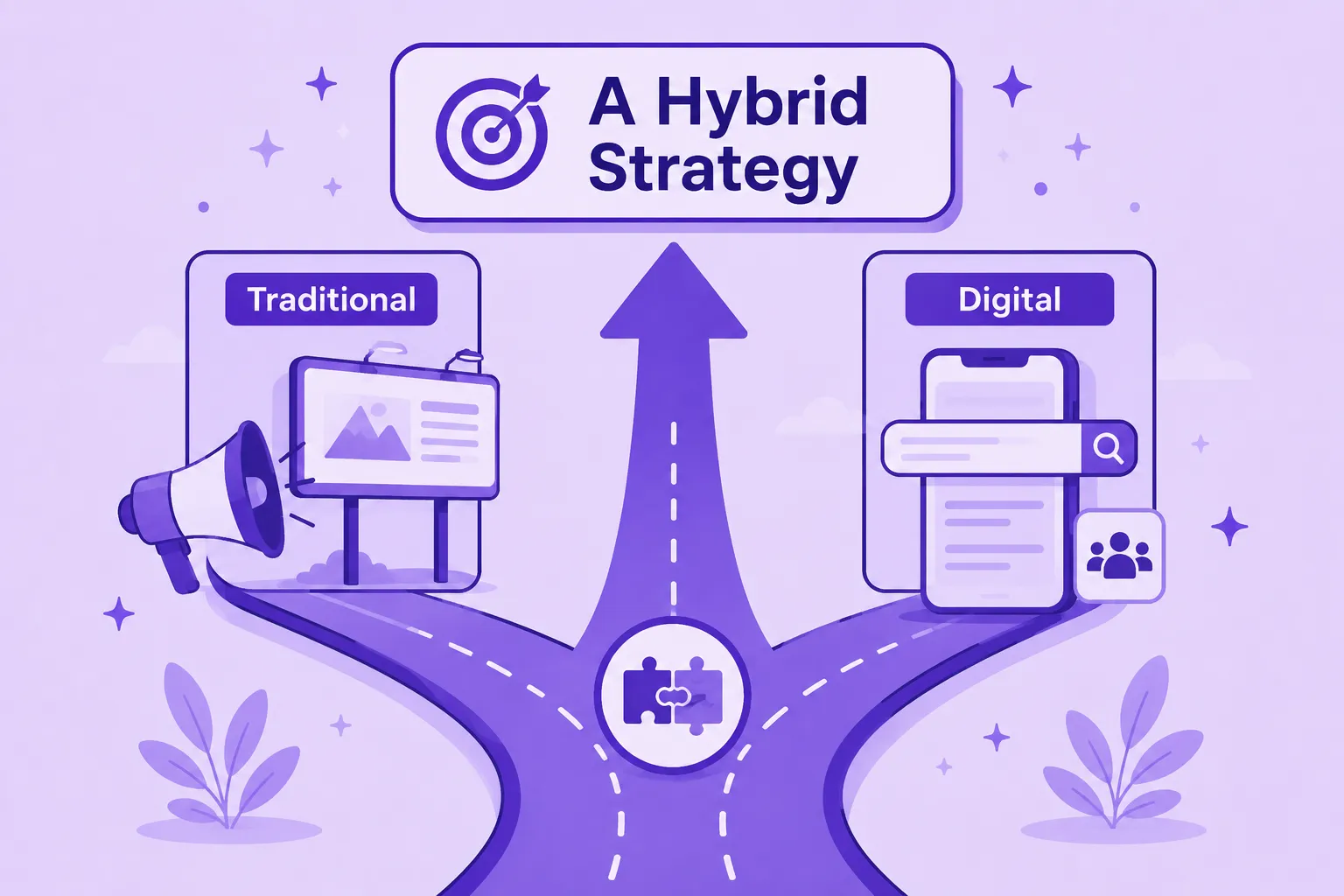
Yes and for many businesses, a hybrid approach is actually the smartest path rather than an either/or decision. A local business might use a traditional channel like a community newspaper or local radio spot to build initial trust and awareness, while running targeted digital campaigns to capture the resulting interest and convert it into measurable leads.
The two aren’t competing strategies as much as complementary ones: traditional marketing can build broad recognition, while digital marketing can capture and convert the resulting demand with far more precision. A person who sees a billboard on their commute may later search for the business online at which point strong local SEO and a well-optimized website are what actually convert that awareness into a customer.
The businesses that get the most value typically don’t ask “traditional or digital” they ask “how much of each, and where does each one do its job best in the customer’s journey.”
Common Mistakes Businesses Make When Choosing
A few patterns show up repeatedly when businesses get this decision wrong:
Assuming digital is always cheaper:
It can be, but poorly targeted or poorly measured digital campaigns can waste budget just as easily as a mistimed traditional one.
Abandoning traditional marketing entirely without testing:
For strongly local or older audiences, cutting traditional channels completely can leave real reach on the table.
Treating digital marketing as "set and forget":
Digital’s biggest advantage is its measurability ignoring the data defeats the purpose of using it.
Not aligning channel choice with the actual customer journey:
Choosing a channel based on internal preference rather than where the audience actually spends attention and makes decisions.
Underestimating the time SEO and content take to compound:
Digital marketing’s long-term efficiency comes from patience expecting instant results undermines its biggest advantage.
How Unosearch Can Help
If your business is leaning toward shifting more budget into digital marketing or you’re already running digital campaigns but not seeing the measurable results you expected that’s exactly where a dedicated digital strategy partner makes the difference.
Not sure where to start with digital marketing?
A revenue-driven SEO strategy ties your digital efforts directly to business outcomes, not just traffic or impressions.
Want your business to show up for nearby customers specifically?
Local SEO services help you capture local search demand the way a well-placed local ad once did — but with better targeting and measurement.
Want to be visible in AI-generated answers too, not just search results?
GEO services make sure your business gets cited inside ChatGPT, Gemini, and AI Overviews as search behavior continues shifting.
Unosearch helps businesses move from traditional, hard-to-measure marketing spend into digital strategies that show clear, trackable returns without losing what traditional marketing does well for the audiences that still need it.
Frequently Asked Questions
What is the main difference between traditional and digital marketing?
Traditional marketing broadcasts to a broad, largely untracked audience through channels like print, TV, and billboards. Digital marketing targets specific audiences based on behavior and intent, with real-time measurement of what’s working.
Is digital marketing better than traditional marketing?
Digital marketing generally offers better targeting, measurability, and flexibility, especially for businesses that need trackable ROI. Traditional marketing still holds an edge for local trust-building and reaching less digitally active audiences.
What are the advantages of digital marketing over traditional marketing?
Key advantages include precise targeting, real-time performance data, lower entry cost, compounding organic visibility over time, and the ability to adjust campaigns mid-flight based on actual results.
Should a small business use traditional or digital marketing?
Most small businesses benefit from starting with digital marketing due to its lower cost and flexibility, while still considering traditional channels if their audience is strongly local or less digitally active.
Can traditional and digital marketing be used together?
Yes. Many businesses use traditional marketing to build broad awareness and trust, while using digital marketing to capture and convert that interest with more precise targeting and measurable results.
References
1. Nielsen : Marketing & Media Research: https://www.nielsen.com/insights
2. HubSpot: Marketing Statistics & Research: https://www.hubspot.com/marketing-statistics
3. Statista Digital Advertising Statistics: https://www.statista.com/markets/digital-advertising/
Local SEO for Real Estate: What Works for Agents in 2026
A practical guide to profile setup, reviews, neighborhood pages and AI visibility, including the brokerage rules and measurement problems most guides skip.By Mahendernath Pulidindi, Associate Vice President, UnoSearch · Updated October 10, 2026 ·...

Local SEO for Lawyers: How Law Firms Win the Map Pack in 2026
Google shows three firms in the Map Pack and hides the rest. This guide explains what decides which three, using Google's own guidelines, the 2026 Local Search Ranking Factors survey and the bar rules that limit what attorneys can do.By Pankaj...
Local SEO for Healthcare: A HIPAA-Safe Playbook for US Practices (2026)
Patients usually pick from the three practices Google shows first. This guide covers what decides those three, plus the HIPAA traps in reviews, tracking and listings that most local SEO for healthcare advice skips.By Rajiv Ranjan, CTO, UnoSearch...