
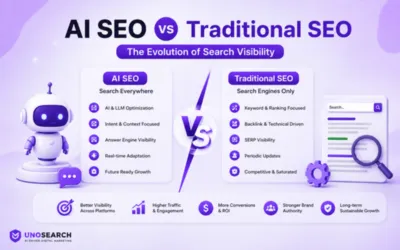
Understand how AI-driven search is changing visibility, content, and discovery and identify where your current SEO strategy may need to evolve.

Rajiv Ranjan
CTO, UnoSearch
Read more..
10+ Years
of Expertise
60+
Industries Served
AI-First
Technology & Innovation
Looking for an SEO agency ? Talk to Unosearch
AI SEO is the practice of optimizing content so it gets cited inside AI-generated answers across ChatGPT, Gemini, Perplexity, and Claude, while traditional SEO focuses on ranking pages within Google and Bing search results to earn clicks. They serve the same goal of visibility, but operate through entirely different mechanics, signals, and conversion economics.
The numbers behind this shift tell the real story. AI-referred visitors now convert at 14.6% versus just 1.7% from traditional organic traffic, an 8.5x lift that reflects pure intent quality. More than 35% of consumers now begin their searches inside AI tools instead of Google, and 60% report that AI delivers clearer answers than a traditional results page. Google itself just slipped below 90% search market share for the first time since 2015, sitting at 89.34% in early 2026.
“Brands still treating AI SEO and traditional SEO as separate budgets are losing twice. The smartest teams in 2026 run one strategy that earns both rankings and citations from the same investment.” — Pankaj Srivastava, Founder, UnoSearch
How AI SEO and traditional SEO actually differ in 2026?
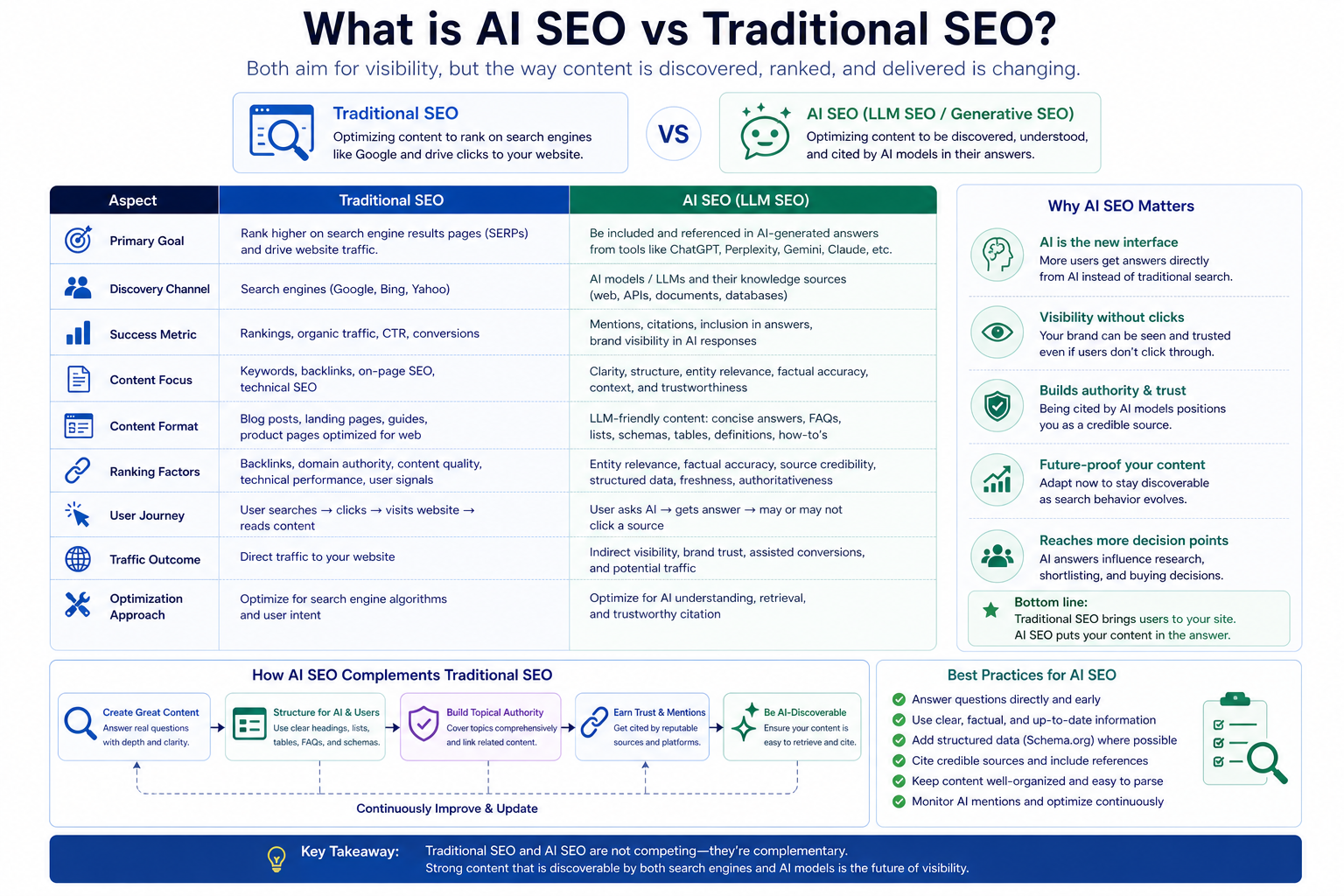
| Parameter | Traditional SEO | AI SEO |
| Targeting Unit | Keywords (3–4 words on average) | Prompts (15–30 words, with query fan-out into 5–8 sub-queries) |
| Visibility Format | Blue-link rankings on Google and Bing SERPs | Sentence-level citations inside ChatGPT, Gemini, Perplexity, and Claude answers |
| Content Structure | Comprehensive long-form, keyword-targeted, optimized for crawlers | Answer-first passages, atomic facts, entity-dense sections built for LLM extraction |
| Authority Signals | Backlinks, domain authority, on-page optimization | Entity recognition, Wikidata presence, Reddit and LinkedIn mentions, earned media |
| Conversion Performance | 1.7% average conversion rate from organic visitors | 14.6% average conversion rate from AI-referred visitors (8.5x higher intent quality) |
Both approaches still rely on crawlable content, technical health, and authority signals. The split happens at the layer where visibility gets earned, and that single distinction reshapes everything from keyword strategy to measurement.
The core differences worth knowing:
- Targeting unit. Traditional SEO targets keywords averaging 3 to 4 words. AI SEO targets prompts that often run 15 to 30 words and trigger query fan-out, where one search becomes 5 to 8 sub-queries.
- Visibility format. Traditional SEO competes for blue-link rankings. AI SEO competes for sentence-level citations inside synthesized answers.
- Content structure. Traditional SEO rewards keyword-targeted, comprehensive long-form. AI SEO rewards answer-first passages, atomic facts, and entity-dense sections that LLMs can extract cleanly.
- Measurement. Traditional SEO tracks rankings, organic traffic, and click-through rate. AI SEO tracks citation share, brand mention frequency, prompt panel presence, and AI-referred conversion rate.
- Authority signals. Traditional SEO leans heavily on backlinks. AI SEO leans on entity recognition, Wikidata presence, Reddit and LinkedIn mentions, plus earned media in trade publications.
- Conversion behavior. Traditional clicks deliver mixed intent. AI citations deliver high-intent users who arrive already pre-qualified by the AI’s recommendation.
About 60% of Perplexity citations still overlap with Google’s top 10 results, which means traditional SEO remains the foundation that AI SEO builds on. Skipping one weakens the other.
Should businesses invest in AI SEO or traditional SEO first in 2026?
Both, but in proportion to where your audience already searches. A brand serving B2B decision-makers, where over 80% rely on AI summaries for at least 40% of their searches, should weight AI SEO heavier from day one. A brand chasing local intent or transactional queries can still lead with traditional SEO and layer AI SEO on top.
The strategy is rarely either-or. Our GEO services at UnoSearch combine both disciplines into a single integrated framework, mapping your topic universe, structuring content for passage-level extraction, deploying schema layers, and earning citations across the platforms your audience actually uses. One investment, two surfaces, compounding returns.
Want to understand how traditional SEO and GEO compare from an investment perspective? Explore our detailed guide on SEO vs GEO: Which Is Better for ROI?
Why choose UnoSearch for AI SEO and traditional SEO together?
UnoSearch is a Google Premier Partner with 11+ years of search experience and $13.7M+ in client revenue across 60+ industries. We build integrated strategies that earn rankings on Google AND citations inside ChatGPT, Gemini, Perplexity, and Claude from the same content investment. Our specialists handle technical SEO, content architecture, schema layering, entity building, digital PR, and prompt panel tracking under one roof. Every AI SEO engagement flows through our proprietary DigiOps platform, giving you live visibility into rankings, citations, and conversion impact across both surfaces. Founders sit inside every client channel.
We help brands grow traffic in AI search
FAQ's
1. Is traditional SEO dead in 2026?
No. Google still reaches 95% of Americans monthly, and around 60% of Perplexity citations overlap with Google’s top 10 organic results. Traditional SEO remains the foundation, but it now needs AI SEO layered on top to capture the visibility happening inside generative engines.
2. Which converts better, AI SEO traffic or traditional SEO traffic?
AI SEO traffic converts dramatically better. Recent data pegs AI-referred visitors at a 14.6% conversion rate versus just 1.7% from traditional organic traffic. The reason is intent quality, since AI tools pre-qualify users before sending them through.
3. Do I need different content for AI SEO and traditional SEO?
Not entirely. Well-structured AI SEO content usually performs strongly in traditional rankings too. The shift is in how each section is built, with answer-first openings, atomic facts, and entity density carrying as much weight as keyword optimization.
4. How long does AI SEO take to show results compared to traditional SEO?
AI SEO typically shows measurable citation lift within 4 to 12 weeks, faster than traditional SEO’s 3 to 6 months for ranking shifts. The difference exists because LLMs use real-time retrieval rather than waiting for index updates.
Contact Us for a Free SEO Consultation Today!
Let us help you grow your business with a customized SEO strategy
References
- PageOnePower — AI SEO vs Traditional SEO: Which Should You Use in 2026 — https://www.pageonepower.com/linkarati/ai-seo-vs-traditional-seo-which-should-you-use-in-2026
- Semrush — Traditional SEO vs AI SEO: What You Actually Need to Know — https://www.semrush.com/blog/traditional-seo-vs-ai-seo/
- SEOmator — AI-Powered SEO vs Traditional Methods: A Data Comparison in 2026 — https://seomator.com/blog/ai-powered-seo-vs-traditional-methods-comparison
- Doc Digital SEM — AI SEO vs Traditional SEO: What Actually Works in 2026 — https://docdigitalsem.com/ai-seo-vs-traditional-seo/
Continue Learning About SEO & AI Search
Local SEO for Real Estate: What Works for Agents in 2026
A practical guide to profile setup, reviews, neighborhood pages and AI visibility, including the brokerage rules and measurement problems most guides skip.By Mahendernath Pulidindi, Associate Vice President, UnoSearch · Updated October 10, 2026 ·...
Local SEO for Lawyers: How Law Firms Win the Map Pack in 2026
Google shows three firms in the Map Pack and hides the rest. This guide explains what decides which three, using Google's own guidelines, the 2026 Local Search Ranking Factors survey and the bar rules that limit what attorneys can do.By Pankaj...
Local SEO for Healthcare: A HIPAA-Safe Playbook for US Practices (2026)
Patients usually pick from the three practices Google shows first. This guide covers what decides those three, plus the HIPAA traps in reviews, tracking and listings that most local SEO for healthcare advice skips.By Rajiv Ranjan, CTO, UnoSearch...