
What Is E-E-A-T in AI Rankings? Complete 2026 Guide
Pankaj Srivastava
Published Date: April 24th 2026
Looking for an SEO agency? Talk to UnoSearch
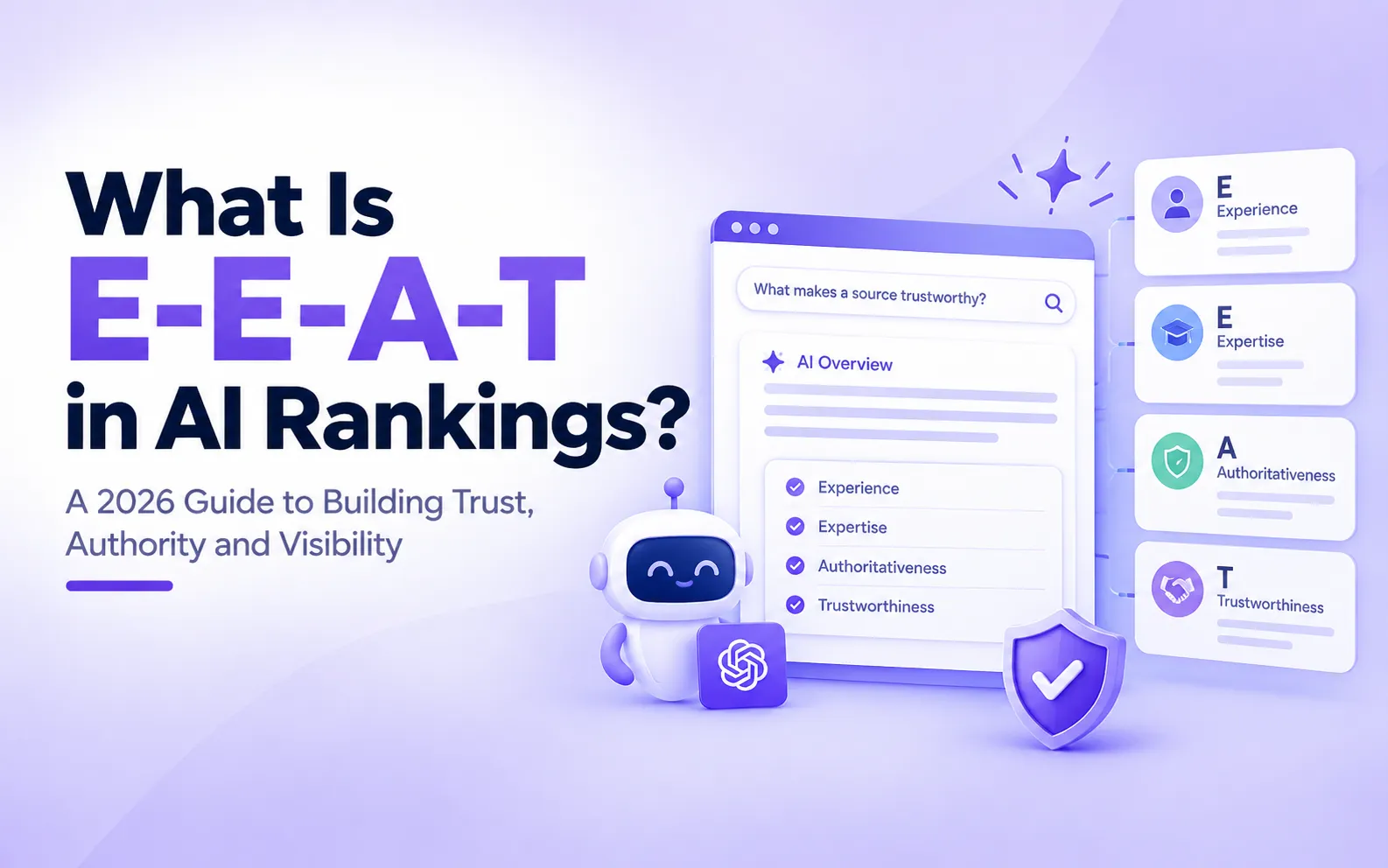
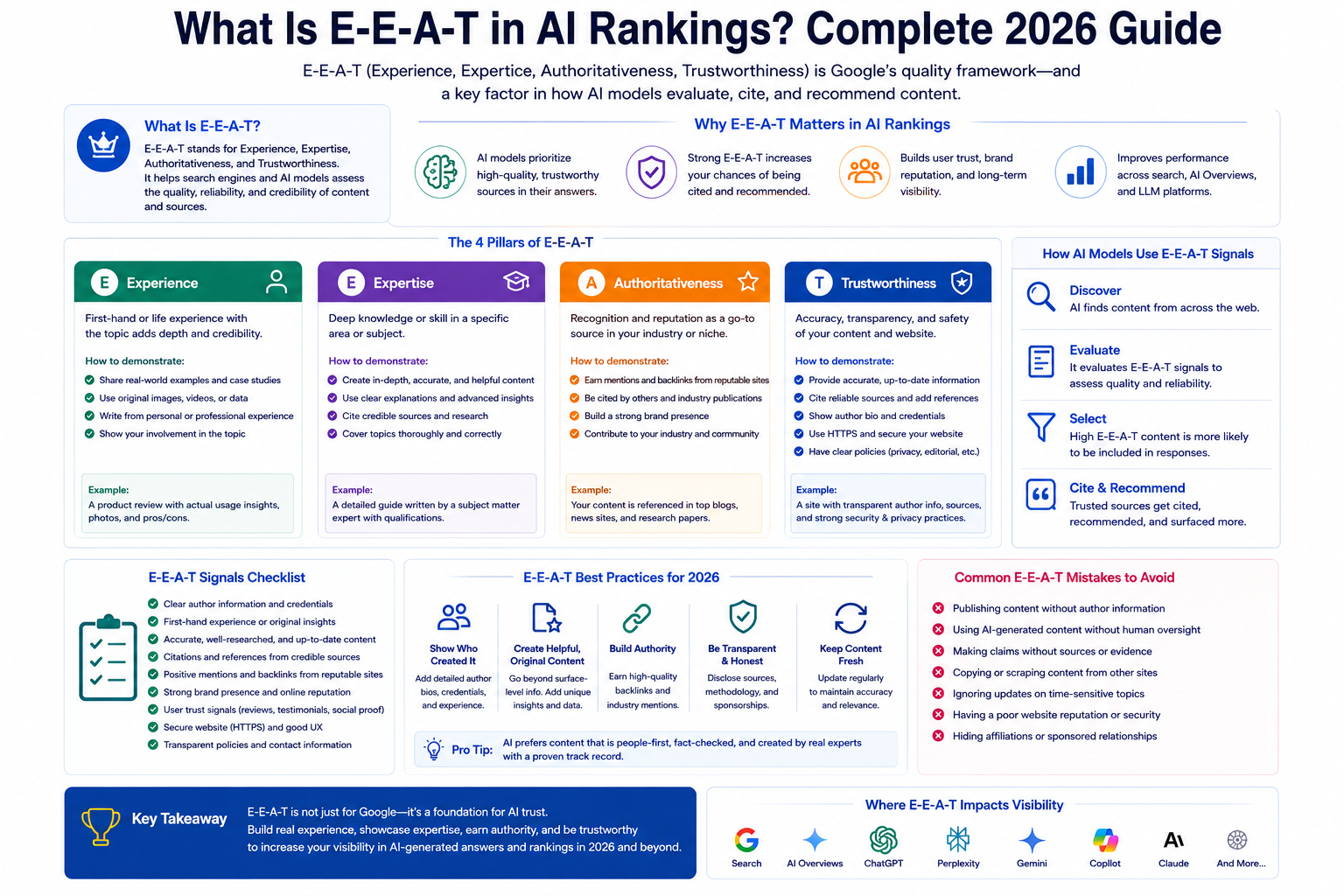
E-E-A-T stands for Experience, Expertise, Authoritativeness, and Trustworthiness. It’s the filter ChatGPT, Gemini, Perplexity, and Claude run every source through before deciding what to cite.
Google introduced the framework inside its Quality Rater Guidelines. By 2026, almost every major LLM has borrowed the same logic for picking sources. One analysis of 15,847 AI Overview results pegs the number at 96%. That’s the share of cited pages carrying strong E-E-A-T signals. Cited pages also pull 35% more organic clicks and 91% more paid clicks than their uncited competitors, so brands still treating E-E-A-T as optional are watching their ground shift quarter after quarter.
“Content without E-E-A-T will not rank, not in Google, not in ChatGPT, not anywhere. The brands investing in authored expertise today are the ones LLMs will reference for the next decade.” — Pankaj Srivastava, Founder, UnoSearch
Breaking down the four pillars of E-E-A-T for AI search
Each letter pulls different weight. Some are harder to fake than others, and the AI models have learned the difference.
- Experience. You’ve actually done the thing. Not researched it, done it. Content from people with skin in the game consistently outperforms tidy desk-research summaries.
- Expertise. Subject-matter knowledge, visible through author bios, certifications, credentials, and a steady publishing record inside one clear domain.
- Authoritativeness. What other people say about you when you’re not in the room. Citations from respected sites, industry mentions, branded search volume – these are the proof points.
- Trustworthiness. Accuracy, transparency, a clean reputation, secure hosting, readable policies. Google’s updated guidance doubles its weight.
Lose the Trust pillar, and the rest falls apart. A site can hold every credential in the industry and still get filtered out of AI citations if its trust signals look wobbly.
Building E-E-A-T is one part of a broader search strategy. Explore our guide to AI SEO optimization to learn how content quality, technical SEO, topical authority, and AI visibility tracking work together to improve search visibility.
How do AI models actually measure E-E-A-T in 2026?
AI models read E-E-A-T across two layers at once: on-page signals like author schema, credential markup, and consistent entity usage, plus off-page signals covering third-party citations, verified reviews, digital PR coverage, and reputation consistency across the open web.
Entity Knowledge Graph density now correlates with AI citation likelihood at r=0.76. In plain terms, LLMs quietly run your content against structured databases before trusting it. Our GEO services at UnoSearch build both layers in parallel. We deploy Author and Organization schema with full credential fields, establish named-expert profiles across relevant platforms, and earn third-party mentions in industry publications. Once trust gets damaged, rebuilding takes six to twelve months. Preventing that loss costs a fraction of fixing it.
Why choose UnoSearch to strengthen your E-E-A-T for AI rankings?
UnoSearch is a Google Premier Partner with 11+ years of search experience and $13.7M+ in client revenue across 60+ industries. We don’t treat E-E-A-T as a checklist. It’s an architecture, built from author entity profiles, schema layering, third-party validation through digital PR, and steady enrichment of trust signals. Our in-house specialists blend traditional SEO, AI SEO, and reputation management into one strategy engineered for ChatGPT, Gemini, Perplexity, and Claude citation capture. Every engagement runs through our proprietary DigiOps platform, giving you live visibility into authority signal growth. Founders sit inside every client channel.
📞 Call Now: +91 8976406245
We help brands grow traffic in AI search
FAQ's
1. Is E-E-A-T an official ranking factor for AI models?
Technically, no. E-E-A-T is a quality framework LLMs lean on to judge source credibility. It isn’t a direct ranking input, but 96% of AI Overview citations come from pages carrying strong E-E-A-T signals, which makes it a ranking factor in practice.
2. What is the difference between E-A-T and E-E-A-T?
Google added the second E for Experience in December 2022. The older E-A-T covered Expertise, Authoritativeness, and Trust. The updated E-E-A-T rewards verifiable first-hand experience, which LLMs value heavily for review content, YMYL topics, and practical how-to guides.
3. How can a new website build E-E-A-T quickly?
Publish authored content written by real experts. Add full author schema with credentials. Earn mentions on niche authority sites. Collect verified reviews. Keep a transparent About page with founder profiles, real photos, and direct contact information.
4. Does E-E-A-T matter more for YMYL topics?
Yes. Your Money or Your Life topics like health, finance, legal, and safety demand the strongest E-E-A-T signals, because AI models apply extra scrutiny before citing any source that could affect someone’s well-being or financial decisions.
Contact Us for a Free SEO Consultation Today!
Let us help you grow your business with a customized SEO strategy
References:
- Google Search Central — Search Quality Rater Guidelines: E-E-A-T Framework — https://developers.google.com/search/docs/fundamentals/creating-helpful-content
- Search Engine Land — How E-E-A-T Became the Universal Standard for AI Search — https://searchengineland.com/e-e-a-t-ai-search-standard-2026/
- Wellows — Google AI Overview Ranking Factors 2026 — https://wellows.com/blog/google-ai-overviews-ranking-factors/
- Semrush — E-E-A-T and Entity Authority in Generative Search — https://www.semrush.com/blog/eeat-entity-authority-ai/