
What is FAQ schema for LLM citations?
Pankaj Srivastava
Published Date: May 11th 2026
Looking for an SEO agency? Talk to UnoSearch
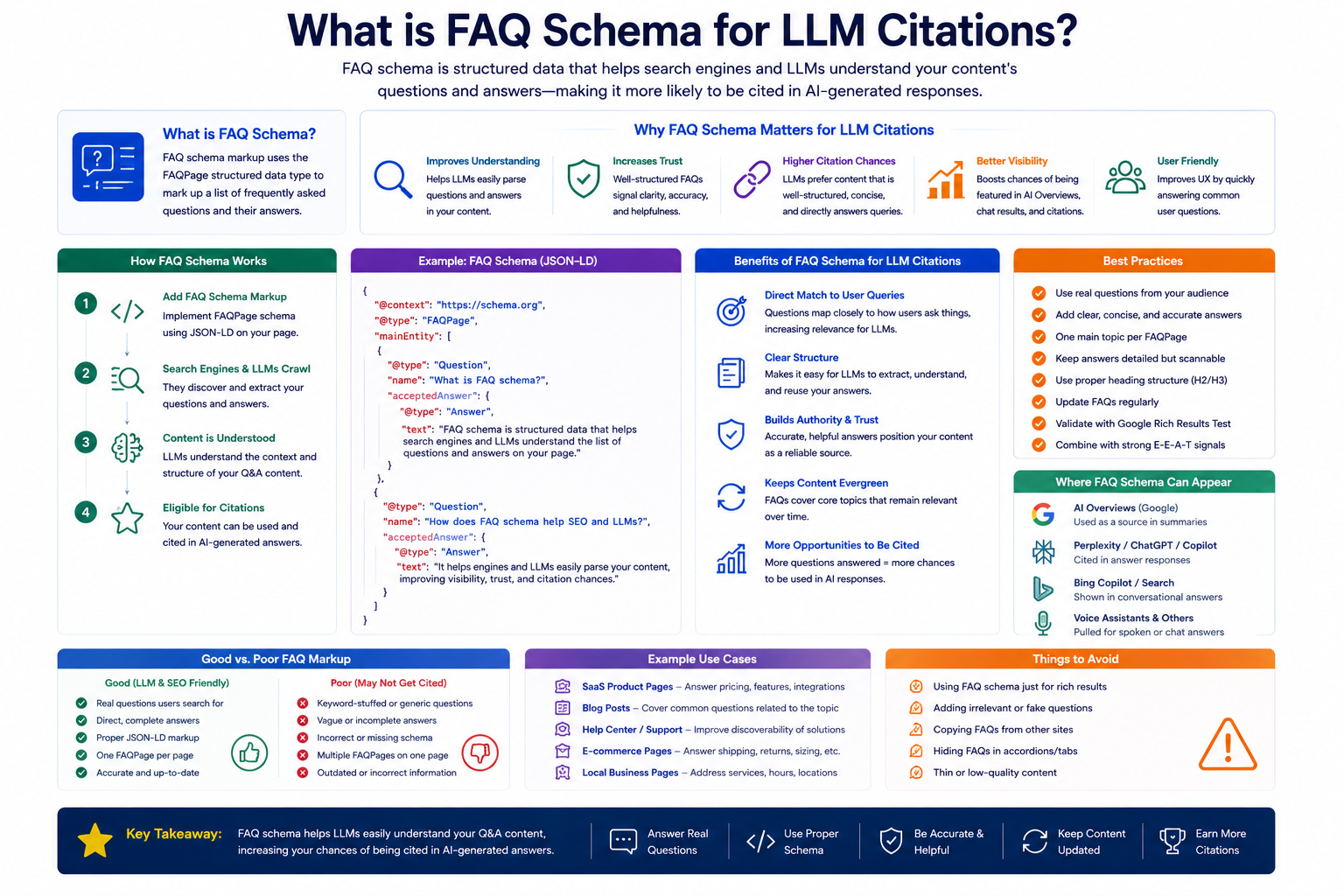
FAQ schema is JSON-LD structured data that marks up question-and-answer blocks on a page, telling search engines and AI systems how each question maps to its answer. For LLM citations, the schema works as a dual-layer signal. Google’s Knowledge Graph uses it to map your content, while ChatGPT, Gemini, and Perplexity extract the visible Q&A text that the schema mirrors on the page.
Most guides oversell or undersell FAQ schema, and both directions miss the point. A February 2026 controlled experiment by Mark Williams-Cook confirmed something uncomfortable for the SEO industry. LLMs tokenize JSON-LD as raw text, not as structured data, which means ChatGPT and Perplexity do not directly parse your FAQPage markup. They extract the visible Q&A content that the schema is supposed to mirror. SE Ranking’s analysis even found pages with FAQ schema averaged 3.6 citations in ChatGPT responses, while pages without averaged 4.2, a slight negative correlation. The real value lives elsewhere.
“FAQ schema does not directly buy you LLM citations. It buys you a clean answer architecture on the page that AI engines can lift word for word, plus a stronger Knowledge Graph footprint that Google’s AI Overview ranks alongside everything else.” — Pankaj Srivastava, Founder, UnoSearch
| Parameter | Without FAQ Schema | With FAQ Schema |
| Page Structure | Variable, often unclear | Enforced Q&A discipline aligned to LLM chunk sizes |
| Knowledge Graph Strength | Weaker entity associations | Stronger Google entity understanding |
| LLM Extraction Speed | Slower, requires inference | Faster, self-contained answer blocks |
| Perplexity Citation Window | Days to weeks | Sometimes inside 2 hours of publication |
| AI Overview Eligibility | Reduced visibility | Improved structural signals |
How FAQ schema actually drives LLM citations in 2026
The schema itself is not the lever. The visible Q&A content is the lever, and the schema acts as scaffolding that forces clean structure across the page. AI engines reward that structure consistently.
The dual-layer logic worth understanding:
- Layer 1, Google’s Knowledge Graph signal. FAQPage schema strengthens how Google interprets your content for AI Overviews and AI Mode. Even though the rich result was removed on 7 May 2026, the schema still feeds Google’s entity understanding behind the scenes.
- Layer 2, the visible Q&A content. ChatGPT, Perplexity, Gemini, and Claude actively extract the on-page Q&A that mirrors the schema. The format makes content easy to lift, since each question maps to a self-contained answer chunk.
- Indirect AI citation lift. Stronger Knowledge Graph presence and cleaner page structure compound, since LLMs preferentially cite pages with high topical authority and easily extractable answers.
- Vector chunk alignment. Answers between 50 and 300 words fit cleanly inside the 150 to 300 word retrieval chunks AI engines use. Schema enforces that length discipline naturally.
- Entity reinforcement. FAQ schema combined with Author and Organization schema creates a clear entity graph, which raises citation probability across every major AI engine.
A documented case study showed a site with perfect schema but only 420 referring domains earned just 12% of AI citations, while a competitor with no schema but 3,200 referring domains earned 68%. Domain authority outweighs schema by roughly 3.5 to 1.
How many FAQs should I include per page for maximum LLM citation lift?
Three to five FAQs per page is the sweet spot. Each answer should run between 50 and 300 words across 2 to 4 self-contained sentences. This range aligns with LLM vector chunk sizes of 150 to 300 words, ensuring each answer fits inside a single retrieval chunk without getting split mid-thought.
Going beyond five questions usually dilutes the signal and pushes lower-value Q&A into the lower half of the page, where citation rates drop sharply. Our GEO services at UnoSearch place 4 to 5 high-intent FAQs near the top of every priority page, mirror them with FAQPage JSON-LD, and validate every block through Google Rich Results Test before publication. Most clients see Perplexity citations on new pages within 2 hours, while ChatGPT typically catches up over the following 6 to 12 weeks.
Why choose UnoSearch for FAQ schema and LLM citation optimization?
UnoSearch is a Google Premier Partner with 11+ years of search experience and $13.7M+ in client revenue across 60+ industries. We treat FAQ schema as one piece of a larger AI citation architecture, not a silver bullet. Our specialists deploy validated FAQPage, Article, Organization, BreadcrumbList, and HowTo schema across every priority template, mirror the schema with visible Q&A content, and track AI citation share weekly across ChatGPT, Gemini, Perplexity, Claude, and Google AI Overviews. Every AI SEO engagement flows through our proprietary DigiOps platform, giving you live visibility into citation growth. Founders sit inside every client channel.
We help brands grow traffic in AI search
FAQ's
1. Do LLMs actually read FAQ schema directly?
Not the JSON-LD code itself. LLMs tokenize structured data as raw text rather than parsing it semantically. The benefit comes from the visible Q&A content the schema enforces, plus the Knowledge Graph signals it sends to Google, which AI Overviews uses for citation selection.
2. Did Google removing FAQ rich results in May 2026 kill FAQ schema?
No. The rich result is gone, but the schema type is still valid. Google explicitly stated that you do not need to remove existing FAQPage markup, since unused structured data does not cause search issues. The schema still feeds Knowledge Graph and AI search infrastructure.
3. How long does it take for FAQ schema to influence LLM citations?
Perplexity and Gemini often cite new FAQ content within 2 hours of publication, while ChatGPT typically lags 6 to 12 weeks because of its slower index refresh cycle. Google AI Overviews usually take 2 to 8 weeks depending on existing domain authority.
4. Should I add FAQ schema to every page on my website?
Only pages with genuine Q&A content. Adding FAQPage schema to content that is not actually structured as questions and answers gets flagged as spam by Google and can hurt trust signals across the entire domain. Quality of fit beats coverage volume every time.
Contact Us for a Free SEO Consultation Today!
Let us help you grow your business with a customized SEO strategy
References
- ZipTie.dev — FAQ Schema for AI Answers: Does It Actually Get You Cited by AI? — https://ziptie.dev/blog/faq-schema-for-ai-answers/
- SEO Strategy — FAQ Schema After 7 May 2026: What Actually Changed — https://www.seostrategy.co.uk/learn/faq-schema-deprecation-2026-rich-result-vs-schema/
- Frase — Are FAQ Schemas Important for AI Search, GEO & AEO? — https://www.frase.io/blog/faq-schema-ai-search-geo-aeo
- Stackmatix — Perplexity AI Optimization Strategy: Citation Guide 2026 — https://www.stackmatix.com/blog/perplexity-ai-optimization-strategy
Continue Learning About SEO & AI Search

Local SEO for Real Estate: What Works for Agents in 2026
A practical guide to profile setup, reviews, neighborhood pages and AI visibility, including the brokerage rules and measurement problems most guides skip.By Mahendernath Pulidindi, Associate Vice President, UnoSearch · Updated October 10, 2026 ·...

Local SEO for Lawyers: How Law Firms Win the Map Pack in 2026
Google shows three firms in the Map Pack and hides the rest. This guide explains what decides which three, using Google's own guidelines, the 2026 Local Search Ranking Factors survey and the bar rules that limit what attorneys can do.By Pankaj...

Local SEO for Healthcare: A HIPAA-Safe Playbook for US Practices (2026)
Patients usually pick from the three practices Google shows first. This guide covers what decides those three, plus the HIPAA traps in reviews, tracking and listings that most local SEO for healthcare advice skips.By Rajiv Ranjan, CTO, UnoSearch...