
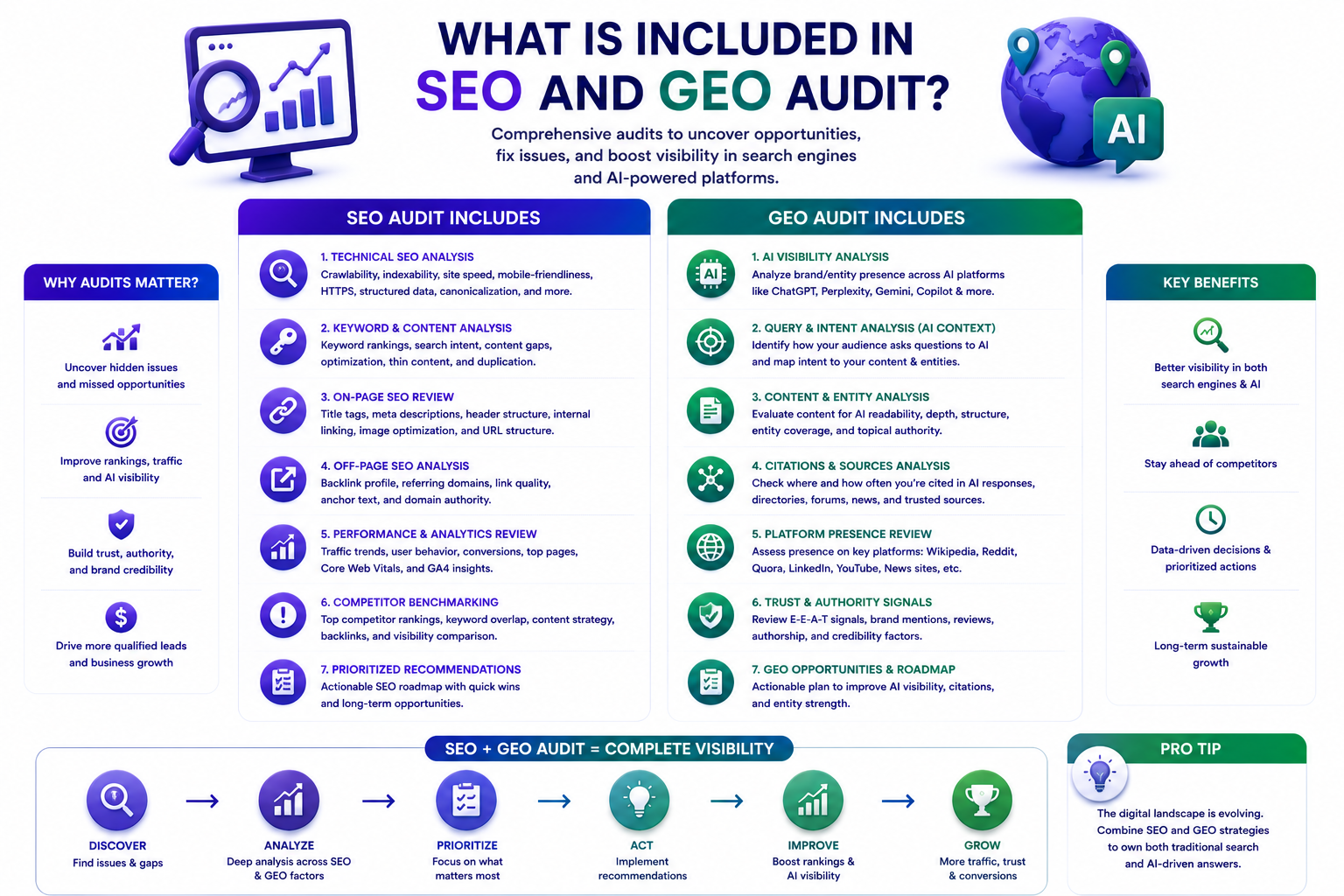
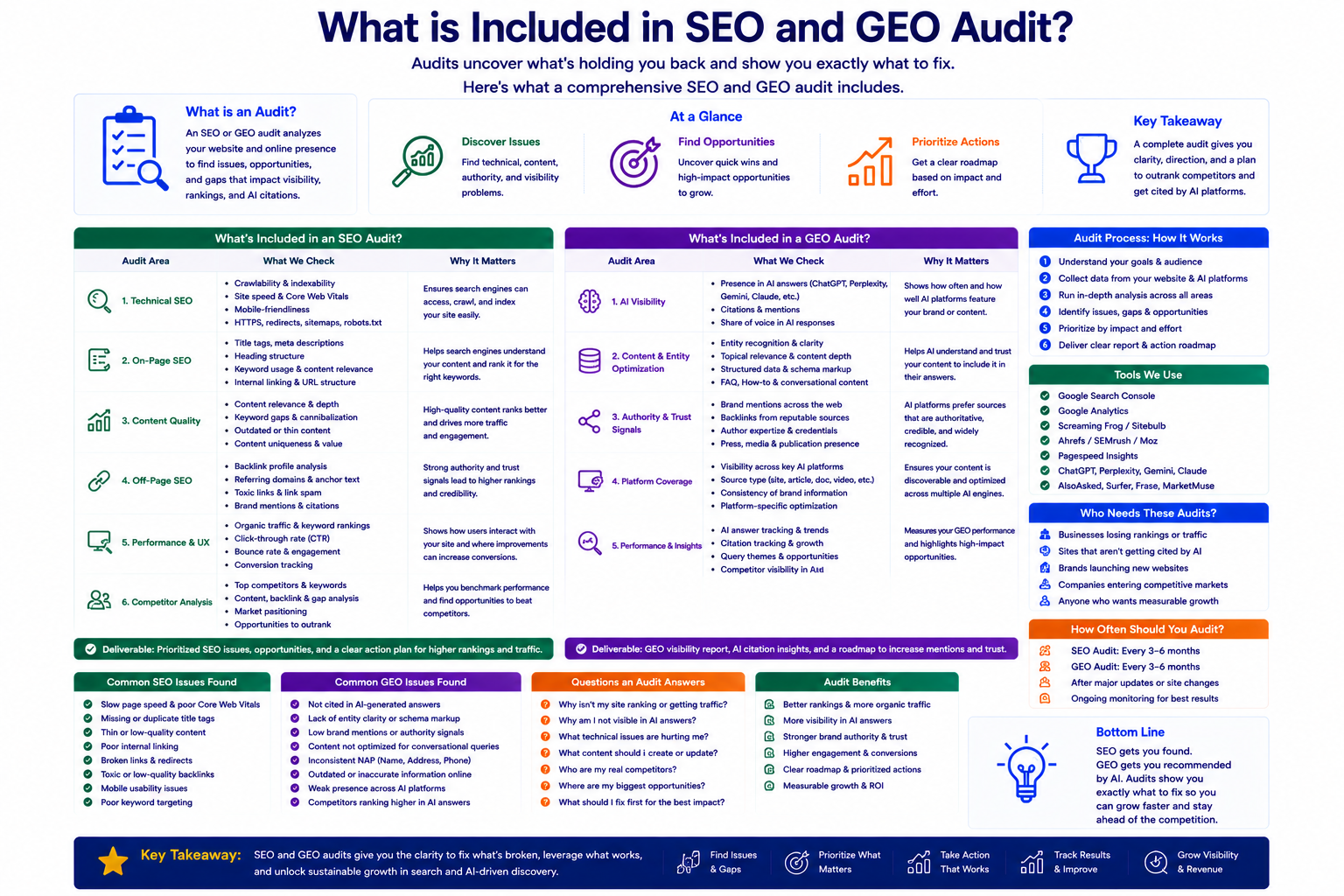
Identify the gaps affecting your Google visibility and AI citations, with actionable insights to strengthen your presence across both traditional and AI search.

Priyanka Dutta Deb
Sr. SEO Analyst, UnoSearch
Read more..
Data-Driven
Rank & Performance Analysis
Insight-Focused
GA4, Search Console & Reporting
Competitor-Aware
Keyword Gap & SERP Research
Looking for an SEO agency? Talk to UnoSearch
A proper SEO and GEO audit in 2026 covers six things; technical health, on-page content, off-page authority, schema and structured data, AI citation share across ChatGPT, Perplexity, Gemini, and Google AI Overviews, plus a prioritised roadmap that ties everything back to revenue. Real audits take 20 to 80 hours depending on site size, cost $2,500 to $15,000, and end with an action list your team can pick up on Monday, not a 200-page PDF that gets filed and forgotten.
The word “audit” has been beaten flat by our industry, and honestly, most of what gets sold under that name is either a templated checklist with a logo on the front or a 200-slide deck thick enough to use as a doorstop. A useful audit is neither of those; it’s a tightly-scoped diagnosis of what’s broken, what’s working, what’s missing entirely, and which fixes deserve the first three months of your team’s attention. Anything that doesn’t finish with a sequenced action list isn’t an audit, it’s documentation with extra steps.
“I tell clients to judge an audit by what they do after reading it, never by how thick it is. If your team closes the document and immediately knows what to fix on Monday, the audit worked, and if they need three meetings just to figure out where to start, you bought a report. The action list is the deliverable, everything else is the working.” — Pankaj Srivastava, Founder, UnoSearch
SEO and GEO Audit Components at a Glance
|
Component |
What Gets Checked |
|
Technical SEO |
Crawl, indexation, Core Web Vitals, redirects, sitemaps |
|
Content & On-Page |
Depth, cannibalisation, internal links, content gaps |
|
Off-Page & Authority |
Backlinks, toxic links, unlinked mentions, link gap |
|
Schema & AI Citation |
Validated markup, prompt-panel tracking across 5 AI engines |
|
Prioritised Roadmap |
Effort vs impact scoring, 90/180/365-day sequencing |
So what’s actually inside a real SEO and GEO audit?
Technical work opens every audit we run, because nothing else moves until Google can actually crawl and render the site cleanly. That means crawl errors, indexation gaps, Core Web Vitals, mobile usability, HTTPS health, sitemap and robots config, redirect chains, broken internal links, and log file analysis on bigger sites. Most audits surface between thirty and a hundred technical fixes from this stage alone, sorted by impact.
On-page content is the next pass, and it answers a different question; do your pages actually deserve to rank? We compare content depth against whoever’s currently winning your target keywords, flag keyword cannibalisation (two of your own pages quietly fighting each other), review internal linking, headings, meta tags, and decide which thin pages need improving, consolidating, or just deleting outright. Content gaps usually surface here too, the queries your competitors rank for that you’re invisible on.
Off-page work then looks at what the rest of the web is saying about you. Backlink profile, toxic links worth disavowing, the link gap against direct competitors, unlinked brand mentions you can chase, and specific digital PR openings your team can act on this quarter. A useful audit doesn’t just list problems here, it points at the opportunities sitting in plain sight.
Schema and structured data is where SEO and GEO start overlapping properly. Every schema type you currently use gets validated through Google’s Rich Results Test, with gaps flagged where you should be using markup but aren’t. This used to be a sidebar in audits; in 2026 it’s central, since validated schema is one of the strongest signals AI engines use when deciding what content to extract and cite.
And then the GEO and AI citation section, which is the part most legacy audits skip entirely. That’s exactly why “audits” floating around the market in 2026 are usually missing half the picture. A real one builds a prompt panel of 30 to 50 high-intent queries for your category, tests them across ChatGPT, Perplexity, Gemini, Claude, and Google AI Overviews, measures your citation share against direct competitors, and pinpoints the content changes that would actually move the number. Princeton’s research found that adding statistics alone lifts AI citations by 41%, and this section spots exactly where those gains are sitting unclaimed in your existing content.
Finally, the roadmap, which is the bit that separates a real audit from a glorified checklist. Every finding gets scored on effort vs impact, sequenced into 90-day, 180-day, and 12-month windows, with an owner assigned to each (in-house, agency, or both). Without that prioritisation, you’ve got a long list of problems with no path through them, which is exactly the failure mode I watch most audits crash into.
How long does a real SEO and GEO audit take, and what does it cost?
A proper audit runs twenty to eighty hours of work depending on site size, costing between $2,500 and $15,000 as a one-off. Small sites under five hundred pages usually land at the lower end, twenty to thirty hours and $2,500 to $5,000. Mid-sized sites with a few thousand pages run forty to sixty hours and $5,000 to $10,000. Enterprise audits on large multi-region or multi-brand sites can climb past eighty hours and $15,000, since the surface area is genuinely that much bigger. Anything quoted under $1,500 is almost certainly a template checklist; anything north of $20,000 needs very specific justification. Our AI SEO services at UnoSearch usually open with an audit, because it’s the only honest way to scope what a retainer should actually include, and we’ll occasionally credit the audit fee against the first three months of an engagement when the scope fits.
Why choose UnoSearch for an SEO and GEO audit?
UnoSearch is a Google Premier Partner with 11+ years of search experience and $13.7M+ in client revenue across 60+ industries. Our audits end in action lists, not 200-page PDFs that disappear into a Dropbox folder, since the point of the work is making the next 90 days obvious to your team. Our specialists cover technical SEO, content and on-page work, link profile analysis, schema validation, and prompt-panel citation tracking across ChatGPT, Gemini, Perplexity, Claude, and Google AI Overviews. Every audit runs through our proprietary DigiOps platform, so you get a live, navigable diagnosis instead of a static document, with findings already sequenced by effort and impact. Founders sit inside every client channel.
We help brands grow traffic in AI search
FAQ's
1. How long should an SEO and GEO audit take?
A proper audit runs 20 to 80 hours of work depending on site size; small sites land at 20 to 30 hours, mid-sized sites at 40 to 60, and enterprise sites at 80+. Calendar time is usually two to four weeks end-to-end, including data gathering, the analysis itself, and the readout call with your team to walk through findings.
2. What's the difference between an SEO audit and a GEO audit?
An SEO audit focuses on traditional ranking factors, things like technical health, content, links, and schema. A GEO audit adds AI citation tracking, content extractability analysis, entity signals, and structured data work tuned specifically for AI engines. In 2026, they should be done together rather than separately, since the underlying work overlaps and splitting them usually duplicates effort across two invoices.
3. How much should I expect to pay for a real audit?
Somewhere between $2,500 and $15,000 as a one-off, depending on site size. Small sites land at $2,500 to $5,000, mid-market at $5,000 to $10,000, and enterprise at $10,000 to $15,000+. Anything dramatically cheaper is usually a template checklist; anything dramatically more expensive should come with a very specific justification you can pressure-test.
4. Will an audit tell me everything that's wrong with my SEO?
A good one tells you everything that actually matters, sequenced by impact, since the goal isn’t flagging every minor issue (that just buries the team in noise). It’s identifying the 20 to 40 changes that would move 80% of the meaningful outcomes. A useful audit edits aggressively for relevance rather than trying to be exhaustive.
Contact Us for a Free SEO Consultation Today!
Let us help you grow your business with a customized SEO and GEO strategy
References
- Semrush, US SEO Pricing and Agency Benchmark 2026, https://www.semrush.com/blog/us-seo-pricing-benchmark-2026/
- Ahrefs, SEO Cost Analysis Across US Markets 2026, https://ahrefs.com/blog/us-seo-cost-analysis-2026/
- Search Engine Land, SEO Retainer Scope and Pricing Report 2026, https://searchengineland.com/seo-retainer-scope-2026
- Conductor, Enterprise SEO Pricing and Team Benchmark 2026, https://www.conductor.com/learning-center/enterprise-seo-pricing-2026/
References
- Semrush, SEO Audit Methodology and Scope Benchmark 2026, https://www.semrush.com/blog/seo-audit-methodology-2026/
- Princeton GEO Research, Generative Engine Optimization Methods and Visibility Impact, https://arxiv.org/abs/2311.09735
- Ahrefs, Technical SEO Audit Standards Report 2026, https://ahrefs.com/blog/technical-seo-audit-standards-2026/
- Search Engine Land, GEO Audit Components and AI Citation Tracking 2026, https://searchengineland.com/geo-audit-components-2026
Continue Learning About SEO & AI Search

Local SEO for Real Estate: What Works for Agents in 2026
A practical guide to profile setup, reviews, neighborhood pages and AI visibility, including the brokerage rules and measurement problems most guides skip.By Mahendernath Pulidindi, Associate Vice President, UnoSearch · Updated October 10, 2026 ·...

Local SEO for Lawyers: How Law Firms Win the Map Pack in 2026
Google shows three firms in the Map Pack and hides the rest. This guide explains what decides which three, using Google's own guidelines, the 2026 Local Search Ranking Factors survey and the bar rules that limit what attorneys can do.By Pankaj...

Local SEO for Healthcare: A HIPAA-Safe Playbook for US Practices (2026)
Patients usually pick from the three practices Google shows first. This guide covers what decides those three, plus the HIPAA traps in reviews, tracking and listings that most local SEO for healthcare advice skips.By Rajiv Ranjan, CTO, UnoSearch...