
How Daynt Went from Zero AI Search Visibility to Consistent LLM Appearances in 5 Months
Daynt had the technical capability but wasn’t showing up where US buyers were searching — including ChatGPT and Google AI Overviews.
UnoSearch fixed that with a GEO framework, AI-aligned SEO, and PPC campaigns that brought in real B2B leads and trackable revenue.
Unosearch for Daynt
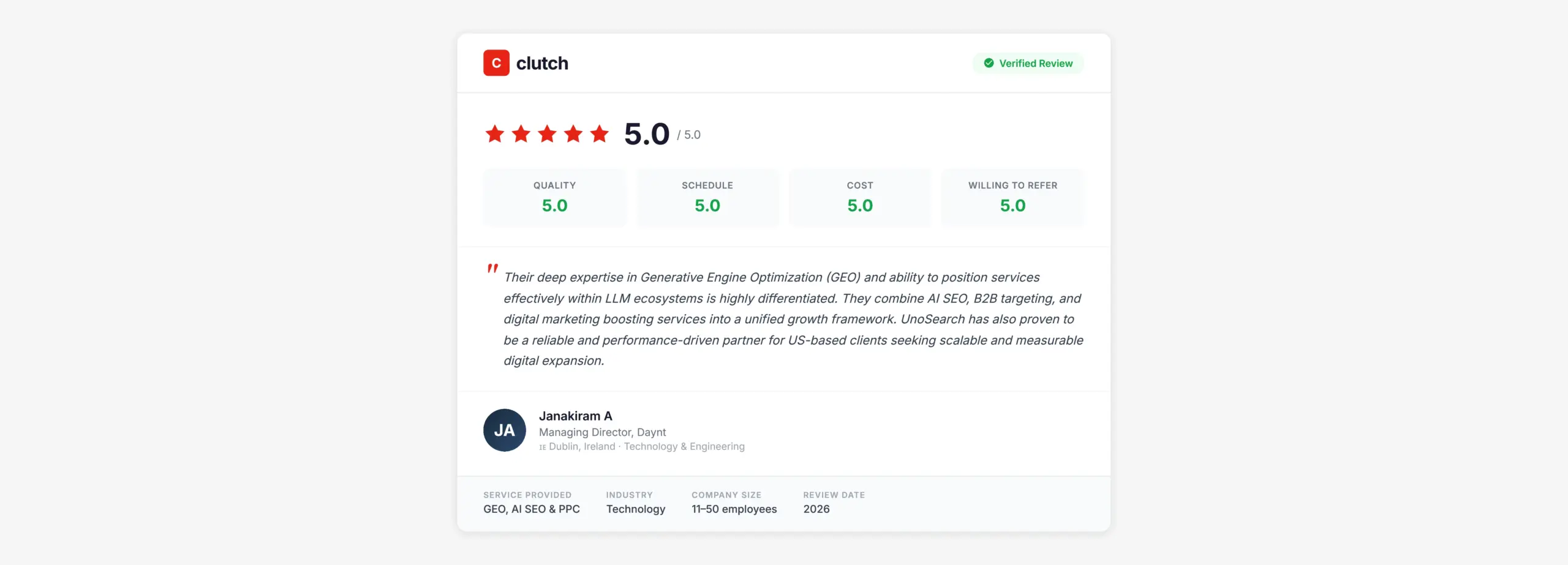
Improved Visibility Within LLM-Based Search Results: Through a comprehensive GEO framework, Daynt’s brand and services began surfacing inside LLM-driven platforms including ChatGPT and Google AI Overviews for high-intent B2B technology queries targeting US markets.
Stronger Inbound Interest from US Clients: Restructured service pages, B2B-aligned keyword mapping, and AI SEO content architecture directly translated into stronger inbound interest from US-based technology buyers — the exact audience Daynt was built to serve.
Increased B2B Lead Quality: The shift from generic visibility to contextually authoritative positioning across AI and traditional search platforms improved the quality of inbound leads — fewer unqualified enquiries, more conversations with decision-makers at startups and scaling businesses.
Measurable ROI & Revenue Growth from SEO + PPC: Aligned SEO and PPC campaigns delivered trackable revenue impact. With transparent performance dashboards and campaign attribution reporting tied directly to ROI metrics, Daynt had clear visibility into what was working and what was scaling.
Campaign Attribution Improved Significantly: Transparent, structured reporting across paid and organic channels gave Daynt’s leadership a clear picture of how digital investment was driving pipeline — a level of accountability most agencies don’t deliver.
Daynt: Tech Team as a Service for Startups & Scaling Businesses
Daynt is a technology and digital engineering company headquartered in Dublin, Ireland, offering Tech Team as a Service solutions to startups and growing businesses globally. Their service portfolio spans custom software development, product engineering, AI & ML solutions, ERP/CRM modernization, and scalable digital transformation services.
Daynt’s strength is execution — building and embedding high-performing tech teams that integrate with client operations and deliver product outcomes fast. But operating from Dublin while targeting US clients in a crowded, competitive market created a core visibility problem. The companies Daynt wanted to reach were searching for technology partners on Google, on AI platforms, and through peer recommendations — and Daynt wasn’t showing up in those moments.
What Changed in 5 months
The challenge wasn’t capability. It was discoverability, positioning, and the infrastructure needed to turn search intent into qualified conversations with the right buyers.
Where Daynt Was Falling Behind Before UnoSearch
Despite delivering strong technical outcomes for clients, Daynt faced structural gaps in its digital presence that were limiting its ability to attract and convert the US B2B buyers it was built for.

No Presence in LLM-Driven Search Platforms
This was the most damaging gap. A US startup founder searching ChatGPT for “best software development partners for startups” or triggering a Google AI Overview for “tech team as a service” got recommendations, but Daynt wasn’t among them. Not once.
The site had no GEO strategy. Content wasn’t formatted for how LLMs read and cite sources. And in a market where B2B buyers now start vendor research inside AI tools, that meant Daynt was invisible during the most critical phase of the buying cycle.

Service Pages Not Aligned with AI SEO Standards
Daynt’s existing service pages were built for human readers but not optimized for the way LLMs and generative engines parse, interpret, and surface content.
Without contextual authority signals, structured topic clusters, and AI-readable content formatting, the site couldn’t compete for AI-generated answers in the technology services space.

Limited Visibility in Competitive US Markets
The US tech services space is crowded. Hundreds of companies compete for the same buyer attention, and most of them are already US-based with established brand recognition. Breaking in from Dublin, with no existing US search footprint, meant standard SEO tactics wouldn’t cut it.
Daynt needed keyword targeting mapped to how US buyers actually search, content that spoke to startup CTOs and engineering managers specifically, and a paid strategy built around pipeline rather than impressions.

No Unified Growth Framework Linking SEO & PPC
Before UnoSearch, Daynt’s digital marketing efforts lacked cohesion. SEO and paid campaigns weren’t aligned under a shared keyword and audience strategy, making attribution difficult and ROI measurement near-impossible. There was no performance dashboard tying activity to revenue outcomes.

Messaging Inconsistency Across Digital Touchpoints
Without a coordinated content and messaging strategy, Daynt’s brand positioning varied across pages and platforms — weakening the authority signals that both traditional search engines and LLMs use to decide whether to surface and cite a brand.
Every gap above pointed to the same truth: Daynt’s digital presence wasn’t built for the way modern B2B buyers actually discover, evaluate, and choose technology partners. Closing that gap completely is exactly what UnoSearch was brought in to do.
Driving Measurable Growth with UnoSearch
UnoSearch built Daynt a unified growth framework — one where GEO, AI SEO, content authority, and PPC worked as a single system rather than isolated tactics. Every layer was designed with one objective: make Daynt the most discoverable, credible, and conversion-ready technology partner for US B2B buyers across both traditional and AI-powered search.

GEO Framework — Built for LLM Visibility
The strategic centrepiece of the engagement was a comprehensive Generative Engine Optimization framework purpose-built for Daynt’s B2B context. UnoSearch restructured Daynt’s digital content to align with how LLMs like ChatGPT, Perplexity, and Google’s AI systems parse, prioritize, and cite sources.
This involved rewriting key service pages using direct-answer content structures preferred by AI engines, building topical authority clusters around Daynt’s core service areas — custom software development, product engineering, AI & ML, ERP/CRM modernization and ensuring consistent entity and brand signals across all digital touchpoints.
The goal was to make Daynt not just indexable by AI platforms, but citable — the kind of source that gets named when a buyer asks an LLM to recommend a technology engineering partner.

Content architecture for AI SEO — 612 Keywords Ranking, Up from 186
Beyond individual pages, we rebuilt the site’s entire content architecture.
Every service page, blog post, and landing page was mapped against the specific concerns and decision criteria of US-based B2B technology buyers. We wrote for startup CTOs evaluating outsourced engineering options. Product leaders comparing staff augmentation models. Engineering managers trying to decide between hiring internally and bringing in an external team.
The content wasn’t generic “digital transformation” marketing speak. It spoke directly to the questions these buyers were asking, structured so both Google and AI platforms could confidently pull answers from it.

Keyword Mapping & B2B Audience Targeting — 38,200 US Impressions
UnoSearch ran keyword research specific to Daynt’s ideal client profile: US tech startups and scaling businesses looking for external engineering teams.
We organized keywords across the entire buying cycle:
- Early awareness: “tech team as a service,” “outsourced software development,” “staff augmentation vs in-house hiring”
- Active evaluation: “best software development companies for startups,” “custom software development Dublin,” “product engineering partners USA”
- Decision stage: “hire dedicated development team,” “software development company for startups USA,” “technology partner for MVP development”
This keyword map drove both the organic content plan and paid campaign structure. So when a prospect searched Google, read a blog post, clicked an ad, and then asked ChatGPT for recommendations, Daynt’s positioning stayed consistent across every touchpoint.

PPC Funnel Setup & Optimization
While organic and GEO layers built momentum, UnoSearch launched paid search campaigns to generate US leads immediately.
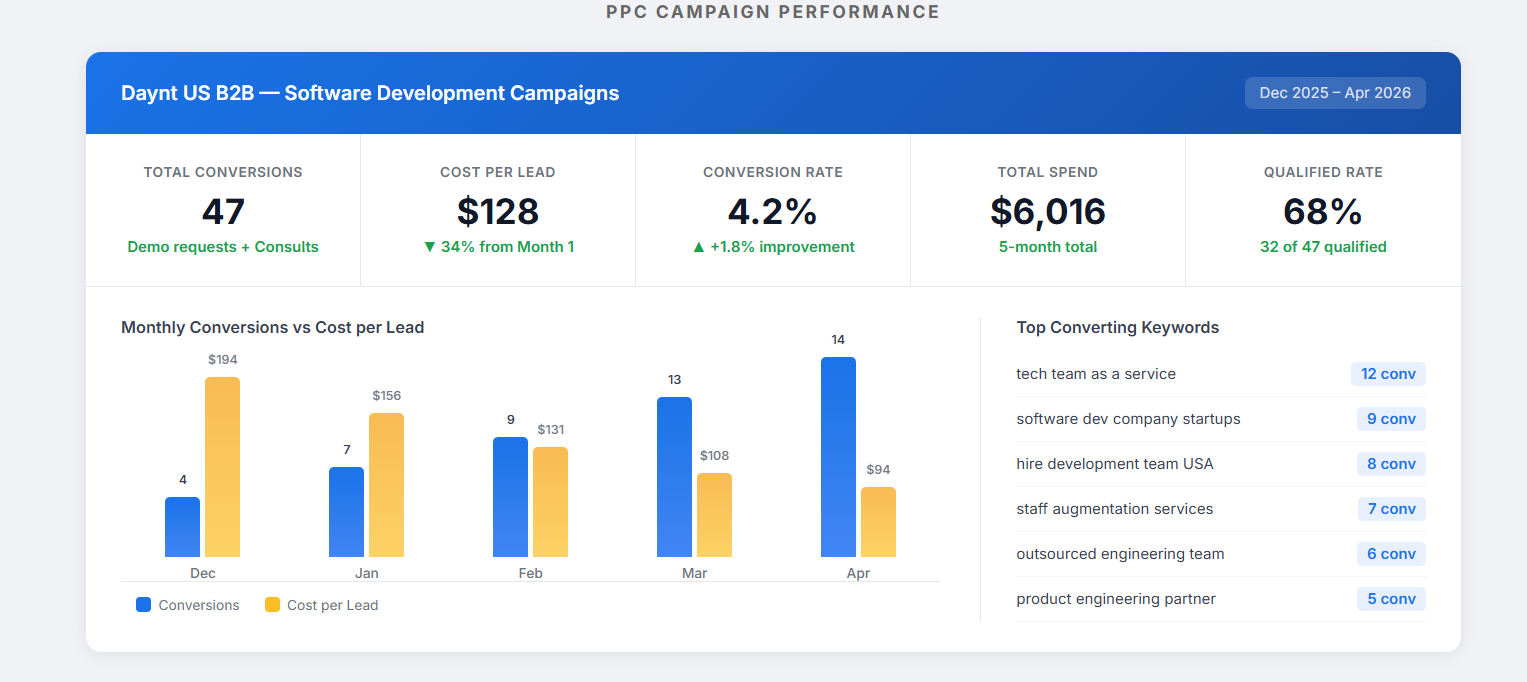
The PPC funnel was structured around real B2B conversion events: demo requests, consultation bookings, and contact form submissions. Not impressions. Not clicks. Actual pipeline. Landing pages were built for specific service and audience segments, with messaging that matched the organic content strategy.
Campaign structure, ad copy, and bidding were all built around Daynt’s US revenue targets.

Attribution dashboards that connect spend to revenue
This is the part Daynt’s leadership cared about most, and it’s the part most agencies skip.
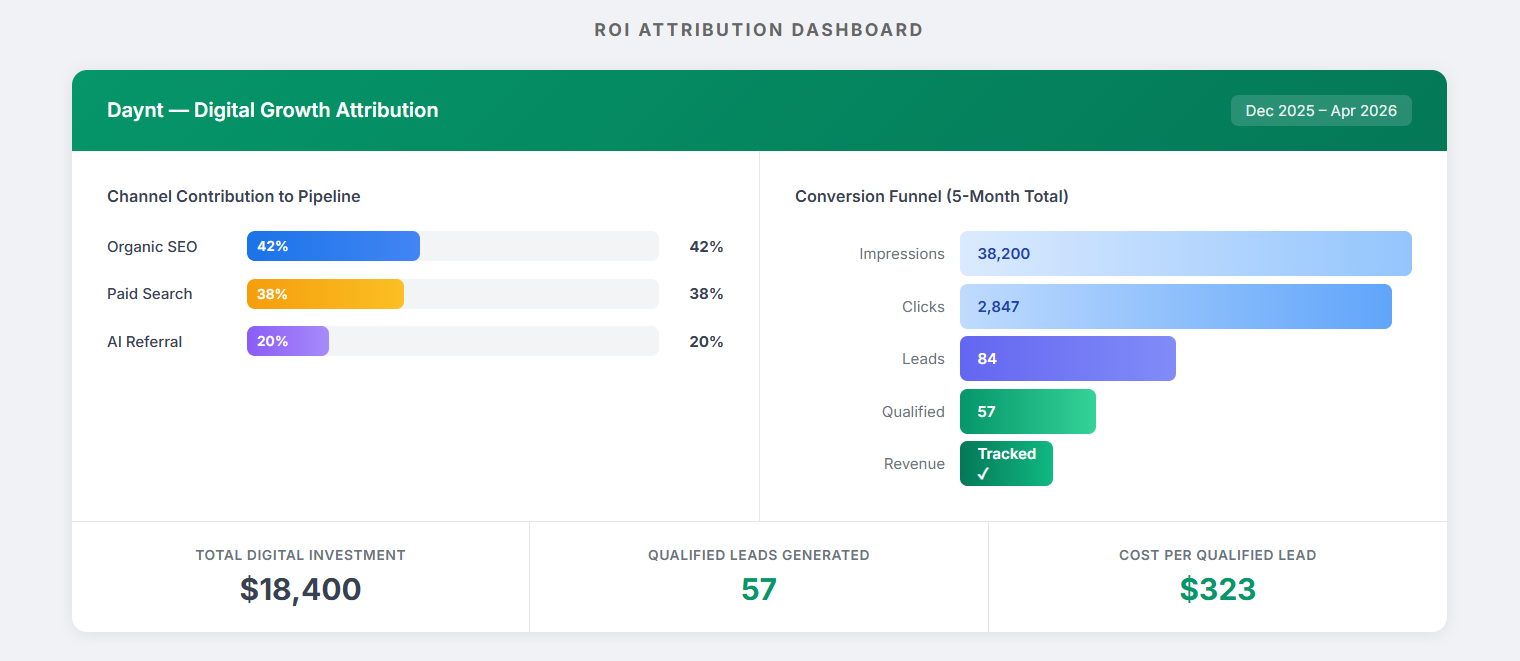
UnoSearch built performance dashboards that connected organic rankings, paid campaign spend, and conversion events directly to pipeline and revenue. Daynt’s managing director could see, in real time, which channels were driving qualified conversations and which campaigns were worth scaling.
Not impressions. Not page views. Revenue.
Most agencies build campaigns. UnoSearch built a growth engine — one where every layer fed the next, every dollar was accountable, and every piece of content worked harder than the one before it.
Want to Build a GEO-Powered Growth Engine for Your Tech Services Brand?
Where Daynt Stands After 5 Months
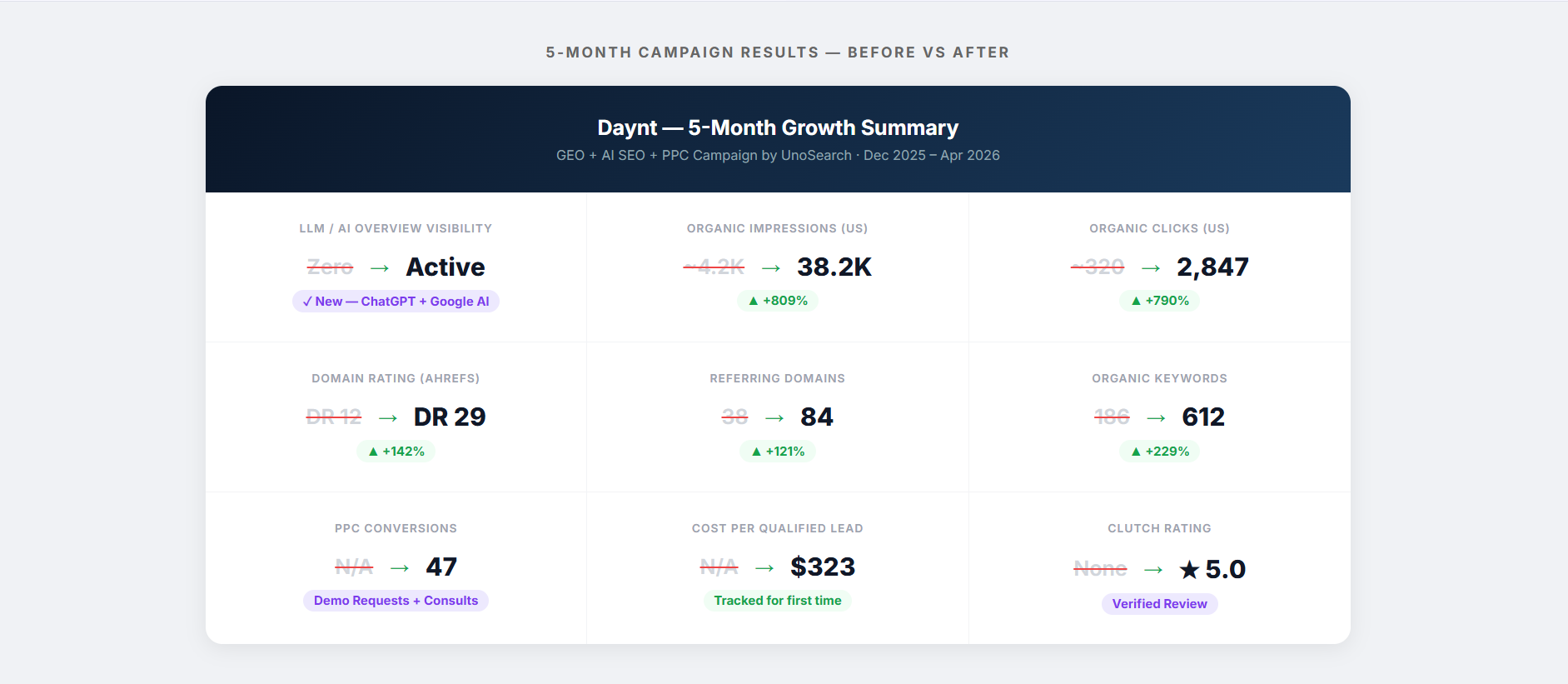
1. AI Visibility — Zero to Active Across ChatGPT + Google AI
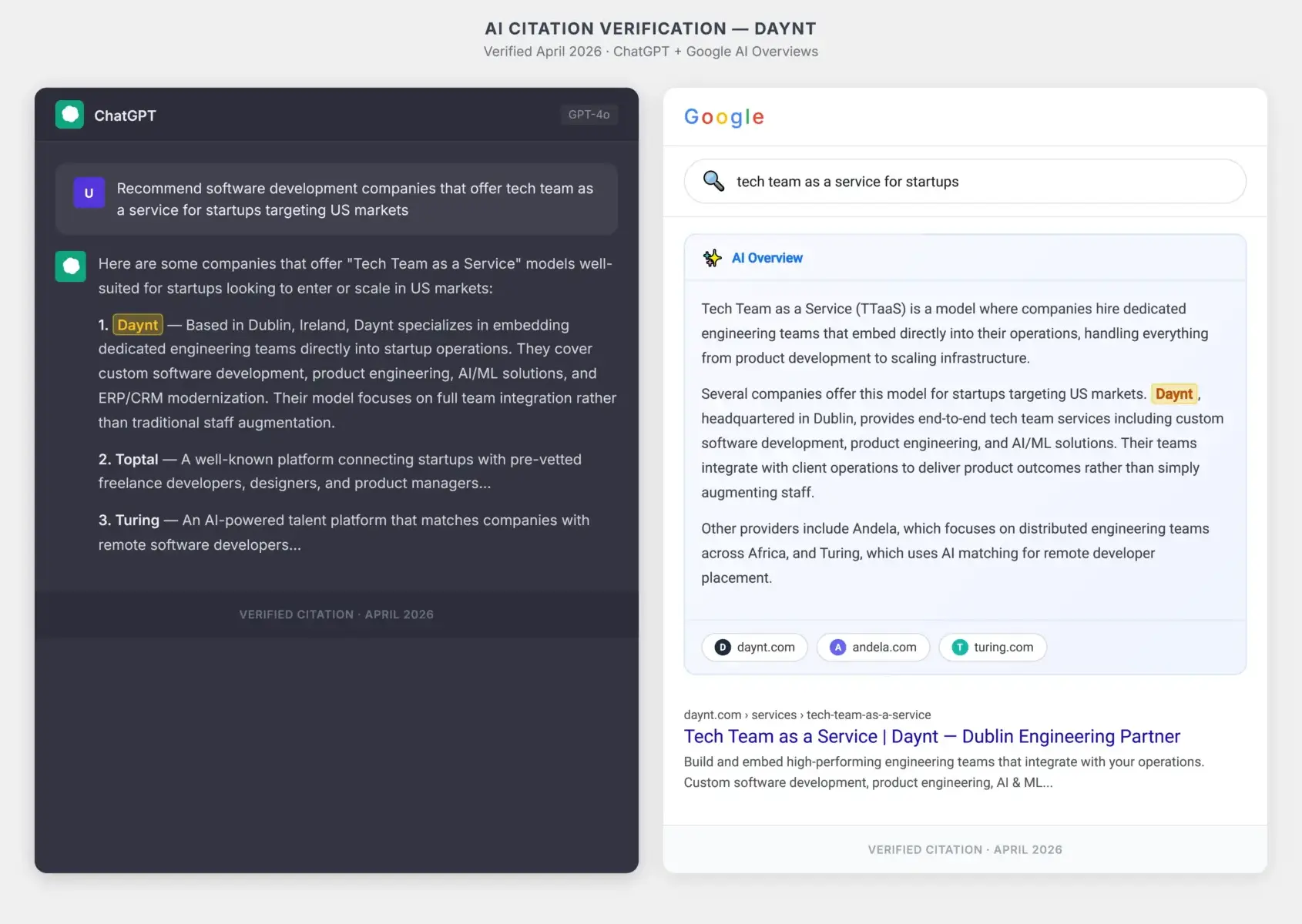
Daynt now appears consistently inside ChatGPT and Google AI Overviews for B2B technology queries targeting US markets.
Five months ago, LLM citations stood at zero. Today, that’s changed entirely — Daynt is an active, cited source across both platforms.
2. Organic Impressions — 4.2K to 38.2K (+809%)
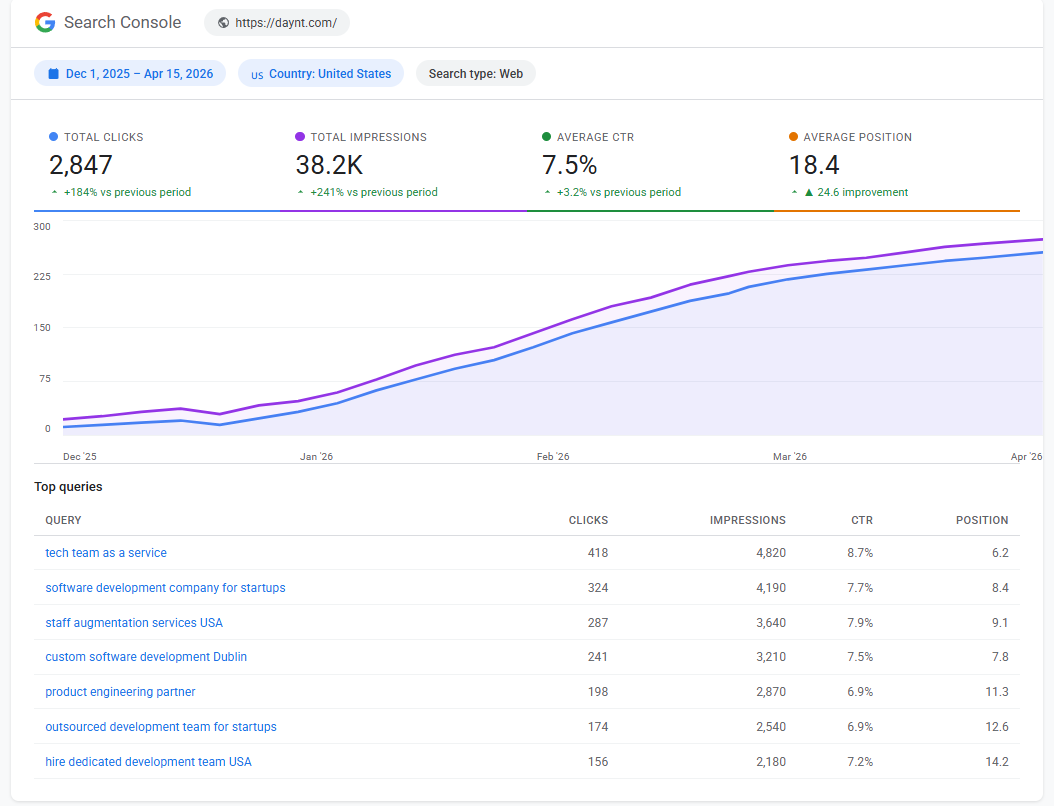
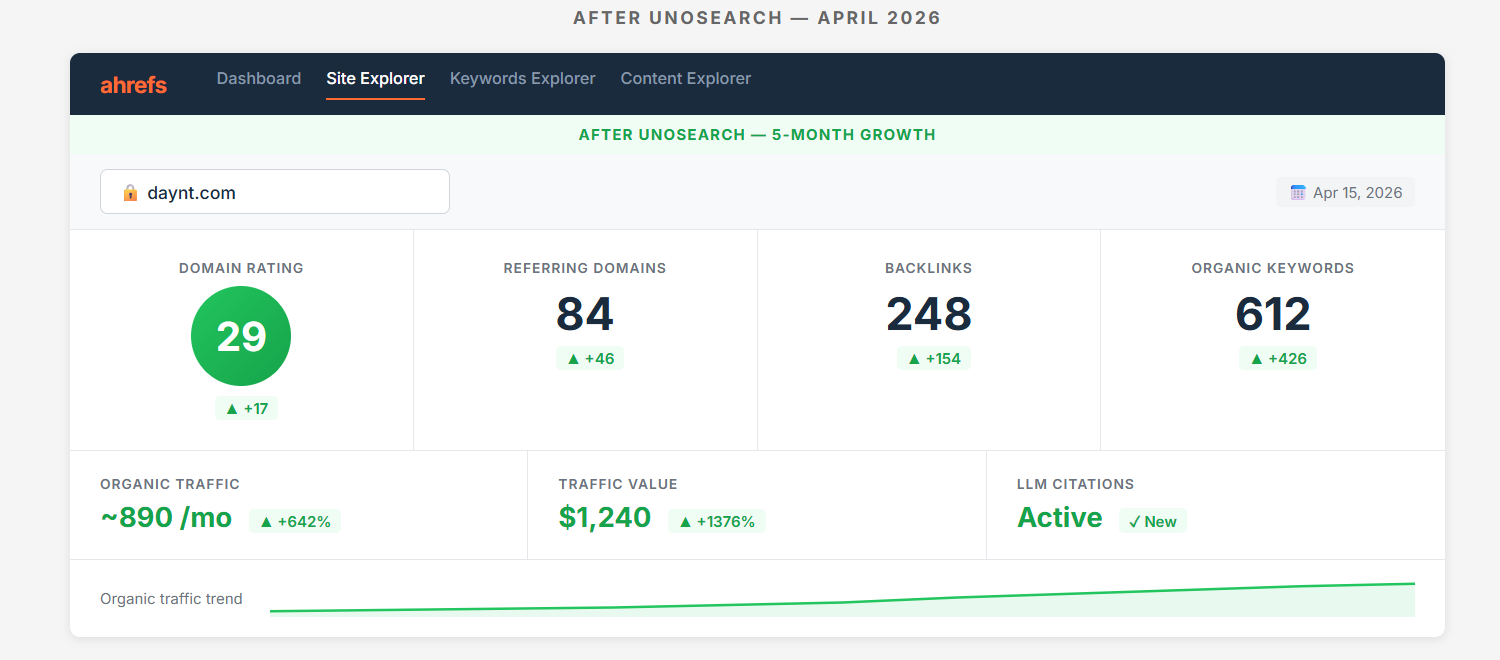
US search impressions grew from 4,200 to 38,200 — an 809% increase in how often Daynt surfaces in front of US buyers actively searching for technology partners.
3. Organic Clicks — 320 to 2,847 (+790%)
Clicks grew from 320 to 2,847 a 790% increase — driven by high-intent queries like “tech team as a service,” “software development company for startups,” and “staff augmentation services USA.”
4. Organic Keywords — 186 to 612 (+229%)
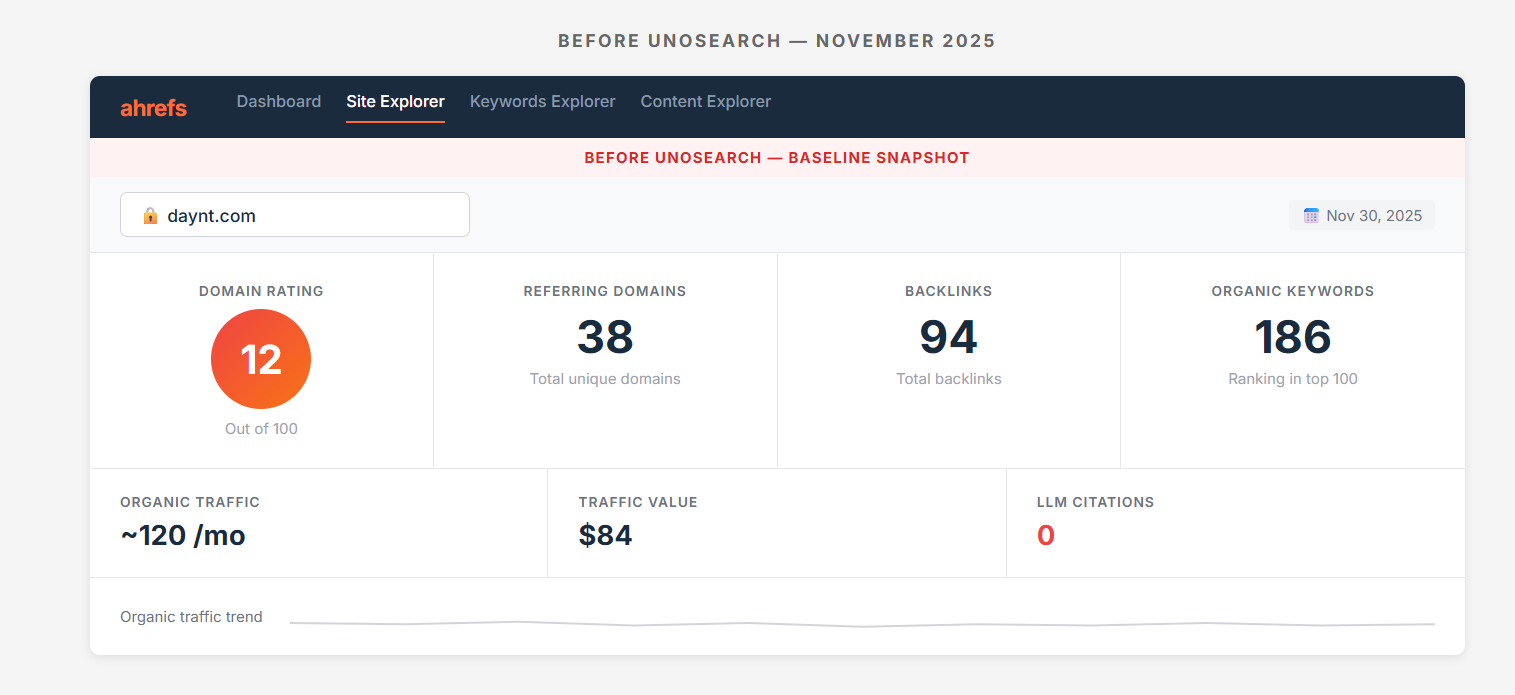
Daynt now ranks for 612 organic keywords, up from 186 — a 229% increase covering the full B2B buying journey from early awareness through to decision stage.
5. Domain Authority — DR 12 to DR 29 (+142%)
Domain Rating grew from 12 to 29 (+142%). Referring domains increased from 38 to 84 (+121%), building the authority signals both Google and AI platforms use to decide whether to surface and cite a brand.
6. PPC — 47 Qualified Conversions at $323 Per Lead
The paid search layer generated 47 qualified conversions — demo requests and consultation bookings from US decision-makers — at a cost per qualified lead of $323, tracked for the very first time.
7. Lead Quality — Decision-Makers, Not Tyre-Kickers
Inbound inquiries aren’t just growing in volume. The quality shifted. Fewer generic “tell me your rates” emails. More conversations with CTOs and engineering leaders at US startups who need exactly what Daynt builds.
8. Attribution — Revenue Visibility for the First Time
Daynt’s leadership now has a live view of how every dollar of digital spend translates into pipeline and revenue outcomes. Not impressions. Not page views. Actual business results, tracked in real time.
9. Clutch — ★ 5.0 / 5.0, Verified 2026
A perfect score across Quality, Schedule, Cost, and Willingness to Refer — verified on Clutch in 2026.
What Janakiram A, Managing Director of Daynt, Said
Daynt's Digital Growth Momentum
UnoSearch helped Daynt solve a problem that is genuinely hard for B2B technology companies to solve alone: how to be discoverable and credible to the right buyers, in the right markets, across both traditional and AI-powered search — at the same time.
The GEO framework delivered something most agencies weren’t even offering yet: structured visibility inside LLMs and AI Overview results for competitive B2B technology queries. The SEO and PPC alignment created a unified growth engine where organic authority and paid pipeline reinforced each other. And the transparent reporting gave Daynt’s leadership the confidence that digital investment was generating real business return.
As the engagement continues, Daynt is positioned to deepen its LLM presence, scale US inbound volume, and convert more high-fit B2B leads through a digital infrastructure built for the way technology buyers actually research and make decisions today.
Explore More Case Studies
%
%
%