
SEO for ChatGPT: How to Get Your Website Cited in AI Answers
Search is changing. People now ask ChatGPT questions they once typed into Google. They may ask for a service provider, compare brands, research a product, or solve a business problem. For a website, this creates a new visibility goal: being useful enough to appear in an AI-generated answer.
SEO for ChatGPT is the process of improving your website, content, and brand signals so AI search systems can discover, understand, cite, and potentially recommend your business. It works with traditional SEO, but it is not a separate ranking formula published by OpenAI.
By Pankaj Srivastava | Published:Feb 14th, 2026 | Updated: September 09, 2026

Traditional SEO is evolving as users turn to AI platforms for answers and recommendations. UnoSearch combines SEO and GEO strategies to help businesses build stronger online authority, improve content visibility, and increase opportunities to be discovered through AI search.

Pankaj Shrivastava
CEO & Co-Founder, UnoSearch
Pankaj Shrivastava is the CEO and Co-Founder of UnoSearch, leading the company’s strategic direction, business growth, and digital marketing initiatives.
Read more..
With extensive experience in SEO and digital marketing, he focuses on helping businesses strengthen their online presence, drive sustainable growth, and adapt to the evolving digital landscape. His expertise spans business strategy, search engine optimization, AI-driven marketing, and performance-focused growth solutions.
10+ Years
of Expertise
60+
Industries Served
AI-First
Digital Growth Strategy
1. Quick Answer
2. SEO for Chatgpt vs Chatgpt for seo
3. SEO vs. GEO
5. How ChatGPT Can Discover
6. The ChatGPT Visibility Funnel
7. ChatGPT’s Crawler Access Your Website
8. What Makes a Page Worth Citing
9. Factors Influence ChatGPT SEO?
10. How to Optimize Your Website for ChatGPT
11. How to Build Brand Authority Beyond Your Website
12. Strategies to Improve Your Brand Visibility in ChatGPT
11.How Unosearch can help
12. FAQs
Quick Answer: What Is SEO for ChatGPT?
There is no official checklist that guarantees a website will rank in ChatGPT. The practical approach is to make your site easy to discover, easy to understand, and easy to trust. Start with technical SEO and indexability. Create clear content that answers real questions. Build topical authority and credible mentions outside your website. Then test real ChatGPT prompts and track mentions, citations, and recommendations over time.
SEO for ChatGPT vs. ChatGPT for SEO
These two terms sound similar, but they describe different goals. SEO for ChatGPT means improving a website so it has a better chance of being discovered, cited, or recommended in ChatGPT responses. ChatGPT for SEO means using ChatGPT to support SEO work, such as keyword research, content ideas, FAQs, meta descriptions, or competitive analysis.
This guide focuses on the first goal. If your aim is to appear in ChatGPT, the main work happens on your website and across the wider web. Using ChatGPT as an SEO assistant can support that work, but it does not replace the need to improve the underlying site.
Expert Insight: AI Visibility Is Not the Same as AI Traffic
Ahrefs analyzed 3,000 websites and found that 63% received at least one visit from an AI chatbot. ChatGPT accounted for 50% of AI referral traffic in that study, while AI chatbots contributed 0.17% of the average site’s traffic. Ahrefs also found that smaller websites received a larger share of their total traffic from AI sources.
The takeaway is not that AI search has replaced Google. AI referral traffic was still small in the study, and some AI visits may be reported as direct traffic. The stronger lesson is that AI visibility is measurable and worth monitoring.
SEO vs. GEO: What Is the Difference?
Traditional SEO focuses on visibility in search engines such as Google and Bing. Generative Engine Optimization, or GEO, focuses on visibility in AI-generated answers. The two overlap because AI systems can use information from search indexes, websites, and other sources.
GEO should not replace SEO. A technically weak website with unclear content is unlikely to become a strong AI source. A better strategy is to build strong SEO foundations and then improve the signals that help AI systems understand your brand, expertise, and content.
To understand how these strategies work in practice, read our complete guide to
AI SEO optimization, which covers content planning, technical SEO, topical authority, and improving visibility across AI-powered search platforms.
How ChatGPT Can Discover and Use Your Website
ChatGPT does not treat every question like a simple Google keyword. A user can provide a location, industry, budget, business type, or several other constraints. When web search is used, the response may draw from multiple sources.
OpenAI identifies OAI-SearchBot as the crawler used to surface websites in ChatGPT search. GPTBot is separate and relates to crawling content that may be used for training OpenAI’s foundation models. ChatGPT-User is user-initiated and is not used to determine search appearance.
If you want your pages to be eligible for ChatGPT search visibility, review your robots.txt rules and make sure you are not blocking OAI-SearchBot unintentionally.
The ChatGPT Visibility Funnel
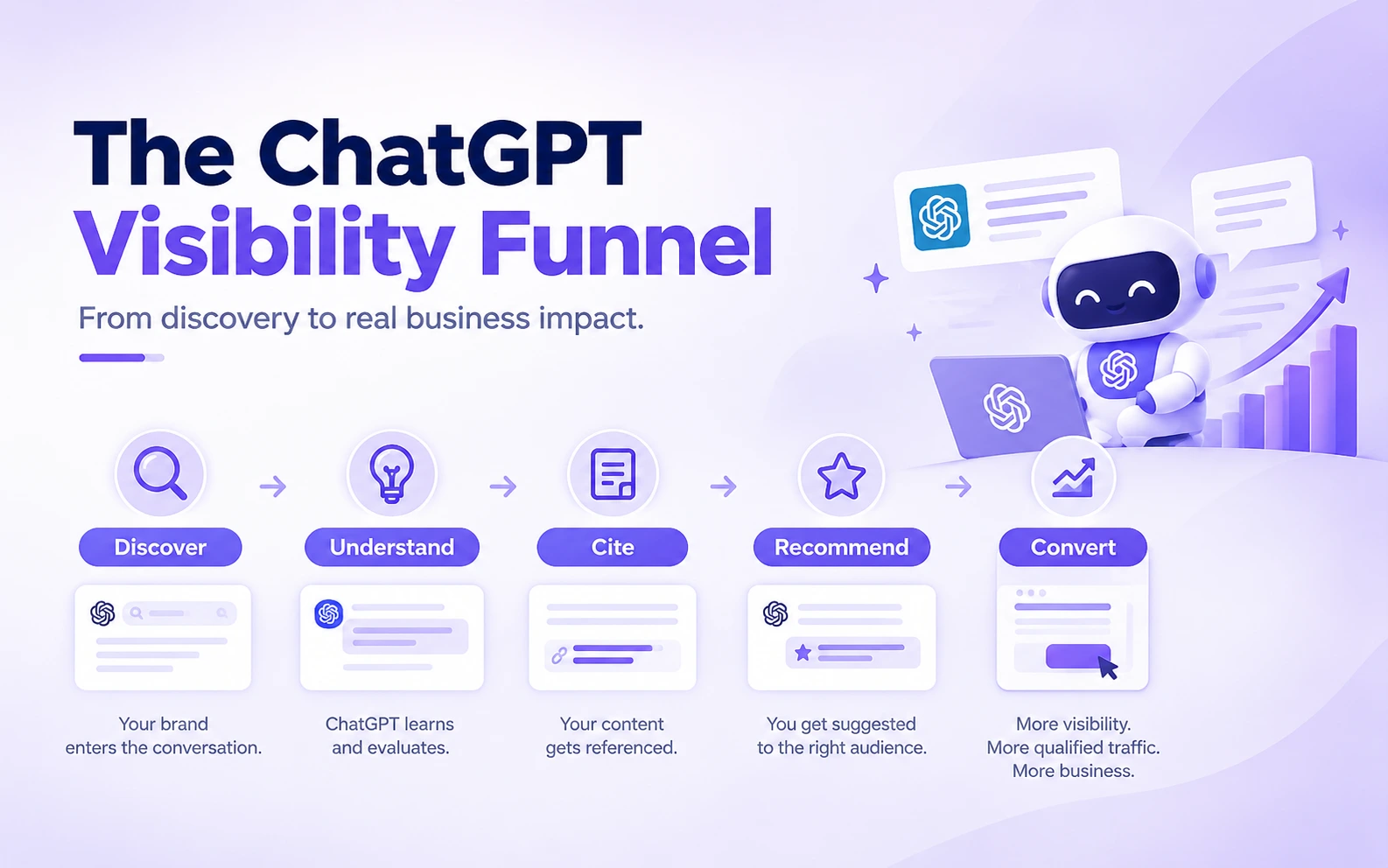
A useful way to plan ChatGPT SEO is to treat AI visibility as a funnel. Each stage solves a different problem.
Discover
AI search systems can access important pages. Crawlability, indexability, robots.txt, internal links, and site structure support this stage.
Understand
The system can tell what your company does, who it serves, what topics it covers, and why its information is useful. Clear pages, descriptive headings, consistent brand details, structured content, and first-party expertise help here.
Cite
A page is useful enough to support an answer. Strong evidence, specific explanations, original research, examples, and clear answers can improve the usefulness of a page as a source.
Recommend
The wider web provides enough context for a brand to be considered for a recommendation. Relevant publications, reviews, expert profiles, associations, and other credible references can strengthen that context.
Convert
What happens after visibility? A user may click the cited source, visit the website, contact the company, or remember the brand for a later decision. This is why AI visibility should be measured as more than rankings alone.
How Do You Let ChatGPT's Crawler Access Your Website?
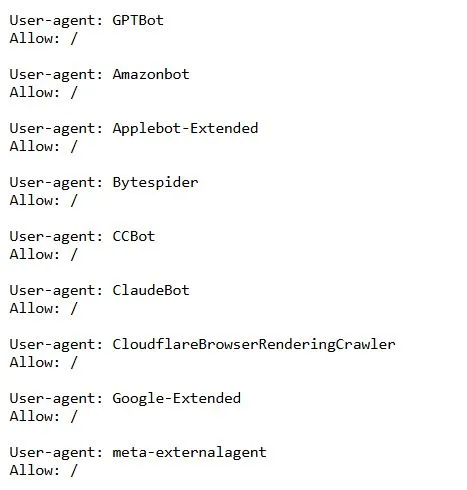
This step gets missed often. Many sites blocked OpenAI’s crawler when ChatGPT first launched, usually to keep content out of AI training. If your robots.txt file still blocks “OAI-SearchBot,” ChatGPT cannot read your pages. It does not matter how good your content is.
To fix this, add the following to your robots.txt file:
Next, submit your sitemap through Bing Webmaster Tools. ChatGPT’s live search runs through Bing. Getting indexed there helps your visibility inside chatgpt seo optimization.
Allowing the crawler is only half the job. Most AI crawlers can’t run JavaScript, so a client-rendered site can stay invisible. Here’s how to check for JavaScript rendering problems on a SaaS site.” That post doesn’t cover JS rendering, and your blog does, so this adds new information.
What Makes a Page Worth Citing?
The best starting point is usefulness to the reader. State the question or problem clearly and answer it early. Then provide the evidence, explanation, examples, and practical detail that support the answer.
Avoid vague statements. A stronger page explains what a business should do, why it matters, and what evidence supports the recommendation. Specific definitions, original data, expert commentary, case evidence, and first-party experience can add information value.
What Factors Influence ChatGPT SEO?
ChatGPT does not publish a fixed public formula for ranking or recommending websites. Instead, marketers can focus on several practical areas that improve how their content is discovered, understood, and supported by credible signals.
Key factors to focus on:
- Discoverability: Ensure important pages are crawlable, indexable, and well-linked.
- Content clarity: Create direct, useful content with enough context to answer user questions.
- Site structure: Maintain a clean, logical website structure that makes information easy to find.
- Authority: Support content with original research, first-party expertise, relevant backlinks, and industry publications.
- Reviews & reputation: Build genuine reviews and maintain a strong presence across relevant platforms.
- Brand consistency: Keep business information accurate and consistent across trusted sources.
How to Optimize Your Website for ChatGPT?
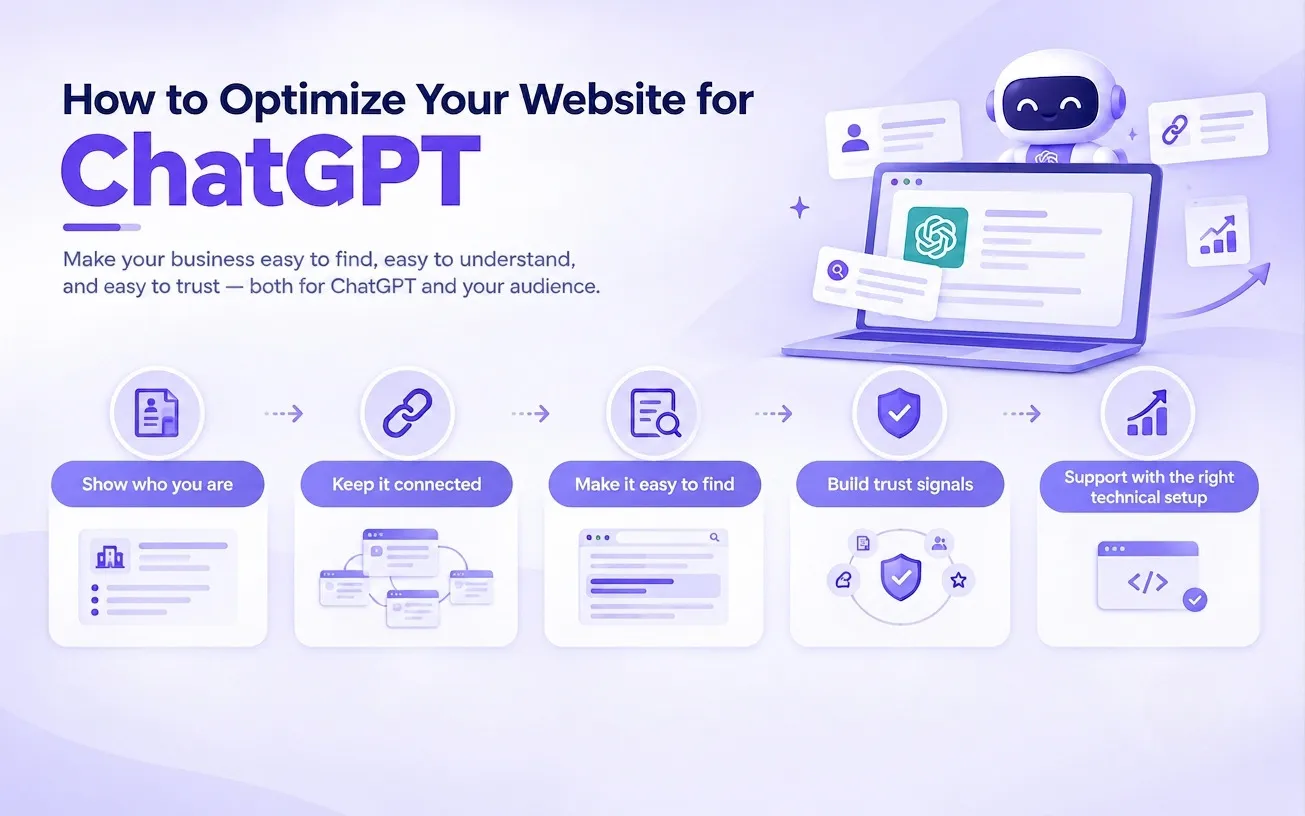
Optimizing for ChatGPT starts with making your business information clear, connected, and technically accessible. Focus on these key areas:
- Strengthen your About page: Clearly explain what your company does, who it serves, where it operates, and its relevant experience.
- Maintain consistent information: Keep company details consistent across your website and important third-party profiles.
- Improve internal linking: Connect service pages, industry pages, case studies, and related articles naturally.
- Build clear topic relationships: Use internal links to help search engines and users understand which pages cover each topic in greater depth.
- Prioritize technical SEO: Make sure important pages are crawlable and indexable.
- Optimize page elements: Use descriptive titles, clear headings, logical URLs, and structured data where appropriate.
How to Build Brand Authority Beyond Your Website?
AI systems can encounter a brand through publications, reviews, industry sites, professional profiles, associations, interviews, and other relevant sources. Your own website is only one part of the evidence available about your business.
For a US-facing company, this may include relevant US publications, industry directories, associations, expert interviews, customer reviews, and credible business profiles. The goal is to build a consistent presence in sources that are relevant to the market and the customer.
Strategies to Improve Your Brand Visibility in ChatGPT
Getting your brand mentioned in ChatGPT is not about adding the phrase ‘ChatGPT’ to your website. The goal is to make your brand easy to discover, understand, verify, cite, and recommend.
Make your website accessible to AI search crawlers
Start with the technical foundation. Check that important pages can be crawled and that you are not blocking OAI-SearchBot from accessing content you want surfaced in ChatGPT search.
Build clear topical authority
Create useful pages around the topics your brand wants to be known for. Cover the main topic, related questions, use cases, comparisons, and practical problems instead of publishing isolated keyword-focused pages.
Make your website accessible to AI search crawlers
Start with the technical foundation. Check that important pages can be crawled and that you are not blocking OAI-SearchBot from accessing content you want surfaced in ChatGPT search.
Give important questions direct answers
Write sections that answer specific questions clearly. Use descriptive headings, short paragraphs, examples, definitions, and supporting evidence so important information is easy to identify.
Show first-hand expertise
Add original insights, real examples, case studies, processes, data, and expert commentary. Information that competitors do not provide can give your content more value.
Strengthen your brand entity
Make it clear who your company is, what you do, who you serve, and where you operate. Keep important brand information consistent across your website and relevant third-party profiles.
Earn mentions on trusted third-party websites
Build relevant mentions through industry publications, associations, expert contributions, interviews, reviews, digital PR, and other credible sources.
Create content worth citing
Ask what information would make the page worth citing. Original research, statistics, expert opinions, detailed comparisons, proprietary frameworks, and real-world examples can give a source stronger information value.
Test real ChatGPT prompts
Test informational, commercial, comparison, and recommendation questions your customers may ask. Record whether your brand is absent, mentioned, cited, or recommended, then repeat the tests over time.
Improve pages ChatGPT already cites
If your brand is already cited, identify which pages appear and improve them with clearer answers, stronger evidence, updated information, and relevant internal links.
Watch: A Closer Look at AI Search Optimization
Reading about seo for chatgpt is useful, but watching how it plays out helps it click faster. This short video walks through how AI search tools evaluate and choose content, which is worth watching before you start making changes to your own site.
Case Study: Getting Cited in Google AI Overview and ChatGPT
UnoSearch’s work for Jinee Green Card combined SEO, GEO, and Meta Ads. The SEO and GEO work focused on structured content, direct-answer formats, FAQ content, internal linking, and entity markup around EB-1A topics. The brand subsequently gained visibility in Google AI Overviews and ChatGPT citations for relevant queries, according to the published case study.
How Can UnoSearch Support Your ChatGPT SEO Goals?
Want AI platforms like ChatGPT to actually recommend your business?
UnoSearch’s GEO Services focus on structuring your content so tools like ChatGPT, Gemini, and Google AI Overview can find it, trust it, and cite it.
Need AI SEO support that goes beyond a few quick fixes?
UnoSearch’s AI SEO Company services help US businesses build a full strategy across traditional search and AI-driven answer tools together.
Worried about what AI tools say about your brand when they summarize reviews or mentions?
UnoSearch’s Online Reputation Management Services help control how your brand shows up across search results, reviews, and AI-generated summaries.
Final Thought:
SEO for ChatGPT is still new and changing fast. But the basics stay familiar: let AI crawl your site, write content that genuinely helps people, and build real credibility across the web. Businesses that treat chatgpt seo optimization as good content practice, not a shortcut, will be the ones ChatGPT recommends when customers ask for help.
Frequently Asked Questions About GEO Audits
What is SEO for ChatGPT?
SEO for ChatGPT is the process of improving your website’s content, structure, credibility, and crawlability so ChatGPT can discover, understand, and potentially cite your pages in AI-generated answers. It focuses on creating useful, trustworthy content rather than simply targeting keywords.
How does ChatGPT SEO work?
ChatGPT SEO works by making your website easier for AI search systems to discover and understand. This includes allowing relevant crawlers to access your site, publishing clear and authoritative content, maintaining strong technical SEO, and building credibility through reputable mentions, backlinks, and other trust signals.
Can ChatGPT SEO help my website get more traffic?
Yes. When ChatGPT uses your website as a source in a search-based answer, users may click the citation and visit your site. Even when users do not click, repeated mentions can increase brand awareness and help establish your business as a credible source within your industry.
What is ChatGPT for SEO?
ChatGPT for SEO refers to using ChatGPT as a tool to support SEO activities such as keyword research, content outlines, title ideas, content analysis, FAQ generation, and search-intent research. However, AI-generated content should still be reviewed for accuracy, originality, expertise, and usefulness before publishing.
Can I use SEO with ChatGPT to improve my Google rankings?
Yes, ChatGPT can support several SEO tasks, including content planning, keyword clustering, search-intent analysis, internal linking ideas, and content optimization. However, using ChatGPT alone does not guarantee higher Google rankings. Search performance still depends on factors such as content quality, relevance, technical SEO, authority, and user experience.
What is ChatGPT SEO optimization?
ChatGPT SEO optimization involves optimizing a website so its content is more likely to be discovered, understood, and referenced by ChatGPT and other AI-powered search experiences. Key areas include crawlability, clear content structure, topical authority, factual accuracy, entity information, original research, and trustworthy external mentions.
References
1. OpenAI’s Official Publishers and Developers FAQ – https://help.openai.com/en/articles/12627856-publishers-and-developers-faq
2. OpenAI Crawlers Documentation –
https://developers.openai.com/api/docs/bots
3. Ahrefs AI Traffic Study –
https://ahrefs.com/blog/ai-traffic-study
Continue Learning About SEO & AI Search
Local SEO for Real Estate: What Works for Agents in 2026
A practical guide to profile setup, reviews, neighborhood pages and AI visibility, including the brokerage rules and measurement problems most guides skip.By Mahendernath Pulidindi, Associate Vice President, UnoSearch · Updated October 10, 2026 ·...
Local SEO for Lawyers: How Law Firms Win the Map Pack in 2026
Google shows three firms in the Map Pack and hides the rest. This guide explains what decides which three, using Google's own guidelines, the 2026 Local Search Ranking Factors survey and the bar rules that limit what attorneys can do.By Pankaj...
Local SEO for Healthcare: A HIPAA-Safe Playbook for US Practices (2026)
Patients usually pick from the three practices Google shows first. This guide covers what decides those three, plus the HIPAA traps in reviews, tracking and listings that most local SEO for healthcare advice skips.By Rajiv Ranjan, CTO, UnoSearch...
Consult Your Digital Marketing Expert Today!