How Much Does Google PPC Cost in 2026? CPC, CPL & Budget Guide
Trying to figure out how much does Google PPC cost before you launch a campaign? You are asking the right question at the right stage. Google PPC price varies depending on your industry, target keywords, location, competition, and campaign objective. So, understanding real 2026 benchmarks, rather than a single guessed number, helps you set a realistic budget and evaluate whether a quote from an agency is fair.
Looking for an SEO agency?
UnoSearch helps brands rank higher and drive real organic growth.
Get Free Proposal1. Average PPC Cost in 2026
2. Google Ads CPC by Industry
3. Google Ads Cost Per Lead
4. Google Ads Budget
5. PPC Cost: India vs. US
6. Factors Affecting Google Ads CPC
7. Why CPC Isn’t the Whole Story
8. Common PPC Budget Mistakes
9. How UnoSearch Manages PPC Budgets
10. UnoSearch PPC Pricing
11. FAQs
Google Ads Costs at a Glance
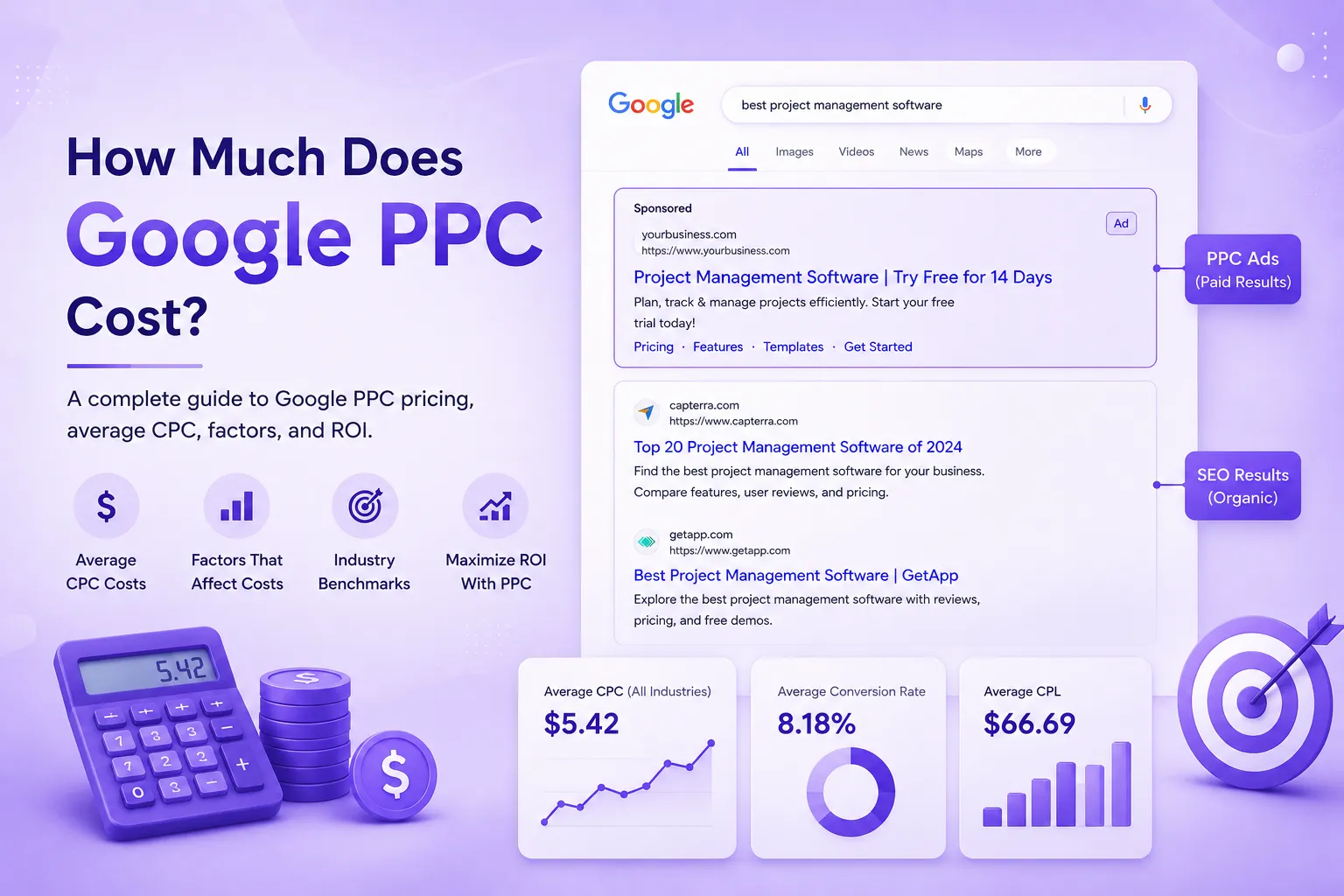
Average CPC: $5.42
The average amount advertisers paid for each search ad click across the analyzed campaigns.
Average conversion rate: 8.18%
About 8 out of every 100 ad clicks resulted in a conversion, such as a lead or desired action.
Average cost per lead (CPL): $66.69
On average, advertisers spent $66.69 to generate one qualified lead from Google Search ads.
Industries covered: 23
The data spans 23 different industries, highlighting how Google Ads costs vary by market.
Campaigns analyzed: 13,474
A large sample of campaigns was analyzed to provide a broader view of typical Google Ads performance.
Source: WordStream/LocaliQ, 2026 Google Ads benchmarks, based on an analysis of 13,474 US-based search advertising campaigns.
How Much Does Google Ads Cost?
There is no single, fixed price for Google Ads. According to WordStream/LocaliQ’s 2026 analysis of 13,474 US-based search advertising campaigns, the average cost per click across all industries was $5.42, the average conversion rate was 8.18%, and the average cost per lead was $66.69. Individual industries can be substantially higher or lower than these averages, so a headline number alone will not tell you what your specific campaign is likely to cost.
Your actual Google Ads budget should be based on your target cost per lead, your expected conversion rate, and the value of a customer to your business, rather than on a single universal CPC figure.
What Is the Average PPC Cost Per Click in 2026?
In 2026, the average CPC across US search advertising campaigns was $5.42. This figure varies significantly by industry, keyword, location, competition, and campaign type, so it should be treated as a benchmark rather than a price you can expect to pay in every account.
What Is the Google Ads CPC by Industry?
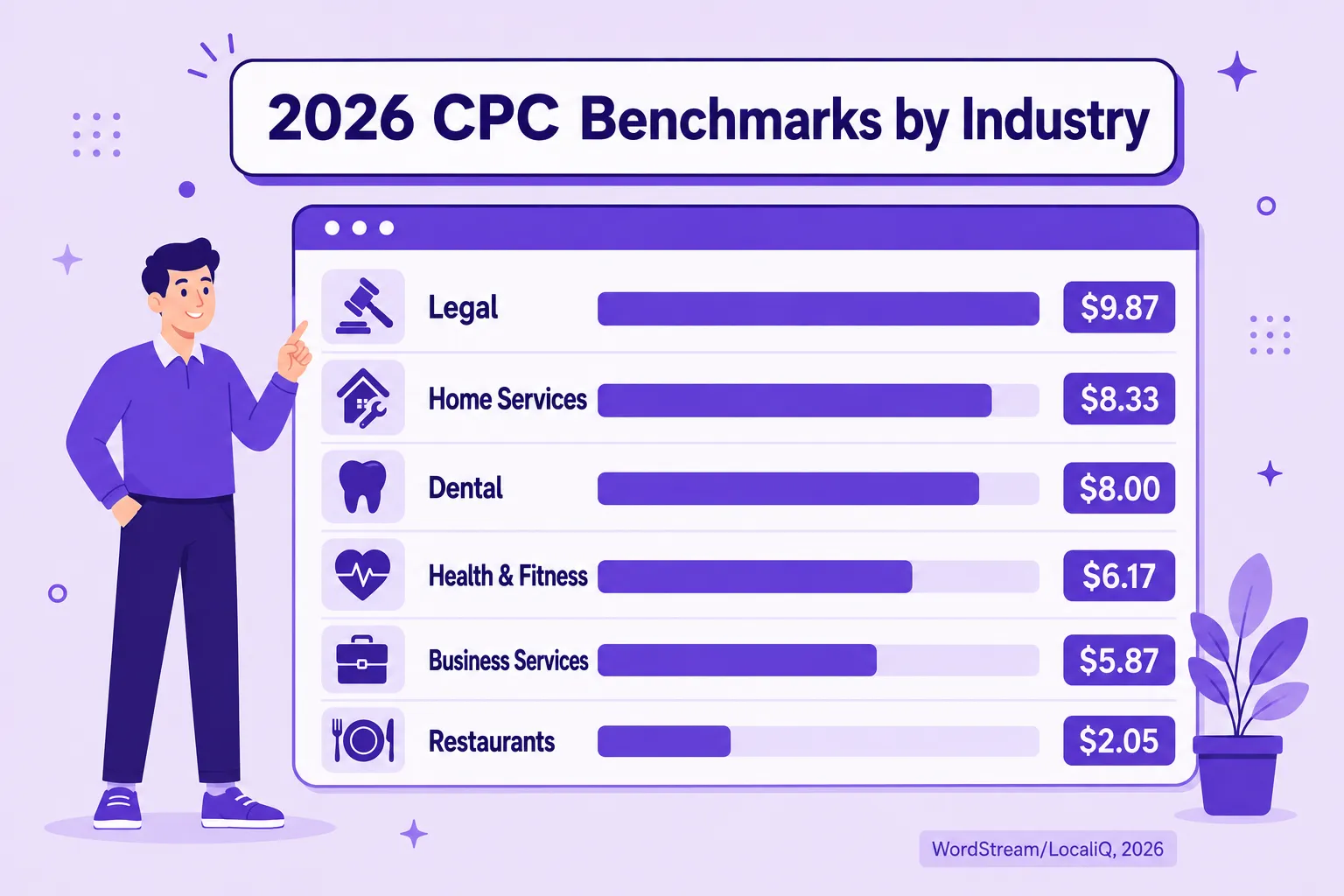
These figures are 2026 average CPC benchmarks for US search advertising, based on an analysis of 13,474 US search campaigns running between April 2025 and March 2026. They are benchmarks, not guaranteed prices.
| Industry | 2026 Avg. CPC |
|---|---|
| Attorneys & Legal Services | $9.87 |
| Home & Home Improvement | $8.33 |
| Dentists & Dental Services | $8.00 |
| Personal Services | $7.17 |
| Health & Fitness | $6.17 |
| Business Services | $5.87 |
| Industrial & Commercial | $5.87 |
| Career & Employment | $5.81 |
| Education & Instruction | $4.81 |
| Physicians & Surgeons | $4.76 |
| Beauty & Personal Care | $4.62 |
| Apparel / Fashion & Jewelry | $4.44 |
| Travel | $2.14 |
| Restaurants & Food | $2.05 |
| Arts & Entertainment | $1.63 |
Benchmark note: These 2026 figures come from an analysis of 13,474 US-based search advertising campaigns running between April 2025 and March 2026. They are benchmarks, not guaranteed campaign costs, and individual results can vary significantly.
What Does Google Ads Cost Per Lead?
CPC tells you what you pay for traffic. Cost per lead tells you what you pay for a measurable business outcome, which is usually the number that matters more when you are evaluating whether a campaign is actually working.
According to the same 2026 dataset, the average cost per lead across all industries was $66.69. Here is how that breaks down for a selection of industries.
| Industry | Avg. CPL |
|---|---|
| Attorneys & Legal Services | $131.63 |
| Business Services | $93.69 |
| Home & Home Improvement | $90.92 |
| Finance & Insurance | $74.44 |
| Dentists & Dental Services | $72.97 |
| Health & Fitness | $67.36 |
| Restaurants & Food | $30.57 |
| Arts & Entertainment | $26.84 |
A higher CPC does not automatically mean a more expensive campaign once you look at cost per lead. An industry with a high CPC but a strong conversion rate can still produce a lower, more efficient CPL than an industry with a cheaper CPC but a weak conversion rate.
How Much Should You Budget for Google Ads?
Rather than treating fixed dollar ranges as industry standards, it is more useful to think about what different budget levels can realistically support.
| Monthly Ad Budget | What It Can Support |
|---|---|
| Under $1,000 | Small-scale testing, limited keywords or local targeting |
| $1,000 – $5,000 | Focused lead generation or a limited product or service range |
| $5,000 – $10,000 | Broader keyword coverage and more conversion data |
| $10,000+ | Larger markets, multiple services or products, or aggressive scaling |
These are planning examples rather than fixed industry thresholds. The right budget for your business depends on your expected CPC, search volume, conversion rate, and the value of each customer.
How to Estimate Your Google Ads Budget
You can estimate a starting budget using a simple formula:
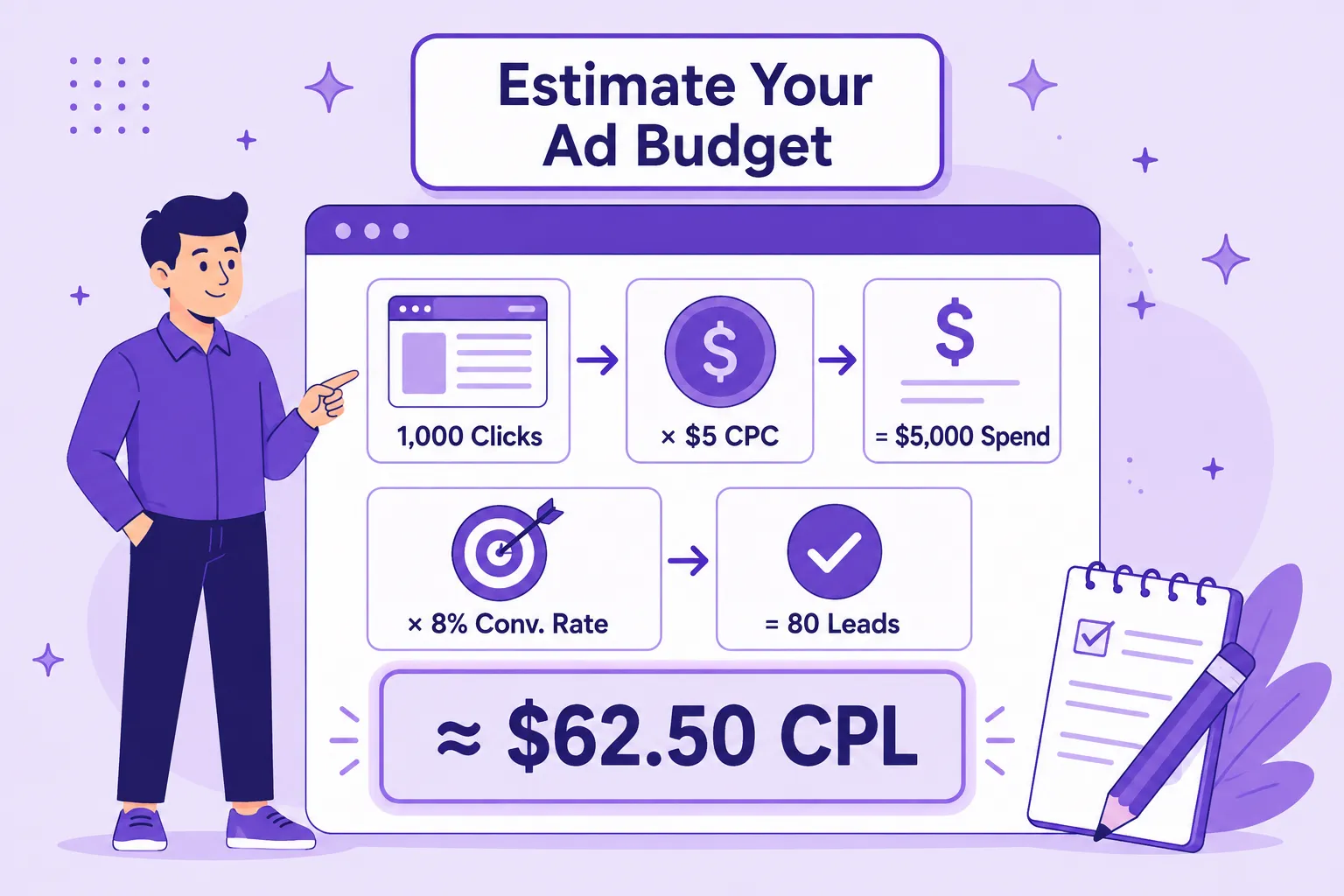
Monthly ad budget = Target number of clicks × Expected CPC
From there, you can estimate expected results:
Expected leads = Clicks × Conversion rate
Estimated CPL = Ad spend ÷ Leads
For example, if your expected CPC is $5 and you want 1,000 clicks, your estimated ad spend would be $5,000. At an 8% conversion rate, those clicks could generate approximately 80 conversions, producing an illustrative CPL of about $62.50.
This is an illustrative calculation, not a guaranteed result. Actual performance depends on your industry, targeting, ad quality, and landing page experience.
What Is PPC Cost in India Compared to the US?
Google Ads costs can differ substantially between countries because advertiser competition, search demand, purchasing power, industry mix, and local market conditions all vary. The US benchmark data above should not be directly applied to campaigns targeting India or other markets, since there is no single, well-substantiated India-versus-US CPC ratio that holds across all industries.
For businesses comparing PPC management costs across countries, it helps to separate the advertising budget paid to Google from the management fee paid to the agency running the campaign. A lower agency fee does not automatically mean a lower cost per lead, since campaign strategy and execution quality still drive the outcome. PPC charges in India vary depending on whether you are referring to Google Ads spend or the management fee charged by an agency.
For a small business in India, an initial Google Ads test budget is usually set based on the target market, expected CPC, expected conversion rate, and an acceptable cost per lead, rather than a fixed industry number. Agency management fees are separate and vary according to campaign complexity, the number of campaigns being run, creative requirements, tracking setup, and reporting needs.
Illustrative example: If your target CPC is ₹100 and you want to generate approximately 300 clicks, your initial media budget would be around ₹30,000. Your actual required budget will depend on traffic quality and conversion performance, so this example should be treated as a starting point for planning, not a guaranteed cost.
What Affects Your Google Ads CPC?
Google PPC charges are not fixed because Google Ads uses an auction system to determine ad placement and the amount advertisers pay for clicks. Ad Rank considers factors including your bid, ad and landing page quality, the expected impact of ad assets, Ad Rank thresholds, the context of the search, and how competitive the auction is at that moment. Google explains that it also provides a 1 to 10 Quality Score as a diagnostic tool for evaluating keyword-level ad quality, but Quality Score itself is not an input in the ad auction.
In practice, this means several factors influence what you actually pay per click:
Your maximum bid
The highest amount you are willing to pay for a click on a given keyword.
Ad and landing page quality
More relevant, higher-quality ads and landing pages tend to perform better in the auction.
Competitor bidding activity
If more advertisers are bidding on the same keyword, the price per click tends to rise.
Search context and location
The same keyword can cost differently depending on when, where, and how it is searched.
Because Quality Score is diagnostic rather than a direct auction input, businesses with strong ad relevance and landing page experience often see better auction outcomes over time, even without simply raising their bids.
Why CPC Alone Doesn't Tell You What PPC Costs
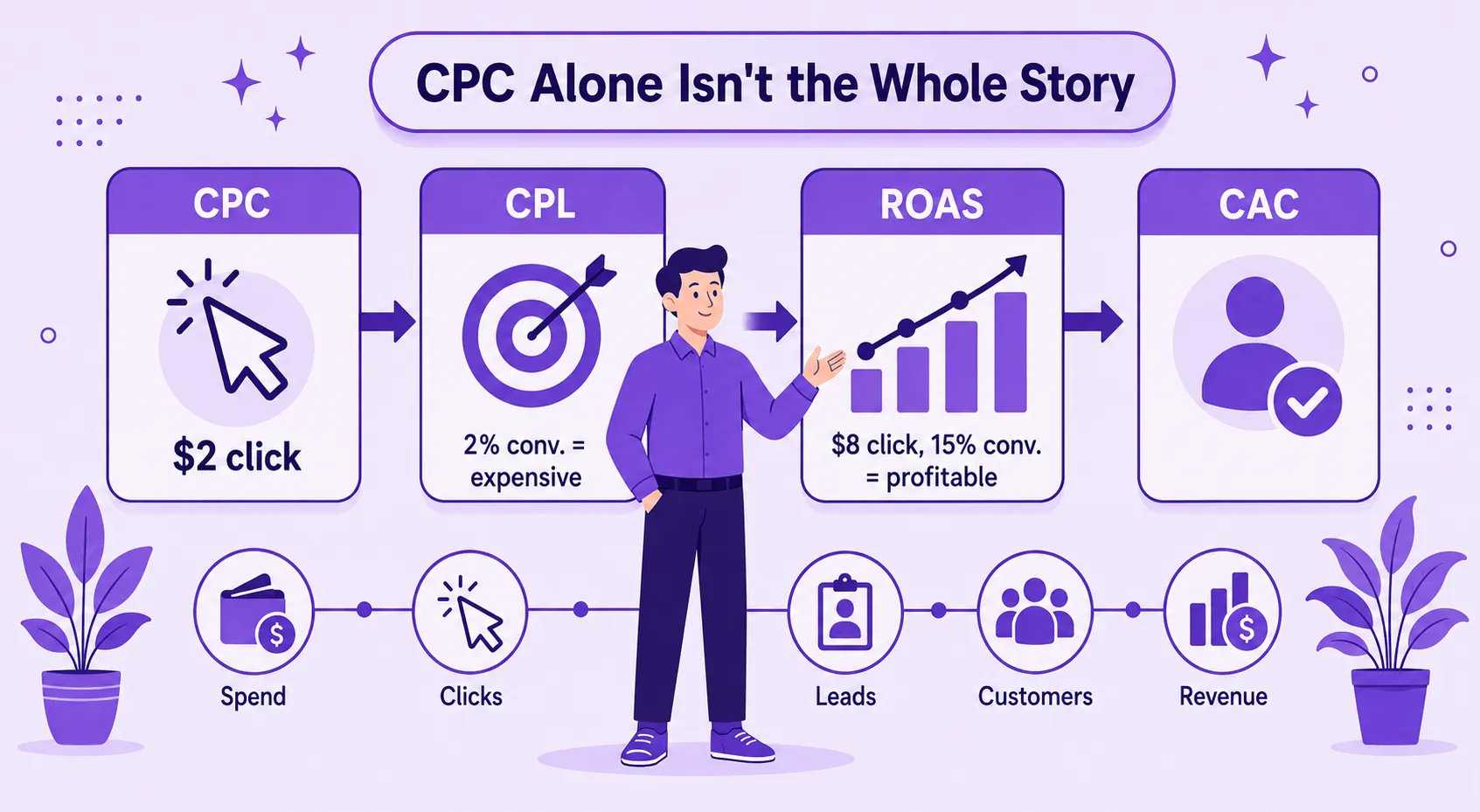
Most conversations about PPC pricing focus entirely on cost per click, but a business ultimately cares about a longer chain of outcomes: ad spend leads to clicks, clicks lead to leads, leads lead to qualified leads, and qualified leads lead to customers and revenue.
This distinction matters because cost per click alone can be misleading:
A $2 CPC with a 2% conversion rate can end up being expensive on a cost-per-lead basis.
An $8 CPC with a 15% conversion rate can be genuinely profitable, despite the higher click price.
Cost per lead (CPL) is generally more useful than CPC for lead generation campaigns.
Return on ad spend (ROAS) is generally more useful for ecommerce campaigns.
Customer acquisition cost (CAC) is more useful once you connect ad performance to actual paying customers.
Evaluating a campaign on CPC alone, without looking at conversion rate and downstream outcomes, is one of the most common ways businesses misjudge whether their PPC spend is actually working.
What Mistakes Waste PPC Budget?
A few patterns show up repeatedly when businesses end up spending more than they should on PPC without realizing it.
| Common Mistake | Why It Wastes Budget | The Fix |
|---|---|---|
| Targeting overly broad keywords | Attracts low-intent clicks that rarely convert | Use more specific, intent-matched keywords |
| Ignoring negative keywords | Wastes spend on irrelevant search queries | Regularly review and add negative keywords |
| Sending traffic to a generic landing page | Lowers ad quality and conversion rate | Match landing pages closely to ad messaging |
| Not monitoring campaigns regularly | Allows underperforming ads to keep spending | Review performance weekly and pause what is not working |
| Judging performance on CPC alone | Misses whether clicks are actually converting profitably | Track cost per lead or ROAS alongside CPC |
How Can Unosearch Help You Manage Your Google Ads Budget?
If you are trying to figure out what a realistic Google Ads budget looks like for your specific business, and you want a partner who ties spend directly to leads and revenue rather than clicks alone, that is exactly where Unosearch fits in.
Not sure how to structure your ad spend?
Unosearch’s PPC management services help you set a realistic budget and manage bidding strategy so spend is measured against cost per lead, not just cost per click.
Looking to generate qualified B2B leads specifically?
LinkedIn lead generation services can complement your Google Ads strategy by reaching decision-makers directly on a platform built for professional targeting.
If you are also comparing this against your overall marketing budget, our guide on digital marketing cost in India breaks that down in more detail.
What Do Unosearch's PPC Management Packages Cost?
If you would rather see a clear, upfront breakdown instead of estimating your own budget from scratch, Unosearch publishes its packages and pricing directly. You can view current plans and rates on the Unosearch pricing page, so you know exactly what you are paying for before you commit to a campaign.
Frequently Asked Questions
How much does Google PPC cost?
Google PPC cost typically averages around $5.42 per click across US search advertising campaigns, based on 2026 benchmark data, though the actual amount depends heavily on your industry, keywords, and competition. Most businesses find it more useful to plan around cost per lead rather than cost per click alone.
How much does Google Ads cost per click?
In the 2026 US search advertising benchmarks referenced throughout this guide, the average CPC was $5.42. Individual industries ranged considerably, so your actual CPC may be higher or lower depending on your sector and keywords.
How much does Google Ads cost per lead?
The 2026 benchmark average cost per lead was $66.69 across the campaigns analyzed, but CPL varies significantly by industry and campaign objective.
Is a higher CPC always bad?
No. A higher CPC can still be worthwhile if those clicks convert into valuable leads or customers at a profitable cost. Cost per lead and return on ad spend are usually more useful measures of success than CPC alone.
Is Google Ads cheaper in India than the US?
Costs can differ substantially between markets, but there is no single India-versus-US CPC ratio that applies across all industries. Campaign location, competition, keyword intent, and industry all influence actual CPC.
References
1. WordStream/LocaliQ 2026 Google Ads Benchmarks https://www.wordstream.com/blog/2026-google-ads-benchmarks
2. Google Ads Help: About Quality Score https://support.google.com/google-ads/answer/6366577
3. Think with Google: Search Advertising Insights https://www.thinkwithgoogle.com/marketing-strategies/search/
Continue Learning About Digital Marketing

Social Media Marketing for E-Commerce: From Reach to Revenue
Posting product photos and hoping for sales is not a strategy. Social media marketing for e-commerce works when you build it the same way you build any other growth channel: with a clear budget, the right platforms, and numbers you can actually measure. This guide...

PPC for E-Commerce: A Profit-First Guide to Paid Ads That Pay Off
Every click on your ad costs money. So the goal is not more clicks. The goal is clicks that turn into profit. PPC for e-commerce puts your products in front of shoppers who are ready to buy. Done well, e-commerce pay per click brings fast, measurable sales. Done...

SEO for Lawyers: How to Get Found by Clients on Google
SEO for lawyers is the practice of improving your website so your firm can appear when people search Google for legal help. Most people looking for legal assistance begin their search online, and firms that appear prominently in those results are more likely to...
Copyright © Digicore Technologies Pvt. Ltd. All Rights Reserved | Privacy Policy

ROI Driven SEO Company in India

10+ Years of Expertise
Proven track record in delivering SEO and digital marketing solutions across industries.

AI-Powered Solutions
Blending human expertise with AI-driven insights for faster growth and higher ROI.

Revenue Achieved Across 60+ Industries
Driving measurable business impact with strategies tailored to diverse sectors.