
GEO vs AEO vs SEO: What is the difference?
Pankaj Srivastava
Published Date: May 21th 2026
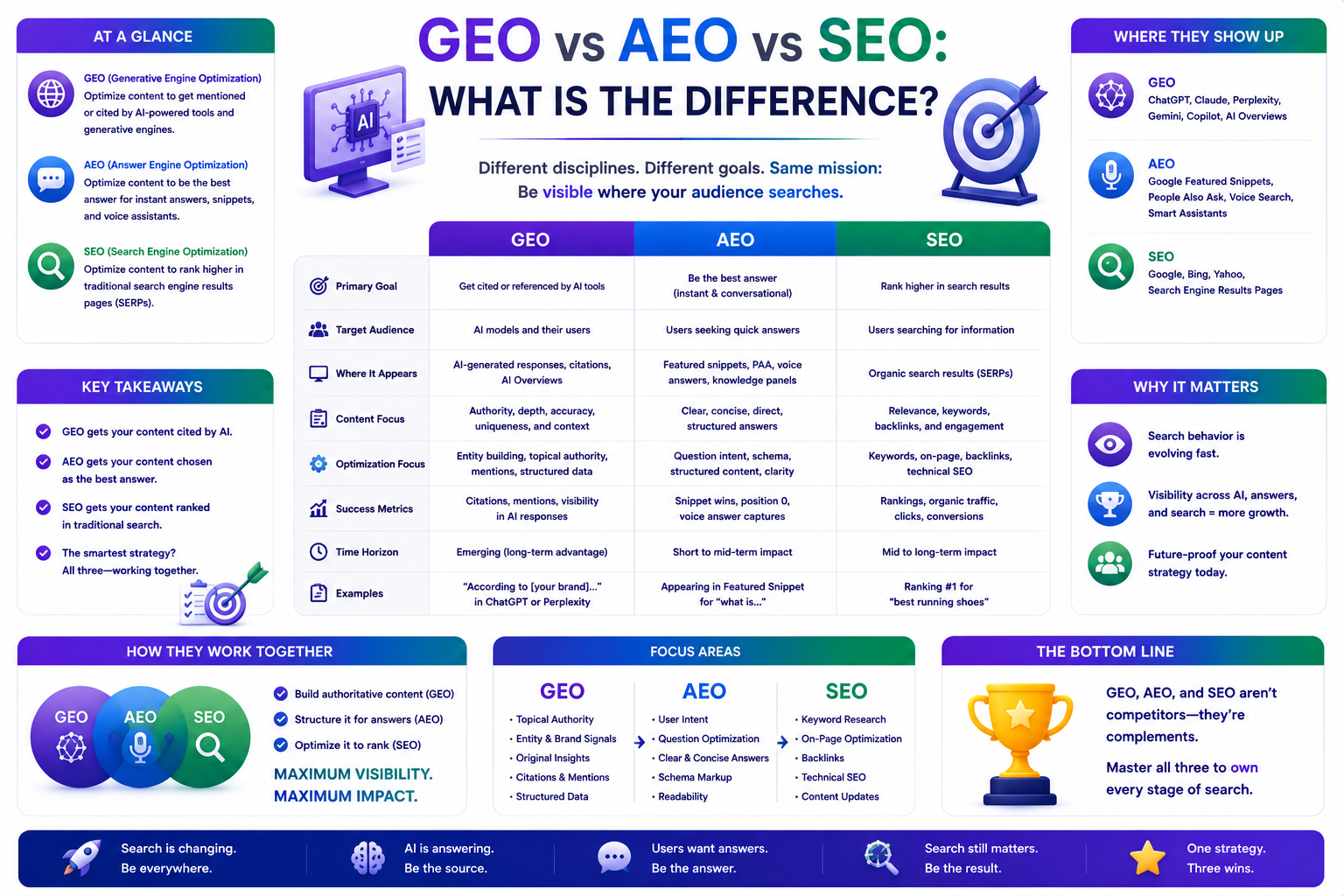
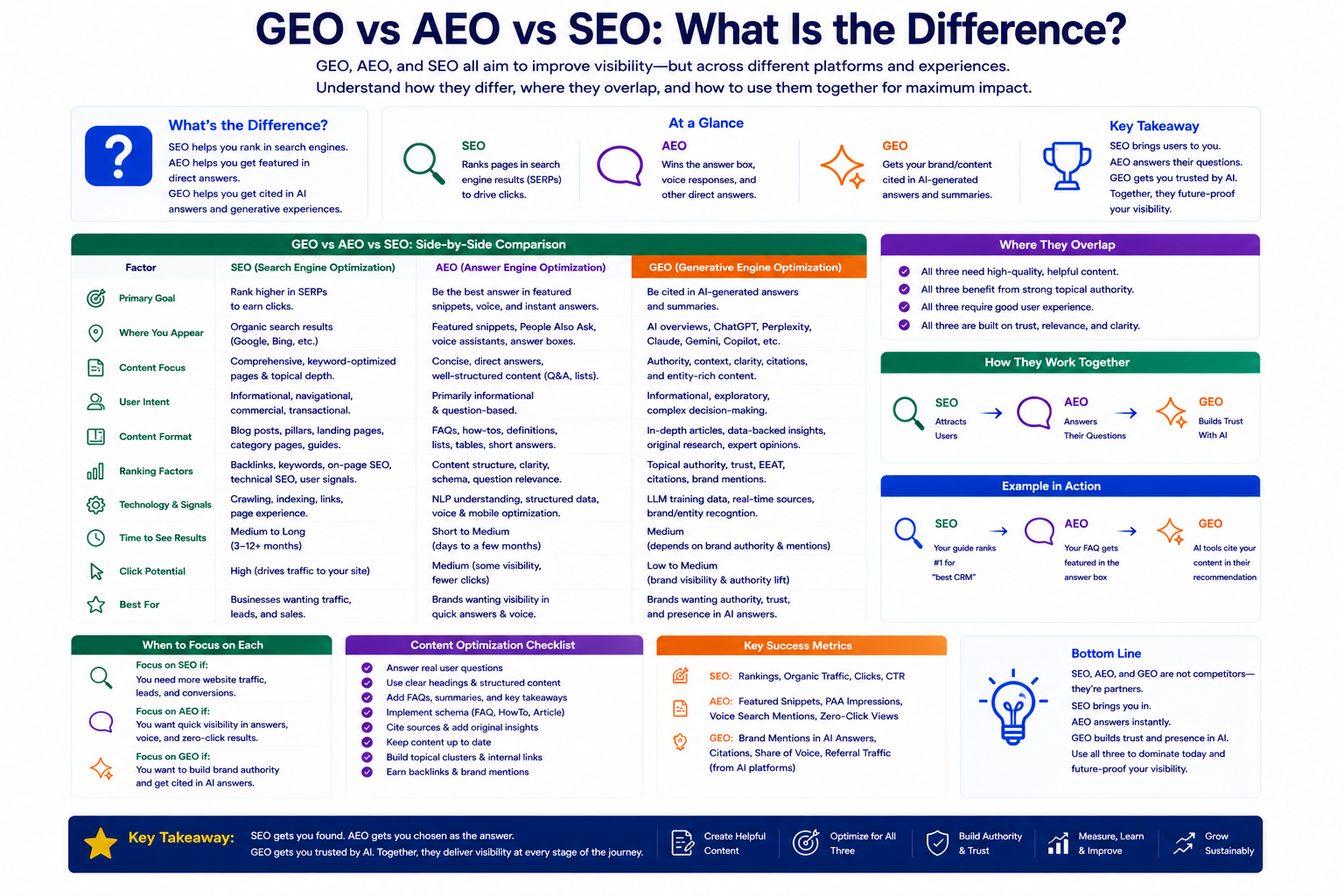
SEO, AEO, and GEO target different ways people discover information online. UnoSearch combines the right strategies to help your brand build search visibility, earn AI citations, and reach potential customers across evolving search experiences.

Pankaj Shrivastava
CEO & Co-Founder, UnoSearch
Pankaj Shrivastava is the CEO and Co-Founder of UnoSearch, leading the company’s strategic direction, business growth, and digital marketing initiatives.
Read more..
With extensive experience in SEO and digital marketing, he focuses on helping businesses strengthen their online presence, drive sustainable growth, and adapt to the evolving digital landscape. His expertise spans business strategy, search engine optimization, AI-driven marketing, and performance-focused growth solutions.
10+ Years
of Expertise
60+
Industries Served
AI-First
Digital Growth Strategy
Looking for an SEO agency? Talk to UnoSearch
SEO gets your pages ranking in Google’s blue links. AEO (Answer Engine Optimization) wins the featured snippets, voice answers, and “position zero” boxes that sit above them. GEO (Generative Engine Optimization) earns citations inside AI answers from ChatGPT, Perplexity, Gemini, and Google AI Overviews. They’re not competing disciplines. They’re three layers of the same search reality in 2026, and 58.5% of searches now end without a click, which is exactly why ignoring the last two costs brands real revenue.
The labels confuse people more than the concepts do. Strip the acronyms away and the difference is simply about where the answer shows up, and what you have to do to be the source of it. One is about ranking. One is about being the single chosen answer. One is about being quoted by a machine that’s writing the answer itself.
“Clients hear three acronyms and assume they need three vendors and three budgets. They don’t. It’s one content engine optimised for three different output surfaces. The brands overthinking the distinction are usually the ones underinvesting in all three.” — Pankaj Srivastava, Founder, UnoSearch
GEO vs AEO vs SEO at a Glance
| Parameter | SEO | AEO | GEO |
| Target Surface | Google’s 10 organic links | Featured snippets, voice, position zero | AI answers (ChatGPT, Perplexity, Gemini, AIO) |
| Core Goal | Rank the page | Become the single chosen answer | Get cited inside the generated response |
| Primary Signal | Backlinks, content depth, technical health | Structured answers, schema, clarity | Entity authority, statistics, extractability |
| Content Shape | Long-form, keyword-aligned | Concise, direct, question-led | Stat-rich, self-contained answer chunks |
| Measurement | Rankings, organic traffic | Snippet ownership, voice share | Citation share across AI engines |
| Time to Result | 6 to 12 months | 4 to 12 weeks | 2 hours to 12 weeks (engine dependent) |
So what actually separates GEO, AEO, and SEO in 2026?
Here’s the cleanest way to think about it. They stack.
SEO is the foundation, and it’s the oldest of the three. The job is getting a page to rank in Google’s organic results through the usual levers: technical health, backlinks, content depth, internal linking, and topical authority. Everything else sits on top of this. Skip it and the other two struggle, since 99% of Google AI Overview citations still come from pages ranking in the organic top 10. Ranking isn’t the finish line anymore, but it’s still the entry ticket.
AEO came next, born when Google started pulling direct answers out of pages and showing them as featured snippets, knowledge panels, and voice results. The goal shifts here. You’re no longer trying to be one of ten links. You’re trying to be the one answer Google reads aloud or boxes at the top. That means structuring content as clear questions and tight answers, layering schema, and writing for the snippet rather than the scroll. AEO is essentially the bridge discipline. It prepared the web for what GEO needs now.
GEO is the newest layer, and the one most brands are behind on. Instead of optimising for a search engine that ranks pages, you’re optimising for a language model that reads the web and writes its own answer, citing sources as it goes. The signals change completely. Entity authority matters more than backlinks. Statistics matter more than keyword density (Princeton’s research found that adding stats lifts AI citations by 41%). And extractability, meaning short, self-contained, fact-dense answer chunks, matters more than long flowing prose, because that’s the shape an LLM can lift cleanly into its response.
The overlap is the part people miss. The same well-structured, stat-rich, schema-backed page can rank in SEO, win an AEO snippet, and earn a GEO citation all at once. That’s why splitting them into three separate budgets is usually a waste. SE Ranking’s 2026 work found only about 21% citation overlap between ChatGPT and Perplexity, which tells you the engines pull differently, but the underlying content asset feeding all of them is the same one.
Which one should brands focus on first in 2026?
Get SEO right before anything else, full stop. Without organic rankings, AEO snippets are out of reach and GEO citations dry up, since both lean on content that already ranks. Once the SEO foundation holds, layer GEO next rather than AEO, because the AI answer surfaces are where attention is moving fastest and where most competitors are still asleep. AEO tends to come along for the ride once SEO and GEO are both solid, since the structured, answer-led content that earns AI citations also tends to win featured snippets. The exception is voice-heavy categories (recipes, local services, quick factual queries) where AEO deserves dedicated attention earlier. The right investment mix can vary based on your goals, current search visibility, and how your audience researches. For a deeper comparison, see our guide on SEO vs GEO for ROI.
Why choose UnoSearch for SEO, AEO, and GEO?
UnoSearch is a Google Premier Partner with 11+ years of search experience and $13.7M+ in client revenue across 60+ industries. We treat SEO, AEO, and GEO as one connected programme rather than three line items, because the content and technical work underneath them overlaps almost completely. Our specialists handle technical SEO, topical clusters, schema layering, entity building, snippet optimisation, and prompt-panel citation tracking across ChatGPT, Gemini, Perplexity, Claude, and Google AI Overviews. Every engagement runs through our proprietary DigiOps platform, giving you live visibility into rankings, snippet ownership, citation share by engine, and conversion impact by source. Founders sit inside every client channel.
To turn these concepts into an actionable strategy, explore our complete guide to AI SEO optimization. It covers content planning, technical SEO, topical authority, and ways to improve visibility across AI-powered search platforms.
We help brands grow traffic in AI search
FAQ's
1. Is GEO just a rebrand of SEO?
No, though they’re closely linked. SEO optimises for ranking in search engine results, while GEO optimises for being cited inside AI-generated answers. They share a foundation (strong content and entity signals help both), but GEO adds work that traditional SEO skips, like extractability tuning, statistics density, and citation tracking across multiple AI engines.
2. What's the difference between AEO and GEO specifically?
AEO targets Google’s own answer features: featured snippets, knowledge panels, and voice results, where Google picks one answer from a ranked page. GEO targets generative engines like ChatGPT and Perplexity, which read multiple sources and write a fresh answer, citing as they go. AEO is about being chosen. GEO is about being quoted.
3. Can one piece of content work for all three?
Yes, and that’s the whole point. A page that’s well-structured, fact-dense, schema-backed, and topically authoritative can rank organically, win a featured snippet, and earn AI citations from the same asset. Splitting them into separate content efforts usually duplicates work for no real gain.
4. Which matters most in 2026?
SEO still matters most as the foundation, since 99% of AI Overview citations come from the organic top 10. But GEO is where the fastest competitive gains sit right now, because most brands haven’t started, and AI answer surfaces are absorbing search attention quickly. The smart play is SEO first, GEO close behind.
Contact Us for a Free SEO Consultation Today!
Let us help you grow your business with a customized SEO strategy
References
- Princeton GEO Research, Generative Engine Optimization Methods and Visibility Impact, https://arxiv.org/abs/2311.09735
- SE Ranking, AI Search Citation Overlap Study 2026, https://seranking.com/blog/ai-search-citation-overlap-2026
- Semrush, AI Search Conversion Benchmark Report 2026, https://www.semrush.com/blog/ai-search-conversion-2026/
- Search Engine Land, Featured Snippets and AI Answers Study 2026, https://searchengineland.com/featured-snippets-ai-answers-2026
Continue Learning About SEO & AI Search
Local SEO for Real Estate: What Works for Agents in 2026
A practical guide to profile setup, reviews, neighborhood pages and AI visibility, including the brokerage rules and measurement problems most guides skip.By Mahendernath Pulidindi, Associate Vice President, UnoSearch · Updated October 10, 2026 ·...

Local SEO for Lawyers: How Law Firms Win the Map Pack in 2026
Google shows three firms in the Map Pack and hides the rest. This guide explains what decides which three, using Google's own guidelines, the 2026 Local Search Ranking Factors survey and the bar rules that limit what attorneys can do.By Pankaj...

Local SEO for Healthcare: A HIPAA-Safe Playbook for US Practices (2026)
Patients usually pick from the three practices Google shows first. This guide covers what decides those three, plus the HIPAA traps in reviews, tracking and listings that most local SEO for healthcare advice skips.By Rajiv Ranjan, CTO, UnoSearch...