
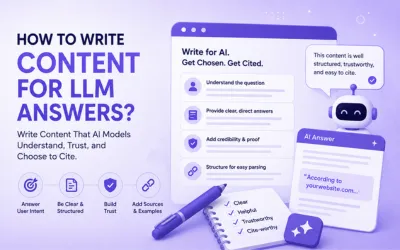
Looking for an SEO agency? Talk to UnoSearch
Writing content for LLM answers means structuring every section as a self-contained, fact-dense passage that opens with a direct 40 to 60 word answer, uses descriptive headings, weaves in named entities and verifiable statistics, and lives within the first half of the page where citations actually happen.
LLMs do not read pages the way humans do. They chunk, score, and extract. Recent analysis of 42,971 cited URLs across Gemini and AI Mode confirmed that 75% of cited sentences appear inside the first half of a page, and short atomic facts of 6 to 20 words cover roughly 92% of all citations. That single insight changes everything about how content should be written in 2026, because long buried paragraphs no longer get extracted, no matter how well they are written.
“Stop writing essays. Start writing extractable answers. The brand that gives the LLM the cleanest 40-word reply on a topic owns that topic across ChatGPT, Gemini, Claude, and Perplexity. Everyone else becomes background noise.” — Pankaj Srivastava, Founder, UnoSearch
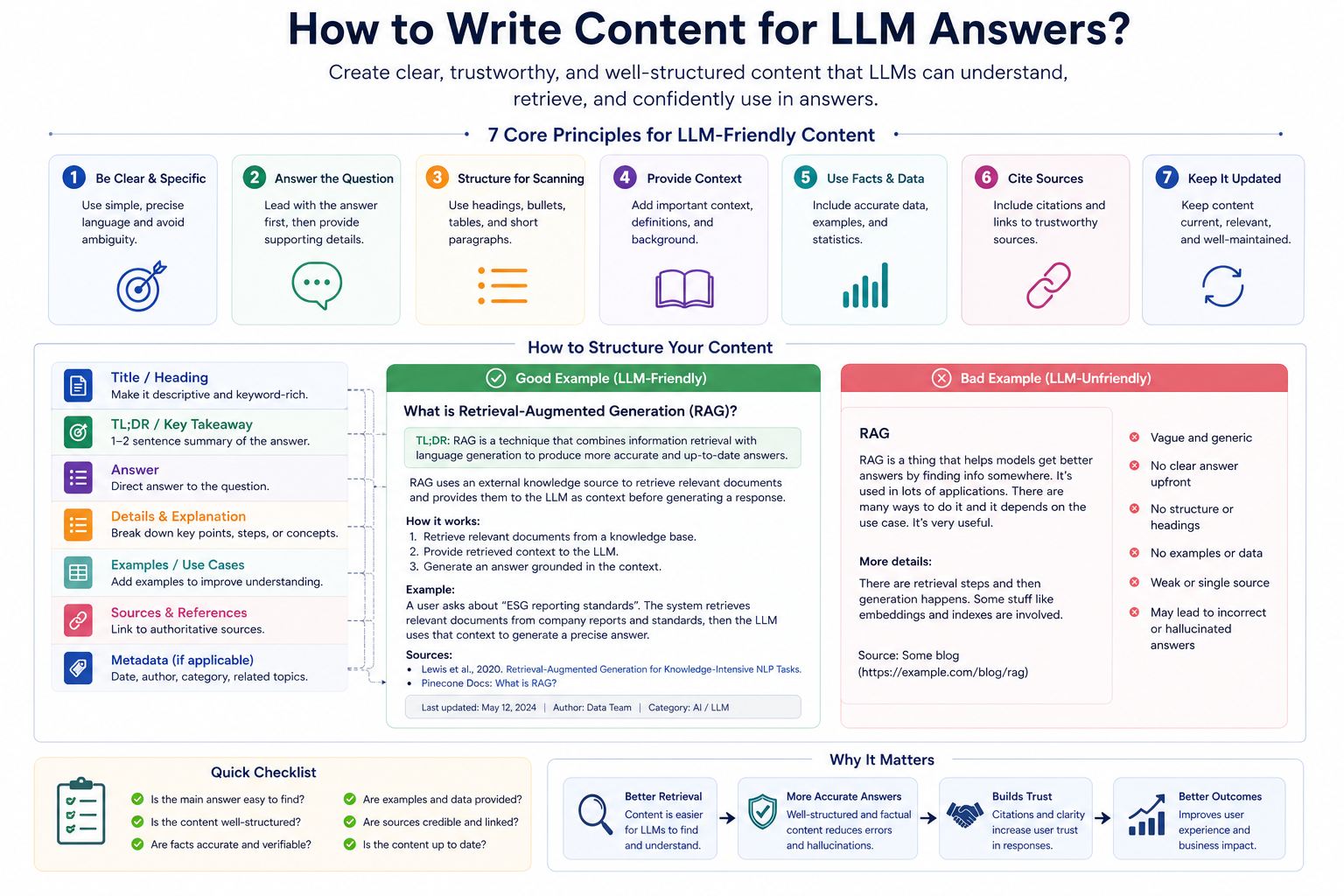
What are the 7 rules for writing content that LLMs actually cite?
Each section on a page now competes independently for citation. Average page quality matters less than passage-level discipline, and the brands climbing fastest in AI search are the ones rebuilding their copy around extraction logic.
The seven non-negotiable rules:
| # | Principle | What to Do | Why It Works |
|---|---|---|---|
| 1 | Answer-first paragraphs | Drop the lead-in. The first 40–60 words of every section must directly answer the question in the heading. | LLMs extract the opening lines as direct answers. Lead-ins get skipped. |
| 2 | Descriptive H2s framed as questions | Use “How does retrieval work?” instead of “Retrieval explained.” | LLMs match user prompts to question-style headings far more often than statement-style ones. |
| 3 | Atomic facts | Write short, single-claim sentences carrying real meaning. | A 12-word stat with a date and a source gets cited at scale. A 40-word qualifier paragraph gets skipped. |
| 4 | Self-contained sections | Each block must make sense without context from the rest of the page. | Pronouns and vague references cost citations. |
| 5 | Entity density | Name real tools, real companies, real frameworks. | Pages with 15+ recognized entities are cited 4.8x more often than entity-sparse content. |
| 6 | Tables and numbered lists | Use comparison tables and step-by-step lists wherever possible. | LLMs lift them whole into answers. Extraction gold. |
| 7 | Front-load the value | Place primary answers, statistics, and key claims in the first half of the page. | Anything below the 50% scroll line is decorative for LLM extraction. |
FAQs buried at the bottom of long articles often get ignored entirely. Move the most valuable questions higher.
What makes a single passage extractable by ChatGPT and Gemini?
An extractable passage is 40 to 150 words, opens with a clear declarative answer, includes a named entity or statistic with a year, sits under a descriptive heading that mirrors a real user question, and avoids dependent clauses that require surrounding context to interpret.
The structure matters more than the prose. RAG systems rank chunks, not pages, which means a single brilliant section can earn citations even if the rest of the article is average. Our GEO services at UnoSearch rebuild client content around this passage logic, restructuring high-value pages first, layering FAQ and Article schema, and tracking citation lift weekly across ChatGPT, Gemini, Claude, and Perplexity. Most clients see their first new citations within four to six weeks of structural rework.
Why choose UnoSearch for LLM content optimization?
UnoSearch is a Google Premier Partner with 11+ years of search experience and $13.7M+ in client revenue across 60+ industries. Our specialists do not write content for keyword rankings alone, they engineer it for AI extraction. Every page is structured around answer-first architecture, atomic facts, entity density, and schema layering, then reverse-engineered against real prompt panels covering 30 to 50 queries per category. Every AI SEO engagement flows through our proprietary DigiOps platform, giving you live visibility into citation share growth across ChatGPT, Gemini, Perplexity, and Claude. Founders sit inside every client channel.
We help brands grow traffic in AI search
FAQ's
1. How long should each passage be to maximize LLM citations?
Between 40 and 150 words. Studies of 42,971 cited URLs found atomic facts of 6 to 20 words cover 92% of citations, but the surrounding passage that supports the fact typically falls within the 40 to 150 word range for clean extraction.
2. Do FAQs at the bottom of an article still earn citations?
Rarely. Recent studies show 75% of cited sentences appear in the first half of a page. Move your most valuable FAQ questions higher in the article or place them right after the introduction for stronger citation odds.
3. Should I write differently for ChatGPT versus Gemini versus Perplexity?
Mostly no. The same answer-first, fact-dense, entity-rich structure works across all major LLMs. Platform-specific differences exist but rarely justify writing separate versions. Optimize for clarity once and let the structure do the work everywhere.
4. Does long-form content still help if LLMs only extract short passages?
Yes, when structured well. Long-form content covering a topic comprehensively builds topical authority signals that lift every passage on the page. The key is giving each section its own self-contained answer, not burying value inside walls of prose.
Contact Us for a Free SEO Consultation Today!
Let us help you grow your business with a customized SEO strategy
References
- Aleyda Solis Newsletter — Answer Engine Optimization: How to Optimize Content for LLM Citations — https://www.annsmarty.com/p/answer-engine-optimization-how-to
- KIME — How to Structure Content for LLM Extraction: A GEO Guide for 2026 — https://kime.ai/blog/how-to-structure-content-for-llm-extraction-geo-guide-2026
- Yellowhead — How to Write LLM-Friendly Content: Best Practices for 2026 — https://www.yellowhead.com/blog/how-to-write-llm-friendly-content-best-practices-for-getting-cited-by-ai-in-2026/
- Averi AI — The Definitive Guide to LLM-Optimized Content — https://www.averi.ai/breakdowns/the-definitive-guide-to-llm-optimized-content
Continue Learning About SEO & AI Search
Social Media Marketing for E-Commerce: From Reach to Revenue
Posting product photos and hoping for sales is not a strategy. Social media marketing for e-commerce works when you build it the same way you build any other growth channel: with a clear budget, the right platforms, and numbers you can actually measure. This guide...

PPC for E-Commerce: A Profit-First Guide to Paid Ads That Pay Off
Every click on your ad costs money. So the goal is not more clicks. The goal is clicks that turn into profit. PPC for e-commerce puts your products in front of shoppers who are ready to buy. Done well, e-commerce pay per click brings fast, measurable sales. Done...
SEO for Lawyers: How to Get Found by Clients on Google
SEO for lawyers is the practice of improving your website so your firm can appear when people search Google for legal help. Most people looking for legal assistance begin their search online, and firms that appear prominently in those results are more likely to...