
How Long Does It Take to Learn SEO?
Thinking about learning SEO but wondering how long it will actually take? Here is an honest timeline, from your first month of basics to professional competence, plus what genuinely speeds up the learning curve and what quietly slows it down.
Looking for an SEO agency?
UnoSearch helps brands rank higher and drive real organic growth.
Get Free Proposal1. The Short Answer
2. Learning vs. Results
3. SEO Timeline
4. What to Learn
5. Learning Factors
6. Practice vs. Theory
7. Learn SEO Faster
8. Is SEO Hard?
9. DIY vs. Expert Help
10. AI & SEO Learning
11. Common Mistakes

How UnoSearch Took A SaaS Company From Buried SERPs to 50%+ Organic Growth and ChatGPT & AI Overview Citations
You can learn SEO basics in one to three months of consistent study. Applying it well enough to improve a real website takes three to six months. Professional competence, where you can plan and troubleshoot a full strategy, usually takes six to twelve months. Mastery never really finishes, because search keeps changing. Practising on a real site is what separates fast learners from slow ones.
Two people can spend the same six months learning SEO and end up in completely different places. One reads articles, watches videos, collects bookmarks, and can define every term but has never fixed a single page. The other picks one website in week two, applies what they learn as they learn it, and by month six can look at a page and tell you why it is not ranking. The difference is not intelligence or time spent. It is method.
So when you ask how long it takes to learn SEO, the honest answer depends less on the calendar than on how you spend it. This guide gives you the realistic timeline stage by stage, the factors that genuinely change it, and the specific habits that make the difference between the two learners above.
The Short Answer
If you want the number you can plan around: most people learn the basics of SEO in one to three months, become competent enough to improve a real website in three to six months, and reach a professional level, where you can confidently plan and troubleshoot a full strategy, in six to twelve months. Mastery is a longer road, and arguably one that never ends, because search changes continuously.
Those ranges assume something specific: consistent effort, roughly an hour a day or five to ten hours a week, combined with hands-on practice. Someone dedicating two hours daily to real projects will move through them faster. Someone reading occasionally without applying anything can spend two years and still not be able to diagnose why a page will not rank.
It also helps to know exactly what you are setting out to learn. SEO is not one skill; it is a bundle of them. If the fundamentals are still hazy, our plain-English explainer on what is SEO takes five minutes and will make everything below make more sense.
Learning SEO Is Not the Same as SEO Working
This confusion trips up almost everyone, and clearing it up early will save you a great deal of frustration. Two very different timelines get muddled together under the same question.
The first is the learning curve: how long before you personally understand and can apply SEO. That is what this guide is about, and it is largely within your control. Study more, practise more, and you get there faster.
The second is the results timeline: how long before the changes you make actually move rankings and traffic. That one is mostly outside your control, because it depends on how quickly search engines crawl, trust, and rank your pages. It typically takes three to six months for measurable results, and we cover it separately in how long it takes for SEO to work.
Why does this distinction matter so much? Because beginners frequently conclude they are bad at SEO when in fact they have learned it perfectly well and are simply waiting on Google. You can do everything right in month two and still see nothing until month five. Knowing that the two clocks run separately is what stops capable people from quitting.
Expert insight: There are no secrets that’ll automatically rank your site first in Google. Focus on creating helpful content and making it easier for search engines to understand your pages.
Google Search Central, SEO Starter Guide
The Realistic SEO Learning Timeline
Here is what the journey actually looks like when someone learns steadily and practises on a real website. Your pace will vary with your background and hours, but the sequence holds.
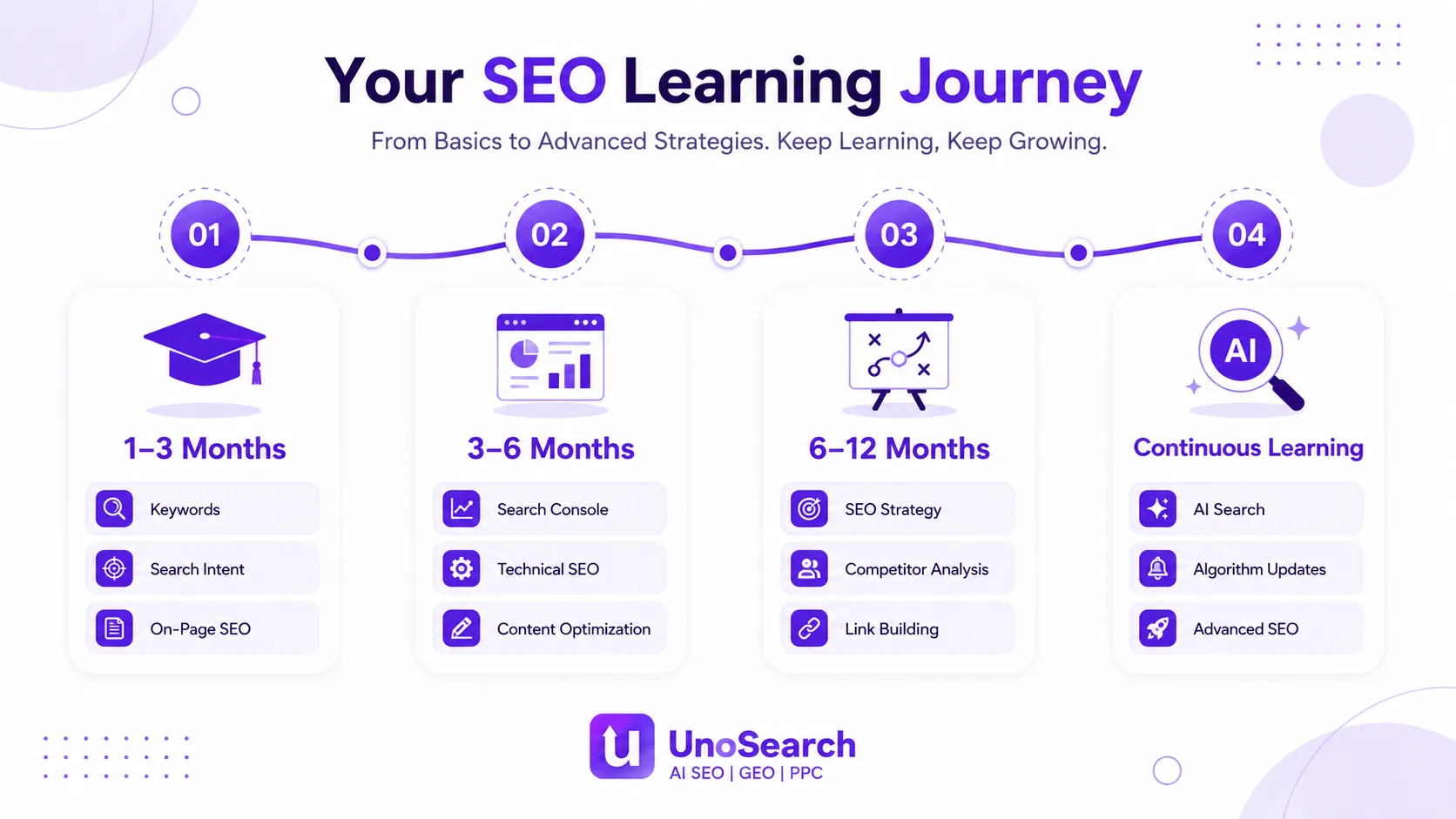
| Stage | What you can do by the end of it |
|---|---|
| Weeks 1–4 | Understand how search engines crawl, index, and rank. Grasp keywords, search intent, title tags, meta descriptions, headings, and internal links. Optimise one real page. |
| Months 2–3 | Apply the basics across several pages. Do keyword research with confidence. Read Google Search Console data. Understand why some pages improve and others do not. |
| Months 3–6 | Handle technical basics: site speed, indexing, sitemaps, redirects, crawl issues. Begin link building. Plan content around intent rather than guessing. |
| Months 6–12 | Think strategically. Plan a full SEO strategy, diagnose why a page fails, analyse competitors, and tie SEO work to business outcomes. This is professional competence. |
| Year 2 and beyond | Depth and judgment. Complex technical problems, large sites, and adapting to algorithm and AI search changes. Learning never stops. |
Notice where the line between beginner and professional actually falls. It is not at knowing what a title tag is; almost anyone learns that in a week. It is at judgment: understanding why one page ranks and a near-identical one does not. That judgment cannot be read into existence. It comes from having watched enough of your own pages succeed and fail to recognise the patterns.
A realistic first-month goal, then, is not to master SEO. It is to understand how SEO works and to improve one real page well enough that you could explain every change you made and why. That is a far better use of thirty days than skimming twenty articles.
What to actually do at each stage
Timelines are easier to act on when you know what the work looks like. Here is the practical version of the table above, stated as what you should be doing rather than what you should know.
Month 1:
Read Google’s own starter documentation. Set up Search Console. Pick one page on a real site and optimise it properly. Do not touch anything else.
Months 2 to 3:
Extend to five or six pages. Do proper keyword research for each. Check Search Console weekly and note which pages gained impressions and which did not.
Months 3 to 6:
Run a technical check on your site. Learn what a sitemap, a redirect, and a canonical tag actually do by fixing real ones. Publish content planned around search intent rather than guesswork. Earn your first few honest links.
Months 6 to 12:
Take a page that outranks yours and reverse-engineer why. Plan a full strategy for a site rather than a list of tasks. Connect your SEO work to a business outcome such as enquiries rather than rankings.
What Actually Determines Your Timeline
Why does one person reach competence in four months and another take fourteen? A handful of factors do most of the work, and only some of them are within your control.
Whether you practise on a real site.
This is the single biggest accelerator. Applying SEO to a live website teaches you in weeks what passive study will not teach in months, because you get real feedback from real data.
Hours per week.
An hour a day consistently beats eight hours in one weekend followed by a month of nothing. Consistency compounds; bursts do not.
Prior experience.
A background in marketing, writing, web development, or data analysis gives you a genuine head start, because parts of SEO are already familiar territory.
Quality of your sources.
Learning from Google’s own documentation and a few credible practitioners is faster than absorbing contradictory advice from dozens of blogs of varying quality.
Whether you follow a structured path.
A course or roadmap removes the constant question of what to learn next, which is where a surprising amount of beginner time evaporates.
Your goal.
Optimising your own small site is a far shorter road than becoming an agency-level strategist. Be clear about which you actually want.
The pattern across all six is worth naming. The factors that speed you up are all about focus and application; the ones that slow you down are all about diffusion and passivity. Fewer sources, one real project, consistent hours, clear goal. That combination is the whole trick.
Why Practice Beats Study (And By How Much)
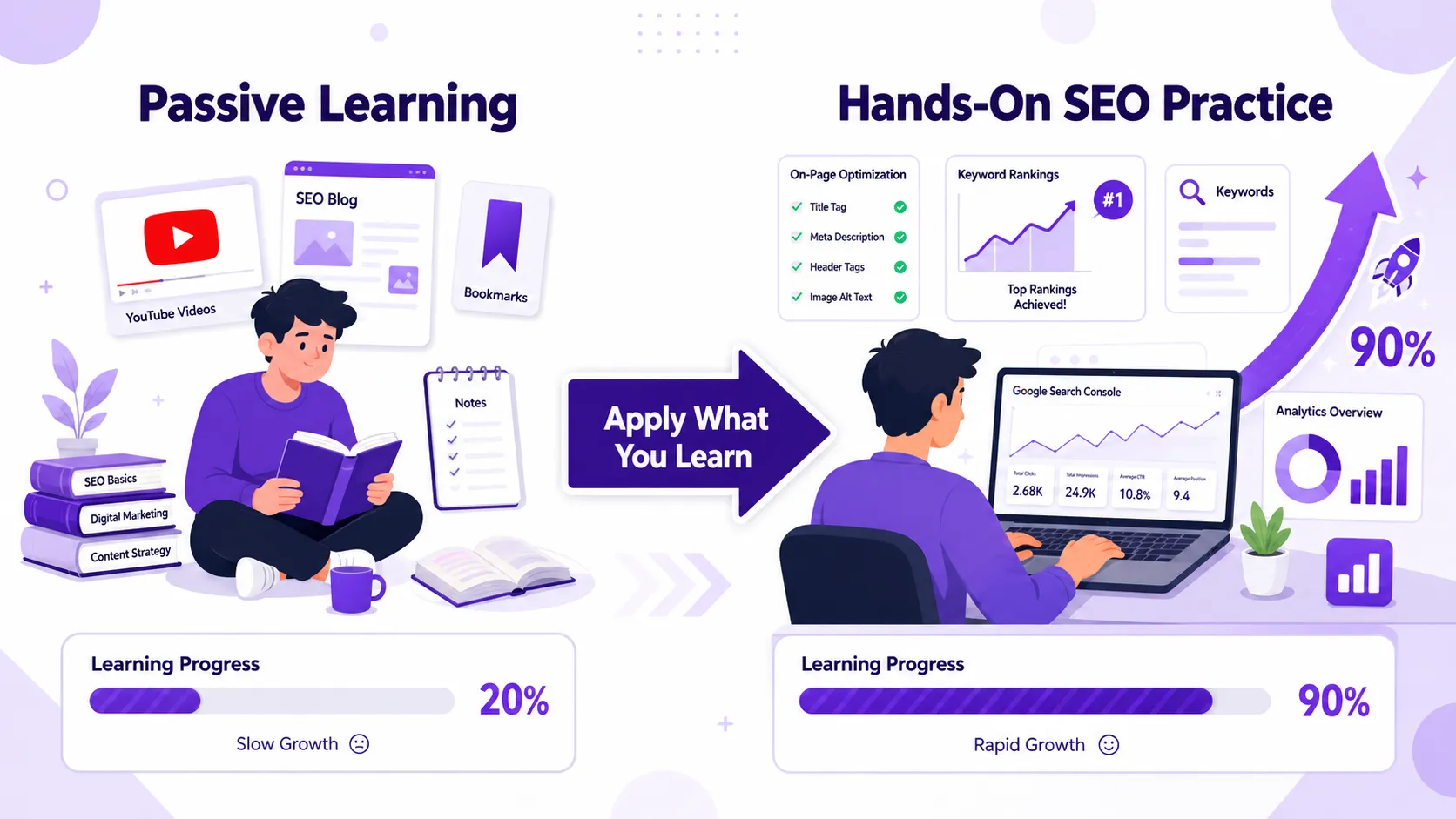
If you take one thing from this guide, take this. Working on an actual website accelerates learning dramatically compared with theory alone, and every experienced practitioner will tell you the same. The reason is straightforward: SEO is a feedback discipline, and without a live site you have no feedback.
When you optimise a page and watch its impressions climb in Search Console over the following weeks, you learn something no article can teach you. You learn what a real improvement looks like in data, how long it takes to appear, how much it fluctuates before settling. You start to develop the instinct that separates people who know SEO vocabulary from people who can actually do SEO.
Consider what happens when a page you optimised does not improve. In a course, that scenario does not exist; every example works. On a real site, you are forced to ask why. Was the keyword too competitive? Did you misjudge the intent behind the search? Is a technical problem stopping the page being indexed at all? Working through that question, once, teaches you more about how search actually behaves than a dozen lessons where everything goes right. Failure is the curriculum, and only a live site can provide it.
The practical implication is that you should not wait until you feel ready to start practising. Start in week two, when you barely know anything, on a page that barely matters. Choose one blog post, find a better keyword for it, rewrite the title, sharpen the introduction, add clearer headings, and link it to a related page. Then watch what happens over the next month. That single exercise, done properly, teaches more than a fortnight of videos.
You do not need a big site or a real business to do this. A personal blog, a hobby project, or a simple site you build for practice is enough. What matters is that the pages are live, indexed, and generating data you can read. If you would rather learn on a site that already has traffic to work with, and want a professional read on what is holding it back, an SEO audit is a fast way to see what experienced eyes look for, which is itself an education.
How to Learn SEO Faster
You cannot skip the practice, but you can waste far less time getting to competence. These are the habits that consistently shorten the curve.
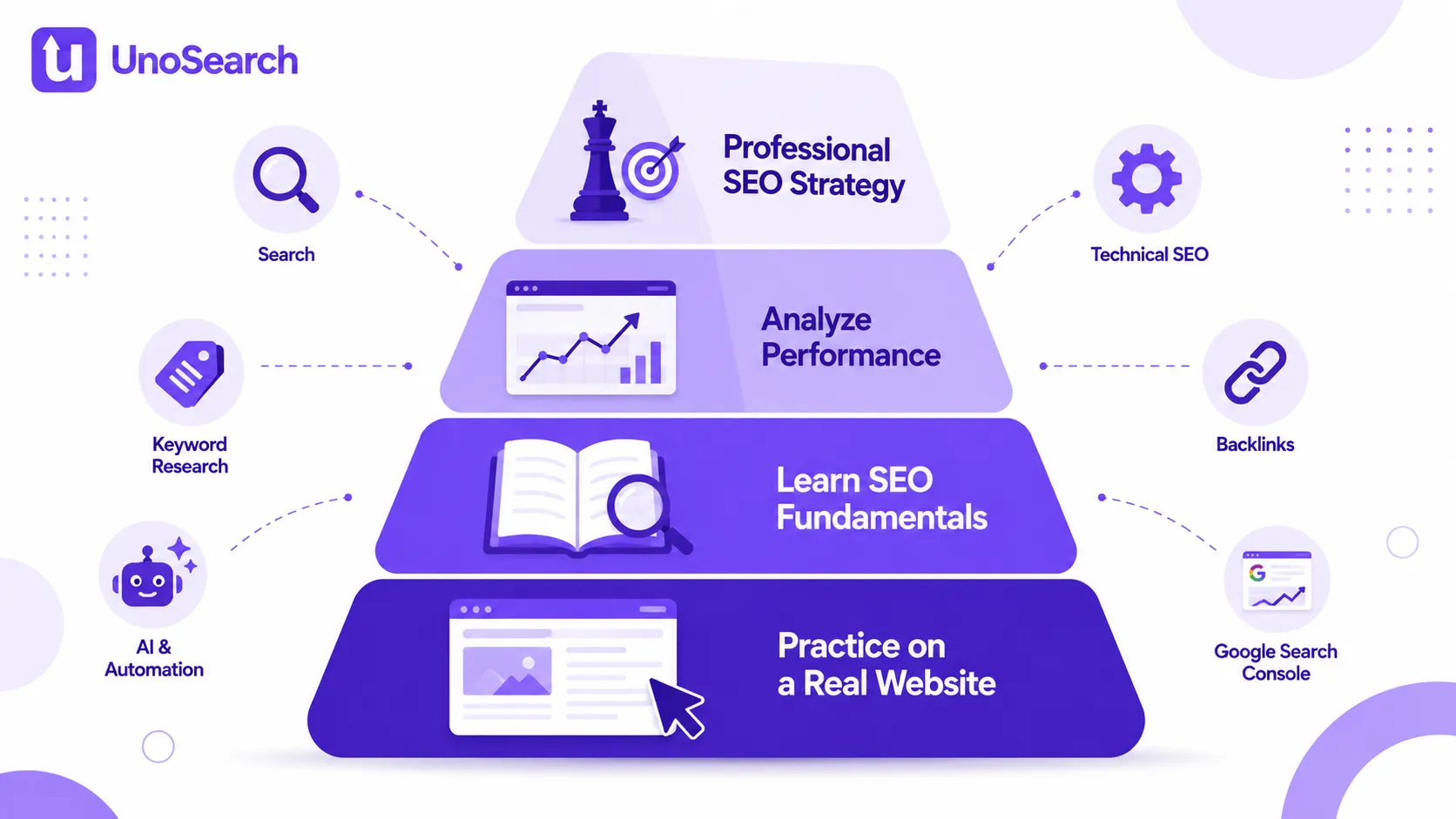
1. Pick one website in week two and never stop working on it.
Every concept you learn gets applied there immediately.
2. Learn from primary sources first.
Google’s own documentation tells you what Google wants. Start there, not with someone’s interpretation of it.
3. Follow one structured path rather than five.
Finish a single course before starting another. Course-collecting feels productive and teaches almost nothing.
4. Study for thirty minutes, then practise for an hour.
Invert the usual ratio. Most beginners study for hours and practise for minutes.
5. Set up Search Console on day one.
You cannot learn from data you are not collecting. Start the feedback loop before you need it.
6. Analyse competitors deliberately.
Take a page that outranks yours and work out precisely why. This builds the diagnostic judgment that defines a professional.
A free course is the cleanest way to get the structure without the cost, and structure is what most self-taught beginners are actually missing. Our roundup of the best free SEO courses for beginners compares the strongest options, several of which include a certificate and take under four hours.
Is SEO Hard to Learn?
SEO is not intellectually difficult. There is no advanced mathematics, no requirement to code, and the core concepts can be explained to a beginner in an afternoon. What makes it feel hard is something else entirely, and naming it helps.
The first difficulty is breadth. SEO touches content, technical site health, analytics, user psychology, and link building, and beginners try to learn all of it simultaneously. That is overwhelming by construction. Learn the fundamentals first and specialise later; nobody masters every branch at once, including professionals.
The second is the delay. In most skills, effort produces visible results quickly. Practise piano for a month and you sound better. Optimise a page and you may see nothing for three months. That lag makes it hard to tell whether you are learning or failing, which is exactly why beginners quit. Track leading indicators like impressions rather than rankings, and you will see your progress much sooner.
The third is the noise. SEO advice is abundant, contradictory, and frequently outdated. A tactic that worked in 2019 may be useless or harmful now. This is why source quality matters so much, and why anchoring yourself to Google’s own guidance is not a beginner shortcut but a professional habit.
Put those three together and you can see why so many capable people conclude they are bad at SEO. They are learning a broad subject from unreliable sources while receiving no timely feedback on whether any of it is working. Change those three conditions, narrow your focus, trust a few good sources, and get a live site producing data, and the same subject becomes entirely tractable. The difficulty was never the material.
Learning SEO Yourself vs Getting Help
Learning SEO yourself is genuinely worthwhile, and for many people it is the right call. If you run a small website, have a few hours a week, and want to understand the channel that brings you customers, self-learning pays for itself many times over. It also makes you a far better judge of anyone you might hire later.
But it costs time, and that is the honest trade-off nobody mentions. Six to twelve months to professional competence is six to twelve months during which your website is being optimised by someone still learning. For a personal blog, that is fine. For a business where search is the main growth channel and every month of underperformance has a cost, it is worth doing the arithmetic.
The clearest way to think about it: learn SEO if you want the skill and have the time, or if your site is small enough that mistakes are cheap. Bring in help if the site is large, the technical problems are beyond you, or the opportunity cost of waiting is high. Many businesses do both, learning the fundamentals so they can direct the work while professional SEO services handle execution. Neither path is wrong; they suit different situations.
What is genuinely a mistake is hiring help while understanding nothing, because you then cannot tell good work from bad, and SEO has no shortage of people willing to sell you the latter. Even a month of learning changes that entirely.
Does AI Change How Long It Takes to Learn SEO?
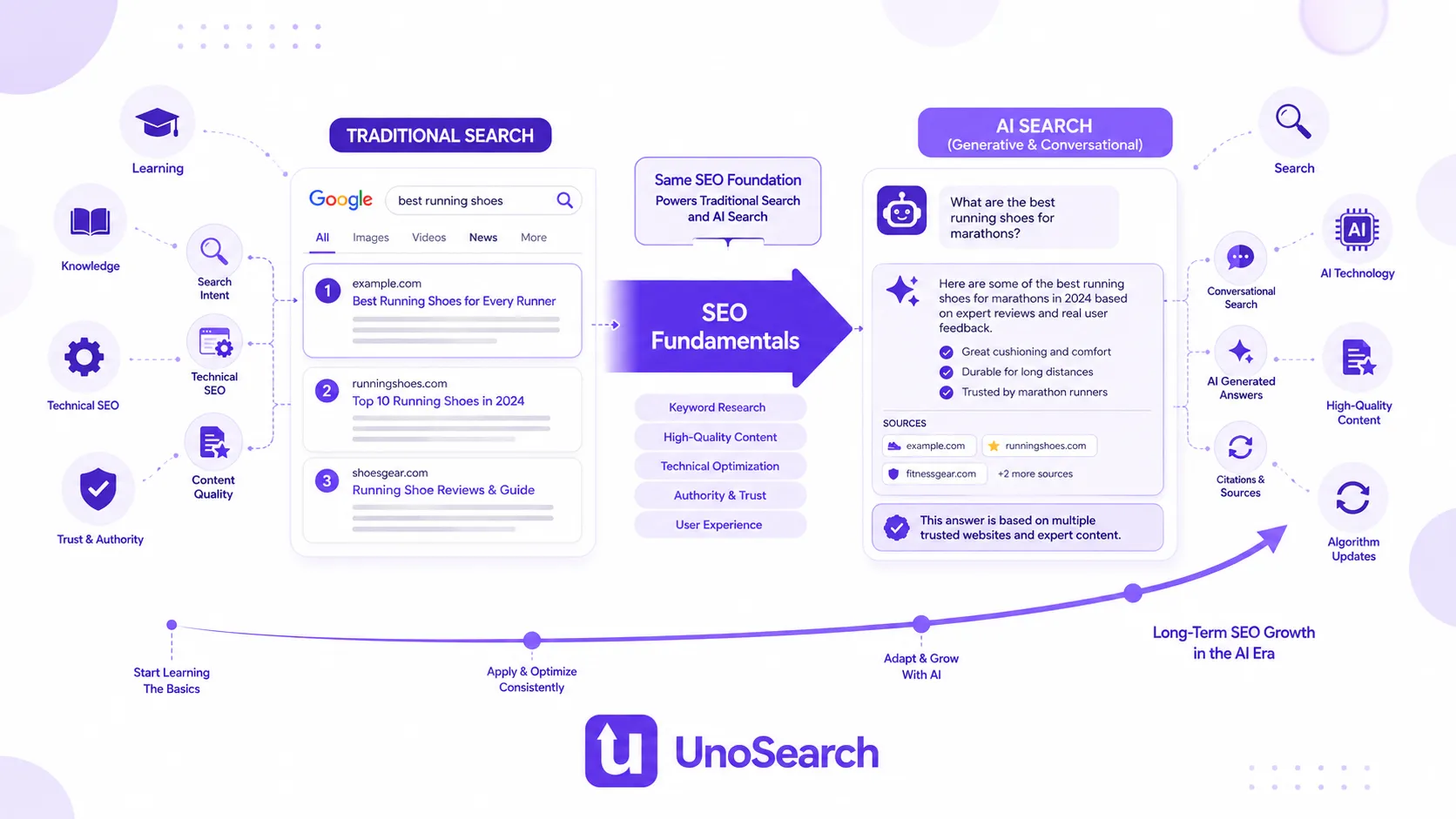
A fair question in 2026, and the answer is more reassuring than most predictions suggest. AI has changed the surface of search: AI Overviews sit above traditional results, and answer engines summarise content directly. But it has not changed what earns visibility, which remains clear, trustworthy, well-structured content that genuinely answers the question.
That means the fundamentals you spend your first six months learning, search intent, content quality, technical health, and authority, are precisely the fundamentals that determine whether an AI engine cites you. You are not learning two disciplines. You are learning one, which now pays off in two places.
What AI does change is the pace of change itself. Staying current matters more than it used to, which reinforces the point that SEO learning never truly finishes. But for a beginner, this is not an extra burden. Learn the fundamentals properly, keep reading primary sources, and you will adapt as the landscape shifts, exactly as practitioners always have which is where working with an experienced
AI SEO company can help you stay ahead of the curve.
Common Mistakes That Slow Learners Down
Most people who take too long to learn SEO are making one of these, and every one of them is fixable today.
Learning without a live site.
The most common and most costly mistake. Without data, you are memorising, not learning.
Collecting courses instead of finishing one.
Enrolling feels like progress. Completing and applying is progress.
Trying to learn every branch at once.
Technical SEO, content, and link building all at the same time guarantees shallow understanding of each.
Judging yourself by rankings in month two.
You are measuring Google’s clock, not your own. Judge yourself by whether you understand what you did and why
Chasing tactics instead of principles.
Tactics expire. The principle behind them, serve the searcher better than the competing page does, does not.
Quitting during the delay.
The gap between doing the work and seeing the result is where most beginners disappear, usually shortly before the result arrives.
Conclusion: Months to Learn, Years to Master
So, how long does it take to learn SEO? One to three months for the basics, three to six to apply them well to a real website, and six to twelve to reach professional competence. Mastery keeps going, because search keeps moving. Those are honest numbers, and they assume the one thing that matters more than any of them: that you are practising on a live site rather than only reading about it.
The reassuring part is that you do not need to reach the end of that road to get value from it. Within a month, you will understand why your pages do or do not appear in search. Within three, you will be improving them deliberately rather than hopefully. That is enough to change how a small business grows. Pick one page today, choose one keyword, and start. The clock only runs for people who begin.
Frequently Asked Questions
How long does it take to learn SEO?
Most people learn SEO basics in one to three months of consistent study, become able to improve a real website in three to six months, and reach professional competence in six to twelve months. Mastery is ongoing, because search engines keep changing.
Can I learn SEO in 3 months?
Yes, you can learn the fundamentals and start applying them effectively in three months with roughly an hour of daily study and hands-on practice. Intermediate and advanced skills, particularly technical SEO and strategy, take six to twelve months or more.
Is SEO hard to learn?
SEO is not intellectually difficult and requires no coding. What makes it feel hard is its breadth, the long delay between doing the work and seeing results, and the volume of contradictory advice online. Focusing on fundamentals from credible sources solves all three.
What is the fastest way to learn SEO?
Practise on a real website from week two. Applying what you learn to live pages and reading the data in Google Search Console teaches you far faster than passive study. Pair that with one structured course rather than many, and study less while practising more.
Do I need a course to learn SEO?
No, but a structured path helps considerably, because it removes the constant question of what to learn next. Several genuinely complete SEO courses are free, and Google’s own documentation is the most authoritative free resource available.
How long does it take to learn SEO without any experience?
With no background, expect the longer end of the ranges: around three months for basics and closer to twelve months for professional competence. Prior experience in marketing, writing, or web development shortens this noticeably.
Is learning SEO different from waiting for SEO to work?
Yes, and confusing the two causes needless frustration. Learning SEO is your personal skill curve, largely within your control. SEO working is the results timeline, typically three to six months, which depends on how quickly search engines crawl and trust your pages.
Learning SEO but want expert eyes on your site while you do?
Book a free consultation with UnoSearch.
Get Free ProposalReferences
1. Google Search Central, SEO Starter Guide, developers.google.com
2. Semrush, How Long Does It Take to Learn SEO, semrush.com
3. Google Search Console, google.com/search-console

Social Media Marketing for E-Commerce: From Reach to Revenue
Posting product photos and hoping for sales is not a strategy. Social media marketing for e-commerce works when you build it the same way you build any other growth channel: with a clear budget, the right platforms, and numbers you can actually measure. This guide...

PPC for E-Commerce: A Profit-First Guide to Paid Ads That Pay Off
Every click on your ad costs money. So the goal is not more clicks. The goal is clicks that turn into profit. PPC for e-commerce puts your products in front of shoppers who are ready to buy. Done well, e-commerce pay per click brings fast, measurable sales. Done...
SEO for Lawyers: How to Get Found by Clients on Google
SEO for lawyers is the practice of improving your website so your firm can appear when people search Google for legal help. Most people looking for legal assistance begin their search online, and firms that appear prominently in those results are more likely to...