
How to Improve Google Ranking: A Step-by-Step Guide to Rank Higher in 2026
Trying to figure out how to improve your website’s Google ranking, but not sure where to start? Here’s an honest, step-by-step breakdown from the first technical fixes that move the needle to the timeline you should realistically expect, plus what genuinely speeds up results and what quietly slows them down.
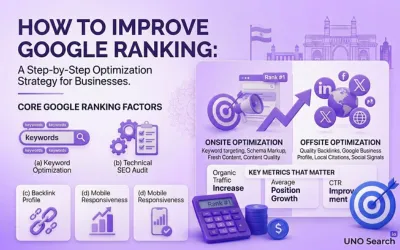
Strengthen your website’s technical foundation, content, and authority with an SEO strategy built around the searches that matter to your business.

Shalini Jadhvani
SEO Consultant, UnoSearch
Read more..
Audit-Driven
Technical & On-Page SEO
Intent-Led
Keyword & Content Strategy
AI-Search Ready
GEO & E-E-A-T Optimization
1. The Short Answer
2. Improving Your Ranking vs. Seeing Results
3. Google Ranking Improvement Timeline
4. What to Fix at Each Stage
5. Factors That Determine How Fast Your Ranking Improves
6. Why Consistency Beats One-Off Fixes
7. How to Improve Google Ranking Faster
8. Is Improving SEO Hard?
9. DIY vs. Getting Expert Help
10. How Do AI Overviews Change Google Ranking?
11. Common Mistakes That Slow Ranking Down
12. How Unosearch Can Help
13. Conclusion
14. FAQs
The Short Answer
If you want the number you can plan around: most technical and on-page fixes start showing early movement in one to two months, meaningful ranking improvement typically appears in three to six months, and compounding, durable results the kind that hold up against competitors usually take six to twelve months. There is no single fix that improves Google ranking overnight, no matter what a tool or agency promises.
Those ranges assume something specific: consistent effort applied across technical health, content quality, and authority-building, not a one-time audit followed by silence. A site that fixes its technical issues, publishes intent-matched content regularly, and earns a handful of credible backlinks each month will see faster, more stable improvement than a site that does a single big push and stops.
It also helps to know what “ranking” actually depends on before chasing tactics. If the fundamentals are still fuzzy, our guide to SEO marketing for beginners is worth reading first it explains the building blocks this guide assumes you already understand.
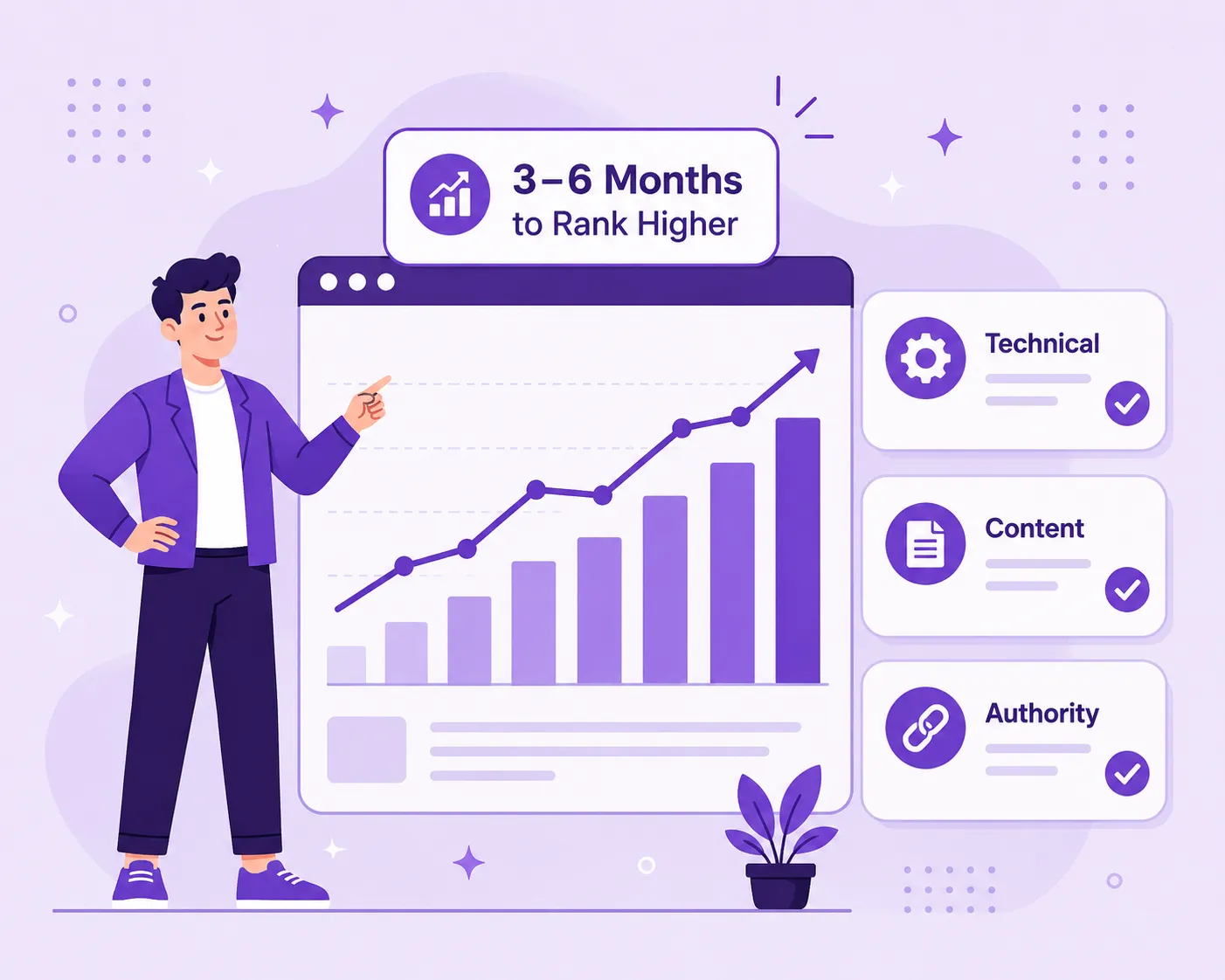
Expert insight: There’s no single trick that instantly improves your Google ranking. Focus on creating genuinely helpful, well-structured content and making it as easy as possible for search engines and increasingly, AI systems to understand your pages.
– Google Search Central, SEO Starter Guide
Improving Your Ranking vs. Seeing Results
This distinction trips up almost everyone, and it’s worth separating clearly. Two different clocks are running, and confusing them causes most of the frustration around SEO.
The first clock is the work: how quickly you can implement the fixes and improvements that are within your control, such as technical repairs, content rewrites, internal linking, and structured data. This can move as fast as you’re willing to work.
The second clock is Google’s response: how long it takes search engines to crawl, re-evaluate, and re-rank your pages after you’ve made changes. This is mostly outside your control. It depends on your site’s crawl frequency, existing authority, and the competitiveness of your target keywords. It typically takes three to six months for measurable ranking movement to appear, even when the work itself was done correctly and quickly a pattern covered in more depth in how long SEO takes to show results.
Why does this matter so much? Because site owners often conclude their SEO “isn’t working” when in fact everything was done right and they’re simply waiting on Google’s crawl and trust cycle. You can fix every technical issue in week one and still see nothing move until month four. Knowing that these two clocks run separately is what keeps people from abandoning a strategy right before it starts paying off.
Google Ranking Improvement Timeline
Here’s what the process actually looks like when technical fixes, content, and authority-building are handled consistently. Your pace will vary based on competition and starting point, but the sequence holds.
| Stage | What Typically Happens |
|---|---|
| Weeks 1–4 | Technical audit completed, crawl/indexing errors fixed, on-page elements (titles, meta descriptions, headers) optimized on priority pages |
| Months 2–3 | Early keyword movement, especially for lower-competition terms; Search Console data starts showing indexing improvements |
| Months 3–6 | Noticeable ranking improvement on target keywords, increased organic impressions and clicks, first backlinks earned |
| Months 6–12 | Compounding results as content depth and backlink authority accumulate; rankings become more resistant to competitor movement |
| Ongoing | Continuous refinement as algorithms and search behavior (including AI Overviews) evolve |
Notice where the real shift happens it’s not in month one, when you’re fixing obvious technical issues. It’s between months three and six, when Google has had enough time to re-crawl, re-evaluate, and trust the changes you made. That gap is exactly where most businesses give up, right before results typically start compounding.
What to Fix at Each Stage
Timelines are easier to act on when you know exactly what the work looks like at each point.
Weeks 1–4:
Run a full technical audit, crawl errors, broken links, indexing issues, page speed, and mobile usability. Fix the highest-impact issues first. Optimize title tags, meta descriptions, and headers on your most important pages.
Months 2–3:
Extend on-page optimization across more pages. Conduct proper keyword research tied to real search intent, not just volume. Check Search Console weekly to see which pages are gaining impressions.
Months 3–6:
Address deeper technical issues sitemaps, canonical tags, redirect chains, Core Web Vitals. Begin building backlinks deliberately rather than passively. Publish content planned around search intent rather than guesswork.
Months 6–12:
Analyze competitors that outrank you and understand exactly why. Build a full content and authority strategy rather than a list of isolated tasks. Tie ranking improvements to actual business outcomes, leads, signups, and revenue, not just position numbers.
Factors That Determine How Fast Your Ranking Improves
Why does one site see movement in three months and another take a year? A handful of factors do most of the work, and only some are within your control.
Your site's existing authority.
A newer site with fewer backlinks takes longer to earn Google’s trust than an established one, regardless of how well you optimize it.
How competitive your keywords are.
Ranking for a low-competition, niche term can happen in weeks. Competing for a broad, high-volume term against established players can take a year or more.
Technical health.
A site full of crawl errors, slow load times, or duplicate content will see delayed results even with great content, because Google has to trust the site’s fundamentals first.
Content depth and relevance.
Pages that fully answer the searcher’s question outperform pages that skim the surface, even if the shorter page was published first.
Consistency of effort.
A steady stream of small improvements compounds faster than one large push followed by inactivity.
Backlink quality.
A handful of links from genuinely relevant, credible sites moves rankings faster than a large volume of low-quality ones.
The pattern across all six is worth naming: the factors that speed things up are all about depth, consistency, and relevance. The ones that slow things down are almost always about neglecting fundamentals in favor of shortcuts.
Why Consistency Beats One-Off Fixes
If you take one thing from this guide, take this: improving Google ranking is a compounding process, not a single project. A one-time technical audit or a single round of content updates can produce a short-term bump, but rankings that hold up long-term come from continuous, incremental work.
Here’s why. Google re-crawls and re-evaluates sites constantly, and competitors are doing the same work you are. A site that publishes consistently, earns backlinks steadily, and keeps fixing technical issues as they appear stays ahead of one that did everything right once and then stopped. Rankings you stop maintaining tend to erode as competitors catch up.
This is also where local visibility often gets overlooked. If your business depends on nearby customers finding you, ranking improvements need to include location-specific signals too something a dedicated local SEO strategy is built specifically to handle, since general SEO efforts often miss it.
How to Improve Google Ranking Faster
You can’t skip the waiting entirely, but you can avoid wasting the time you do spend. These habits consistently shorten the path to visible improvement.
1. Fix technical issues first.
Content and links won’t help if Google can’t crawl or trust your site.
2. Set up and check Search Console weekly.
You can’t improve what you’re not measuring.
3. Target intent, not just keywords
A page that matches what the searcher actually wants outperforms one stuffed with the right words but the wrong answer.
4. Build internal links deliberately.
Help Google (and users) understand how your pages relate to each other.
5. Earn a few quality backlinks consistently,
Rather than chasing large volumes of low-value ones.
6. Structure content for both search engines and AI answers.
Clear headers, direct answers, and structured data help you show up in both traditional results and AI Overviews.
Is Improving SEO Hard?
Improving your site’s SEO isn’t intellectually difficult there’s no advanced technical skill required to understand the core concepts. What makes it feel hard is something else entirely.
The first difficulty is breadth.
SEO touches technical health, content, structure, and authority all at once, and many site owners try to fix everything simultaneously. That’s overwhelming by design. Fix the highest-impact issues first, then move outward.
The second is the delay.
In most areas of business, effort produces visible results quickly. With SEO, you can do everything correctly in month one and see nothing move until month four. That lag makes it hard to tell whether your strategy is working, which is exactly why many site owners abandon it too early.
The third is the noise.
SEO advice online is abundant, contradictory, and often outdated a tactic that worked in 2019 may do nothing (or actively hurt you) today. Anchoring your strategy to fundamentals, crawlability, relevance, and genuine authority rather than shifting trends is what actually holds up.
DIY vs. Getting Expert Help
Improving your Google ranking yourself is genuinely worthwhile if you have the time and your site is small enough that mistakes are low-cost. It also makes you a far better judge of any agency you might hire later.
But it comes with a real trade-off: the six to twelve months it takes to reach compounding results is time during which your site is being optimized by someone still learning the ropes, or juggling it alongside other responsibilities. For a personal or small business site, that’s fine. For a business where organic search is a primary growth channel, the opportunity cost of slower, inconsistent execution is worth weighing seriously.
The clearest way to think about it: handle it yourself if you have the time and a smaller site where mistakes are cheap. Bring in help if your site is larger, the technical issues are beyond your comfort zone, or the cost of waiting is high. Many businesses do both — learning the fundamentals so they can direct the work, while a revenue-driven SEO strategy handles execution and ties it to measurable outcomes.
How Do AI Overviews Change Google Ranking?
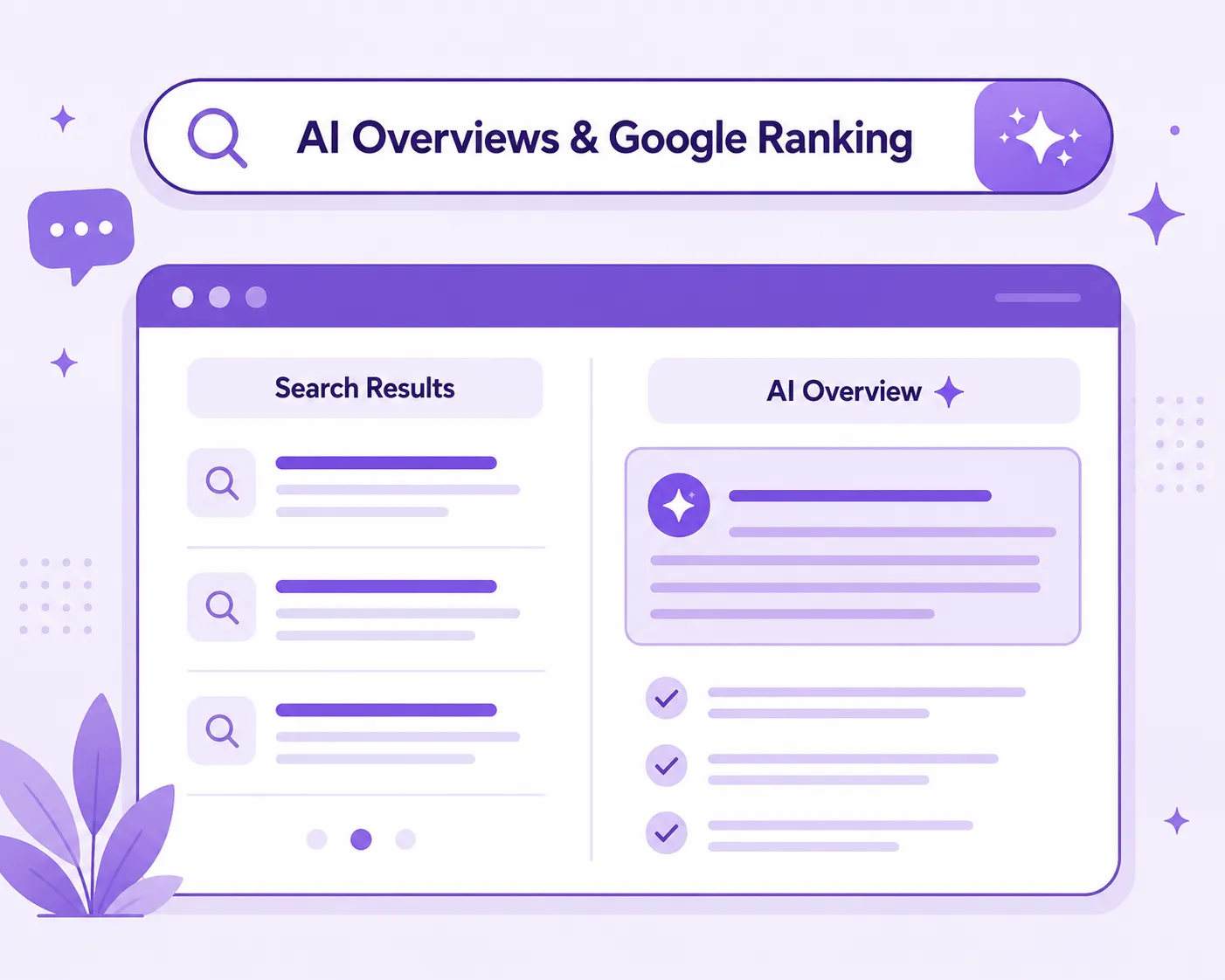
A fair question in 2026. AI Overviews and chatbot answers have changed the surface of search, but they haven’t changed what earns visibility in the first place clear, trustworthy, well-structured content that genuinely answers the question still wins, whether it’s ranked on a results page or cited inside an AI-generated answer.
That means the fundamentals covered in this guide technical health, search intent, and authority are the same fundamentals that determine whether an AI engine cites your site. You’re not managing two separate strategies. You’re managing one, which now pays off in two places: traditional rankings and AI-generated answers.
What has changed is the pace of change itself, and how content needs to be structured to be “extractable” clear headers, direct answers, and structured data all help both traditional SEO and Generative Engine Optimization (GEO) at once. This is precisely where GEO services built specifically around AI-answer visibility can help you stay ahead of the shift, rather than treating it as an afterthought.
Common Mistakes That Slow Ranking Down
Most sites that struggle to improve their Google ranking are making one of these mistakes and every one of them is fixable.
| Common Mistake | Why It Hurts Ranking | The Fix |
|---|---|---|
| Ignoring technical SEO | Crawl and indexing issues limit visibility before content even matters | Run regular technical audits |
| Publishing thin or duplicate content | Doesn't satisfy search intent, gets outranked by deeper pages | Rewrite with genuine depth and originality |
| Keyword stuffing | Feels unnatural, hurts readability and rankings both | Use keywords naturally, prioritize intent |
| Judging progress too early | Confuses the "waiting on Google" delay with failure | Track leading indicators like impressions, not just rankings |
| No consistent publishing or link-building | Stalls authority-building momentum | Maintain a steady, ongoing content and outreach cadence |
| No mobile optimization | Hurts both rankings and user experience directly | Test and fix mobile usability regularly |
Conclusion: Weeks to See Movement, Months to See Results That Hold
So, how do you improve your Google ranking? Fix the technical fundamentals first, match your content to real search intent, build authority consistently, and give Google the time it needs to re-crawl and trust the changes. Early movement typically appears within one to two months, meaningful improvement within three to six, and durable, compounding results within six to twelve.
The reassuring part is you don’t need to wait until month twelve to see value. Within a month, you’ll understand exactly what’s holding your site back. Within three, you should start seeing early signals in Search Console. Pick your highest-impact technical issue today, fix it, and start the clock — it only runs for the sites that begin.
How Unosearch Can Help You With All of This
If you’ve read through everything above and you’re thinking, “this is a lot to manage on my own,” you’re not wrong improving your Google ranking involves technical fixes, content strategy, link building, and now, visibility inside AI answers too. That’s exactly where Unosearch comes in.
1. Not sure how do I rank higher on Google?
Unosearch runs a full technical and on-page audit to find exactly what’s holding your site back, backed by a revenue-driven SEO strategy built around real business outcomes, not just rankings.
2. Wondering how to improve SEO on your website?
Their team builds a content and structure strategy tailored to your industry, not a generic template.
3. Need visibility in local search specifically?
Their local SEO services help you show up where nearby customers are actually searching.
4. Trying to figure out how to rank your website on Google
While also showing up in ChatGPT, Gemini, and AI Overviews? Unosearch’s GEO services are built specifically to get your business cited inside AI-generated answers, not just ranked on a results page.
Instead of piecing together advice from different guides and tools, Unosearch handles the whole picture so your site ranks higher on Google and gets cited where people are increasingly asking questions: inside AI-generated answers.
Frequently Asked Questions
How do I improve my Google ranking?
Start with a technical audit to fix crawl and indexing issues, then optimize on-page elements like titles and headers, build content around real search intent, and earn backlinks from credible, relevant sites consistently over time.
How long does it take to improve Google ranking?
Early movement typically appears in one to two months, meaningful improvement in three to six months, and durable, compounding results in six to twelve months, depending on competition and consistency.
How do I rank higher on Google without paid ads?
Focus on organic fundamentals: technical health, intent-matched content, internal linking, and steady backlink building. It takes longer than paid ads but builds visibility that doesn’t disappear when you stop spending.
What are the main types of SEO?
The main types are on-page SEO (your own content and HTML), off-page SEO (backlinks and reputation), technical SEO (crawlability, speed, mobile), and local SEO (showing up for searches in your area).
Why isn't my Google ranking improving?
The most common causes are unresolved technical issues, thin or duplicate content, inconsistent publishing, or judging progress too early — before Google has had time to re-crawl and trust the changes.
Does improving SEO help with AI Overviews and chatbot answers too?
Want to turn this understanding into real traffic?
Book a free consultation with UnoSearch and we'll map your first three months of SEO. Get Free ProposalReferences
1. Google Search Central – SEO Starter Guide
https://developers.google.com/search/docs/fundamentals/seo-starter-guide
2. Google Search Console (official)
https://search.google.com/search-console/about
3. Google – How Search Works
https://www.google.com/search/howsearchworks/
4. Moz – Beginner’s Guide to SEO
https://moz.com/beginners-guide-to-seo
Continue Learning About Digital Marketing

Local SEO for Real Estate: What Works for Agents in 2026
A practical guide to profile setup, reviews, neighborhood pages and AI visibility, including the brokerage rules and measurement problems most guides skip.By Mahendernath Pulidindi, Associate Vice President, UnoSearch · Updated October 10, 2026 ·...

Local SEO for Lawyers: How Law Firms Win the Map Pack in 2026
Google shows three firms in the Map Pack and hides the rest. This guide explains what decides which three, using Google's own guidelines, the 2026 Local Search Ranking Factors survey and the bar rules that limit what attorneys can do.By Pankaj...

Local SEO for Healthcare: A HIPAA-Safe Playbook for US Practices (2026)
Patients usually pick from the three practices Google shows first. This guide covers what decides those three, plus the HIPAA traps in reviews, tracking and listings that most local SEO for healthcare advice skips.By Rajiv Ranjan, CTO, UnoSearch...