
How Long Does It Take for SEO to Work?
Wondering when your SEO efforts will finally pay off? This guide gives you a realistic, month-by-month timeline for how long SEO takes to work in 2026, the factors that speed it up or slow it down, and the early signs that tell you it is working long before rankings move.
Looking for an SEO agency?
UnoSearch helps brands rank higher and drive real organic growth.
Get Free Proposal1. Why SEO Takes Time
2. The Short Answer
3. Month-by-Month Timeline
4. Timelines by Site Type
5. What SEO Working Looks Like
6. What Speeds It Up
7. Getting Faster Results
8. What to Do Meanwhile
9. SEO Timelines in 2026
10. Why It Takes Longer
11. Conclusion
12. FAQs

How UnoSearch drove 284+ leads, 7x client inquiries, and Page 1 rankings for a Navi Mumbai law firm in just 15 months.
Most websites start to see measurable SEO results in three to six months, with stronger, compounding gains between six and twelve months. New sites take longer, often six to twelve months, because search engines need time to build trust. This guide breaks down the real month-by-month timeline and what actually influences how fast SEO works.
It is the question every business owner asks the moment they start investing in search: how long does it take for SEO to work? You have set up your site, published content, maybe hired help, and now you are watching Google Search Console daily, wondering when something will happen. It is a fair question, and you deserve an honest answer rather than the vague “it depends” most guides offer.
Here is the honest, useful version. Most websites begin seeing measurable results in three to six months, with stronger, compounding gains between six and twelve months. But that range hides a lot of important detail: what “results” actually means, what happens each month, and why a brand-new site behaves completely differently from an established one. This guide breaks all of that down.
The Short Answer
If you want the clean answer you can repeat in a meeting, here it is: SEO typically takes three to six months to start showing measurable results, and six to twelve months to deliver significant, compounding growth. Newer websites sit at the longer end of that range, while established sites with existing authority can sometimes see movement in as little as four to eight weeks.
But that single number, on its own, is not very useful, because it depends heavily on your starting point. A ten-year-old site with a history of quality content will move faster than a domain registered last month. A low-competition local niche will show results sooner than a cut-throat national industry. So rather than fixate on one figure, it helps to understand the pattern: what happens, and when, across the first year.
It also helps to be clear on what SEO actually is before judging its timeline, because misunderstanding the mechanism is what leads to unrealistic expectations. If you want the plain-English foundation first, our guide on what is SEO explains how search engines find, understand, and rank pages, which is exactly why the process takes the time it does.
Why SEO Takes Time (The Honest Reason)
Before the timeline, it is worth understanding why SEO is slow, because it makes the wait far easier to accept. The delay is not a flaw or a sign something is broken. It is how the system is designed to work.
Search engines rank pages based on trust, and trust cannot be built instantly. When you publish a page, Google has to discover it, crawl it, index it, and then evaluate it against every competing page already ranking for that term. It looks at how users interact with your page, whether other credible sites reference you, and whether your content stays consistent and useful over time. All of that takes time to accumulate, by design, because a system that ranked pages instantly would be trivially easy to manipulate with spam.
New sites face an extra hurdle. A brand-new domain has no history, no backlink profile, and no behavioural data, so Google is effectively being asked to trust a complete stranger. This is sometimes informally called the “sandbox” period, where new domains see indexation and low-position impressions but not significant rankings, regardless of content quality. It is well documented among SEOs even though Google has not formally confirmed the term. The takeaway: the first several months for a new site are largely about proving legitimacy.
A helpful way to think about it is building a professional reputation. Imagine a brand-new consultant with no clients, no reviews, and no track record. Even if they are brilliant, people are cautious at first, because there is no evidence yet. Over time, as they deliver good work and others vouch for them, trust accumulates and referrals speed up. Search engines treat websites the same way. Your early content is you doing good work; your backlinks are others vouching for you; and consistent quality over months is the track record that finally earns Google’s confidence. You cannot shortcut a reputation, and you cannot shortcut SEO for the same reason.
Expert insight: New websites typically need to be patient for four months to a year before seeing significant SEO results, not because Google is deliberately slow, but because the trust and relevance signals that drive rankings require time to accumulate and validate.”
Paraphrasing Google Search Advocate John Mueller, on new-site ranking timelines
The data backs this up starkly. A large-scale study by Ahrefs found that the average page ranking in Google’s top ten is over two years old, and only around 5.7 percent of newly published pages reach the top ten within a year. That is not meant to discourage you; it is meant to set honest expectations. SEO is a long game, and knowing that from the start is what keeps you from quitting too early.
The Real Month-by-Month SEO Timeline
Here is what a realistic SEO campaign actually looks like, month by month. Your exact experience will vary with your starting point and effort, but this pattern holds for most sites. Notice that the early months produce little visible traffic and a lot of invisible groundwork; that is normal and necessary.
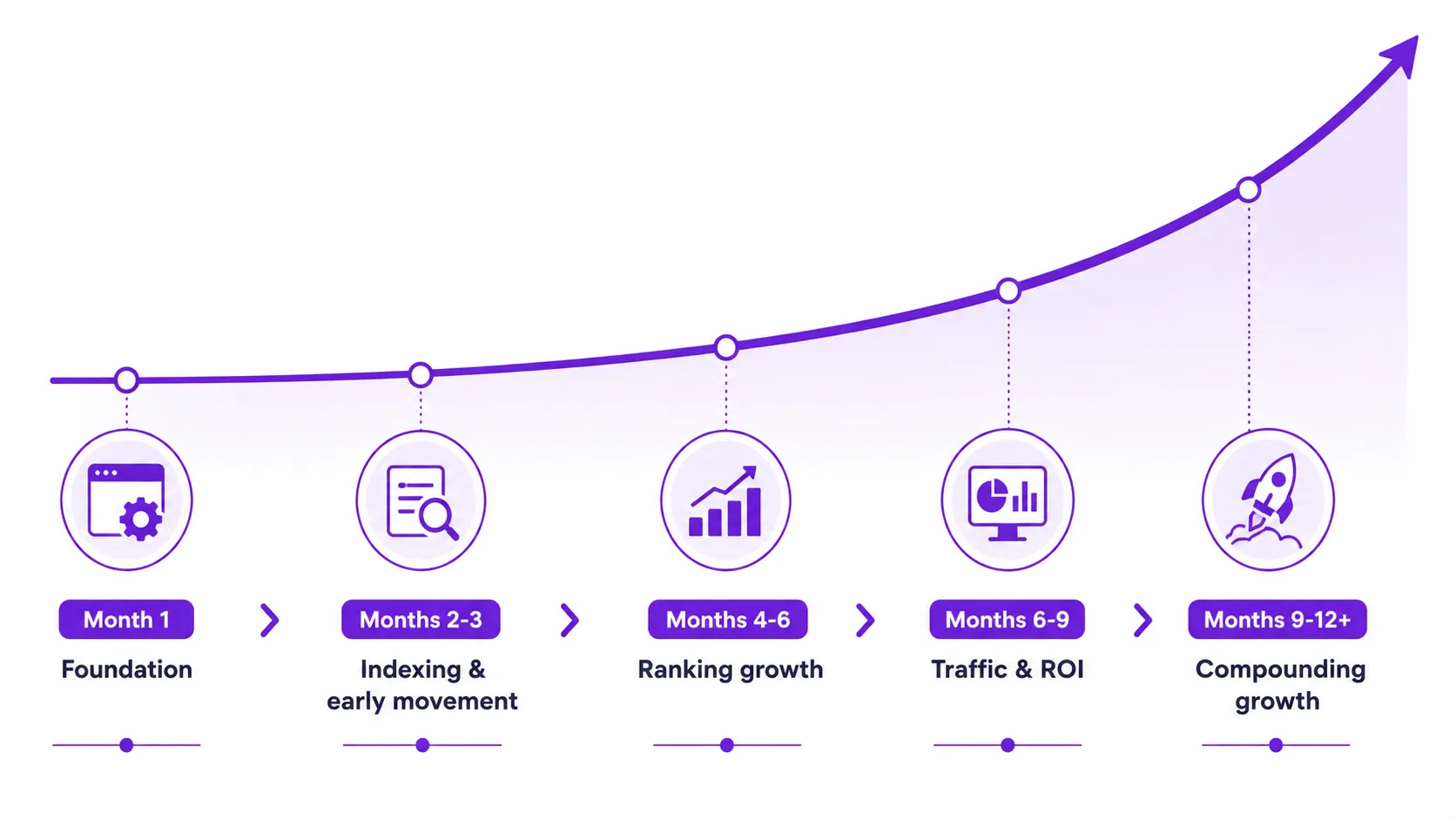
| Timeframe | What actually happens |
|---|---|
| Month 1 | Foundation: technical audit, fixing crawl and speed issues, keyword research, and content planning. Almost no visible ranking change, but the base is being built. |
| Months 2–3 | Content goes live and gets indexed. Early keyword movements and rising impressions appear in Search Console. Possible traffic on low-competition or long-tail terms. |
| Months 4–6 | Measurable keyword ranking improvements and a consistent upward trend in organic traffic. Early conversion signals. This is when most people stop asking whether SEO is working. |
| Months 6–9 | Significant traffic growth, first-page rankings for target keywords, and clear return on investment for most sites. |
| Months 9–12+ | Strong topical authority, stable rankings, and compounding growth that keeps building with less additional effort. |
A crucial detail beginners miss: even after a page starts climbing, it often bounces up and down before it settles. A new article might appear at position 20, drop, then climb again as Google gathers data on how searchers interact with it. This volatility is completely normal and part of the evaluation process, not a sign that something is wrong. Judge progress month over month, not day to day.
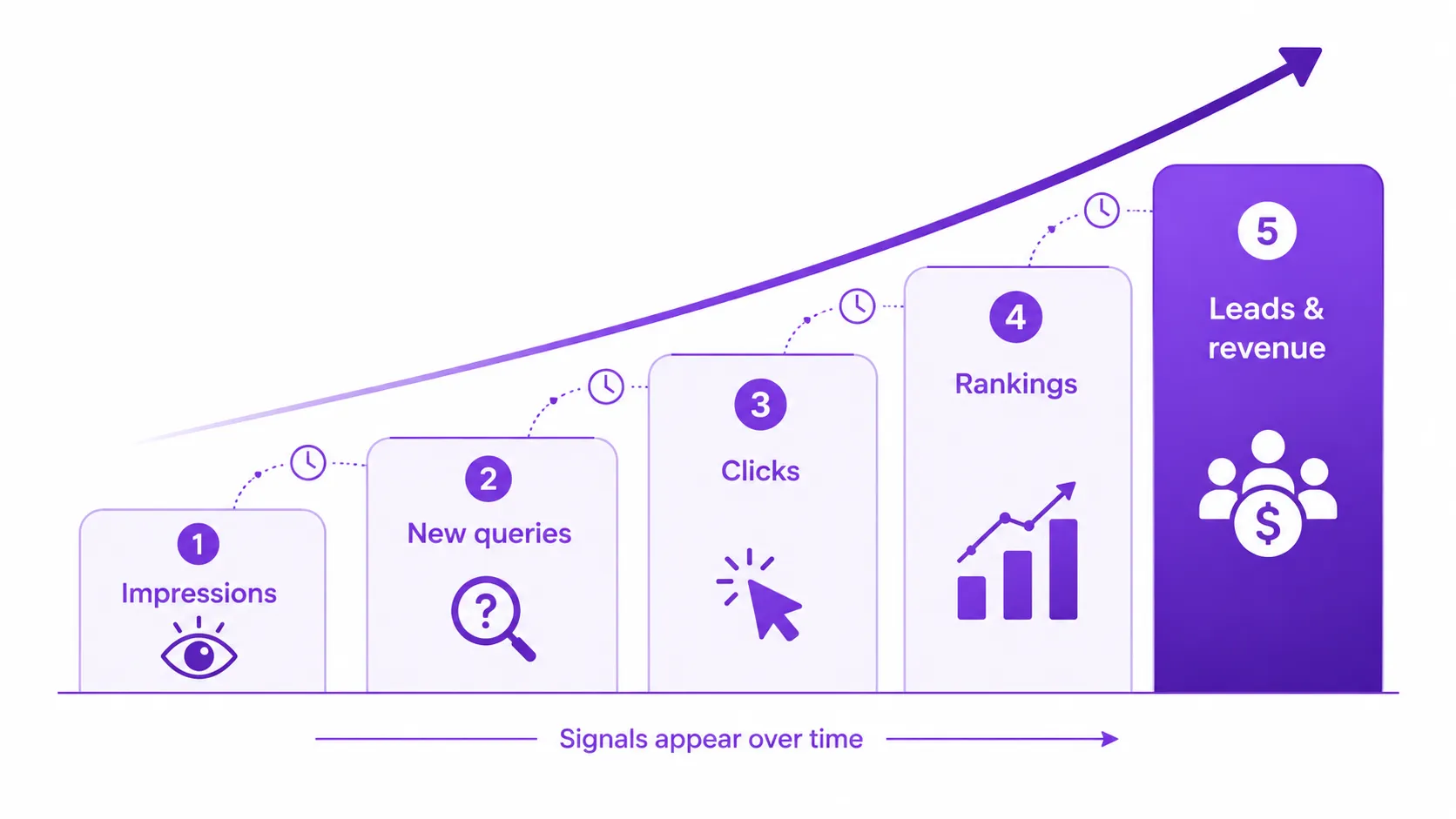
Notice also that “results” appear in a specific order: impressions rise first, then clicks, then rankings climb, then leads and revenue follow. If you only watch for the final outcome (sales), you will feel like nothing is happening for months while, in reality, the leading indicators are moving in the right direction the whole time.
Timelines by Site Type
Because the single biggest factor is your starting point, it helps to see how the timeline shifts for different kinds of sites. These are realistic ranges, not guarantees, but they show why one blanket number never fits everyone.
| Type of site | Typical timeline | Why |
|---|---|---|
| Brand-new domain, no history | 6–12 months | No trust, backlinks, or behavioural data yet; must prove legitimacy first. |
| Established site, some authority | 4–8 weeks to a few months | Existing trust means new optimisation work is rewarded faster. |
| Local business with Google Business Profile | 3–6 months (map results often sooner) | Local competition is lower; citations and reviews build local trust quickly. |
| Low-competition or niche site | 3–6 months | Fewer competitors chasing the same terms means quicker visibility. |
| Ecommerce or highly competitive niche | 6–12 months or more | Many strong competitors and large page counts extend the timeline. |
The practical lesson is to judge your own timeline against the right benchmark. If you are a brand-new site in a competitive niche, expecting results in three months will only lead to frustration and premature quitting. If you are an established local business, you may see meaningful movement much sooner than the generic “six months” figure suggests. Knowing which row you fall into is the difference between realistic patience and needless worry.
Part of the frustration with SEO comes from watching the wrong metric. If you judge success only by “am I number one yet,” you will feel stuck for months even while real progress is happening. The trick is to watch the leading indicators that move first, in the order they move.
What 'SEO Working' Actually Looks Like
| Signal | What it tells you |
|---|---|
| Impressions rising | Google is starting to show your pages for more searches. The earliest positive sign. |
| New queries appearing | Your pages are being matched to more search terms, a sign of growing relevance. |
| Clicks increasing | Your titles and descriptions are earning the click, and traffic is beginning. |
| Average position improving | Your rankings are climbing, even if not yet on page one. |
| Leads and revenue | The lagging indicator that ultimately matters, and the last to move. |
If impressions are rising but clicks are not, your titles and meta descriptions likely need work. If clicks rise but leads do not, your pages may be attracting the wrong visitors or failing to convert. Reading these signals in order tells you not just whether SEO is working, but exactly where to focus next. This is also why setting up measurement from day one matters so much: without a baseline, you cannot see the early progress that keeps you motivated through the slow months.
The Factors That Speed SEO Up or Slow It Down
Why does one site rank in three months while another takes a year? The timeline is driven by a handful of factors. Understanding them tells you both what to expect and what you can influence.
Domain age and history.
An established site with a clean track record moves faster than a brand-new domain with no history. This is the single biggest factor, and the one you cannot rush.
Competition in your niche.
Ranking for “local bakery in a small town” is far faster than “best CRM software.” The more competitors chasing a term, the longer it takes.
Content quality and consistency.
Publishing substantial, helpful content regularly (a few quality pieces a month) accelerates indexing and authority. Sporadic, thin content slows everything.
Backlink profile.
Quality links from credible sites remain a top ranking signal. Earning a few genuine ones speeds trust-building.
Technical health.
A slow site, crawl errors, or pages blocked from indexing act as silent brakes, no matter how good your content is.
Local vs national.
Local SEO and Google Business Profile optimisation often show results in weeks, especially in less competitive markets, far faster than national campaigns.
The pattern across all of these is clear: you cannot skip the trust-building process, but you can stack the odds in your favour. Fix technical issues early, start with lower-competition keywords, publish consistently, and earn genuine links. Do those, and you land at the faster end of the range rather than the slower end.
How to Get Faster SEO Results (Safely)
You cannot cheat the timeline, but you can accelerate within it, as long as you avoid shortcuts that carry penalty risk. Anything promising page-one rankings in thirty days is either targeting terms nobody searches or using tactics that collapse just as fast as they appear.
1. Fix technical foundations first.
Remove crawl blocks, fix speed, and ensure your key pages are indexable before anything else.
2. Start with low-competition, long-tail keywords.
These rank sooner and bring early wins that build momentum.
3. Publish consistently.
A steady cadence of quality content signals an active, authoritative site and speeds crawling.
4. Improve existing pages.
Refreshing and strengthening pages you already have often produces faster gains than starting from scratch.
5. Match search intent precisely.
Give searchers exactly the type of page they want, so Google has less reason to rank a competitor above you.
6. Earn a few credible links.
Genuine links from relevant sites accelerate the trust that rankings depend on.
These are the same fundamentals that turn SEO from a slow gamble into a predictable growth channel over time. If you want to understand how that connects to actual leads and revenue rather than just rankings, our guide on SEO marketing for beginners ties the timeline to real business outcomes.
What to Do While You Wait for SEO to Work
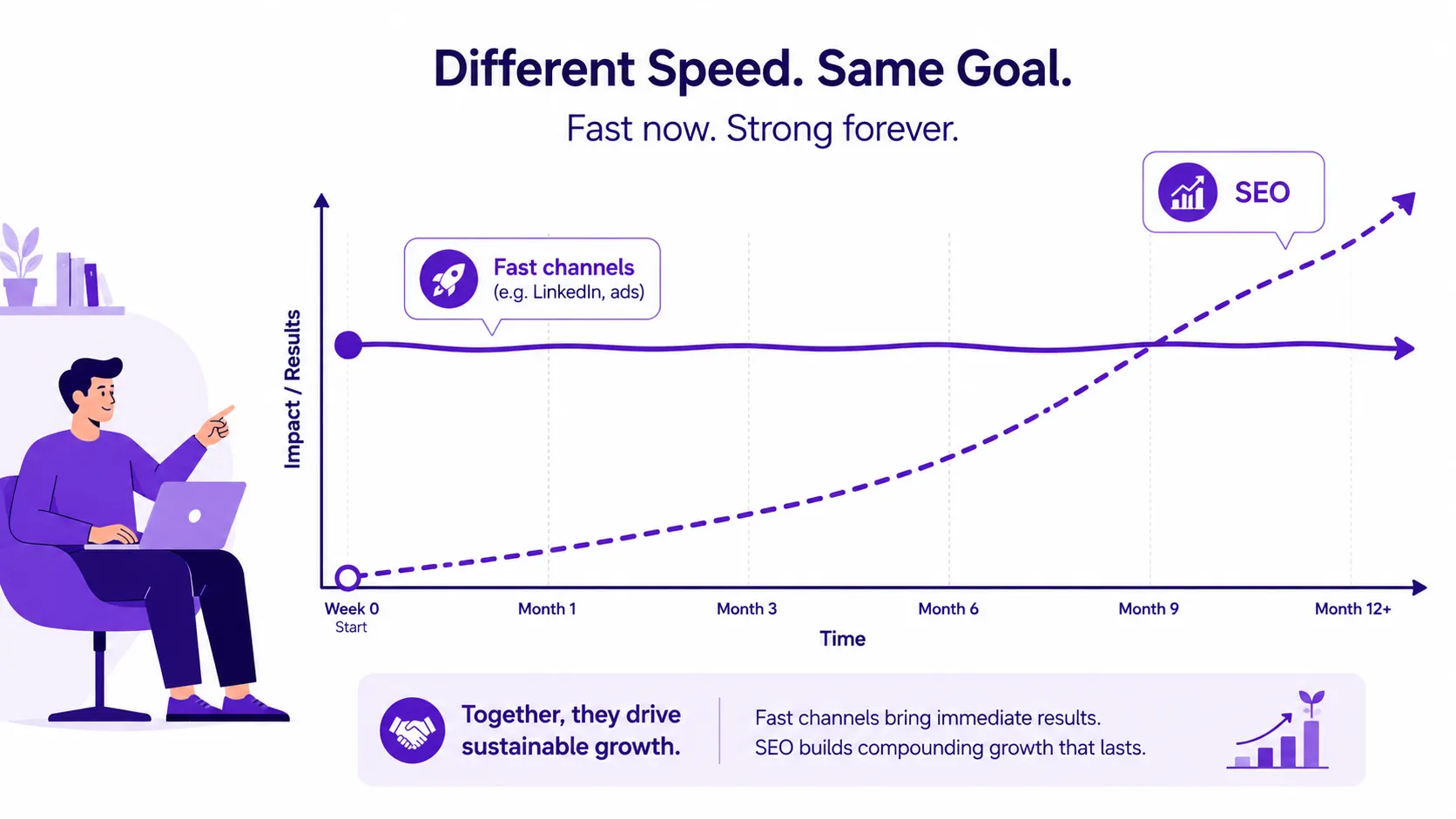
Here is the practical reality: SEO is the right long-term investment, but it is slow, and most businesses cannot afford to simply wait six months for their first lead. The smart approach is to run a faster channel alongside SEO so you have cash flow and customers now, while your organic search asset builds in the background.
Paid channels are the obvious complement, since they deliver traffic immediately while SEO matures. For B2B and service businesses in particular, one of the most effective fast channels is LinkedIn lead generation, which reaches decision-makers directly and can produce qualified enquiries within days rather than months. Pairing a fast channel like this with a patient SEO strategy gives you the best of both: immediate results now and compounding, lower-cost results later.
The mindset shift is to stop seeing SEO and faster channels as competitors and start seeing them as a portfolio. Fast channels carry you through the SEO waiting period; SEO gradually reduces how much you need to rely on paid traffic. Businesses that combine the two rarely feel the pain of the SEO wait, because leads are arriving from elsewhere while the organic engine warms up.
SEO Timelines in 2026: What AI Search Changes
One important update for 2026: “SEO working” no longer means only ranking blue links. AI Overviews now sit at the top of many results, and answer engines like ChatGPT and Perplexity summarise information directly. This means results can now show up as citations and mentions in AI answers, sometimes before you rank number one in the traditional sense. You might be winning visibility before you ever hit the top of the classic results.
The encouraging part is that the timeline for AI visibility follows the same logic: it rewards clear, well-structured, trustworthy content, which is exactly what earns traditional rankings. Optimising for both at once is not two jobs; it is one. This is where the newer discipline of AI SEO services comes in, making sure your content is structured to be surfaced and cited by AI engines as well as ranked by Google. The businesses that adapt early to this shift build an even more durable advantage.
None of this changes the core timeline, though. Whether the goal is a top ranking or an AI citation, the underlying trust and quality signals still take months to accumulate. AI search adds new ways to win, but it does not offer a shortcut around the fundamental patience SEO requires.
Common Reasons SEO Takes Longer Than Expected
If your SEO feels slower than the timelines above, it is usually one of these, and most are fixable.
Weak technical foundation. If
Google cannot crawl or index your site properly, everything stalls.
Inconsistent effort.
Trying SEO for two months, stopping, then restarting almost never works. Consistency beats bursts.
Targeting keywords that are too competitive.
A new site chasing head terms will wait a very long time.
Thin or mismatched content.
Pages that do not fully answer the search intent will not rank no matter how long you wait.
No links or authority signals.
Without any credible sites referencing you, trust builds very slowly.
If you have been at it for six to nine months with proper effort and see no movement at all, that is the point to audit your strategy, site health, and keyword choices, rather than simply waiting longer. Genuine SEO is slow, but total silence after nine months of real work usually signals a fixable problem, not just the need for more patience.
Want to learn the fundamentals while you wait?
Understanding SEO yourself makes the wait far less frustrating, because you can read the early signals and know your effort is working. If you want a genuinely free way to build that knowledge, our roundup of the best free SEO courses for beginners points you to the strongest options, several with certificates.
Conclusion: Patience, With a Plan
So, how long does it take for SEO to work? Realistically, three to six months for measurable results and six to twelve months for significant, compounding growth, with newer sites at the longer end. The wait is not a flaw; it is the price of a system that rewards genuine quality and trust over shortcuts. The businesses that win with SEO are rarely the ones that found the fastest hack. They are the ones that stayed consistent the longest.
The best approach is patience with a plan: fix your foundations, start with achievable keywords, publish consistently, watch the leading indicators, and run a faster channel alongside so you are not waiting empty-handed. Do that, and SEO stops feeling like a gamble and starts feeling like what it truly is, a compounding asset that keeps paying off long after the work is done. The best time to start building it was months ago; the second best time is today.
Frequently Asked Questions
How long does it take for SEO to work?
Most websites start seeing measurable SEO results in three to six months, with stronger, compounding gains between six and twelve months. New sites take longer, often six to twelve months, because search engines need time to build trust in a new domain.
Why does SEO take so long to work?
Search engines rank pages based on trust, which cannot be built instantly. Google must discover, crawl, index, and evaluate your pages against competitors, and assess how users and other sites respond over time. That process is deliberately gradual to prevent manipulation.
How long does SEO take for a new website?
A brand-new website usually takes six to twelve months to gain meaningful organic traction, because it has no history, backlinks, or behavioural data. Google needs time to establish trust before rewarding it with rankings.
How long does SEO take for a new website?
A brand-new website usually takes six to twelve months to gain meaningful organic traction, because it has no history, backlinks, or behavioural data. Google needs time to establish trust before rewarding it with rankings.
Can SEO work faster than six months?
Sometimes. Established sites with existing authority can see movement in four to eight weeks, and local SEO or low-competition, long-tail keywords can produce results within a few weeks to a couple of months. Competitive terms take much longer.
How do I know if my SEO is working?
Watch the leading indicators in Google Search Console: rising impressions first, then new queries, then clicks, then improving average position. Leads and revenue move last. Progress in impressions is an early sign SEO is working even before rankings climb.
Is it normal for rankings to go up and down?
Yes. A new page often appears, drops, then climbs again as Google gathers data on how users interact with it. This volatility is a normal part of the evaluation process, not a sign that something is wrong. Judge progress month over month.
What should I do while waiting for SEO to work?
Run a faster channel alongside SEO, such as paid ads or LinkedIn lead generation, so you get leads immediately while your organic search asset builds. This removes the pain of the SEO waiting period and gives you cash flow now.
Want a realistic SEO timeline for your specific site, plus faster wins while it builds?
Book a free consultation with UnoSearch.
Get Free ProposalReferences
- Google Search Central, SEO Starter Guide, developers.google.com
- Ahrefs, How Long Does It Take to Rank in Google? (study), ahrefs.com
- Google Search Console, google.com/search-console

Social Media Marketing for E-Commerce: From Reach to Revenue
Posting product photos and hoping for sales is not a strategy. Social media marketing for e-commerce works when you build it the same way you build any other growth channel: with a clear budget, the right platforms, and numbers you can actually measure. This guide...

PPC for E-Commerce: A Profit-First Guide to Paid Ads That Pay Off
Every click on your ad costs money. So the goal is not more clicks. The goal is clicks that turn into profit. PPC for e-commerce puts your products in front of shoppers who are ready to buy. Done well, e-commerce pay per click brings fast, measurable sales. Done...

SEO for Lawyers: How to Get Found by Clients on Google
SEO for lawyers is the practice of improving your website so your firm can appear when people search Google for legal help. Most people looking for legal assistance begin their search online, and firms that appear prominently in those results are more likely to...