
SEO Marketing for Beginners: Connecting SEO to Business Growth
Wondering how SEO actually grows a business, not just its traffic? This beginner’s guide connects SEO to real outcomes: leads, sales, and lower marketing costs. Learn how organic search fits your marketing, why it beats relying on ads alone, and how to measure what matters.
Looking for an SEO agency?
UnoSearch helps brands rank higher and drive real organic growth.
Get Free Proposal1. What SEO Marketing Means
2. Why SEO Is Powerful
3. How SEO Drives Leads
4. Keywords & Buyer Journey
5. SEO vs Paid Marketing
6. Measuring What Matters
7. A Beginner’s Plan
8. Common Mistakes
9. Who It Works For
10. How Long It Takes
11. Conclusion
12. FAQs

From 4 referral leads a month to 312 inbound consultation requests Content-Led SEO, LinkedIn B2B Lead Generation, and Google Search Ads.
SEO marketing is using search engine optimization as a channel to grow your business, not just your traffic. Done right, it turns organic search into a steady source of leads and sales that compounds over time and lowers your cost per customer. This guide shows beginners how SEO connects to real business growth and how to measure it.
Most beginners learn SEO as a set of tactics: keywords, titles, links. That is useful, but it misses the point that matters most to a business owner. SEO is not an end in itself. It is a marketing channel, and like any channel, it only counts if it brings customers. This guide is about that connection, how the technical work of SEO turns into leads, sales, and sustainable growth.
If you are brand new and still want the plain definition of the term first, read our short explainer on what is SEO. Here, we assume you roughly know what SEO is, and we focus on the question a business owner actually cares about: how does it grow my business?
What SEO Marketing Actually Means
SEO marketing is the practice of using organic search as a channel to attract, convert, and retain customers. The distinction from plain SEO is subtle but important. Plain SEO asks, how do I rank this page? SEO marketing asks, how does ranking this page bring me customers and revenue? One is a tactic; the other is a strategy with a business goal attached.
Think of it this way. A florist could rank number one for a term nobody searches, or for a term searched only by people who will never buy. That is SEO without marketing thinking. SEO marketing instead starts from the business: who are my customers, what do they search when they are ready to buy, and how do I make sure they find me at that moment. The tactics are the same, but the aim is a customer, not a ranking.
This shift in thinking is what separates SEO that quietly grows a business from SEO that produces impressive-looking reports and no revenue. Traffic is a means, not the goal. When you treat SEO as marketing, every decision, which keywords to chase, which pages to build, what content to write, gets filtered through one question: will this bring the right people, at the right moment, ready to act?
Expert insight:“The biggest mistake I see SEOs make is chasing rankings and traffic instead of revenue. What matters is if SEO drives qualified leads, reduces customer acquisition costs, or increases brand awareness in your target market.”
Backlinko, on building an SEO strategy
Why SEO Is Such a Powerful Marketing Channel
Every marketing channel has a shape. Paid ads are fast but stop when the money stops. Social builds community but rarely drives ready-to-buy intent. Email is powerful but only reaches people who already know you. SEO has a shape that makes it uniquely valuable for long-term growth: it reaches people at the exact moment they are searching for what you offer, and it compounds.
The intent is the first advantage. Someone typing “emergency plumber near me” or “best CRM for small business” is not being interrupted by your marketing; they are actively looking for it. That is fundamentally different from an ad that catches someone mid-scroll. Search captures demand that already exists, which is why organic leads often convert at a higher rate and lower cost than interrupt-based channels.
The second advantage is compounding. A paid ad is like renting a stage: you pay for every second you are on it, and the moment you stop, you are gone. A ranking page is like owning the stage. Once it earns its position, it keeps drawing visitors month after month with no per-click cost. Over time, that turns a marketing expense into a business asset, which is exactly why Entrepreneur describes strong SEO as something that “works while you’re sleeping and lowers your customer acquisition cost over time.”
There is also a trust dividend. People know ads are paid for, but a high organic ranking looks earned. Appearing at the top of the unpaid results signals to searchers that Google considers you a credible answer, and that credibility carries into how they perceive your business before they have even clicked. Few other channels give you authority and traffic at the same time.
These advantages stack in a way that is easy to underestimate. High intent means the visitors are more likely to buy. Compounding means the cost of reaching them falls over time. Trust means they arrive already predisposed to believe you. Put together, a single well-ranked page can quietly become one of the most profitable assets a business owns, generating enquiries year after year for a one-time investment of effort. That is why experienced marketers describe SEO not as a cost line but as an asset on the balance sheet, something that keeps returning value long after the work that created it is done.
How SEO Turns Into Leads and Sales
This is the part beginners most often miss. Ranking is not the finish line; it is the start of a chain that ends in a customer. Understanding that chain is what makes SEO a marketing channel rather than a vanity project. It runs in four stages.
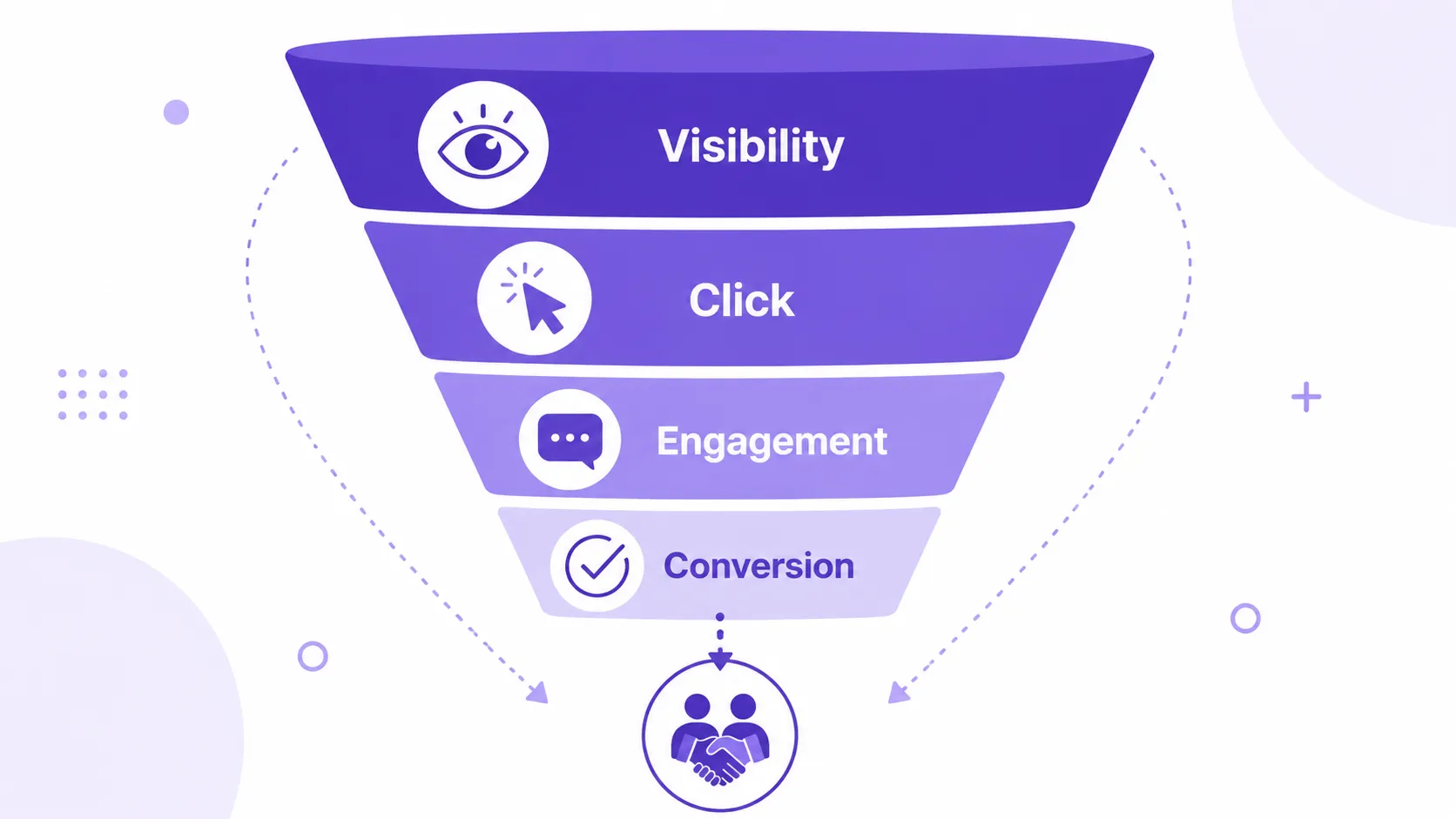
| Stage | What happens |
|---|---|
| 1. Visibility | Your page ranks for a term your ideal customer searches, so they see you at the moment of need. |
| 2. Click | A clear, relevant title and description earn the click over competing results. |
| 3. Engagement | The page answers their question and builds enough trust that they want to go further. |
| 4. Conversion | A clear next step (call, form, purchase) turns the visitor into a lead or sale. |
A page can rank beautifully and still fail at stage four if there is no clear next step, or fail at stage three if the content disappoints. That is why SEO marketing cares about the whole chain, not just the ranking. A high-ranking page with no call to action is like a busy shop with no till: plenty of visitors, no sales.
The practical implication is that the pages you prioritise matter enormously. A blog post that ranks for a broad informational term brings traffic but few direct sales. A service page that ranks for “[your service] in [your city]” brings fewer visitors but far more customers, because those searchers are ready to buy. SEO marketing means deliberately choosing to rank for the terms that sit closest to a purchase, then making sure the page converts once they arrive.
A concrete example makes this vivid. Imagine a small law firm that specialises in helping small businesses. It could pour effort into ranking a blog post for “what is a limited company,” a term with huge search volume. That post might attract thousands of visitors a month, but almost none of them are ready to hire a lawyer; they are students, curious founders, and researchers. Now imagine the same firm instead ranks its service page for “business lawyer for small companies in [city].” That term has a fraction of the volume, but nearly everyone searching it has a real, immediate need and the intent to hire. Ten visitors from the second page can be worth more than a thousand from the first. That is the entire difference between SEO and SEO marketing in one comparison: one optimises for traffic, the other for customers.
Matching Keywords to the Buyer’s Journey
Not all searches are equal, and understanding why is the heart of SEO marketing. People search differently depending on how close they are to buying, and matching your content to that stage is what turns traffic into revenue. There are broadly three stages.
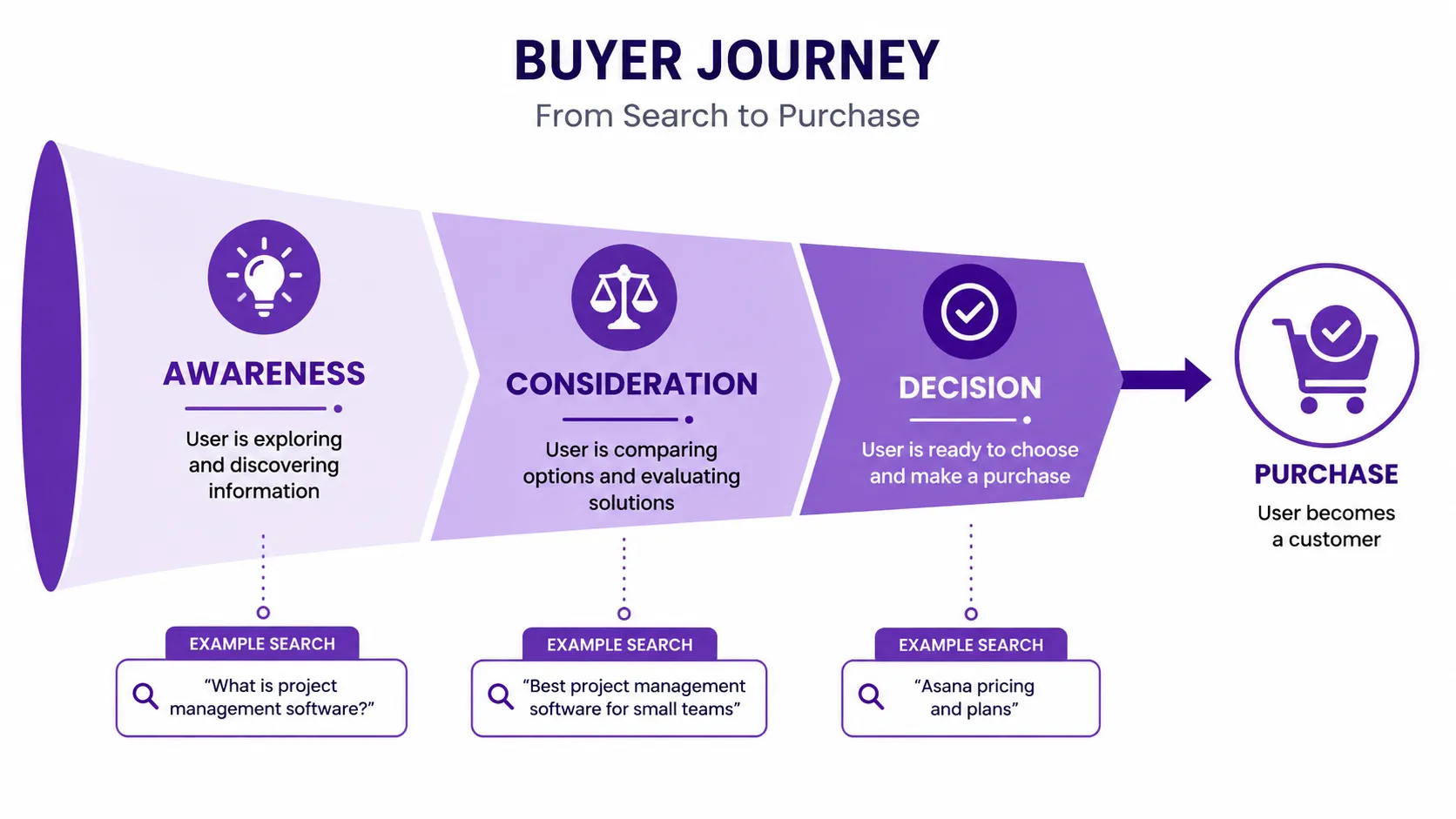
Awareness (top of funnel):
The searcher has a problem but does not know the solution yet. “why is my website slow.” Content here builds trust and captures people early.
Consideration (middle):
They are comparing options. “best website speed tools” or “managed hosting vs shared hosting.” Content here positions you as a strong choice.
Decision (bottom of funnel):
They are ready to act. “hire website speed optimization service” or “[service] near me.” These searches are the closest to revenue.
A common beginner mistake is to chase only high-volume awareness keywords because they bring the most traffic, then wonder why the traffic does not convert. The smarter approach is to secure your decision-stage keywords first, since they bring customers even at low volume, then build awareness and consideration content to feed the top of the funnel. A handful of well-ranked bottom-of-funnel pages can be worth more to a business than thousands of untargeted visitors.
If you are still learning how to find and choose these keywords in the first place, the step-by-step order is laid out in our guide on search engine optimization for beginners: where to start, which walks through keyword research and intent before you write a single page.
SEO Marketing vs Paid Marketing
Beginners often frame this as a choice: SEO or ads. In reality, the two do different jobs, and the smartest marketing uses them together. Understanding the trade-offs helps you decide where to put your effort and budget.
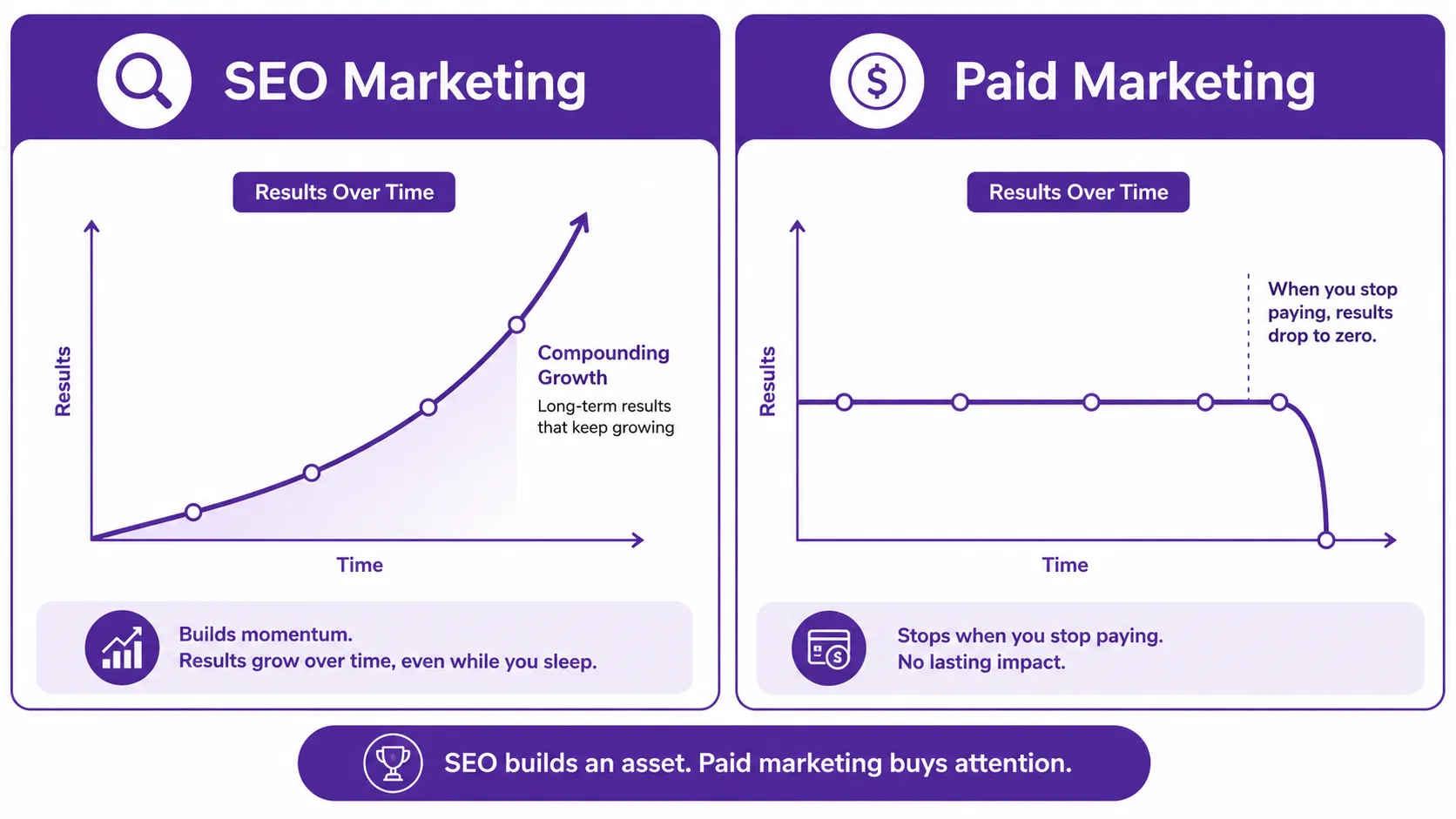
The honest way to use both: run ads when you need traffic now, when you are testing a new offer, or when you want to appear for a term you cannot yet rank for organically. Meanwhile, invest in SEO as the long-term engine that gradually reduces how much you need to spend on ads. Many businesses use paid search to test which keywords convert, then build SEO content around the winners. The channels feed each other rather than compete.
The strategic mistake is treating them as either/or forever. Relying only on ads means your traffic vanishes the day you pause spending, leaving you renting your entire customer base. Relying only on SEO means you miss fast opportunities and early traction. A beginner does not need to master both at once, but should understand that SEO is the asset you are building while ads are the lever you can pull for speed.
Measuring What Actually Matters
Here is where most beginner SEO marketing goes wrong: measuring the wrong things. It is easy to celebrate rising rankings and traffic, but those are means, not ends. If SEO is a marketing channel, it has to be judged by business outcomes, not vanity metrics.
The metrics that actually reflect business value are simple. Track your organic traffic, yes, but more importantly track the leads that come from organic search, and the revenue those leads produce. As Entrepreneur’s small-business SEO guide puts it, if organic traffic increases but leads do not, you may be ranking for the wrong terms; if leads increase but few close, your messaging may be misaligned. Those diagnostics are only possible if you are measuring outcomes, not just positions.
A practical measurement setup for a beginner needs just a few free tools. Google Search Console shows what you rank for and which queries bring clicks. Google Analytics shows what visitors do once they arrive and whether they convert. Set one clear, business-focused goal before you start, something like “generate a set number of qualified enquiries per month from organic search,” rather than the vague “rank higher.” A real target is what turns SEO from an activity into an accountable channel.
It also helps to watch a small set of leading and lagging indicators together. Impressions and rankings are leading indicators: they move first and tell you whether your visibility is growing. Clicks and traffic come next. Leads and revenue are the lagging indicators that ultimately matter, but they move last, so judging SEO only by them in the early months can be misleading. A healthy pattern is rising impressions in month one or two, rising clicks by month three or four, and rising enquiries by month four to six. If impressions climb but clicks do not, your titles and descriptions need work. If clicks climb but enquiries do not, your pages are attracting the wrong visitors or failing to convert. Reading these signals together tells you not just whether SEO is working, but exactly where to fix it.
A Beginner’s SEO Marketing Plan
Pulling it together, here is how a beginner should approach SEO as a marketing channel rather than a checklist. This is a way of thinking, not a rigid script.
1. Start from the business, not the keyword.
Define what a win looks like: more enquiries, more bookings, more sales of a specific service.
2. Map your customers’ searches
Identify the terms they use at each stage, especially the decision-stage terms closest to buying.
3. Prioritise pages that convert.
Optimise your core service and product pages first, since they turn visits into customers
4. Make every page convert.
Ensure each page has a clear, single next step so visits become leads.
5. Measure outcomes, then improve.
Track leads and revenue, and double down on what works.
Turning this plan into daily action is exactly what our 30-day action plan is built for, if you want a structured way to execute it in your first month.
Common SEO Marketing Mistakes Beginners Make
Knowing the traps saves time and money. These are the ones that most often stop SEO from turning into growth.
Chasing traffic instead of customers.
Ranking for popular but irrelevant terms brings visitors who never buy.
Ignoring conversion.
Sending traffic to pages with no clear next step wastes every ranking you earn.
Measuring only rankings.
A page-one position means nothing if it does not produce conversions.
Expecting instant results.
SEO compounds over months; quitting early forfeits the payoff just before it arrives.
Treating SEO as separate from marketing.
SEO works best woven into your wider marketing, not run in a silo.
Skipping the learning step.
Jumping in without understanding the basics leads to wasted effort on the wrong things.
That last point is worth a note. You do not need to become an expert before you start, but a few hours of structured learning pays for itself many times over. If you want a genuinely free way to build that foundation, our roundup of the best free SEO courses for beginners points you to the strongest options.
Who SEO Marketing Works Best For
SEO marketing is not equally valuable for every business, and being honest about that is part of using it well. It works best when your customers actively search for what you offer, and when the value of a customer justifies the time it takes to rank. For most businesses, both of those are true, which is why SEO is so widely used, but it helps to see where it shines brightest.
Local service businesses are among the biggest winners. A plumber, dentist, law firm, or salon lives on “near me” and city-based searches, and local SEO lets even a one-person business appear ahead of national brands in its own area. The searches are high-intent (someone looking for an “emergency electrician” is ready to call now), and the competition is local rather than global, which makes ranking achievable. For these businesses, SEO marketing is often the single highest-return channel available.
Businesses with a clear online buying or enquiry process also benefit strongly: online stores whose products people search for, service companies that take enquiries through a form, and SaaS or consulting businesses whose buyers research solutions before choosing. In each case, search captures demand at the exact moment it forms. The businesses that get less from SEO are those whose customers never search for them, or who need sales tomorrow rather than in six months. Even then, SEO is usually worth starting in parallel, because the asset it builds keeps compounding while other channels handle the short term.
How Long Before SEO Marketing Pays Off?
Since SEO marketing is an investment, the natural question is when it returns. For most businesses, meaningful results begin within three to six months, with stronger, compounding gains between six and twelve months, and newer sites sitting at the longer end. We break down the reasons and how to set expectations in how long does SEO take to show results.
It is worth reframing that timeline as a feature, not a flaw. The reason SEO takes months is the same reason it lasts: search engines are cautious about trusting new content, so trust is earned gradually and then holds. Unlike ads, where the return disappears the instant you stop paying, SEO builds an asset whose returns grow over time. The businesses winning in search today started months or years ago; the best time to begin building that asset is now.
How UnoSearch approaches SEO marketing
UnoSearch is a Google Premier Partner with over a decade of search experience, and our whole approach is built on the idea in this guide: SEO is a growth channel, judged by leads and revenue, not vanity metrics. We work across SEO, local SEO, and the newer GEO and AEO disciplines that decide whether AI tools recommend a business. Whether you learn it yourself or bring in help, the principle is the same, tie every bit of SEO back to a business outcome.
Conclusion: SEO Is Marketing, Not Just Rankings
The shift that turns a beginner into an effective SEO marketer is simple to state and powerful in practice: stop chasing rankings and start chasing customers. SEO marketing means using organic search deliberately to bring the right people to the right pages at the right moment, then converting them and measuring the result in leads and revenue. Get that mindset right and every tactic falls into place. For the complete foundation behind these ideas, our main SEO for beginners guide ties the whole picture together.
You do not need a big budget or a technical background to begin. You need to treat SEO as what it truly is: one of the most durable, cost-effective marketing channels available, an asset that keeps working long after the work is done. Pick one high-intent page that matters to your business, make it genuinely useful, give it a clear next step, and start measuring the leads it brings. That single step is the beginning of SEO that actually grows a business.
Frequently Asked Questions
What is SEO marketing?
SEO marketing is using search engine optimization as a channel to grow your business, not just your traffic. It focuses on attracting the right searchers, converting them into leads or sales, and measuring the result in business outcomes rather than rankings alone.
How does SEO help a business grow?
SEO brings people to your site at the moment they are searching for what you offer, and a ranking page keeps doing so over time with no per-click cost. That compounding, high-intent traffic turns into leads and sales while lowering your customer acquisition cost.
Is SEO marketing better than paid ads?
They do different jobs. Ads deliver instant traffic but stop when you stop paying; SEO takes months but compounds into a lasting asset. Most businesses use both, ads for speed and testing, SEO as the long-term growth engine.
How do I measure if SEO marketing is working?
Track leads and revenue from organic search, not just rankings and traffic. Use Google Search Console and Google Analytics, and set a clear business goal such as a target number of qualified enquiries per month from organic search.
Do I need a big budget for SEO marketing?
No. Much of SEO can be done yourself with free tools, and small, focused sites regularly out-rank larger competitors on specific high-intent terms. The main investment is time and consistency rather than money.
How long does SEO marketing take to work?
Most businesses see meaningful results in three to six months, with stronger, compounding gains between six and twelve months. Newer sites take longer because they start with less authority.
Can SEO marketing work for a small local business?
Yes, often exceptionally well. Local SEO lets a small business appear for “near me” and city-based searches, capturing ready-to-buy customers in its area and competing with much larger brands on its home turf.
Want SEO that’s measured in leads, not just rankings?
Book a free consultation with UnoSearch.
Get Free ProposalReferences
- Google Search Central, SEO Starter Guide, developers.google.com
- Entrepreneur, A Beginner-Friendly SEO Guide for Small Businesses, entrepreneur.com
- Backlinko, How to Create an Effective SEO Strategy, backlinko.com
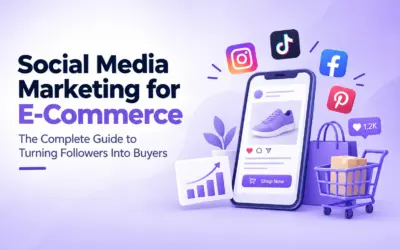
Social Media Marketing for E-Commerce: From Reach to Revenue
Posting product photos and hoping for sales is not a strategy. Social media marketing for e-commerce works when you build it the same way you build any other growth channel: with a clear budget, the right platforms, and numbers you can actually measure. This guide...
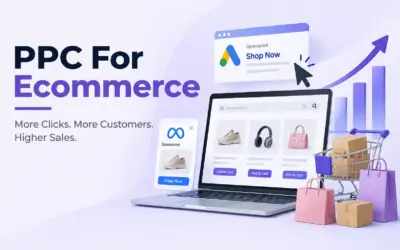
PPC for E-Commerce: A Profit-First Guide to Paid Ads That Pay Off
Every click on your ad costs money. So the goal is not more clicks. The goal is clicks that turn into profit. PPC for e-commerce puts your products in front of shoppers who are ready to buy. Done well, e-commerce pay per click brings fast, measurable sales. Done...
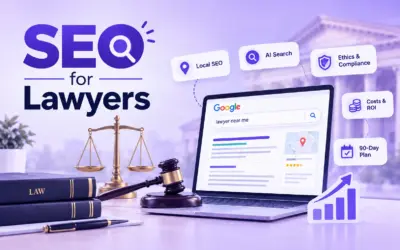
SEO for Lawyers: How to Get Found by Clients on Google
SEO for lawyers is the practice of improving your website so your firm can appear when people search Google for legal help. Most people looking for legal assistance begin their search online, and firms that appear prominently in those results are more likely to...