
What is SEO? A Beginner Guide To Understand
New to SEO and wondering what it actually means? This beginner guide explains what is SEO, how search engines find and rank pages, the four main types, and why it matters more than ever in 2026. No jargon, just clear answers.
Looking for an SEO agency?
UnoSearch helps brands rank higher and drive real organic growth.
Get Free Proposal
How UnoSearch took SparkPoint from Page 4 to Page 1, 8 to 86+ leads, and $180K in new contracts
If you have heard the term SEO thrown around and quietly wondered what it actually means, this guide is for you. No jargon, no assumptions, no pressure to already know the basics. By the end, you will understand what SEO is, how it works, the main types, and why so many businesses treat it as one of their most valuable marketing channels.
If you are looking for the full step-by-step playbook once the concept clicks, that lives in our complete SEO for beginners guide. Here, we focus only on answering one question properly: what is SEO?
What SEO Means?
The key word is optimization, which simply means improvement. You are improving your website, its content, and its technical setup so it lines up with what search engines are looking for and what searchers actually want. Google itself describes SEO plainly: it is about helping search engines understand your content, and helping users find your site and decide whether to visit it. That is the whole idea in one sentence.
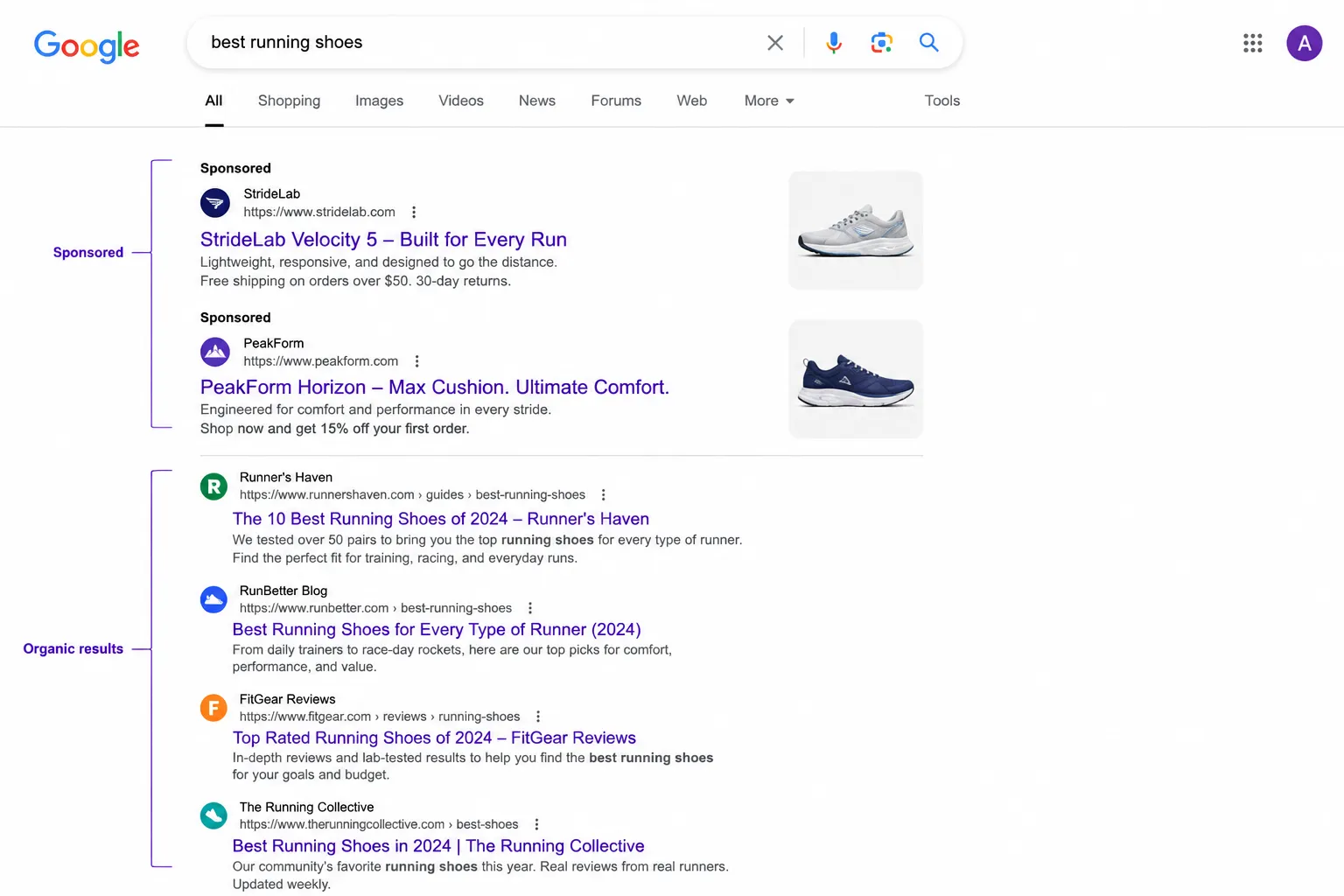
One distinction matters from the start. The results SEO improves are the unpaid ones, called organic results. They are the listings Google shows because it judged them genuinely relevant, not because someone paid for the spot. The paid listings, the ads at the top of the page, are a separate channel. SEO is how you earn a place among the organic results through merit rather than budget.
A useful one-line definition to hold onto: SEO is making your site easy for search engines to find, understand, and rank. Everything else in this guide is just an explanation of those three words: find, understand, rank.
Why It Is Called Organic?
Beginners often get confused by the word organic, so it is worth clearing up. In search, organic simply means unpaid or earned. An organic result is one that ranks because Google decided it deserved to, based on relevance and quality, not because money changed hands.
The opposite is paid search, where advertisers bid to appear at the top of the results and pay each time someone clicks. Both can appear on the same page, but they work completely differently. Paid traffic stops the moment you stop paying, while organic traffic, earned through SEO, can keep arriving month after month with no per-click cost.
That durability is a big part of why SEO is so valued. A page that climbs into the top results becomes a quiet, compounding asset: it keeps working while you sleep, and the cost of each new visitor effectively drops over time. The catch is that this payoff builds gradually rather than appearing overnight, which is why expectations matter so much; we cover that timeline in how long does SEO take to show results. Understanding the organic-versus-paid distinction is fundamental, because it explains both why SEO takes patience and why it is worth the wait
How Search Engines Actually Work
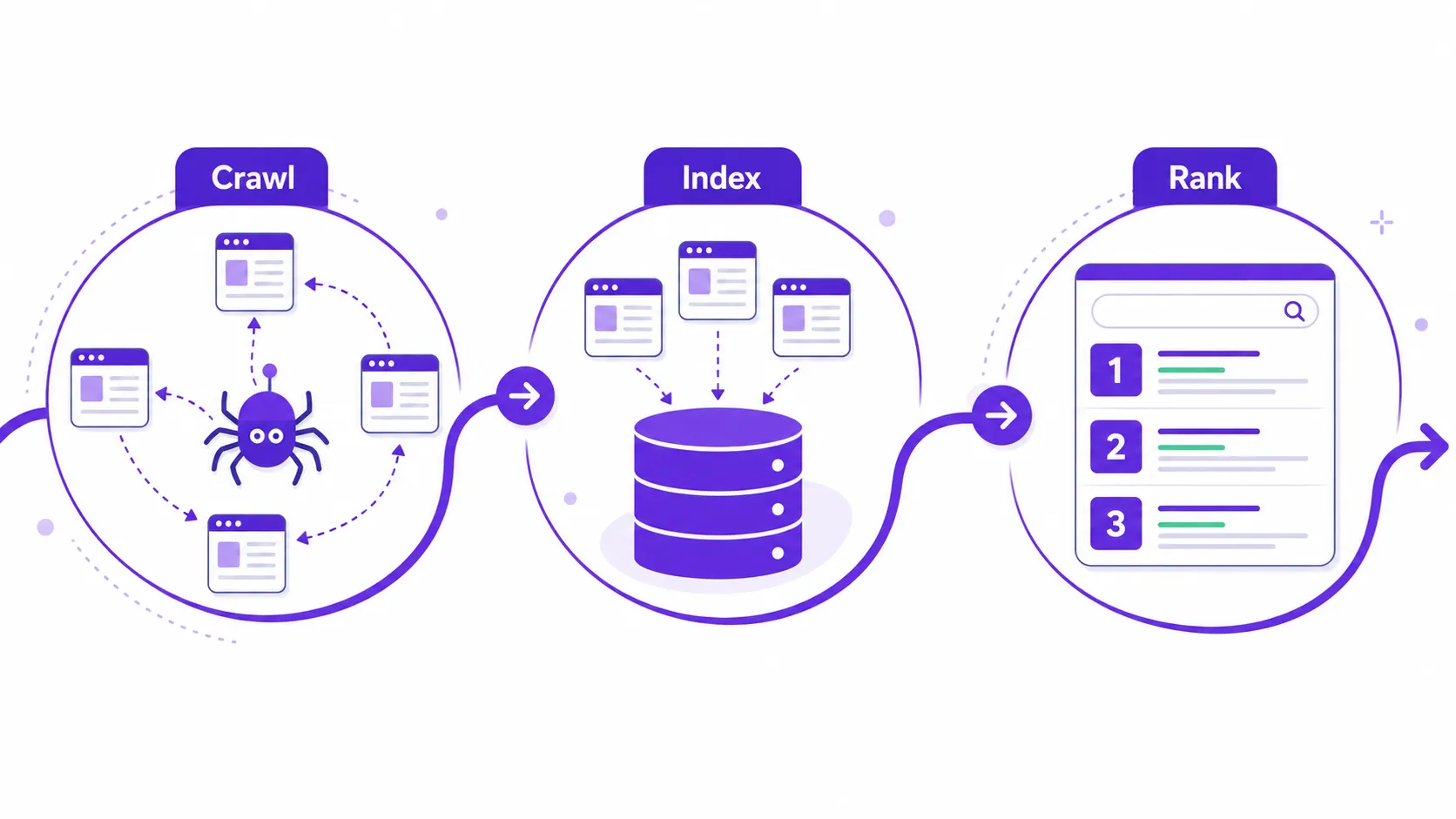
To understand SEO, you first need a simple picture of how a search engine works. Every major one, Google included, runs on the same three-step process. Think of Google as a librarian for the entire internet.
- Google sends out automated programs, called crawlers or bots, that travel the web by following links from page to page, discovering content as they go. Think of it as a librarian walking through the shelves to discover which books are available. If no page links to yours and you never tell Google it exists, the crawler may never find it, which is why links and sitemaps matter. For a deeper look at what you can expect to invest in this process, see our guide to [link building cost in India].
- The content the crawlers find is analyzed and stored in a vast database called the index. This is the librarian cataloguing each book so it can be found later. A page that is not indexed simply cannot appear in search results at all. Pages can fail to get indexed for ordinary reasons, such as being accidentally blocked, being too thin, or duplicating content that already exists elsewhere.
- When someone searches, Google scans its index and orders the results from most to least useful for that specific query, using hundreds of signals. This is the librarian recommending the best book for your exact question. The order is not fixed; it can differ by location, device, and even the searcher’s history, which is why two people can search the same thing and see slightly different results.
Ranking is where the competition happens, and it is worth knowing what Google is weighing. It does not just match keywords. It assesses whether a page is relevant to the query, whether it is high quality and trustworthy, and whether it offers a good experience, such as loading quickly and working on mobile. Understanding that these three things drive rankings makes the rest of SEO far less mysterious.
The Main Types of SEO:
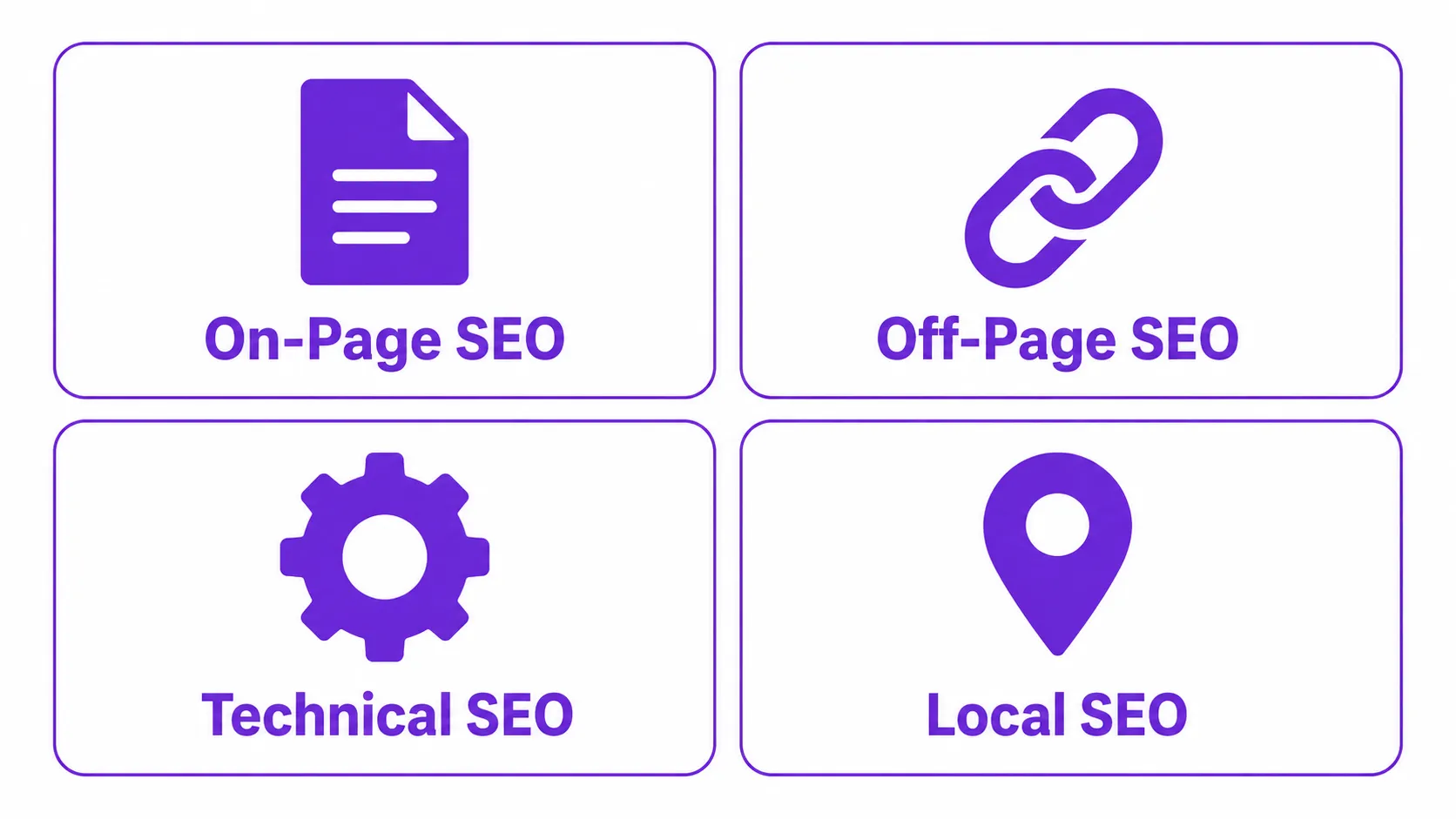
| Type | What it means |
|---|---|
| On-page SEO | Improving the content and HTML on your own pages: the words, titles, headings, and how well the page answers the search. Fully within your control. |
| Off-page SEO | Building your site's reputation through signals from other websites, mainly backlinks (links from other sites to yours), which act like votes of confidence. |
| Technical SEO | Making sure search engines can crawl and read your site, and that it is fast, secure, and works on mobile. The plumbing behind the scenes. |
| Local SEO | Helping a business show up for searches in its area, such as “dentist near me,” through Google Business Profile and local signals. |
On-page SEO
Off-page SEO
Technical SEO
Local SEO
It matters if you serve a specific area. It is what makes a business appear in the map results and “near me” searches, driven largely by your Google Business Profile, reviews, and local consistency. A plumber, clinic, or restaurant lives or dies by local SEO, while a purely online business may not need it at all.
Why SEO Matters
The numbers make the case starkly. For a typical search, the number one organic result receives roughly 40 to 60 percent of all the clicks for that query, while results two and three get far less, and only a small fraction of searchers ever click beyond the first page, according to Optimizely. In other words, visibility is concentrated at the very top, and SEO is how you compete for those positions.
There is also the matter of trust and cost. People tend to trust organic results more than ads, because a high ranking looks earned rather than bought. And unlike advertising, where traffic stops the instant you stop paying, a well-ranking page keeps bringing visitors for months or years with no ongoing per-click cost. That combination, high trust and durable, compounding traffic, is why businesses of every size invest in SEO.
For a small business especially, SEO can be the great equalizer. You may not be able to outspend a large competitor on ads, but you can out-rank them on a specific, well-chosen topic by being more helpful. That is the bridge between SEO and actual growth, which we explore in SEO marketing for beginners.
Who actually needs SEO?
The common thread is simple: if your customers ever use a search engine to find businesses, information, or products like yours, then SEO determines whether they find you or a competitor. The few cases where SEO matters less are businesses with no online component at all, or those whose audience genuinely never searches for them. For almost everyone else, being invisible in search means leaving steady, intent-driven traffic on the table.
A very short history of SEO
That history matters for a beginner because it explains why the old tricks no longer work and why modern SEO rewards substance over shortcuts. Every major change has pushed in the same direction: toward content that genuinely serves the searcher. If you understand that trajectory, you can ignore most of the outdated advice still floating around the internet and focus on what has consistently won, which is being the most useful, trustworthy answer to a real question.
SEO vs Paid Ads: A Quick Comparison
| Factor | SEO (organic) | Paid ads (PPC) |
|---|---|---|
| Speed | Slow to build (months) | Instant traffic |
| Cost model | No per-click cost once ranking | Pay for every click |
| Longevity | Keeps working over time | Stops when budget stops |
| Trust | Often trusted more | Labelled as an ad |
The honest summary: paid ads are like renting visibility, while SEO is like owning it. Ads are excellent when you need traffic today or are testing an offer. SEO is the long-term asset that lowers your reliance on paid traffic over time. Used together, ads can carry you while your SEO matures.
Picture a simple example. Two competing local bakeries launch websites the same week. One runs ads and gets immediate clicks but pays for every single one; the moment the budget pauses, the visitors vanish. The other invests in SEO, sees little for the first couple of months, then slowly starts ranking for terms like “custom birthday cakes” in its city. Six months in, the second bakery is getting a steady stream of free, high-intent visitors every day, while the first is still paying per click for the same traffic. Neither approach is wrong, but the example shows why SEO is treated as an investment rather than an expense: the effort compounds into an asset you keep.
Common Myths About SEO
- “SEO is a one-time job.” It is not. Search changes, competitors publish, and rankings shift, so SEO is ongoing maintenance and improvement, not a task you finish.
- “SEO is just stuffing keywords.” That approach stopped working years ago. Modern SEO is about genuinely answering what people are searching for, written naturally for humans.
- “You can pay Google to rank organically.” You cannot. Paying buys ads, not organic positions. Organic rankings are earned through relevance and trust.
- “SEO gives instant results.” It does not. Most sites take months to see meaningful movement, which is normal and expected.
- “AI search has killed SEO.” It has not. AI answers mostly pull from pages that already rank well, so strong SEO is the foundation of AI visibility, not its replacement.
How Long Until SEO Works?
The short version of why it takes time: search engines are deliberately cautious about trusting new content, because instant ranking would let spam flood the results. The upside is that once a page earns trust and starts ranking, it tends to keep ranking, and the traffic compounds. SEO rewards patience and consistency more than speed.
SEO in 2026: What Has Changed
The reassuring part for a beginner is that you do not need a separate strategy for AI. The work that earns AI placements is the same work that earns classic rankings: clear answers, well-structured content, credible sources, and genuine expertise. Google’s emphasis on E-E-A-T, which stands for Experience, Expertise, Authoritativeness, and Trust, has only grown. In practice that means real first-hand knowledge, honest sourcing, and a named author behind the content. Get those right and you are optimizing for both Google and the AI layer sitting on top of it.
What SEO Is Not
SEO is also not the same as paying Google. No amount of money buys an organic position; ads and organic rankings are entirely separate, and Google is explicit that you cannot pay your way into the organic results. Nor is SEO about tricking the algorithm. The era of keyword stuffing and spammy links is long gone, and those tactics now actively harm you. Finally, SEO is not only for big companies with large budgets. Much of it is free to do yourself, and small, focused sites regularly out-rank larger competitors on specific topics by simply being more helpful. Knowing what SEO is not is just as useful as knowing what it is, because it protects you from the bad advice that fills the internet.
Why learn SEO with UnoSearch
UnoSearch is a Google Premier Partner with over a decade of search experience, helping brands grow across both traditional search and AI-driven discovery. We work across SEO, local SEO, and the newer GEO and AEO disciplines that decide whether AI tools recommend a business. This guide explanation reflects the same fundamentals we apply for clients every day.
Conclusion: SEO in One Sentence
If you take one thing from this guide, let it be this: SEO is making your website easy for search engines to find, understand, and rank, so the right people discover you without you paying for every visit. It works through crawling, indexing, and ranking; it splits into on-page, off-page, technical, and local; and it matters because visibility online begins with search. When you are ready to put it into practice step by step, start with where to begin in search engine optimization for beginners: where to start, then follow the full month-by-month plan in our 30-day action plan.
SEO is not magic and it is not a trick. It is the steady, sensible work of making genuinely useful content that search engines and people can both trust. Understand that, and you already know more about SEO than most people who use the term.
Frequently Asked Questions
What does SEO stand for?
What is SEO in simple words?
How does SEO work?
What are the main types of SEO?
The main types are on-page SEO (your own content and HTML), off-page SEO (backlinks and reputation), technical SEO (crawlability, speed, mobile), and local SEO (showing up for searches in your area).
Is SEO free?
Is SEO still worth it in 2026?
How is SEO different from paid ads?
Want to turn this understanding into real traffic?
Book a free consultation with UnoSearch and we'll map your first three months of SEO. Get Free ProposalReferences
References
- Google Search Central, SEO Starter Guide, developers.google.com
- Optimizely, What is Search Engine Optimization (SEO)?, optimizely.com
- Google Search Console, search.google.com/search-console
Continue Learning About SEO & AI Search
Social Media Marketing for E-Commerce: From Reach to Revenue
Posting product photos and hoping for sales is not a strategy. Social media marketing for e-commerce works when you build it the same way you build any other growth channel: with a clear budget, the right platforms, and numbers you can actually measure. This guide...
PPC for E-Commerce: A Profit-First Guide to Paid Ads That Pay Off
Every click on your ad costs money. So the goal is not more clicks. The goal is clicks that turn into profit. PPC for e-commerce puts your products in front of shoppers who are ready to buy. Done well, e-commerce pay per click brings fast, measurable sales. Done...
SEO for Lawyers: How to Get Found by Clients on Google
SEO for lawyers is the practice of improving your website so your firm can appear when people search Google for legal help. Most people looking for legal assistance begin their search online, and firms that appear prominently in those results are more likely to...